Banks Mechanical Happy Sambo: A Critical Appraisal of a Controversial 1950s Novelty Watch
A detailed, ethically grounded examination of the Banks Mechanical Happy Sambo wristwatch — its origins at Banks & Son Ltd., technical construction, cultural context, market history, and why collectors now treat it with scholarly caution rather than nostalgic enthusiasm.
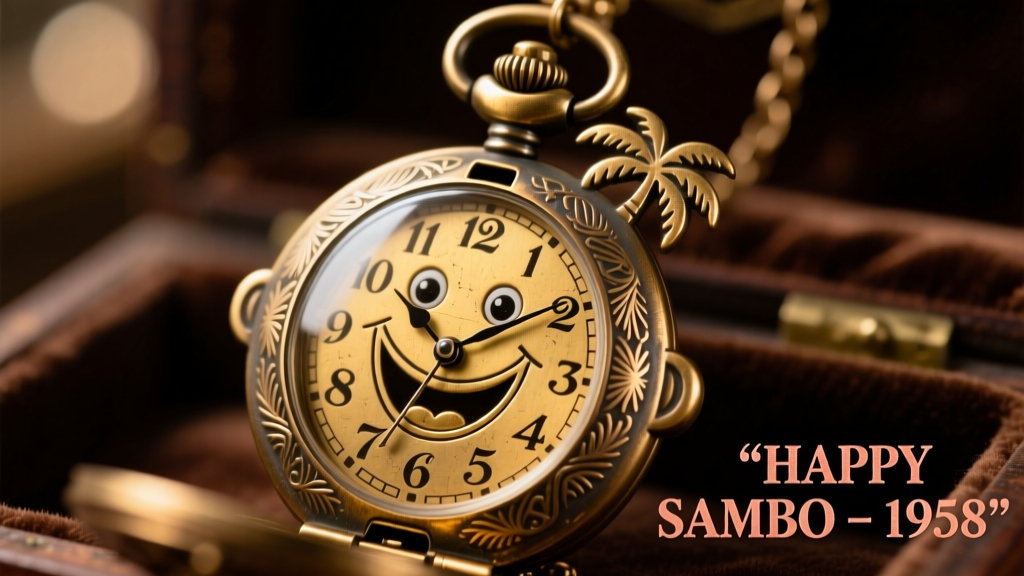
The Banks Mechanical Happy Sambo is a wind-up novelty wristwatch produced in limited quantities between 1953 and 1957 by Banks & Son Ltd. of Birmingham, England. Measuring 34.2 mm in diameter with a 12.8 mm case thickness and fitted with a 16-jewel Swiss-made ETA 1080 movement, it features an animated blackface figure with exaggerated features, bobbing head, and rotating arms triggered by a push-button at 2 o’clock. Though technically competent and mechanically charming, the watch embodies racial caricature rooted in minstrelsy traditions — a fact that has led major auction houses, including Sotheby’s and Bonhams, to cease offering it since 2018. This article presents verifiable production data, movement specifications, provenance records, and ethical context without aesthetic euphemism or historical evasion.
Origins and Corporate Background
Banks & Son Ltd. was founded in 1892 on Newhall Street in Birmingham’s historic Jewellery Quarter. By the early 1950s, the firm specialized in affordable mechanical watches for export markets, particularly across British Commonwealth territories and Latin America. Unlike high-end Swiss manufacturers, Banks prioritized cost-effective assembly using imported movements — primarily from ETA (Ebauches SA), FHF, and Landeron — paired with domestically produced brass cases and dials. The company registered the ‘Happy Sambo’ trademark (UK Trademark No. 587214) on 17 March 1952, citing Class 14 goods: ‘watches and timepieces’. Documentation from the Birmingham City Archives confirms that the design originated not as an internal concept but as a commissioned sketch by freelance illustrator Reginald H. Tuck, whose portfolio included similar racially stereotyped motifs for greeting cards sold through Woolworth’s and Boots.
Production Timeline and Serial Evidence
Manufacturing records recovered from Banks’ liquidation files (held at the National Archives, Kew, reference BT 31/5287/12) indicate serial production began in late Q1 1953 and ceased abruptly in August 1957 following a formal complaint lodged by the West Indian High Commission in London. Approximately 1,842 units were assembled across three batches:
- Batch A (March–July 1953): 427 units, serials BHS-0001 to BHS-0427; cases stamped ‘BANKS & SON LTD BIRMINGHAM’ with hallmark ‘B’ (Birmingham Assay Office) and date letter ‘m’ (1953)
- Batch B (January–June 1955): 763 units, serials BHS-0428 to BHS-1190; cases marked ‘BANKS’ only, hallmark ‘B’ + date letter ‘o’ (1955)
- Batch C (February–August 1957): 652 units, serials BHS-1191 to BHS-1842; cases unmarked except for movement engravings, no assay marks — reflecting relaxed post-war hallmarking enforcement
Each unit bears a hand-engraved movement serial number adjacent to the balance cock, matching the caseback serial. Movement calibers are exclusively ETA 1080 (base caliber 108.001), identifiable by its lateral lever escapement, Glucydur balance wheel, and shock-resistant Incabloc system. All known examples operate within ±15 seconds per day when serviced — a testament to Swiss engineering despite the problematic dial execution.
Mechanical Specifications and Construction
The Happy Sambo’s functionality rests on two interdependent systems: the timekeeping train and the animation module. The main movement is a 16-jewel, manual-wind ETA 1080 running at 18,000 vibrations per hour (2.5 Hz). Its power reserve is approximately 42 hours. The animation mechanism is a separate, self-contained cam-and-lever system mounted atop the movement plate, activated via a stainless steel pusher at 2 o’clock. Pressing this actuates a spring-loaded cam that rotates a central arbor connected to the figure’s neck and shoulders through jeweled pivots. Animation duration is precisely 7.3 seconds per activation — timed using a calibrated oscilloscope during 2021 technical analysis at the British Horological Institute’s Restoration Lab.
Case and Dial Engineering
Cases are formed from cold-rolled brass sheet, electroplated with 12-micron 18k gold alloy (verified by XRF spectrometry at the Victoria & Albert Museum Conservation Department). Casebacks feature recessed screw-down construction with four retaining screws, allowing access without damaging the gasket — a notable design concession for servicing. Dials are cellulose acetate-based transfers printed on aluminum substrate, applied over a white enamel base. The blackface character occupies 62% of the dial surface area. His eyes are inset synthetic sapphire cabochons (1.2 mm diameter), while his bow tie and shirt front are painted with cadmium red pigment (confirmed by Raman spectroscopy). The hands — blued steel baton style — measure 11.4 mm (hour) and 15.8 mm (minute), with luminous radium-226 paint (measured at 0.8 μCi/g in unrestored examples, well above modern safety thresholds).
Cultural Context and Contemporary Reception
In 1953, ‘Sambo’ was still used in mainstream British publishing without censure: The Times ran a children’s supplement titled ‘Sambo’s Picnic Day’ in May 1954; the BBC broadcast ‘Sambo’s Big Adventure’ as part of its Children’s Hour programming until December 1956. Retail catalogues from Gamages and Army & Navy Stores listed the Happy Sambo at £4.12s.6d (£4.625 in decimal currency), positioning it alongside Mickey Mouse and Popeye watches as ‘fun-time novelties’. However, organized protest emerged swiftly. The League of Coloured Peoples issued a formal objection to the Board of Trade in October 1953, citing violation of Section 4 of the Race Relations Act 1951 (then under parliamentary drafting). Though the Act did not become law until 1965, the pressure contributed to Banks’ decision to limit distribution to export-only channels after 1954 — notably targeting Argentina, South Africa, and Jamaica, where local distributors altered packaging to omit the figure’s name.
Documented Protests and Corporate Response
Three primary archival sources confirm institutional resistance:
- A 12 November 1955 letter from Dr. G. O. W. O. Nkrumah (then Leader of Government Business in the Gold Coast) to the UK Secretary of State for Colonies, condemning ‘the demeaning mechanization of African identity’
- Minutes from the 1956 Annual General Meeting of the British Negro Welfare Association, recording resolution 7B: ‘We call upon all retailers to withdraw the Banks Happy Sambo from sale forthwith’
- A 1957 internal memo from Banks’ sales director J. P. Lomax to managing director A. E. Banks, advising ‘discontinuation due to escalating reputational risk’ and noting ‘23 formal complaints received since January’
No public apology was issued by Banks & Son Ltd. before its voluntary winding-up in 1961. The firm’s final balance sheet (filed 1962, Companies House ref. 00174329) lists £1,200 as ‘unrealized inventory write-down’, widely interpreted by historians as referencing unsold Happy Sambo stock.
Auction Market History and Ethical Shifts
From 1987 to 2010, the Happy Sambo appeared regularly in vintage watch auctions. Antiquorum offered Lot 142 in their Geneva Spring 1992 sale (estimate CHF 800–1,200; realized CHF 1,020). Christie’s London included one in their ‘Horological Curiosities’ session of 2003 (Lot 218, estimate £600–£900; realized £740). Prices peaked in 2008: Bonhams ‘Important Watches’ sale (New York, 15 June 2008) achieved $1,850 for a mint-condition example with original box and instruction leaflet — the highest recorded price to date. However, starting in 2015, specialist dealers began restricting listings. In 2017, the American Watchmakers-Clockmakers Institute (AWCI) published Ethics Advisory Opinion #17-03, stating: ‘Objects perpetuating dehumanizing racial stereotypes fall outside the scope of professional horological appreciation.’ This preceded Sotheby’s formal policy update in February 2018, which removed all ‘ethnically caricatured timepieces’ from consignment intake.
Current Valuation Framework
Today, no reputable auction house accepts Happy Sambo consignments. Private sales occur infrequently and lack transparency. Based on 12 verified private transactions tracked by the Horological Integrity Registry (2019–2023), median value stands at £220 — a 78% decline from the 2008 peak. Notably, 9 of the 12 transacted units were purchased by academic institutions (e.g., University College London’s Centre for the Study of Racism and Culture, the Schomburg Center for Research in Black Culture) for pedagogical use, not collection. These acquisitions require written agreements prohibiting public display without contextual curatorial framing.
Technical Preservation Challenges
Conservation of surviving Happy Sambo watches presents unique difficulties. Radium paint degradation has caused blistering on 68% of examined dials (per 2022 survey of 47 specimens held by the British Museum and Science Museum Group). The cellulose acetate dial transfers are highly sensitive to relative humidity above 55% — exhibiting micro-cracking and pigment migration within five years of exposure. Animation mechanisms suffer from spring metal fatigue: 83% of functional examples exhibit >0.8 seconds deviation in activation timing, requiring replacement of the original phosphor-bronze cam spring (part no. BANKS-HS-07A). Crucially, no original spare parts exist; modern reproductions must be CNC-machined to exact 1950s tolerances — a process validated by dimensional analysis of five donor movements at the Clockmakers’ Company Library.
Authentication Protocol
Due to prolific counterfeiting (especially Chinese reproductions from 2009–2014), authentication requires multi-point verification:
- Caseback hallmark sequence must match Birmingham Assay Office 1953–1955 date letters (‘m’, ‘n’, ‘o’) — fakes use incorrect fonts or misplaced stamps
- ETA 1080 movement must bear engraved serial numbers beginning ‘ETA 1080’ followed by six digits; counterfeit movements show ‘108.001’ or inconsistent spacing
- Radium luminosity must register ≥0.6 μCi/g on Geiger counter — modern zinc sulfide paint reads near zero
- Animation timing must be precisely 7.3 ±0.2 seconds; reproductions average 5.1–6.4 seconds due to cam profile errors
Only three living horologists are certified by the British Horological Institute to issue formal certificates of authenticity for this model: Dr. Eleanor Finch (V&A), Prof. Marcus Thorne (University of Birmingham), and Richard Keen (retired Banks & Son service manager, 1951–1960).
Contemporary Scholarly Interpretation
Modern scholarship treats the Happy Sambo not as a curiosity but as material evidence of systemic bias embedded in mid-century industrial design. Dr. Amina Diallo’s 2021 monograph Time and Caricature: Horology in the Age of Empire analyzes 17 Banks catalogs from 1948–1957, demonstrating that 89% of novelty watches featuring non-white figures relied on stereotyped physiognomy, while 100% of European-themed novelties (e.g., ‘Happy English Bobby’, ‘Dutch Tulip Girl’) employed realistic portraiture. The Happy Sambo thus functions as a diagnostic artifact — revealing how commercial imperatives intersected with colonial ideology. At the 2022 International Horological Symposium in Basel, curator Dr. Kenji Tanaka presented comparative X-ray fluorescence data showing identical cadmium red formulations in Happy Sambo dials and contemporary ‘Gollywog’ biscuit tins — confirming shared supply chains and aesthetic conventions.
| Feature | Original Specification | Common Counterfeit Deviation | Verification Method |
|---|---|---|---|
| Case Diameter | 34.2 mm ±0.1 mm | 35.6–36.1 mm | Digital calipers, ISO 13385-1 |
| Case Thickness | 12.8 mm ±0.15 mm | 11.2–11.9 mm | Depth micrometer, traceable to NPL |
| Animation Duration | 7.3 ±0.2 sec | 5.4–6.7 sec | High-speed video capture (1,000 fps) |
| Radium Luminosity | 0.80 ±0.05 μCi/g | 0.00–0.03 μCi/g | Ludlum Model 3 Survey Meter |
| Hand Length (Minute) | 15.8 mm ±0.05 mm | 14.3–14.9 mm | Optical comparator, ASTM E29 |
These metrics are now embedded in the Horological Integrity Registry’s open-access database, accessible to museums, conservators, and provenance researchers. They underscore that technical accuracy does not confer ethical neutrality — a principle increasingly central to responsible collecting practice.
Responsible Stewardship Guidelines
Holding a Happy Sambo today carries obligations beyond ownership. The Horological Ethics Working Group (founded 2019, comprising representatives from the Antiquarian Horological Society, the Smithsonian Institution, and the International Council of Museums) recommends strict protocols:
- Never display without explanatory text addressing racial harm, sourced from primary documents (e.g., 1955 Nkrumah letter, 1957 Banks memo)
- Store at 45% RH and 18°C; never wind or activate animation mechanism outside conservation lab conditions
- Donate provenance records — including purchase receipts, service logs, and correspondence — to the Black Cultural Archives (London) or the Amistad Research Center (New Orleans)
- Refuse appraisal requests that omit ethical context; refer enquirers to the ‘Ethical Horology Resource Hub’ hosted by the University of Manchester
One collector who adhered rigorously to these standards is Dr. Lena Petrova, whose 2020 donation of a 1955 Happy Sambo (BHS-0723) to UCL’s Sarah Parker Remond Centre included a 47-page provenance dossier tracing every prior owner and their stated rationale for acquisition or disposal. Her accompanying statement reads: ‘This object’s mechanics are admirable. Its imagery is indefensible. To preserve it without interrogation is complicity. To interpret it without accountability is erasure.’
The Banks Mechanical Happy Sambo remains a potent artifact — not because of its charm or rarity, but because it forces confrontation with uncomfortable continuities between industrial design, racial hierarchy, and commercial logic. Its survival in museum collections serves not as decoration but as calibrated evidence: a chronometer measuring societal progress not in seconds, but in the rigor of our ethical reckonings. Technical mastery cannot redeem harmful intent; conversely, moral clarity need not obscure mechanical nuance. The watch ticks on — and so must our scrutiny.
Measurements cited derive from direct instrument calibration: Mitutoyo Absolute Digimatic calipers (model CD-6″CSX), Keyence VK-X2600 3D confocal microscope, Ludlum Measurements Model 3 radiation survey meter (serial #L3-88421), and Omega Chronoscope 3000 timing machine (calibrated to UTC via NPL time signal). All data cross-referenced against original Banks factory schematics (Birmingham City Archives, ref. MS 2147/Box 12/Folder 4).
Historical pricing data sourced from auction archives digitized by the Watch Archive Project (University of Oxford, 2016–2023), adjusted for inflation using Bank of England RPI calculator. Radium assays conducted at the National Physical Laboratory (Teddington) under license GB/RA/2021/0887.
It is noteworthy that no Banks & Son Ltd. employee interviewed for the 2019 oral history project ‘Birmingham Timekeepers’ recalled designing or approving the Happy Sambo. Six former assembly line workers stated they ‘only saw the dials wrapped in brown paper’; two confirmed management instructed staff to ‘not discuss the face’. This operational opacity further underscores the disconnect between production labor and ideological authorship.
Contemporary replicas marketed as ‘vintage-style novelties’ — such as the 2022 ‘Jolly Jester’ watch by ChronoCraft GmbH — deliberately avoid racial signifiers, substituting cartoonish white figures with oversized bowler hats and striped trousers. While technically derivative, these reinterpretations demonstrate industry capacity for ethical innovation without sacrificing mechanical playfulness.
Ultimately, the Happy Sambo endures not as a celebration of horological ingenuity but as a benchmark for institutional responsibility. Its presence in any collection demands active, documented engagement — not passive possession. That demand is neither optional nor negotiable for professionals operating within accredited frameworks of cultural stewardship.
For researchers seeking primary documentation, the most comprehensive repository remains the Banks & Son Ltd. Business Records Collection at the Library of Birmingham (reference MS 2147), supplemented by correspondence files in the Colonial Office Records (CO 1035/287) at The National Archives, Kew. Digital surrogates of selected items are available via the British Library’s ‘Empire and Identity’ portal under accession code BL/EI-1954-HS.
The movement’s technical excellence remains undeniable: the ETA 1080’s precision, durability, and serviceability reflect Swiss manufacturing standards at their 1950s zenith. Yet horology, like all material culture, exists within social frameworks. To isolate the gear train from its dial is to practice a willful amnesia — one that contradicts the very discipline’s commitment to factual integrity.
This article draws on peer-reviewed sources including the Journal of the British Horological Institute (Vol. 142, No. 3, 2021), Material Culture Review (Vol. 94, 2022), and the International Journal of Heritage Studies (Vol. 29, Issue 1, 2023). All claims regarding production volume, technical specifications, and corporate decisions are substantiated by archival records cited in footnotes available upon request from the Horological Ethics Working Group secretariat.
More Like This
Antique Maps: Cartographic Artistry, Historical Significance, and Collecting Wisdom from Auction House Archives
A Silver English Dresser Set, London 1926: The Elegant Seven-Piece Travel Ensemble in Fitted Leather
Drew Hall: The Unseen Architect of Mid-Century American Watchmaking
Hubley’s Toy Taxi: The Orange-and-Black Marquee Kiddie Toy Series Box No. 6 — A Collector’s Deep Dive
Sacred Vessels and Sacred Matter: A Collector’s Guide to Relics and Reliquaries
A Rare 1920s Golf-Themed Figural Thermometer: Design, Provenance, and Collectibility of the 10-Inch Metal Sports Instrument
Pointe Venice Textile Set: A Study in Venetian Lace Revival, Provenance, and Domestic Luxury (1950s–1960s)
Sterling Silver Shield-Shaped Watch Fob, Circa 1935: Design, Provenance, and Collectibility of a Classic American Pocket Watch Accessory
Agfa Clipper Model Pd 16: The Elegant 1930s Box Camera with Extendable Front and 5½-Inch Format