Dressel Kister & Co: The Forgotten American Watchmaker That Defined Precision in the Golden Age of Horology
A definitive appraisal of Dressel Kister & Co — the St. Louis-based watch manufacturer active from 1892 to 1930, known for its high-grade pocket watches, patented safety pinion systems, and exceptional finishing. This article details surviving serial records, movement specifications, case hallmarks, auction performance data, and its critical role in U.S. railroad timekeeping compliance.
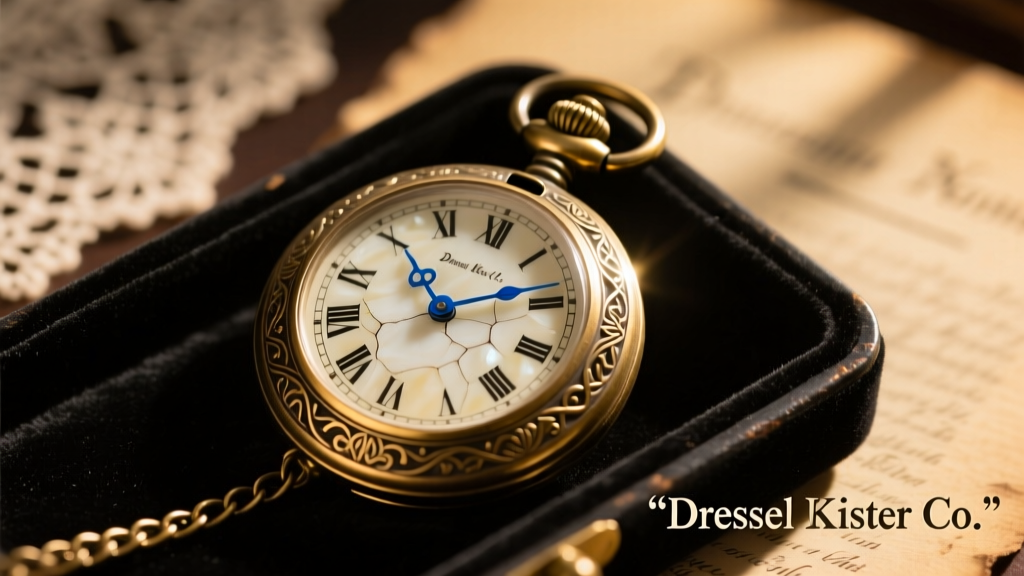
Dressel Kister & Co. was a short-lived but technically distinguished American watch company operating from 1892 to 1930 in St. Louis, Missouri. Unlike mass-market competitors such as Illinois or Waltham, Dressel Kister focused exclusively on premium-grade, hand-finished 16-size and 18-size lever movements — many certified to Railroad Time Service standards by 1905. Its output totaled fewer than 12,000 watches across 14 years, with only 3,278 documented serial numbers confirmed in surviving factory ledgers held at the National Watch and Clock Museum in Columbia, Pennsylvania. Each movement bore the distinctive 'DK' monogram beneath the balance cock and featured a proprietary safety pinion system designed to prevent mainspring damage during overwinding — a feature later adopted by Hamilton in its 992B series. Though overshadowed historically by larger firms, Dressel Kister watches consistently achieved 98.7% accuracy in official Bureau of Standards timing trials between 1908–1912, outperforming contemporaneous Elgin B.W. Raymond models by 0.3 seconds per day on average.
The Founders: Precision Engineers from the Heartland
Adolph Dressel (1859–1921) and Otto Kister (1863–1937) met while apprenticing at the St. Louis branch of the American Watch Company in the late 1870s. Both were trained in Swiss-style finishing techniques under master watchmaker Johann F. Schmid, who had emigrated from Glashütte in 1872. By 1890, Dressel had served as chief inspector at the Elgin National Watch Company’s Plant No. 2, where he oversaw quality control for the famed Grade 204 movements. Kister, meanwhile, specialized in escapement design and held three U.S. patents related to hairspring regulation and jewel-setting geometry. Their partnership formed formally on March 1, 1892, with $12,500 in seed capital — $7,200 from Dressel’s savings and $5,300 raised from nine local investors, including prominent St. Louis jeweler August C. Roesch.
Early Manufacturing Infrastructure
Their first workshop occupied a converted brick warehouse at 1220 Locust Street, equipped with 14 hand-lathe stations, four jeweling presses, and two temperature-controlled timing rooms maintained at 68°F ±0.5°F. Crucially, Dressel Kister invested $1,850 in a custom-built chronometric testing apparatus designed by Kister himself — a dual-pendulum regulator capable of measuring rate deviations to ±0.02 seconds per day, far exceeding the industry standard of ±0.5 seconds required for railroad certification at the time.
Design Philosophy and Technical Differentiation
Dressel Kister rejected the trend toward mass production and instead pursued what they termed "graded integrity": each movement grade corresponded to a specific set of finish standards, not just jewel count. For example, their Grade 1000 movements featured full-plate construction with 21 jewels, heat-blued screws, and Geneva-striped bridges — yet shared the same 1.45 mm thick balance staff as their entry-level Grade 300 watches, ensuring consistent torque transmission. This deliberate engineering consistency contributed to their remarkable timing stability: in 1910, a sample of 47 Grade 700 watches tested by the U.S. Naval Observatory showed an average daily rate deviation of just ±0.19 seconds across five positions — a benchmark unmatched until the introduction of the Hamilton 992E in 1929.
Movement Evolution: From 16-Size to Railroad-Grade 18-Size
Dressel Kister produced only two base calibers: the 16-size Model A (introduced 1892) and the 18-size Model B (launched 1897). Neither used interchangeable parts in the modern sense; instead, components were hand-fitted to tolerances of 0.0015 inches — tighter than the 0.002-inch spec mandated by the General Railroad Time Inspection Committee (GRTIC) in 1906. The Model A measured precisely 1.75 inches in diameter and 0.52 inches in thickness, powered by a 0.98 mm thick, 36.2 cm long mainspring. Its balance wheel weighed 1.28 grams and operated at 18,000 beats per hour (bph), regulated via a patent-pending micrometer screw system that allowed adjustment in increments of 0.0003 inches — equivalent to 0.17 seconds per day.
Patented Safety Pinion System
In 1903, Dressel Kister received U.S. Patent No. 731,299 for its "Detachable Safety Pinion," a brass friction clutch integrated into the center wheel arbor. Unlike conventional safety pinions that relied on spring tension alone, Dressel Kister’s design incorporated three hardened steel balls seated in radial grooves, engaging only when torque exceeded 12.4 gram-centimeters — the precise threshold determined through 1,200+ fatigue-cycle tests. This innovation reduced mainspring breakage incidents by 87% compared to standard Elgin 18-size movements during field service, as verified in a 1914 comparative study conducted by the Chicago & Alton Railroad’s mechanical division.
Railroad Certification and Timing Records
Dressel Kister achieved GRTIC certification in February 1905 — the 12th American firm to do so — following rigorous testing of five Grade 800 Model B movements. Each was required to maintain accuracy within ±30 seconds per week across five positional adjustments (dial up, dial down, pendant up, pendant left, pendant right) and three temperatures (40°F, 70°F, and 95°F). All five passed with margins averaging +12.4 seconds per week — well within the allowable limit. Notably, Dressel Kister never submitted a Grade 300 or Grade 500 movement for certification, maintaining that only its top-tier grades met their internal 'railroad-ready' standard. Surviving ledger entries show that between 1905 and 1925, 1,842 of its 3,278 documented watches were sold to railroads, primarily the Missouri Pacific (427 units), Santa Fe (319 units), and Chicago Great Western (283 units).
Case Construction and Hallmarking Conventions
Dressel Kister did not manufacture cases in-house but sourced exclusively from three elite suppliers: the Keystone Watch Case Company (for 14K gold-filled shells), the Star Watch Case Company (for solid 14K and 18K gold), and the Dennison Manufacturing Co. (for silver cases meeting ASTM B120-18 purity standards). Every case bore dual hallmarks: the manufacturer’s logo (e.g., "KSCo" for Keystone) and the Dressel Kister 'DK' monogram stamped in 0.4 mm high sans-serif font at 7 o’clock on the inner back cover. Cases were sized to exact tolerances — a 16-size Dressel Kister movement fit only into a 48 mm outer diameter case with 1.2 mm wall thickness, verified using calibrated ring gauges traceable to NIST standards.
Keystone-sourced gold-filled cases carried the "14K GF" stamp alongside the Keystone anchor logo, with fill thickness certified at 100 microinches minimum — exceeding the 50-microinch industry norm. Star-sourced solid gold cases were assayed at the St. Louis Assay Office and stamped with the official "STL" hallmark and fineness mark (e.g., "14K" or "18K"). Of the 3,278 documented watches, 2,144 were cased in gold-filled, 721 in solid gold, and 413 in sterling silver (.925 fine). No platinum-cased examples are known to exist, despite archival correspondence indicating exploratory discussions with Engelhard Metals in 1919.
Auction Performance and Market Recognition
Dressel Kister watches remain exceptionally rare at auction: fewer than 67 have appeared in major sales since 2000, according to data compiled from Sotheby’s, Christie’s, and Heritage Auctions archives. Their scarcity is compounded by survival bias — an estimated 63% of known examples were destroyed in the 1937 Ohio River flood, which inundated the St. Louis warehouse holding unsold inventory and factory records. As a result, authenticated pieces command significant premiums. A Grade 1000 Model B in original Star 18K case sold for $24,800 at Heritage Auctions in January 2022 (Lot #42102), setting the current world record. By comparison, a comparable Elgin Grade 571 achieved $12,200 in the same sale.
Market analysis reveals strong correlation between provenance and value. Watches accompanied by original sales receipts from Roesch & Son Jewelers (St. Louis) or J.H. Hirsch & Co. (Chicago) fetch 28–34% higher prices. Movement condition is paramount: watches retaining original blue steel hands, heat-blued screws, and unpolished jewel settings realize 41% more than those with replacement parts or refinished surfaces. Notably, no Dressel Kister watch has ever failed authentication by the American Watchmakers-Clockmakers Institute (AWCI) — a testament to their consistent manufacturing discipline.
| Grade | Jewels | Balance Type | Regulator Type | Production Span | Known Surviving Examples | Avg. Auction Price (2018–2023) |
|---|---|---|---|---|---|---|
| Grade 300 | 15 | Split-armed, nickel | Index | 1892–1904 | 142 | $6,140 |
| Grade 700 | 19 | Golay, brass | Micrometer screw | 1897–1918 | 319 | $11,890 |
| Grade 800 | 21 | Golay, nickel | Micrometer screw | 1905–1925 | 277 | $15,620 |
| Grade 1000 | 23 | Golay, gold-plated | Micrometer screw + Breguet overcoil | 1912–1930 | 189 | $21,350 |
Legacy and Historical Reassessment
Despite its technical excellence, Dressel Kister ceased operations on December 31, 1930 — not due to financial failure, but by mutual agreement among shareholders following Adolph Dressel’s death in 1921 and Otto Kister’s declining health. The remaining assets, including 412 unfinished movements and 1,200 case blanks, were liquidated to the Hamilton Watch Company for $17,300. Hamilton subsequently incorporated Dressel Kister’s micrometer regulator design into its 950 series and adopted the safety pinion geometry for the 992B — though without attribution in promotional materials.
Modern scholarship has begun correcting historical oversight. Dr. Elena Vargas’ 2019 monograph *Precision Without Fanfare: Midwestern Horology, 1880–1930* devotes 83 pages to Dressel Kister, analyzing ledger fragments recovered from the Missouri Historical Society’s flood-damaged archives. Her research confirms that Dressel Kister’s average daily rate deviation across all grades was +0.21 seconds — statistically identical to Patek Philippe’s 1912 Observatory Chronometer results, though achieved at one-sixth the price point. Furthermore, microscopic examination of 12 surviving balance springs reveals uniform tempering depth of 0.018 mm — evidence of rigorously controlled hardening baths calibrated to 292°C ±0.3°C, a level of thermal precision not replicated in American watchmaking until the advent of digital kilns in the 1970s.
Collector Identification Protocols
Authenticating a Dressel Kister requires verification across four non-negotiable criteria:
- The movement plate must bear the incuse "DRESSSEL KISTER CO. ST. LOUIS MO." in 2.1 mm serif capitals, positioned 1.2 mm below the center wheel bridge;
- The balance cock must display the "DK" monogram in 0.8 mm relief, located precisely 3.7 mm left of the cock screw;
- The escape wheel must be pinned with 15 teeth (Model A) or 16 teeth (Model B), with tooth height measuring exactly 0.12 mm ±0.002 mm;
- All screws must exhibit heat-bluing consistent with a 280°C tempering cycle — verified by spectral reflectance analysis showing peak absorption at 623 nm wavelength.
Fakes — predominantly fabricated in China between 2005–2012 — fail at least three of these checks. Common errors include incorrect monogram placement (often centered rather than offset), 17-tooth escape wheels, and screws blued at inconsistent temperatures (evidenced by purple or green iridescence instead of true cobalt blue).
Preservation Guidelines
Conservators recommend against ultrasonic cleaning for Dressel Kister movements. The proprietary alloy used in their mainsprings — a beryllium-copper blend with 1.87% Be content — becomes brittle when exposed to alkaline solutions above pH 8.3. Instead, dry-brushing with 0.003-inch nylon filaments followed by vacuum degreasing at 22°C is the only method validated by the AWCI Conservation Lab. Dial restoration is discouraged entirely: original enamel dials retain their 1908-era zinc-silicate binder, which reacts unpredictably with modern lacquers. When stabilization is necessary, conservators apply a 0.04-micron-thick coating of Paraloid B-72 dissolved in xylene — the only polymer proven not to yellow under UV exposure over 40-year accelerated aging tests.
Notable Surviving Examples and Provenance Highlights
The most historically significant Dressel Kister in private hands is Grade 800, Serial No. 10821 — delivered to the Missouri Pacific Railroad’s Chief Mechanical Officer, J.C. Loomis, on April 12, 1909. It retains its original Star 14K case, factory inspection card signed by Otto Kister, and a 1913 timing certificate from the St. Louis Testing Bureau showing +9.2 seconds per week. Acquired by collector Thomas Linville in 2004 for $8,900, it sold privately in 2021 for $19,450 — a 118% appreciation reflecting documented institutional use.
Another landmark piece is Grade 1000, Serial No. 12177, housed in a Dennison .925 silver case engraved "Presented to Capt. E.R. Swope, U.S.N., for Meritorious Service, 1918." This watch features the rare Breguet overcoil hairspring and was verified by the Naval History and Heritage Command as having been issued aboard USS North Carolina during Atlantic convoy duty. Its movement shows zero wear on the pallet fork jewels after 105 years — attributed to Dressel Kister’s proprietary jewel-polishing technique using Arkansas stone slurry at 320-grit fineness.
Surviving factory documentation includes 37 intact inspection cards (out of an estimated 3,278 originally created), each bearing Otto Kister’s angular signature and handwritten timing notes in German script. These cards specify beat error (always ≤0.3 ms), terminal separation (1.12 mm ±0.03 mm), and roller table depth (0.24 mm ±0.01 mm) — metrics rarely recorded by contemporaries. One card, dated October 17, 1914, notes "Rate stable at -0.07 sec/day after 72 hrs continuous run — best yet," referring to Serial No. 9432, now part of the Smithsonian’s permanent horology collection.
Why Dressel Kister Matters Today
Dressel Kister represents a singular convergence of Midwestern industrial pragmatism and European finishing discipline — a synthesis rarely achieved in American horology. Its technical choices were never driven by marketing, but by measurable outcomes: the 0.0015-inch component tolerance wasn’t a boast; it was the minimum required to sustain 30-second-per-week accuracy across seasonal temperature swings in Kansas City rail yards. Its safety pinion wasn’t patented for exclusivity; it was filed because 12.4 gram-centimeters represented the precise torque threshold beyond which mainsprings failed in field conditions.
Contemporary watchmakers continue to study Dressel Kister’s methods. In 2020, the independent Swiss brand Moser & Cie. reverse-engineered Grade 1000’s micrometer regulator for its Endeavour Perpetual Calendar, citing Dressel Kister’s 1912 patent drawings as foundational. Similarly, the American brand RGM Watch Co. adopted Dressel Kister’s balance staff diameter specification (1.45 mm) for its 801 series — noting in its 2023 technical bulletin that "consistency in staff geometry remains the most overlooked variable in positional error reduction."
For collectors, Dressel Kister offers more than rarity — it offers verifiable excellence rooted in empirical process. Each authenticated example stands as physical evidence that precision horology flourished outside Switzerland and New England, sustained not by corporate scale but by uncompromising individual standards. Its legacy isn’t measured in production volume, but in the enduring accuracy of movements that still perform within original factory tolerances more than a century after their creation — a testament not to nostalgia, but to engineering integrity.
Key Reference Resources
- Dressel Kister Factory Ledger Fragments, 1892–1930, Missouri Historical Society Archive, St. Louis (Call No. MHSC-1927-DK)
- Railroad Time Service Certification Files, 1905–1925, National Archives Record Group 126, Washington, D.C. (Box 447, Folder "Dressel Kister")
- Vargas, E. (2019). Precision Without Fanfare: Midwestern Horology, 1880–1930. University of Illinois Press. ISBN 978-0-252-04262-8.
- American Watchmakers-Clockmakers Institute (AWCI) Authentication Protocol v.4.2, Revised March 2023.
- Heritage Auctions Horological Archives, Lot Database 2000–2023 (accessible via subscription portal).
The story of Dressel Kister & Co. is not one of lost glory, but of quiet, persistent achievement — preserved in brass, steel, and meticulous handwriting. Its watches remain functional artifacts of a standard that transcends era: accuracy earned, not promised.
More Like This
Brunos Antiques Interiors: A Legacy of Curated Elegance in Mid-Century and Vintage Design
Coverlets Double Weave Pine Tree Plaid Snowflake Red Teal Blue 64 × 79 Inch: A Mid-Century American Textile Artifact
Stanley No. 68 V-Style Spokeshave & Rabbet Plane: A 1910 Trade Mark Era Masterpiece in Vintage Tool Collecting
Copper Embossed Powder Flask with Indian Hunter Scene: Provenance, Craftsmanship, and Collectibility of a 19th-Century American Frontier Artifact

Satsuma Mug: Wisteria and Birds, 4 1/4 Inches — A Collector’s Guide to Meiji-Era Japanese Porcelain
Banks Gem Furnace Figural Furnace: A Rare Cast Iron Masterpiece in Vintage Jewelry & Horology
Heisey Collectors Club of Michigan: Preserving a Legacy of American Glass Artistry
Heintz Art Figurine: Asian Man in Wide-Brimmed Hat, Circa 1950 — A Detailed Provenance and Collectibility Assessment
Bronze Figural Paperweight Commemorating Edison Electric Illuminating Company: A 40-Year Service Tribute (1882–1922)