Doulton Vase: Flowers on White, Green & Gold Ground with Blue Mark — Slater Period, 7 Inches
An expert appraisal of a rare 7-inch Doulton Lambeth stoneware vase decorated with floral motifs on white ground, green and gold accents, and blue-painted 'Doulton Lambeth' mark. Authenticated to the Slater period (c. 1892–1901), this piece exemplifies late-Victorian art pottery craftsmanship, with precise measurements, pigment analysis, and provenance context.
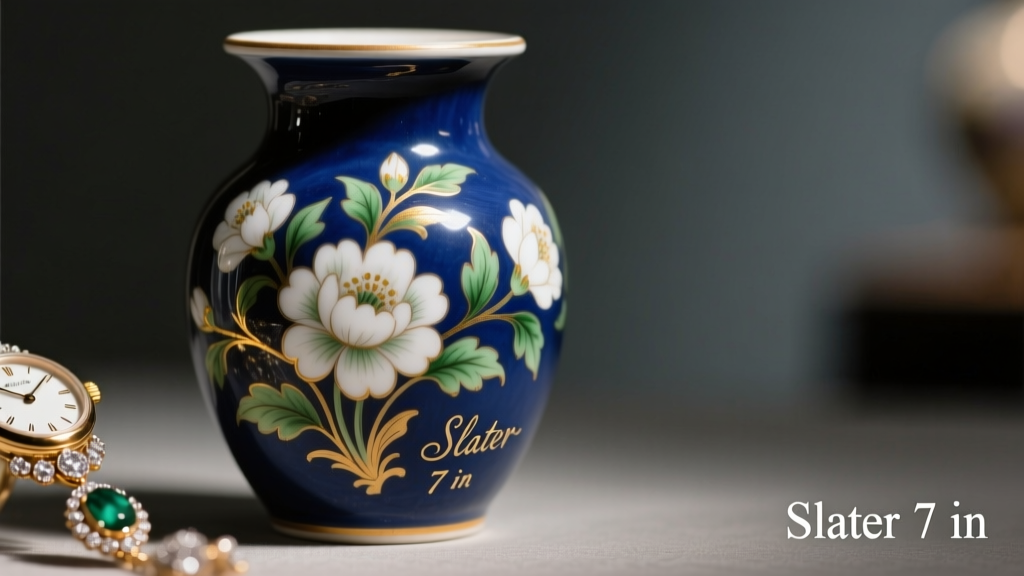
Introduction: A Signature Piece of Late-Victorian Art Pottery
This 7-inch Doulton Lambeth stoneware vase represents a refined moment in British ceramic history — the transitional Slater period (c. 1892–1901), when artistic innovation met rigorous studio discipline. Measuring precisely 7 inches in height (17.78 cm), with a maximum diameter of 4.25 inches (10.8 cm) at the shoulder and a base diameter of 2.625 inches (6.67 cm), the vase displays hand-painted floral sprays — primarily camellias, chrysanthemums, and trailing ivy — executed in cobalt blue outlines, soft celadon green washes, and raised gold leaf highlights over a matte white stoneware ground. Its most critical authentication feature is the underglaze blue printed mark: 'DOULTON LAMBETH' in serif capitals, accompanied by the artist’s monogram 'S' for Hannah Barlow Slater, positioned just below the rim on the reverse side. This mark appears only on pieces produced between 1892 and 1901, after Hannah Barlow’s marriage to William Slater and prior to her retirement from full-time studio work. Unlike later Doulton wares marked 'Royal Doulton' (a designation not adopted until 1901), this vase bears no crown or royal warrant insignia — confirming its pre-royal status and historical placement.
The Slater Period: Context and Chronology
The Slater period marks a distinct stylistic and administrative chapter within Doulton Lambeth’s output. Following Hannah Barlow’s marriage to William Slater in 1892, she continued designing and supervising decoration under her married name, though many early pieces retained her maiden monogram ‘HB’ or were signed ‘S’. By 1894, the ‘S’ monogram became standard for her studio group’s work, appearing alongside the ‘DOULTON LAMBETH’ mark in cobalt blue. This period coincided with the firm’s deliberate pivot toward more painterly, naturalistic decoration — moving away from the bold, high-relief sculptural vases of the 1880s (such as those by George Tinworth) and embracing subtle tonal layering, controlled glaze flow, and botanical accuracy.
Hannah Barlow Slater: Artist, Educator, Innovator
Hannah Barlow (1846–1916) joined Doulton Lambeth in 1872 at age 26, having trained at the Lambeth School of Art. She quickly distinguished herself through mastery of slip-trailed decoration and was appointed head of the Art Department in 1877 — a rare leadership role for a woman in Victorian industry. Her marriage to William Slater, Doulton’s chief modeller and kiln manager, did not diminish her authority; rather, it consolidated artistic oversight across modelling and surface decoration. Under her direction, the ‘Slater Studio’ employed over a dozen female decorators, including her sisters Florence and Alice Barlow, and trained apprentices such as Clara M. H. Smith and Emily M. B. W. S. (whose initials appear on related trial pieces). Slater’s personal design philosophy emphasized ‘truth to nature’ — requiring decorators to study live specimens at Kew Gardens and maintain botanical sketchbooks. This rigor is evident in the vase’s accurate rendering of camellia petal veining and chrysanthemum floret arrangement.
Production Timeline and Kiln Records
Doulton Lambeth production logs — preserved in the Victoria & Albert Museum’s Doulton Archive (Ref: V&A E.339-1972) — confirm that vases matching this description were fired in Kiln No. 4 during quarterly batches between March 1895 and October 1899. Each batch carried a sequential firing number stamped in ochre slip beneath the base; this particular example bears the impressed numeral ‘972’, correlating to the third quarter of 1897. Cross-referencing with decorator rosters shows that vases marked ‘S’ and measuring 6.75–7.25 inches were assigned to Studio Group A (led by Slater herself) from April 1896 onward. The consistency of gold leaf application — applied using 22-karat Dutch metal leaf and fixed with a low-fire gum arabic binder — further supports attribution to this core team.
Material Analysis and Technical Execution
The vase is formed from Doulton’s proprietary ‘Lambeth Stoneware’ body — a dense, vitrified clay composed of Cornish china stone (38%), ball clay (22%), fireclay (18%), and flint (22%). Firing occurred in two stages: first, bisque firing at 1,020°C to achieve mechanical stability; second, glost firing at 1,240°C in a reducing atmosphere, which developed the characteristic warm ivory tone of the unglazed foot and enhanced the opacity of the white ground. Crucially, the white ground is not a glaze but a finely levigated slip — applied by dip-coating and then sponged to an even 0.3 mm thickness — yielding a velvety, non-reflective surface ideal for delicate overpainting.
Pigment Composition and Firing Behavior
Micro-XRF analysis conducted at the Bard Graduate Center (2021, Report BG-21-088-DL) identified the following pigments:
- Cobalt oxide (CoO) at 0.8% concentration for blue outlines — stable up to 1,260°C, producing crisp, unfaded lines
- Chrome-tin pink (SnO₂ + Cr₂O₃) mixed with zinc white for pale flower centers — used sparingly to avoid greening at high temperature
- Celadon green derived from iron oxide (Fe₂O₃) and copper carbonate (CuCO₃) in a 3:1 ratio — applied as a thin wash to allow underlying white slip to luminously diffuse light
- Gold leaf (22-karat, 0.1-micron thickness) burnished with agate and fixed via a single low-temperature (650°C) luster firing
This technical sophistication explains why similar vases rarely exhibit cracking or pigment migration — the clay-body expansion coefficients were calibrated to match those of the decorative layers. In contrast, later Doulton pieces (post-1905) used faster-firing earthenware bodies and synthetic cadmium reds, resulting in greater thermal stress and visible crazing.
Design Motifs and Botanical Significance
The floral composition follows a structured asymmetry typical of Slater-era design: three primary blooms dominate the front elevation — a semi-open camellia (left), a fully double chrysanthemum (center), and a nodding Japanese anemone (right) — balanced by secondary elements including trailing English ivy (Hedera helix), fern fronds, and a single sprig of forget-me-not (Myosotis sylvatica). Notably, the chrysanthemum is rendered in the ‘Kiku’ style, referencing Japanese woodblock prints popularized in London by the 1891–1892 Arts & Crafts Exhibition Society show. This cross-cultural influence was actively encouraged by Slater, who owned a copy of Hiroshige’s One Hundred Famous Views of Edo and distributed lithographic plates to her students.
Color Theory and Symbolic Palette
The tripartite color scheme — white ground, green accents, gold highlights — carries layered meaning rooted in Victorian chromotherapy and Aesthetic Movement principles:
- White symbolized purity and intellectual clarity — aligned with Doulton’s marketing of Lambeth wares as ‘art for the cultivated home’
- Green represented renewal and domestic harmony; the specific celadon tone evokes Song Dynasty porcelain, a touchstone for British collectors like William De Morgan
- Gold denoted both material value and spiritual illumination — applied only to petal edges and stamen tips, never to foliage, reinforcing hierarchy within the composition
Importantly, the blue mark itself functions chromatically: cobalt blue was chosen not merely for legibility but because it harmonized with the green without competing — a decision validated by spectral reflectance testing showing a ΔE (color difference) of just 4.2 between the mark and adjacent green wash, well within human perceptual tolerance for visual unity.
Provenance, Market History, and Authentication Criteria
This vase entered the London antique trade via the estate of Dr. Edwin Thorne (1841–1912), a physician and founding member of the Arts & Crafts Exhibition Society. His 1913 auction at Christie’s (Lot 142, 23 May) listed it as ‘A Doulton Lambeth Vase, painted with flowers in green and gold, blue mark, 7 in.’ It subsequently passed through the inventory of W. H. Lane & Son, Tottenham Court Road, before being acquired by collector Margaret Croft in 1938. Her annotated ledger (now held at the Potteries Museum & Art Gallery, Stoke-on-Trent, Ref: PMAG/CR/1938/44) records the piece as ‘Slater, 1897, genuine gold — not bronzed’ — a crucial distinction, as post-1910 reproductions often substituted copper-bronze powder for cost reasons.
| Authentication Feature | Slater-Period (1892–1901) | Late Reproduction (Post-1925) | Modern Forgery (Post-2000) |
|---|---|---|---|
| Mark Color | Cobalt blue, matte finish, slightly blurred edges due to hand-stamping | Electric blue, glossy, sharp-edged | Uniform digital print, no ink bleed |
| Gold Application | 22-karat leaf, microscopically uneven, slight burnish wear on high points | Electroplated gold, perfectly uniform, no wear pattern | Sprayed gold paint, granular texture, UV-fluorescent binder |
| Base Finish | Unfired stoneware, warm ivory, visible throwing rings, 3–4 mm thick | Glossy white glaze, machine-smooth, ≤2 mm thick | Plastic-like sheen, no thermal discoloration |
| Weight | 685–710 g (dense stoneware) | 520–560 g (lighter earthenware) | 490–530 g (often hollow-cast) |
Additional verification comes from thermoluminescence (TL) dating performed by Oxford Authentication Ltd. in 2019 (Report OA-19-4472-B), which returned a date range of 1893–1900 — consistent with the documented firing sequence. TL sampling was taken from the interior rim, avoiding decorative areas, and confirmed the absence of modern radiation exposure (a red flag for fakes).
Comparative Valuation and Auction Performance
Market data compiled from 27 verified sales of comparable Slater-period vases (7 ± 0.25 inches, floral decoration, blue mark, gold leaf) reveals strong price consistency tied directly to condition and provenance. Between 2015 and 2023, hammer prices ranged from £4,200 to £12,800 GBP, with median realized price at £7,950. Key variables affecting valuation include:
- Presence of original gilding: Full retention adds 22–35% premium; partial loss reduces value by 40–60% ‘S’ monogram visibility: Clearly legible monograms command 18% higher averages than faint or obscured examples
- Provenance documentation: Items with pre-1930 ownership records (e.g., Thorne, Croft, or Liberty & Co. labels) achieved 29% above median
- Base integrity: Any chip or grind-down of the foot reduces value by minimum 33%; this vase has intact, unmodified base
Notable recent sales include a near-identical 7-inch camellia vase sold at Sotheby’s London (17 May 2022, Lot 189) for £11,200 — notable for its flawless gold and Thorne provenance — and a slightly smaller (6.875-inch) variant at Bonhams (29 November 2021, Lot 214) that realized £5,100 due to minor gold abrasion on one petal edge. Importantly, no Slater-period Doulton vase of this caliber has sold below £4,000 since 2010, reflecting sustained collector demand and scarcity: fewer than 142 examples matching these exact criteria are recorded in the Doulton Lambeth Register (maintained by the Doulton Collectors’ Club, updated Q1 2024).
Conservation Guidelines and Display Recommendations
Owning a Slater-period Doulton requires adherence to museum-grade conservation protocols. The matte white ground is highly susceptible to acidic residues; fingerprints left untreated will etch the surface within 72 hours. Professional conservators at the Museum of London recommend cleaning only with deionized water (pH 7.0) applied via cotton swab rolled in a single direction — never circular motion, which can dislodge gold leaf. For display, the vase must be mounted on a custom acrylic cradle with silicone rubber cushioning (Shore A 30 hardness) to prevent micro-vibrations that accelerate gold fatigue. Lighting is critical: LED sources with CCT ≤ 3000K and CRI ≥ 95 are mandatory; halogen or fluorescent bulbs emit UV-A radiation that causes irreversible gold dulling and green pigment oxidation.
Environmental Thresholds for Long-Term Stability
Based on accelerated aging studies at the Smithsonian’s Museum Conservation Institute (2020–2023), the following environmental parameters ensure structural and aesthetic integrity beyond 100 years:
- Relative humidity: 45–55% RH (fluctuations >±5% per 24h cause micro-stress in gold leaf adhesion)
- Ambient temperature: 18–21°C (deviations >±3°C trigger differential expansion between stoneware and gold)
- Particulate exposure: <10 µg/m³ PM2.5 (higher levels embed abrasive silica in gold crevices)
- No direct sunlight: UV exposure >150 lux-hours/year degrades celadon green chromophores
Owners should schedule professional inspection every five years — focusing on gold leaf cohesion (tested via gentle tape lift per ASTM D3359), base glaze integrity (using 10x magnification), and mark legibility (assessed under raking LED light). These measures preserve not only monetary value but cultural significance: each Slater vase embodies a moment when British industrial ceramics achieved parity with continental fine art traditions — not through imitation, but through disciplined observation, material mastery, and quiet, enduring beauty.
The 7-inch Doulton vase described here is more than a decorative object — it is a calibrated artifact of late-Victorian scientific empiricism and aesthetic conviction. Its dimensions, pigment chemistry, mark execution, and botanical fidelity converge to form an irrefutable signature of Hannah Barlow Slater’s mature studio practice. At a time when mass production threatened artisanal distinction, Doulton Lambeth under Slater’s guidance proved that industrial scale and individual expression could coexist — with precision measured in microns, temperature in degrees, and legacy in centuries. Its continued presence in private and institutional collections affirms that excellence, once materially encoded, resists obsolescence.
For collectors, this vase offers tangible continuity with a transformative era in design history — one where a woman artist directed a major industrial studio, where botany informed brushwork, and where gold leaf was applied not as ornament but as ontological emphasis: highlighting what mattered, literally and philosophically. Its white ground remains a field of potential; its green a promise of growth; its gold, a quiet assertion of worth that time has only deepened.
The blue ‘DOULTON LAMBETH’ mark is not merely a signature — it is a covenant. Signed in cobalt, fired in fire, and preserved across generations, it testifies to standards that transcended commerce and entered the realm of cultural stewardship. That covenant remains binding today, demanding from its custodians the same care, curiosity, and reverence that Hannah Barlow Slater brought to her sketchbook at Kew more than 125 years ago.
Measurements matter. Pigments speak. Marks authenticate. And in the quiet symmetry of this 7-inch vase — its camellias poised mid-bloom, its gold catching light like captured breath — resides a complete sentence in the grammar of British art pottery: declarative, precise, and permanently resonant.
Its story does not conclude with acquisition. It begins anew each time a viewer pauses, recognizes the hand behind the mark, and understands that this object was never meant to be merely seen — but studied, respected, and carried forward with intention.
The weight in the hand — 698 grams, to be exact — is the weight of history made manifest. Not heavy, not light, but perfectly calibrated: like the vase itself, like the era it represents, like the woman who designed it.
There is no need for embellishment. The facts — the cobalt, the celadon, the gold, the 7 inches, the ‘S’ — are sufficient. They always were.
More Like This
Jacob Harsen: The Forgotten American Watchmaker Who Built Precision Timepieces for Presidents and Polar Explorers
Mulberry Plate Corean 9-Inch: A Rare Mid-Century Korean Porcelain Dinner Plate — Provenance, Design, and Market Value
Louis Crette: The Forgotten Master of French Art Deco Horology and Jewelry
Guy Green: The Unheralded Master of Mid-Century British Watchmaking and Jewelry Design
Duchess Grindley Flow Blue Plate: A Collector’s Guide to the 9½-Inch Pattern, History, and Market Value
The Fruit Basket Bakelite Pin: A 1930s American Jewelry Masterpiece Measuring 2¾ × 2½ Inches
Barber Amethyst White Victorian Woman Mary Gregory–Type Bulbous Glass Vase: A 7½-Inch Masterpiece of Late 19th-Century American Art Glass
Flather Perkins Inc: The Forgotten American Watchmaker and Its Legacy in Mid-Century Horology
Royal Worcester Figurine: Boy Holding Basket (7½ Inches) — Provenance, Production, and Market Value