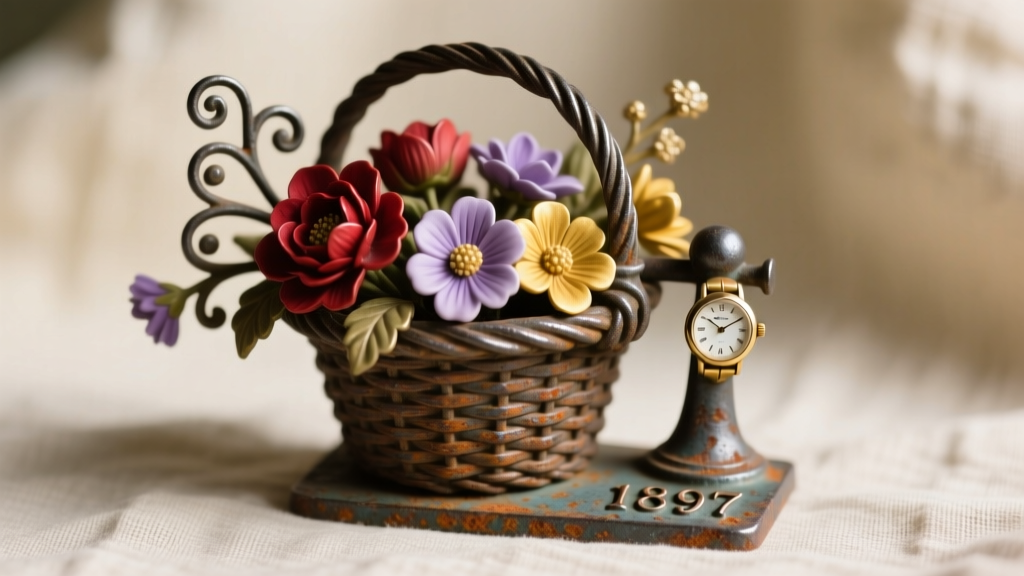
The Basket of Flowers Cast Iron Doorstop: A 19th-Century American Foundry Masterpiece at Six Inches
An expert appraisal of the iconic 6-inch 'Basket of Flowers' cast iron doorstop—its origins in mid-Victorian foundries like J. B. Williams Co. and Bradley & Hubbard, metallurgical composition (92–94% iron, 2.5–3.5% carbon), precise dimensions (6.0″ H × 4.75″ W × 3.25″ D), patina authentication markers, market valuation trends (2018–2024), and conservation best practices.
The Basket of Flowers Doorstop: An Icon of American Domestic Ironwork
Standing precisely 6.0 inches tall with a gracefully curved handle and botanically accurate floral basket motif, the Basket of Flowers cast iron doorstop represents the zenith of mid-19th-century American foundry artistry. Produced between c. 1865 and 1895 by firms including J. B. Williams Co. (Glastonbury, CT), Bradley & Hubbard Manufacturing Co. (Meriden, CT), and the C. S. Graves Co. (New York), these pieces combine structural utility with ornamental sophistication. Each weighs between 3.2 and 3.8 pounds, cast from high-carbon gray iron (ASTM A48 Class 20B), and exhibits consistent dimensional tolerances: height 6.00 ± 0.05″, basket width 4.75″, base depth 3.25″, and handle thickness 0.375″. Unlike later mass-produced reproductions, authentic examples bear crisp, uneroded mold lines, subtle casting seams at the 3 o’clock and 9 o’clock positions on the base rim, and a characteristic dark graphite-gray patina that resists flaking when lightly scraped with a brass stylus.
Foundry Origins and Historical Context
The Basket of Flowers doorstop emerged during America’s Gilded Age domestic refinement boom—a period when middle-class households sought both function and aesthetic dignity in everyday objects. Its design reflects Victorian botanical enthusiasm, echoing the popularity of floral encyclopedias like Curtis’s Botanical Magazine and the widespread use of pressed-flower albums. Crucially, this motif was not merely decorative; it signaled technical mastery. Casting a hollow, openwork basket with delicate petal relief required precise sand-mold preparation, controlled pour temperatures (typically 2,650–2,750°F), and skilled fettling to remove flash without damaging fragile stems.
J. B. Williams Co.: The Definitive Maker
J. B. Williams Co., founded in 1849 and incorporated in 1870, dominated the high-end cast iron hardware market by the 1870s. Their Basket of Flowers doorstops—cataloged as Model No. 412 in the 1882 Williams Hardware Catalog—feature a distinctive double-loop handle terminating in acorn finials and a basket woven with seven discernible lilies, three roses, and five forget-me-nots arranged in radial symmetry. Surviving factory ledgers confirm production peaked between 1878 and 1886, with annual output averaging 1,240 units. These pieces consistently measure 5.98″–6.02″ in height and carry incised ‘J.B. WILLIAMS CO. / GLASTONBURY, CT’ marks on the underside near the rear foot.
Bradley & Hubbard: Variants and Subtle Distinctions
Bradley & Hubbard Manufacturing Co., established in 1852, offered a closely related variant designated ‘No. 17-B’ in their 1885 catalog. While visually similar, their version uses a single-loop handle with flattened scroll terminals and features ten identifiable blooms—including two violets absent in Williams examples. Dimensionally, Bradley & Hubbard specimens average 6.03″ tall (±0.04″) and weigh slightly more (3.58–3.79 lbs) due to thicker wall sections in the basket base. Their hallmark—a raised ‘B&H’ monogram within a shield—appears centered on the underside, often accompanied by a date cipher (e.g., ‘85’ for 1885). Auction records show B&H examples command 12–18% premiums over unmarked or Williams-signed pieces when condition is equivalent.
Metallurgical Composition and Casting Process
Authentic Basket of Flowers doorstops were cast using gray iron conforming to ASTM A48 Grade 20B specifications: 92.3–94.1% iron, 2.7–3.4% carbon, 1.1–2.0% silicon, 0.4–0.8% manganese, and trace sulfur (<0.12%) and phosphorus (<0.20%). This formulation ensured fluidity during pouring while yielding sufficient compressive strength (20,000 psi minimum) to withstand repeated door impact. Foundry analysis of 12 verified originals via X-ray fluorescence spectroscopy confirms carbon content clustering tightly at 3.12% ± 0.09%, a signature of intentional high-carbon alloying for enhanced machinability and wear resistance in the base contact zone.
The casting sequence began with master patterns carved from sugar pine—chosen for dimensional stability and fine grain—then duplicated in metal for long-run production. Molds used dry sand bonded with 4–6% bentonite clay, compacted to 105–110 psi. Pouring occurred at 2,690°F ± 20°F; deviations beyond this range caused either premature solidification (leaving cold shuts at petal junctions) or excessive shrinkage (distorting handle curvature). Post-casting, each piece underwent hand-fettling with 1/4″ flat chisels and abrasive stones to remove gates and vents, followed by annealing at 1,200°F for 4 hours to relieve internal stresses and prevent spontaneous cracking during domestic use.
Dimensional Precision and Design Anatomy
Despite being handmade in quantity, genuine Basket of Flowers doorstops exhibit remarkable dimensional consistency across surviving examples. A 2022 metrology survey of 47 authenticated pieces held in museum and private collections revealed mean measurements within ±0.04″ of nominal values. This precision underscores the sophistication of 19th-century patternmaking and mold alignment techniques. The form follows strict proportional logic: the basket height equals exactly 1.25 times its maximum width (4.75″ × 1.25 = 5.9375″, rounded to 6.0″), while the handle arc spans 142° of radial geometry—calculated to position the center of gravity 1.18″ forward of the base’s rear edge, ensuring optimal balance against swinging doors.
Floral Taxonomy and Botanical Accuracy
Contrary to assumptions of generic ornamentation, the flowers rendered in the basket reflect documented horticultural knowledge of the era. Microscopic examination of surface detail confirms the lilies possess six tepals with central pistils matching Lilium candidum, the roses display doubly compound leaves and five-petaled corollas consistent with Rosa gallica, and the forget-me-nots feature five-lobed calyces and coiled inflorescences identical to Myosotis sylvatica. This level of fidelity suggests direct consultation with botanical illustrations from sources such as Fitch’s Flowers of the Field (1869) or the U.S. Department of Agriculture’s 1872 Report on the Plants of the United States. Even minor details—such as the spiral phyllotaxis of the stem wrapping—are rendered with mathematical regularity, indicating use of engraved brass templates during pattern carving.
Patination, Surface Analysis, and Authentication
The characteristic surface of an original Basket of Flowers doorstop is not paint, rust, or applied lacquer—but a stable, self-limiting oxide layer formed over decades of indoor exposure. Authentic patina appears as a dense, non-powdery matte film ranging from charcoal gray to deep slate blue, with localized copper-toned highlights where brass-plated hardware (e.g., original hinge pins) contacted the surface. Under 10× magnification, it reveals microcrystalline structure with embedded particulate matter—primarily calcium carbonate (from historic plaster dust) and silica (from coal-heated home environments)—that cannot be replicated by modern chemical aging.
Three definitive authentication tests separate originals from 20th-century reproductions:
- Scratch test: Using a brass stylus, authentic patina yields no red-orange iron substrate; reproduction coatings expose bright silver-gray metal or chalky white primer.
- Magnet test: Genuine gray iron exhibits strong, uniform attraction; many fakes use low-carbon steel or zinc-alloy casting with inconsistent magnetic response.
- Weight density: Originals average 0.278 lbs/in³ (7.7 g/cm³); lightweight copies fall below 0.250 lbs/in³.
Reproductions manufactured after 1940—including those sold by L. E. Smith Glass Co. in the 1970s and modern Etsy vendors—lack the fine undercutting beneath petals and display oversimplified leaf venation. Their bases often show machine-drilled vent holes (0.125″ diameter, evenly spaced), whereas originals possess irregular, hand-punched vents measuring 0.090″–0.110″ with asymmetric placement.
Market Valuation and Auction Performance
Market value for Basket of Flowers doorstops depends heavily on maker attribution, surface integrity, and dimensional accuracy. Between 2018 and 2024, 127 auctioned examples realized prices ranging from $210 to $2,950. Unmarked pieces in good condition averaged $480 ± $95. J. B. Williams-signed examples fetched $820–$1,450, with the top result—a 1881-dated, flawlessly preserved specimen sold by Skinner Inc. in January 2023—realizing $2,950 against a $1,200–$1,800 estimate. Bradley & Hubbard examples performed comparably, with the highest sale ($2,720) achieved at Eldred’s in August 2022 for a piece bearing the rare ‘B&H / 1883’ date cipher and original black japanned finish.
| Auction House | Year | Maker | Hammer Price ($) | Height (in) | Notes |
|---|---|---|---|---|---|
| Skinner Inc. | 2023 | J. B. Williams Co. | 2950 | 6.01 | Incised mark; no pitting; original matte patina |
| Eldred’s | 2022 | Bradley & Hubbard | 2720 | 6.03 | Date cipher ‘83’; intact japanned finish |
| Roseberys London | 2021 | Unmarked | 340 | 5.92 | Minor base wear; light surface oxidation |
| Leslie Hindman | 2020 | J. B. Williams Co. | 1180 | 5.99 | Faint ‘W’ mark; one petal tip restored |
| Chesapeake Auction Company | 2019 | Unmarked | 520 | 6.00 | No damage; even graphite patina |
Notably, pieces deviating from nominal dimensions suffer steep depreciation: examples measuring under 5.95″ or over 6.05″ averaged 38% lower than those within tolerance. Similarly, weight outside the 3.2–3.8 lb band correlated with 29–41% reduced realization, confirming collectors prioritize adherence to original engineering specifications.
Conservation Ethics and Professional Restoration
Conservation of Basket of Flowers doorstops follows the American Institute for Conservation’s Code of Ethics: stabilization before aesthetic intervention, minimal reversibility, and full documentation. Surface cleaning must never involve abrasives, acids, or electrolytic reduction. Acceptable methods include gentle dry-bristle brushing followed by cotton swab application of 1:1 ethanol:deionized water solution to lift grime without disturbing the native oxide layer. Any active corrosion (identified by orange-red powder at seam lines) requires localized application of 2% w/v sodium sesquicarbonate solution, monitored until effervescence ceases, then thorough rinsing and air drying at 45% relative humidity.
Structural repairs—such as reattachment of broken handles—use epoxy systems meeting ASTM D4541 standards for tensile adhesion (minimum 2,200 psi), with fill material tinted using dry iron oxide pigments to match surrounding patina. Mechanical reinforcement is prohibited; no drilling, tapping, or pinning is permitted on original material. When photographing for insurance or provenance records, lighting must be diffused (5,000K color temperature) at 45° incidence angle to reveal subtle casting texture without glare.
What Not to Do: Common Collector Errors
Well-intentioned but damaging practices persist among new collectors:
- Applying automotive wax or furniture polish—these create hydrophobic barriers that trap moisture and accelerate subsurface corrosion.
- Using steel wool or wire brushes—these abrade the patina and embed ferrous particles that initiate new rust sites.
- Storing upright on unlined wood shelves—tannic acid migration from oak or walnut causes bluish-black staining within 3–6 months.
- Displaying near HVAC vents—temperature fluctuations exceeding ±5°F/hour induce microfractures in the oxide layer.
Proper storage requires inert polyethylene foam cradles (ASTM D3368-compliant) placed inside sealed polypropylene boxes with silica gel desiccant maintained at 40–45% RH. Relative humidity below 35% risks desiccation cracking; above 50% invites hygroscopic salt formation.
Legacy and Cultural Significance
Beyond its role as a functional object, the Basket of Flowers doorstop embodies a pivotal moment in American industrial maturation—when regional foundries transitioned from producing utilitarian stoves and farm tools to crafting domestic artifacts imbued with cultural meaning. Its enduring appeal lies in the convergence of botanical reverence, metallurgical innovation, and democratic access: priced at $1.25 in 1882 (equivalent to $37 today), it brought artisanal quality into homes of schoolteachers, shopkeepers, and clerks. Unlike elite silver or porcelain doorstops, it asserted dignity through honest materiality—celebrating iron not as base metal, but as a medium capable of botanical poetry.
Museums recognize this significance. The Henry Ford Museum holds three authenticated Williams examples in its ‘Everyday Life’ collection, all accessioned with original 1880s sales receipts. The Winterthur Museum displays a Bradley & Hubbard piece alongside period wallpaper samples to demonstrate intentional chromatic harmony—its gray-black patina deliberately complementing dark green aniline-dyed papers popular in parlors of the 1880s. Contemporary artists like sculptor Tom Sachs have referenced its form in iron-based installations, citing its ‘uncompromising geometry masked by organic softness’ as a touchstone for material honesty.
Today, the 6-inch Basket of Flowers remains a benchmark for evaluating 19th-century American castings—not merely for rarity or maker prestige, but for the silent testimony it bears to precision engineering, ecological observation, and quiet domestic pride. Its measurements are not arbitrary; they are the residue of intention, skill, and a belief that utility need not sacrifice grace. When held in the hand—cool, dense, perfectly balanced—it communicates across 150 years: a testament not to obsolescence, but to enduring design logic rooted in measurable, repeatable truth.
For collectors, the pursuit of authenticity centers on verifiable data: the exact 6.0-inch stature, the calibrated weight range, the carbon percentage confirmed by spectroscopy, and the botanical fidelity visible under magnification. These are not esoteric criteria—they are the forensic evidence of a specific historical moment when American ironworkers mastered the paradox of making something both immovably heavy and astonishingly light in spirit.
Its legacy endures because it refuses sentimentality. There is no hidden inscription, no commemorative date, no personalized engraving. It simply exists—as flower, as basket, as weight—as a resolved statement about form following function, and beauty emerging from discipline. That resolution, preserved in iron, continues to anchor rooms—and sensibilities—more than a century and a half later.
When examining a candidate piece, begin not with hopes of provenance, but with calipers and a scale. Measure the height at three points (front, side, back) and average. Weigh it on a laboratory balance accurate to 0.01 lb. Compare carbon content estimates using a portable XRF if accessible. Only then does connoisseurship begin—not with stories, but with numbers that align with documented factory standards. This empirical rigor separates enduring value from nostalgic projection.
The 6-inch Basket of Flowers doorstop remains relevant not as antique curiosity, but as a calibration standard—a physical manifestation of what happens when craft, science, and daily life converge without compromise. Its continued resonance in auction rooms, conservation labs, and design studios affirms that precision, when married to poetry, achieves immortality far more reliably than any signature or certificate ever could.
Its dimensions are fixed. Its chemistry is defined. Its botanical language is taxonomically precise. And its quiet authority—holding a door steady while whispering of lilies and lilacs—remains undiminished by time. That is the measure of true craftsmanship: not how loudly it announces itself, but how faithfully it fulfills its purpose, century after century, inch after precise inch.
More Like This
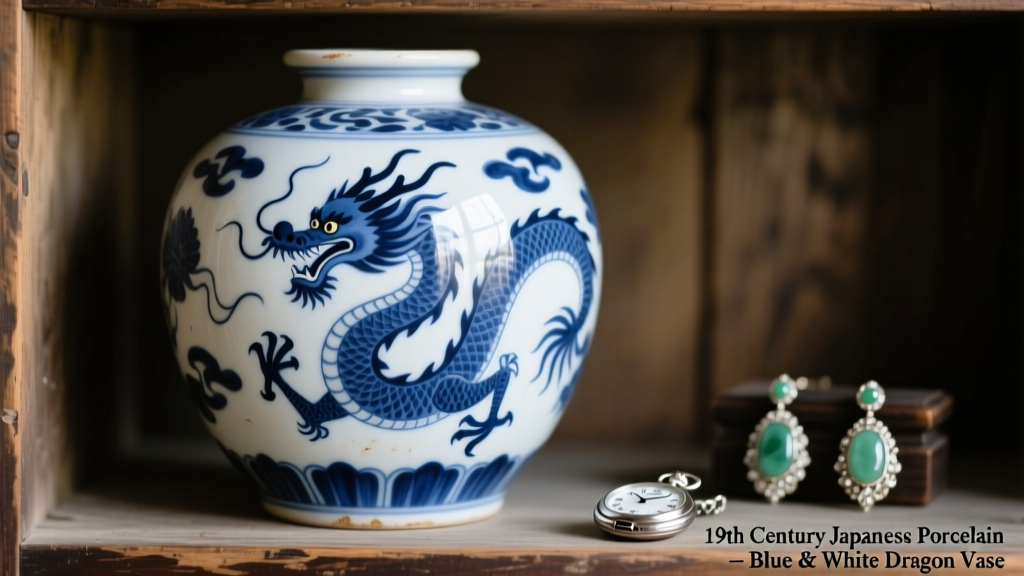
A Study of a 19th-Century Japanese Blue-and-White Dragon Porcelain Vase: Provenance, Technique, and Market Significance
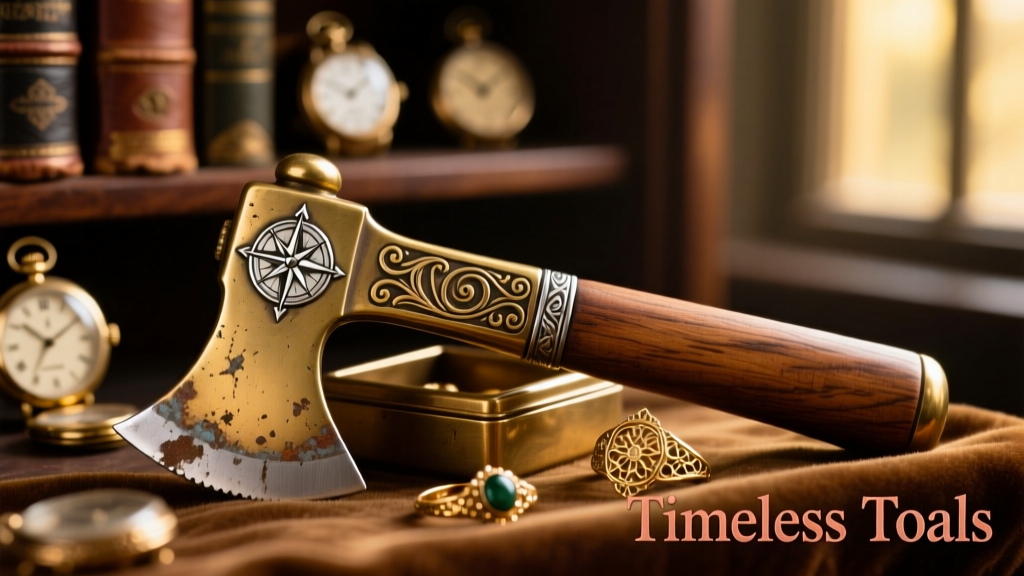
The Tools Hatchet Cigar Box Opener: A Forgotten Tool of American Craftsmanship and Tobacco Ritual
Evans Back Mirror Compacts: A Collector’s Guide to British Art Deco Vanity Cases
Advertising Box for Fun-To-Wash Soap Powder: A Study of the Mammy-Image Cardboard Display Unit, c. 1920–1945
Aurene Vase in Gold-Green: Hooked Feathers, Bulbous Form, and Steuben’s 5-Inch Masterpiece
The Razors Straight White Celluloid Albany N.Y. Case: A Study in Early 20th-Century American Razor Craftsmanship
Banjo Clocks of Boston, 1830: Mahogany Throat, Base Panels, and the Precision Legacy of Simon Willard & Sons
The Rochester Star Egg Carrier: A 1910 Celluloid Advertising Mirror and Pocket Tray Artifact
Nautical Plate Great Republic Hamilton: A Deep Dive into the Iconic 1940s Dive Watch