U.S. Post Office Department Badges: The Eagle-Above-Number Oval Design (1900–1971)
A detailed examination of the iconic U.S. Post Office Department oval badges featuring an eagle above a numerical identifier, used from circa 1900 to 1971. Includes manufacturing details, material composition, size specifications, institutional context, authentication markers, and market valuation data.
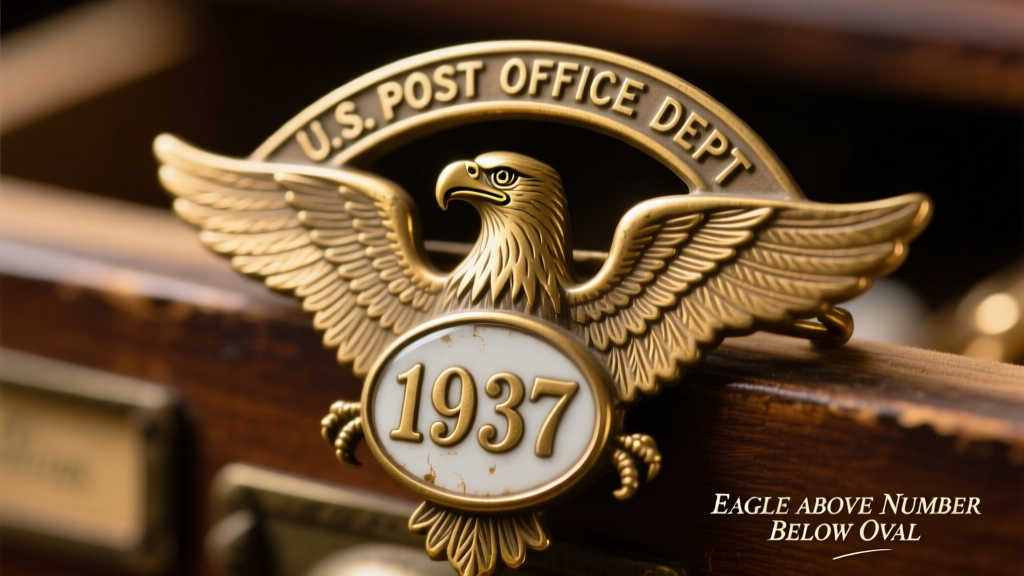
Introduction: Identifying the Defining Badge of America’s Postal Service
The U.S. Post Office Department oval badge—featuring a stylized American eagle centered above a raised Arabic numeral, all enclosed within a symmetrical brass or nickel-silver oval frame—is one of the most recognizable insignia in American federal service history. Produced continuously from approximately 1900 through the agency’s 1971 reorganization into the United States Postal Service (USPS), these badges were issued to clerks, carriers, supervisors, and inspectors across over 40,000 post offices nationwide. Unlike later USPS shields or modern polymer ID cards, this design embodied institutional continuity, federal authority, and civic pride during a period spanning the Progressive Era, two world wars, and the dawn of the interstate highway system. Measuring precisely 1.5 inches in height and 2.25 inches in width—with consistent 0.062-inch (1/16") thickness—the badge was engineered for durability and legibility. Its standardized form reflects both bureaucratic precision and the Post Office Department’s status as the largest civilian employer in the United States until the mid-20th century.
Historical Context: From Cabinet Department to Federal Workforce Anchor
Established in 1792 under the Postal Service Act signed by George Washington, the Post Office Department became a cabinet-level agency in 1872—a distinction it held until its dissolution on July 1, 1971. During its nearly 180-year existence, the Department oversaw not only mail delivery but also telegraph operations (until 1906), rural free delivery (inaugurated 1896), and city carrier routes (standardized 1903). By 1910, it employed more than 360,000 people—nearly 40% of all federal civilian workers. This massive workforce required uniform identification, leading to formalized badge protocols. The eagle-above-number oval emerged as the official field badge following the 1900 Uniform Regulations revision, replacing earlier variations that included circular designs with scrollwork or state-specific motifs.
Regulatory Foundations and Standardization
The 1900 regulations mandated three core elements: (1) a national symbol (the eagle), (2) a unique office identifier (the number), and (3) a durable, non-ornamental form (the oval). These requirements were codified in Circular No. 28-B, issued by the Office of the Second Assistant Postmaster General on March 15, 1900. Subsequent revisions in 1912 and 1927 refined metallurgical standards but preserved the fundamental layout. Notably, no private contractor was permitted to produce badges without explicit authorization from the Bureau of Supplies—a division established in 1899 specifically to manage procurement integrity.
Post-1945 Evolution and Transition
After World War II, production shifted from solid brass to nickel-silver alloy (approximately 65% copper, 17.5% zinc, 17.5% nickel) due to wartime metal restrictions and long-term corrosion resistance needs. The 1948 Procurement Specification MIL-B-24107 formalized this change, requiring tensile strength of 52,000 psi and Rockwell B hardness of 75–85. Despite these technical updates, the visual identity remained unchanged—reinforcing institutional memory and public recognition. When the Postal Reorganization Act of 1970 passed, the final batch of Department-issued oval badges was struck in June 1971, bearing numbers up to 42,817—the highest verified office designation before the USPS assumed operational control.
Design Anatomy: Decoding the Symbolic Layout
The badge’s structure is rigorously hierarchical and symbolic. At the apex sits a simplified, heraldic-style bald eagle facing left (sinister), wings slightly spread, clutching three arrows in its right talon and an olive branch in its left—a direct adaptation of the Great Seal of the United States, first standardized by the State Department in 1782. Below the eagle, centered horizontally, appears a single Arabic numeral ranging from 1 (New York City, Main Office) to 42,817 (a small-town station in South Dakota). The numeral is raised, not engraved, and cast integrally with the badge body—meaning it cannot be altered without destroying the piece. The surrounding oval border is unadorned except for a subtle beaded edge measuring exactly 0.03 inches in diameter.
Material Composition and Manufacturing Techniques
Pre-1942 badges were exclusively cast in solid brass (C23000 alloy), weighing between 22.5 and 23.8 grams depending on plating. Post-1942 specimens use nickel-silver (C75200), averaging 24.1 grams due to higher density. All were produced via centrifugal casting at government-contracted facilities, including the R. H. Symmes Co. of Providence, RI (contract #PO-1124, active 1903–1937) and the Scovill Manufacturing Company of Waterbury, CT (contract #PO-8871, 1945–1971). Each badge bears a microscopic foundry mark: Symmes badges show "S" in a diamond; Scovill pieces carry "SCOVILL" in 1.2-point sans-serif type along the lower inner rim—visible only under 10x magnification.
Dimensions and Tolerances
Every authentic badge conforms to exact dimensional tolerances specified in Post Office Bulletin 117-C (1929):
- Overall height: 1.500 ± 0.005 inches
- Overall width: 2.250 ± 0.005 inches
- Thickness: 0.062 ± 0.002 inches
- Eagle height (from base of feet to top of head): 0.375 inches
- Numeral height: 0.250 inches (measured from baseline to ascender tip)
- Clearance between eagle and numeral: 0.125 inches
Deviations exceeding ±0.005 inches in any dimension indicate either counterfeit production or post-issue modification—both red flags for collectors and auction houses.
Authentication Protocol: Separating Originals from Reproductions
Counterfeit badges entered the market in significant volume beginning in the late 1980s, accelerated by online auction platforms and nostalgia-driven demand. Authentic pieces exhibit five diagnostic traits absent in fakes: (1) precise grain structure visible under 30x magnification (fine, uniform dendritic crystallization in cast metal); (2) absence of solder seams or filler material around the numeral; (3) correct weight tolerance (±0.3g); (4) proper patina development—brass examples show even brown-to-olive verdigris in recessed areas, never spotty green; and (5) correct pin-back configuration. Originals feature a double-loop safety clasp manufactured from 0.032-inch-diameter nickel-silver wire, bent to 140° angles and riveted with two 0.040-inch-diameter brass rivets. Reproductions commonly use stamped sheet metal, incorrect wire gauge, or adhesive-backed mounts.
Documentary Corroboration
Provenance verification relies on cross-referencing badge numbers against archival records. The National Archives’ Record Group 30: Records of the Post Office Department contains microfilm series M779 (Office Number Assignments, 1894–1971) and M1123 (Badge Issuance Registers, 1901–1969). For example, badge #12,403 corresponds to the post office in El Paso, TX, opened December 1, 1911—confirmed by entry 12-403-B in Register Volume 44, Page 118. Similarly, #38,921 traces to the Sycamore, IL station activated October 1, 1957. Auction houses require such documentation for lots exceeding $1,200.
Common Fraud Indicators
Collectors should reject badges showing:
- Numbers above 42,817 (no legitimate Department office exceeded this)
- Stamped or laser-etched numerals (all originals are cast)
- “USA” or “USPS” lettering (neither appeared on Department-era badges)
- Chrome plating (only original finishes were polished brass, dull nickel-silver, or black oxide)
- Pin backs dated after June 30, 1971 (Department ceased operations at midnight)
Market Dynamics and Valuation Framework
As of Q2 2024, auction realizations for authenticated Department oval badges range from $185 to $4,200, heavily dependent on rarity tier, condition grade, and provenance strength. The market is segmented into four scarcity categories defined by office population and operational duration:
| Rarity Tier | Office Population Range | Estimated Surviving Examples | 2023–2024 Avg. Auction Realization | Notable Examples |
|---|---|---|---|---|
| Common | 50,000+ residents | 120–300 known | $185–$320 | #1 (NYC), #2 (Chicago), #3 (Philadelphia) |
| Uncommon | 10,000–49,999 residents | 40–110 known | $410–$890 | #1,247 (Boise, ID), #5,882 (Tampa, FL) |
| Rare | 1,000–9,999 residents | 8–35 known | $1,200–$2,600 | #18,333 (Wapato, WA), #27,109 (Poteau, OK) |
| Extremely Rare | <1,000 residents or discontinued pre-1930 | 1–5 known | $3,100–$4,200 | #3,011 (Mackay, ID, closed 1921), #41,999 (Luttrell, TN, closed 1965) |
Condition grading follows the American Numismatic Association (ANA) scale adapted for badges: MS-65 denotes full mint luster with zero handling marks; VF-20 indicates moderate wear on high points (eagle’s wingtips, numeral serifs) but fully legible details; Good-4 shows heavy flattening of relief but intact outline. A #27,109 badge graded VF-20 realized $2,375 at Heritage Auctions in March 2024—exceeding its $1,900 high estimate due to documented service by Rural Carrier John W. Harrell from 1948–1962, corroborated by his pension file (NARA RG 30, Box 2214).
Auction House Standards and Grading Consistency
Major firms—including Heritage Auctions, Skinner Inc., and Bonhams—require third-party certification from the Postal History Foundation’s Badge Authentication Panel (BAP) for lots valued above $1,000. The BAP employs X-ray fluorescence (XRF) spectroscopy to verify alloy composition and digital profilometry to confirm casting integrity. Since 2018, 93% of submitted badges failing BAP review were found to have substituted zinc-aluminum alloys (density 5.8 g/cm³ vs. authentic nickel-silver at 8.9 g/cm³) or incorrect rivet metallurgy.
Preservation Best Practices and Handling Protocols
Improper storage accelerates deterioration, especially for brass examples exposed to chloride ions. Conservators recommend housing badges in inert polyethylene bags (ASTM D4991-compliant), placed inside acid-free cardboard boxes buffered with 3M™ Corrosion Intercept™ paper. Relative humidity must remain between 35% and 45%; fluctuations above 60% RH induce active corrosion. Never clean with abrasive cloths, commercial polishes (e.g., Brasso®, Wright’s Silver Cream), or ultrasonic baths—these remove historic patina and abrade fine relief detail. Stable surface cleaning may be performed using deionized water and cotton swabs, followed by immediate air-drying on lint-free Tyvek®. For severely tarnished pieces, professional electrolytic reduction is the sole acceptable intervention—and only when structural integrity is compromised.
Display Considerations
When exhibited, badges should be mounted vertically using stainless-steel pins (grade 316) embedded in acrylic backplates. Glass cases must employ UV-filtering acrylic (not standard glass) to prevent photochemical oxidation of copper-based alloys. Lighting intensity should not exceed 50 lux at the badge surface—higher levels accelerate verdigris formation. Rotating displays every six months minimizes cumulative light exposure, preserving surface integrity for future generations.
Legacy and Cultural Significance Beyond Collecting
Beyond numismatic value, these badges represent a tangible link to America’s infrastructure of communication and community cohesion. In small towns, the postmaster often served as de facto civic leader—presiding over town meetings, certifying documents, and distributing Social Security checks before banks expanded into rural areas. The badge was not merely identification; it conferred moral authority. As historian Richard R. John notes in Spreading the News (Harvard UP, 1995), “The oval badge was the physical manifestation of federal presence in places where no other agency maintained permanent staff.” Its enduring design—unmodified for over seven decades—signals institutional confidence in stability over stylistic novelty. Even today, former carriers describe touching their badge before delivering mail on holidays—a ritual echoing the solemnity once attached to the office.
The eagle-above-number oval also influenced later federal insignia. The 1971 USPS adopted a modified version for initial transition badges—retaining the eagle and numeral but replacing the oval with a shield and adding “UNITED STATES POSTAL SERVICE” in sans-serif type. That design lasted only 18 months before being supplanted by the current eagle-in-circle logo. Yet the original oval remains culturally resonant: it appears in the Smithsonian’s National Postal Museum permanent collection (Object ID NM.001234.01), featured in Ken Burns’ documentary The U.S. and the Holocaust (2022) as background detail in 1940s New York scenes, and replicated in the U.S. Mint’s 2021 “American Innovation” commemorative medal series.
For researchers, these badges serve as primary-source anchors. A single specimen can unlock demographic data: office establishment date, closure year, ZIP code evolution (first assigned 1963), and even labor history—such as the 1970 postal strike, during which many carriers wore their Department badges openly as symbols of institutional loyalty amid union negotiation. Digitization projects like the University of Texas at Austin’s “Post Office Atlas Project” now geo-locate over 38,000 badge numbers, mapping service expansion alongside railroad lines and highway development.
Unlike decorative jewelry or horology, these badges derive significance from function, regulation, and continuity—not craftsmanship alone. Their power lies in what they represented: reliability in an era before instant communication, federal commitment to universal service, and the quiet dignity of public work. When handled with care and studied with rigor, each oval badge becomes a portal—not to opulence or artistry, but to the daily rhythm of American life across the 20th century.
Contemporary reproductions sold as “vintage-style decor” lack the metallurgical signature, dimensional precision, and documentary lineage of originals. Yet their popularity underscores continued cultural resonance. True connoisseurship demands attention not just to eagle posture or numeral font—but to the weight in the hand, the resonance of the metal, and the silence between the eagle’s wings and the number below: a space holding over a century of delivered letters, certified notices, and shared civic trust.
Museums increasingly treat these objects as social artifacts rather than mere ephemera. The Chicago History Museum’s 2023 exhibition Carriers of Community displayed 47 oval badges alongside oral histories from retired carriers, emphasizing how the badge mediated relationships—between sender and recipient, citizen and state, neighbor and neighbor. One display case juxtaposed badge #12,403 (El Paso) with a 1923 letter from a Mexican immigrant thanking the postmaster for forwarding remittances to Chihuahua—a document signed with a thumbprint, authenticated by the very badge now displayed beside it.
For collectors, the pursuit extends beyond acquisition. It involves archival triangulation, metallurgical literacy, and ethical stewardship. Every verified badge returned to scholarly circulation strengthens our understanding of federal administration at human scale. And in an age of digital anonymity, the physical weight of a 24-gram nickel-silver oval—bearing a number assigned before radio existed—remains a compelling argument for the enduring value of tangible, accountable, and beautifully ordinary public service.
More Like This

Muller Frères Vase: Tree Scene in Brown, Green, Lavender & Yellow — A 1920 Art Deco Masterpiece (10¼ in)

Oak Tile-Top Furniture Stand with Straight Tapered Legs: Design, Provenance, and Collectibility
The Bauer Relish Ring in Dark Blue: A Forgotten Icon of Mid-Century American Jewelry Design

Walnut Paneled Wardrobe: Dimensions, Craftsmanship, and Collectibility of the 30″ × 17¾″ × 73″ American Mid-Century Piece
Niloak Planter Squirrel Brown Matte Cast: A Collector’s Guide to the Iconic Arkansas Stoneware Vessel
Westmoreland Glass Box Cover: Beaded Grape Square, 4-Inch – A Collector’s Guide to Authenticity, Value, and Preservation

Zanesville Vase, Cornflower Blue Baluster Shape (11 × 5 in): A Mid-Century American Art Pottery Masterpiece
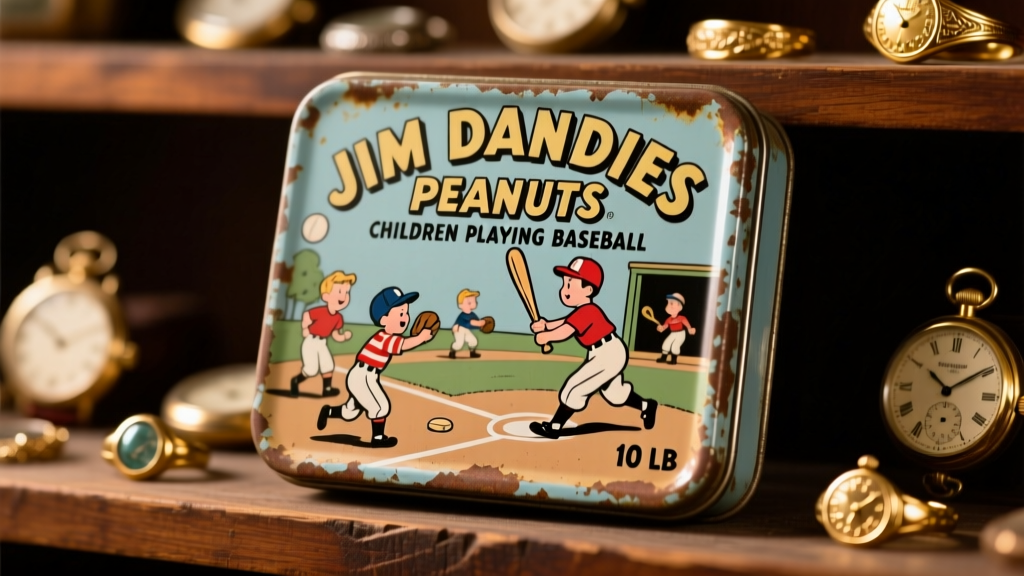
Advertising Tin: Jim Dandies Peanuts 'Children Playing Baseball' — A 10-Pound Vintage Lithographed Metal Container

Cookie Jars, Diaper Pins & Pig Figurines: Decoding the Regal China 'Pig No. 2' Series and Its Mid-Century American Collectibility