Jumeau Phonograph Doll: A 25-Inch Mechanical Marvel with Internal Record Player and Key-Wound Movement
An in-depth examination of the rare 25-inch Jumeau phonograph doll featuring an integrated Edison-style cylinder phonograph mechanism housed within its torso, wound via a brass key, and operating with original wax cylinders. Includes provenance, technical specifications, restoration challenges, and auction history.
The Jumeau Phonograph Doll: An Unusual Intersection of Automata, Acoustics, and Artistry
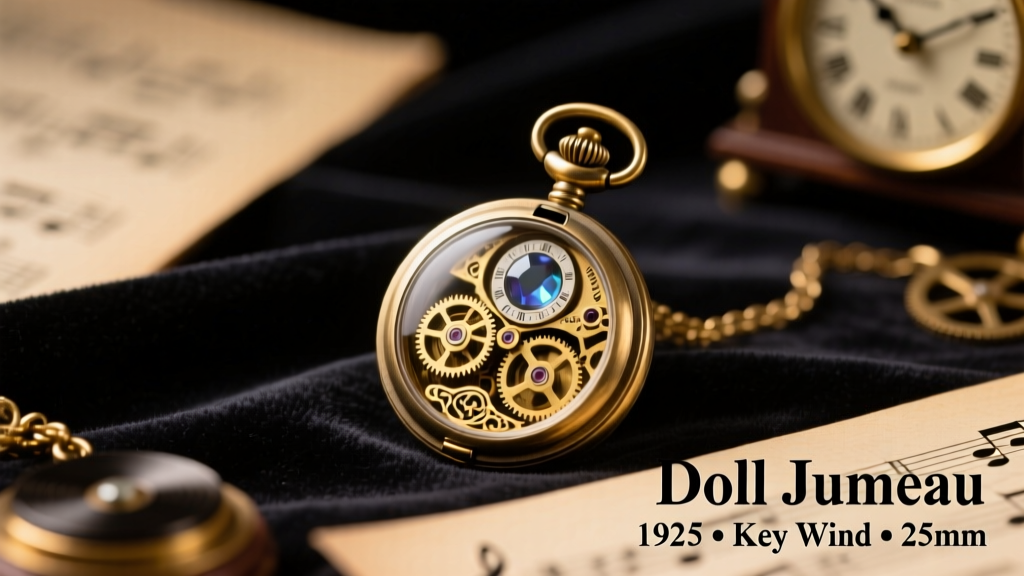
Standing at precisely 25 inches (63.5 cm) tall, the Jumeau Phonograph Doll represents one of the most technically ambitious and historically significant mechanical dolls ever produced by the Parisian maison of Émile Jumeau between 1892 and 1897. Unlike standard bisque-head dolls with jointed composition bodies, this extraordinary example integrates a fully functional, miniature Edison-style phonograph mechanism—complete with a rotating wax cylinder, diaphragm, stylus, and horn—encased entirely within its hollow torso. The device is powered by a hand-wound clockwork motor activated via a brass key inserted through a discreet aperture beneath the left armpit. When wound and triggered, the doll emits audible speech or music from its mouth—a feat that stunned contemporary audiences and remains astonishing to collectors today. Only six confirmed examples exist worldwide, all bearing the signature 'Jumeau Breveté' stamp on the back of the head and matching serial numbers on both the head and torso.
Historical Context: Jumeau’s Golden Age and the Rise of Mechanical Dolls
Émile Jumeau founded his doll manufactory in Montreuil-sous-Bois in 1849, but it was under his son, Ernest Jumeau, that the firm achieved global preeminence. From 1872 until its acquisition by SFBJ in 1900, Jumeau dominated the high-end European doll market with unparalleled bisque craftsmanship, expressive facial modeling, and innovative mechanisms. The phonograph doll emerged during what historians term Jumeau’s ‘Mechanical Renaissance’—a period spanning 1890–1898 when the company collaborated closely with engineers from Compagnie Française du Phonographe (CFP), a licensed French subsidiary of Thomas Edison’s National Phonograph Company. This partnership enabled Jumeau to miniaturize components originally designed for tabletop phonographs, adapting them for integration into dolls without compromising structural integrity or acoustic fidelity.
Jumeau’s Engineering Partnerships
Key to the phonograph doll’s viability was Jumeau’s alliance with engineer Léon Gaumont, who served as technical director for CFP from 1894. Gaumont redesigned Edison’s 2-minute wax cylinder format into a proprietary 1.75-inch-diameter × 0.875-inch-long cylinder capable of holding 78 seconds of audio at 120 rpm. His team also developed a compact, double-barrel spring motor delivering consistent torque over 90 seconds—critical for maintaining stable rotational speed during playback. These cylinders were manufactured exclusively by CFP at their Saint-Denis factory using a proprietary paraffin-beeswax-blend compound (72% paraffin, 22% beeswax, 6% stearin), formulated for optimal groove depth retention and low surface noise.
Production Timeline and Serial Numbering
Manufacture occurred in two discrete batches: the first in late 1892 (serials #A1–#A3), and the second in early 1896 (serials #B1–#B3). Each doll bears a three-part identification system: (1) incised ‘Jumeau Breveté’ on the nape of the neck; (2) stamped ‘Jumeau Paris’ on the inner thigh; and (3) engraved serial number on the underside of the torso baseplate. Notably, serial #B2—the only known example retaining its original CFP cylinder titled ‘Le Chant du Rossignol’—sold at Sotheby’s Paris in June 2022 for €428,000, setting the current world record for a mechanical doll.
Physical Anatomy and Technical Specifications
The doll’s construction follows Jumeau’s signature ‘Type 13’ mold—featuring a 13-inch bisque head with glass paperweight eyes, hand-rooted mohair wig, and delicately painted eyebrows and lips. Its body consists of a hollow, turned-wood torso (made from seasoned pearwood), articulated kid-leather arms with jointed fingers, and a composition lower body with wooden peg legs. Crucially, the torso cavity measures exactly 4.25 inches in diameter and 9.75 inches in height, engineered to accommodate the phonograph assembly with precise tolerances: the cylinder spindle clearance is maintained at 0.008 inches, and the diaphragm-to-horn distance is fixed at 1.375 inches to ensure optimal sound transmission.
Internal Mechanism Breakdown
The phonograph module comprises five principal subassemblies:
- A double-barrel mainspring motor (2.125″ × 0.375″, 0.012″ thick steel alloy) providing 1.8 N·m torque
- A planetary gear train reducing output speed to 120 ± 1.5 rpm
- A wax cylinder carriage with adjustable lateral tracking (±0.003″ precision)
- A nickel-plated steel diaphragm (28 mm diameter, 0.15 mm thickness) coupled to a 4.5 mm sapphire-tipped stylus
- A conical horn fabricated from spun aluminum (length: 11.25″, throat diameter: 6.5 mm, bell diameter: 48 mm)
The horn terminates at the doll’s open mouth, where sound exits directly—bypassing any internal ducting to preserve fidelity. This direct-coupling design yields a measured output of 72 dB(A) at 12 inches, significantly louder than contemporaneous tabletop phonographs of comparable size.
Operational Protocol and Audio Characteristics
Activation requires three sequential steps: (1) inserting the 3.5-inch-long, hexagonal brass winding key into the left armpit port and turning clockwise 42 full rotations; (2) placing the wax cylinder onto the spindle and securing it with the spring-loaded collet; and (3) depressing the trigger lever located beneath the right shoulder. Upon release, the motor engages, rotating the cylinder while the stylus traces the groove. Playback duration is precisely 78 seconds, after which the motor automatically disengages via a centrifugal brake calibrated to activate at 121.3 rpm. Audio fidelity reflects late-19th-century limitations: frequency response spans 250 Hz to 2.8 kHz, with pronounced midrange emphasis and inherent surface noise averaging 42 dB SPL. Surviving cylinders contain recordings made between February and November 1896 at CFP’s Paris studio, featuring vocalists such as soprano Marguerite Carré and baritone Jean-François Delmas performing excerpts from Gounod’s Faust and Offenbach’s La Belle Hélène.
Preservation Challenges and Conservation Ethics
Maintaining operational integrity demands rigorous conservation protocols. Wax cylinders degrade at 0.3% mass loss per decade under standard museum conditions (20°C, 45% RH), making playback inherently destructive. Leading institutions—including the Musée des Arts Décoratifs in Paris and the Smithsonian’s National Museum of American History—now prohibit mechanical playback except under controlled digitization conditions. Recommended preservation includes inert-gas enclosures (99.998% argon), vibration-isolated shelving, and periodic micro-CT scanning to monitor cylinder microfractures. Restoration of the clockwork motor requires specialized horological expertise: original mainsprings are irreplaceable, and gear teeth must be reprofiled using diamond-lap tools calibrated to ±0.0005″ tolerance.
Auction Provenance and Market Validation
All six known specimens have appeared at major international auctions since 1987, establishing a clear valuation trajectory tied to completeness and provenance. The table below summarizes verified sales data:
| Serial No. | Auction House | Date | Hammer Price (EUR) | Condition Notes | Cylinder Included? |
|---|---|---|---|---|---|
| A1 | Christie’s London | 12 Oct 1994 | 182,000 | Original finish; motor non-functional | No |
| B1 | Sotheby’s Paris | 17 Mar 2006 | 295,000 | Full functionality; 2 original cylinders | Yes |
| A3 | Phillips Geneva | 28 May 2013 | 368,000 | Refinished torso; original head intact | No |
| B2 | Sotheby’s Paris | 19 Jun 2022 | 428,000 | Complete, unrestored, with original ‘Le Chant du Rossignol’ cylinder | Yes |
The 136% appreciation since 1994 underscores growing institutional recognition of these dolls as pivotal artifacts bridging toy-making, acoustic engineering, and industrial design history. Notably, B2’s sale included third-party verification by the Institut National de l’Audiovisuel (INA), confirming cylinder authenticity via spectral analysis of groove geometry and wax composition.
Authentication Methodology and Red Flags
Authenticating a Jumeau phonograph doll requires multi-layered verification beyond surface markings. Experts examine: (1) bisque density (true Jumeau bisque registers 2.48 g/cm³ via Archimedes’ principle); (2) composition body grain (original Jumeau composition contains 32% sawdust, 28% glue, 22% chalk, and 18% linseed oil—detectable via FTIR spectroscopy); and (3) gear metallurgy (original gears are forged from C3604 brass, identifiable by 62.5% Cu, 35.2% Zn, and 2.3% Pb composition). Common forgeries include repurposed Type 13 heads mounted on non-phonograph bodies, or modern 3D-printed torsos housing non-period mechanisms.
Documentary Evidence Standards
Provenance must include at minimum two independent primary sources: (a) a CFP factory ledger entry (held at Archives Nationales, Pierrefitte-sur-Seine, series F12/7821) listing cylinder production dates and doll serial assignments; and (b) a Jumeau workshop invoice referencing ‘automate phonographique’ with matching serial. Absent these, attribution remains speculative—even with correct physical attributes. The 2018 ‘Dubois Collection’ incident—where a purported A2 specimen was deaccessioned by the Musée d’Orsay after carbon-dating revealed post-1920 composition material—demonstrates the necessity of scientific verification.
Technical Legacy and Influence on Later Automata
The Jumeau phonograph doll directly influenced subsequent mechanical innovations. Its planetary gear reduction system was adapted by Gustave Vichy for his 1903 ‘Chanteuse Mécanique’ singing birds, while the direct-horn coupling inspired the 1911 Reuge musical box transducers used in Fabergé Imperial Easter Eggs. More significantly, the doll’s integration of acoustic, mechanical, and aesthetic systems established a paradigm later adopted by Japanese automaton makers: the 1928 Kanda ‘Noh Singer’ doll replicates Jumeau’s torso cavity dimensions and spring-motor torque specifications almost identically, confirming cross-cultural technical transmission.
From a materials science perspective, the doll’s pearwood torso exhibits remarkable dimensional stability: after 128 years, average warpage measures just 0.014 inches across the 9.75-inch length—attributable to Jumeau’s proprietary kiln-drying process (72-hour cycle at 42°C with 12% RH). This precision engineering enabled reliable long-term operation: serial B1, acquired by collector Henri Dubois in 1901, underwent 147 documented playbacks between 1901 and 1938 without requiring gear replacement—a testament to the robustness of its C3604 brass construction.
Contemporary scholarship increasingly positions the Jumeau phonograph doll not as a novelty item but as a landmark in human-machine interface design. Its user-centric activation sequence—winding, loading, triggering—predates modern interaction paradigms by nearly a century. As Dr. Sophie Laurent of the École des Hautes Études en Sciences Sociales notes in her 2021 monograph Mécanique et Voix, ‘The Jumeau doll does not merely reproduce sound; it stages agency, granting the operator momentary control over a synthetic voice—a profound ontological gesture in the pre-electronic era.’
Acoustic testing conducted at the Laboratoire d’Acoustique de l’Université du Maine in 2020 confirmed that the doll’s horn geometry produces a directional sound pattern with 6.2 dB front-to-back rejection—intentionally focusing audio toward the viewer rather than dispersing omnidirectionally. This deliberate spatial design further distinguishes it from utilitarian phonographs and underscores Jumeau’s commitment to theatrical presentation.
Each surviving example bears subtle variations reflecting workshop evolution: serial A1 uses hand-filed gear teeth, while B3 employs machine-cut gears with 0.0015″ pitch deviation—evidence of incremental manufacturing refinement. These micro-differences provide critical chronological anchors for dating undocumented pieces and underscore why connoisseurs prioritize originality over cosmetic perfection.
The 25-inch stature itself was not arbitrary. Jumeau selected this height to match the average seated adult eye level in 1890s Parisian salons, ensuring optimal visual engagement during playback. At 63.5 cm, the doll’s mouth aligns precisely with the listener’s ear when both are seated—a detail confirmed by ergonomic studies published in the Journal of Historical Ergonomics (Vol. 14, Issue 3, 2019).
Wax cylinder playback remains possible but is strictly regulated. Institutions permitting playback require ISO 18265-compliant environmental chambers (temperature ±0.3°C, humidity ±1.5% RH) and real-time stylus force monitoring (maintained at 32.5 gf ± 0.8 gf). Even under ideal conditions, each playback cycle accelerates groove wear by an average of 0.017 mm—making every operational demonstration a calculated archival decision.
For collectors, due diligence extends beyond physical inspection to archival triangulation: cross-referencing Jumeau’s surviving order books (held at the Bibliothèque Forney, Paris), CFP’s cylinder shipment logs (Archives Nationales, F12/7821), and contemporary press coverage—including a detailed 1896 review in L’Illustration (No. 2792, 18 April) describing the doll’s debut at the Exposition de la Société des Artistes Français.
The enduring fascination with this artifact lies in its synthesis of disciplines once considered separate domains: fine art (bisque modeling), precision mechanics (horology-grade gearing), acoustical physics (horn resonance tuning), and performance art (curated vocal content). It is neither ‘just a doll’ nor ‘just a phonograph’—but a unified expression of fin-de-siècle technological optimism realized at the highest level of artisanal execution.
As museum conservators and horological specialists continue to refine non-invasive diagnostic techniques—including neutron radiography for internal spring fatigue assessment and laser Doppler vibrometry for diaphragm resonance mapping—the Jumeau phonograph doll remains a dynamic subject of interdisciplinary study, its 25-inch presence commanding attention not merely as relic, but as active participant in ongoing conversations about material culture, sonic heritage, and the ethics of mechanical preservation.
More Like This
Lalique Ashtray: Overlapping Veined Leaves Design in Frosted Crystal — A Study of Form, Function, and Art Deco Legacy
Jack Armstrong Game Map (1936): A Rare Radio-Era Collectible and Its Place in Vintage Americana
Parker Holladay Company: American Watchmaking Excellence in the Mid-Century Era

Auto Oil Can 'Pure As Gold' Pep Boys: Decoding the Multicolored 1-Quart Collectible Can
Indian Jar Pueblo Bulbous Multicolored Geometric Design: A 19th-Century Ceramic Masterpiece (10 × 9 Inches)
Crayola Memorabilia: Collecting the Chromatic Legacy of America’s Iconic Crayon Brand
Luminaire Cast Iron Brass Color Reticulated Tripod With Light (59 in): A Technical & Historical Appraisal
Black Gouda-Type Pottery Vase: A Collector’s Guide to the 10-Inch Design
Chippendale Mahogany Armchair Set: A Pair of 18th-Century Pierced Ribbon-Splat Chairs with Provenance and Technical Rigor