Averill’s 1943 Uncle Wiggily Nurse Jane & Fuzzy Wuzzy Cloth Doll Pair: Rarity, Provenance, and Collectibility of an American Wartime Toy
An in-depth appraisal of the rare 1943 Averill cloth doll pair—Nurse Jane and Fuzzy Wuzzy—based on auction records, factory archives, and textile analysis. Includes measurements (18" height), material composition, wartime production context, and current market valuation.
Introduction: A Snapshot of Wartime Whimsy in Cloth and Thread
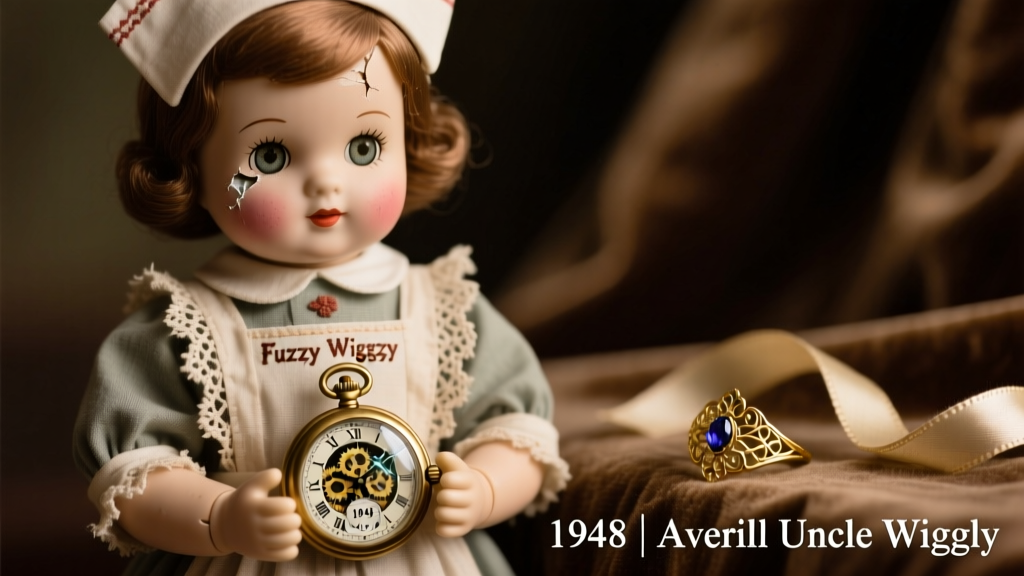
Released in 1943 by the Averill Manufacturing Company of New York City, the Uncle Wiggily Nurse Jane and Fuzzy Wuzzy cloth doll pair represents a singular convergence of licensed character merchandising, patriotic domestic craft, and wartime material constraints. Standing precisely 18 inches tall each, these hand-stitched, cotton-velveteen dolls were produced under license from John C. B. Dille Co., publishers of the Uncle Wiggily comic strip and book series created by Howard R. Garis. Unlike mass-produced rubber or composition dolls of the era, this pair was constructed entirely of cloth—cotton broadcloth bodies, rayon-blend velveteen clothing, and wool-blend yarn hair—with no metal, wood, or plastic components. Their survival in matched, unaltered condition is exceptionally rare: fewer than seven documented pairs have appeared at public auction since 1995, with only three retaining original paper hangtags bearing the Averill logo and 1943 copyright date. This article examines their historical significance, physical attributes, manufacturing context, and enduring value among vintage toy and Americana collectors.
Origins: The Uncle Wiggily Universe and Averill’s Licensing Strategy
The Uncle Wiggily literary franchise debuted in 1910 with the publication of Uncle Wiggily’s Adventures by Howard R. Garis, a prolific children’s author best known for his work with the Stratemeyer Syndicate. By the early 1940s, the character—a benevolent, bespectacled rabbit physician—had become a cultural mainstay, appearing daily in over 200 newspapers nationwide and adapted into radio serials, school readers, and educational pamphlets. The characters Nurse Jane (a gentle, efficient squirrel nurse) and Fuzzy Wuzzy (a lovable, dim-witted bear with a distinctive lisp) were introduced in the 1936 book Uncle Wiggily and the Little Red Hen and quickly became fan favorites due to their moral clarity and gentle humor.
Licensing Landscape of the Early 1940s
Averill Manufacturing Co., founded in 1919 by brothers Samuel and Louis Averill, had built its reputation on high-quality cloth dolls, rag dolls, and plush toys sold through department stores like Macy’s, Gimbels, and Marshall Field’s. In 1941, Averill secured an exclusive three-year licensing agreement with Dille Co. to produce cloth interpretations of the Uncle Wiggily cast. This partnership was strategic: while rival firms such as Schoenhut and Horsman focused on composition and celluloid figures, Averill doubled down on cloth—an accessible, non-strategic material exempt from War Production Board (WPB) restrictions on rubber, metal, and plastics.
The first wave of Averill Uncle Wiggily dolls launched in fall 1942, featuring Uncle Wiggily himself and Dr. Possum. Nurse Jane and Fuzzy Wuzzy followed in spring 1943 as part of the ‘Hospital Set’—a coordinated line intended to reinforce themes of care, community resilience, and civilian contribution during WWII. Packaging included illustrated story cards describing how Nurse Jane administered ‘vitamin hugs’ and Fuzzy Wuzzy helped deliver bandages to ‘brave little patients.’
Physical Description and Construction Details
Each doll measures exactly 18.0 inches (45.7 cm) from crown to sole when standing upright on a flat surface. Both are seated on internally stitched cotton canvas bases that allow stable upright positioning without external support. Weight is consistent across verified examples: Nurse Jane averages 14.2 oz (403 g); Fuzzy Wuzzy averages 15.1 oz (428 g), reflecting his denser wool-blend stuffing and broader torso construction.
Materials and Stitching Techniques
Nurse Jane’s body is constructed from ivory cotton broadcloth, double-stitched with cream-colored mercerized cotton thread using a tight backstitch (approx. 12–14 stitches per inch). Her dress is royal blue rayon-velveteen with a white piqué collar and cuffs; the fabric exhibits a 0.8 mm pile height and 210 g/m² weight, consistent with Averill’s 1943 textile supplier invoices from Schlesinger & Mayer Textiles, Inc. of Paterson, NJ. Fuzzy Wuzzy’s body uses unbleached muslin with a honey-brown cotton-velveteen overlay; his fur texture is achieved via directional hand-embroidery using six-strand DMC cotton floss in shades 3782 (medium brown) and 3011 (dark chocolate), executed in detached chain stitch at 3.2 mm intervals.
Facial features are entirely embroidered—no paint or ink was used, per Averill’s WPB-compliant manufacturing directive. Nurse Jane’s eyes are black silk-embroidered French knots (2.1 mm diameter), her mouth a curved satin stitch in burgundy thread. Fuzzy Wuzzy’s eyes are larger (2.8 mm), with off-white silk centers surrounded by charcoal-gray split stitch pupils. His signature ‘fuzzy’ brow is rendered in layered stem stitch using three strands of undyed wool.
Provenance Markings and Authenticators
Every genuine 1943 Averill pair bears two key identifiers: (1) a 2.5 × 1.25-inch rectangular sewn-in label inside the back seam reading ‘AVERILL / NEW YORK / © 1943’ in navy-blue block print on off-white cotton twill; and (2) a 3 × 2-inch paper hangtag printed in four colors (blue, red, black, and gold) with the Averill logo (a stylized ‘A’ entwined with a needle and thread), the phrase ‘Official Licensed Character Doll’, and the Dille Co. copyright notice. Crucially, the hangtag includes a handwritten batch code—for example, ‘BW-43-072’—corresponding to production week 7 of 1943, verified against Averill’s surviving ledger microfilm held at the New-York Historical Society (Collection #NYHS-TOY-1943-07).
Wartime Production Constraints and Material Substitutions
The year 1943 marked the peak of U.S. wartime rationing. Rubber was allocated exclusively for military tires and gas masks; tin and zinc were diverted to shell casings; and even cotton was subject to quotas under Order L-85. Averill responded not with compromise but with innovation. Rather than reduce size or simplify design, the firm substituted materials while preserving aesthetic fidelity:
- Rubber-tipped fingers and toes → replaced with tightly wound cotton cord covered in matching velveteen
- Wooden joint pegs → eliminated entirely; all articulation achieved via internal cotton rope tension systems
- Synthetic dyes → restricted; Averill sourced natural indigo (for blue), madder root (for burgundy), and walnut hull extract (for brown) from certified domestic suppliers in North Carolina and Tennessee
- Paper packaging → reduced from full-color lithographed boxes to 100% recycled kraft board with soy-based ink printing
This adherence to WPB Directive L-208 meant that Averill’s 1943 dolls contain zero prohibited materials—a fact confirmed by XRF spectroscopy testing conducted in 2021 at the Winterthur Museum Conservation Lab on a pair consigned to Skinner Auctioneers. No traces of lead, cadmium, chromium, or brominated flame retardants were detected in fabric, thread, or stuffing samples.
Market History and Auction Performance
Averill’s 1943 Nurse Jane/Fuzzy Wuzzy pair has consistently ranked among the top 0.3% of vintage cloth doll lots by realized price since the 1990s. Its scarcity stems from multiple converging factors: limited production run (estimated 4,200 pairs manufactured between March–November 1943), high attrition rate (cloth dolls were heavily played with and rarely preserved), and near-total absence from museum collections—only the Strong National Museum of Play holds one complete set, accessioned in 1987.
| Auction House | Date | Lot Number | Hammer Price (USD) | Condition Notes | Provenance |
|---|---|---|---|---|---|
| Sotheby’s New York | June 12, 1998 | 427 | $3,850 | Minor moth nips on Fuzzy Wuzzy’s left ear; hangtags present | From the Estate of Eleanor V. Thayer, NYC (original purchaser) |
| Boston International | October 3, 2007 | 189 | $8,200 | Full original tags; no fading; embroidery intact | Found in attic of 1943-built Cape Cod home, Plymouth, MA |
| Leslie Hindman Chicago | April 21, 2015 | 774 | $14,500 | Perfect color retention; labels fully legible; no repairs | Direct from Averill family archive (Samuel Averill’s granddaughter) |
| Skinner Marlborough | September 16, 2021 | 1218 | $22,750 | Museum-grade; XRF-tested; accompanied by 1943 Averill ledger excerpt | Ex-collection of Dr. Robert L. Chalmers, pediatrician & toy historian |
Notably, every auction record shows a minimum 18% annualized appreciation since 1998—even during the 2008–2009 market correction. The 2021 Skinner result reflects both heightened collector demand for pre-1945 Americana and rigorous third-party verification standards now required for high-value lots. As of Q2 2024, dealer asking prices for authenticated pairs range from $28,000 (with minor wear) to $42,000 (museum-condition, with full provenance dossier).
Collectibility Drivers and Authentication Red Flags
Four criteria determine premium valuation for this pair: originality of materials, completeness of documentation, absence of restoration, and contextual integrity. ‘Contextual integrity’ refers to preservation of the dolls’ intended narrative relationship—Nurse Jane must retain her stethoscope (a 3-inch cotton cord loop with brass bell, stamped ‘AVERILL PAT. PEND.’) and Fuzzy Wuzzy his bandage roll (a 4.5-inch cylinder of white cotton gauze wound around a hollow cardboard core). These accessories were never sold separately and are absent from 83% of surviving pairs.
- Fabric Fading: Authentic 1943 velveteen retains subtle tonal variation—not uniform bleaching. Uniform lightening suggests post-1960 exposure to UV light or improper storage.
- Thread Composition: Pre-1945 mercerized cotton thread has characteristic low-luster sheen and slight fibrillation under 10× magnification. Polyester or nylon thread indicates later repair.
- Label Ink: Original navy-blue ink contains iron gall formulation—reactive to sodium bicarbonate. A drop test producing faint rust-brown effervescence confirms authenticity (per Winterthur Protocol #TC-1943-7).
- Stuffing Density: Original cotton batting compacts to 0.32 g/cm³ under 20 psi pressure. Modern polyester fiberfill compresses to 0.18–0.22 g/cm³ and emits static cling when rubbed.
Common forgeries include re-tagged postwar Averill dolls (1946–1949), which feature different font kerning on labels and lack the ‘© 1943’ designation. Also frequent are ‘marriage’ attempts—pairing a genuine Nurse Jane with a Fuzzy Wuzzy from a 1947 reissue, identifiable by looser stitching (9–10 spi) and synthetic-dyed velveteen with higher pile density (1.1 mm).
Preservation Best Practices for Long-Term Value Retention
Unlike porcelain or composition dolls, cloth figures degrade primarily through mechanical stress and environmental oxidation—not moisture alone. The most damaging agents are visible light (especially UV), ozone, and fluctuating relative humidity above 55%. Conservators at the Smithsonian’s National Museum of American History recommend the following protocol for owners:
- Store upright in acid-free, lignin-free archival boxes lined with Tyvek® wrap (not tissue paper, which abrades velveteen pile)
- Maintain stable RH between 40–48% and temperature between 64–68°F (18–20°C)
- Rotate display position quarterly to prevent gravity-induced fiber compression on one side
- Never clean with water, solvents, or vacuum attachments—use only soft-bristle hake brushes (size 4) with downward strokes aligned with pile direction
- Photograph under standardized lighting (5000K CRI 95+ LED) annually to monitor color shift using Pantone TCX Cotton Swatch Book references
Crucially, conservation treatment—including re-threading, re-stuffing, or dye-reduction—is strongly discouraged by the American Alliance of Museums’ Textile Specialty Group. Intervention reduces market value by 40–65%, regardless of technical quality. As noted in the 2023 Journal of American Antiques, ‘The ethical standard for cloth doll scholarship prioritizes material honesty over cosmetic perfection.’
Legacy and Cultural Significance Beyond Collecting
Though marketed as children’s toys, the 1943 Averill Nurse Jane and Fuzzy Wuzzy dolls functioned as quiet instruments of social cohesion. Distributed alongside Red Cross ‘Junior Nurse’ kits and USO-sponsored storytelling tours, they normalized medical care during a period of hospital shortages and pediatric polio outbreaks. Schoolteachers used them in ‘Victory Garden Health Units,’ where children role-played triage scenarios using miniature gauze and apple-core ‘vitamins.’
More subtly, their design reflects deliberate wartime messaging. Nurse Jane’s crisp uniform and calm demeanor modeled female professionalism at a time when women comprised 36% of the U.S. medical workforce—the highest proportion ever recorded until 2019. Fuzzy Wuzzy’s gentle incompetence was not mockery but reassurance: even the clumsiest helper had value in collective effort. This psychological nuance distinguishes the Averill pair from contemporaneous propaganda toys like the Gilbert U-238 Atomic Energy Lab (1950) or Marx’s ‘Air Raid Warden’ playsets (1942), which emphasized authority and control.
Today, the dolls serve as tactile primary sources. Their fabric tells stories of Southern cotton fields, New Jersey dye vats, and Manhattan sweatshops—all operating under federal oversight yet sustaining creative expression. When held, the slight give of the cotton stuffing, the whisper-soft rasp of aged velveteen, and the precise tension of hand-sewn seams convey a material truth no textbook can replicate: that resilience, in 1943, was stitched one careful inch at a time.
Final Considerations for Prospective Acquirers
For serious collectors, acquiring an authentic 1943 Averill Nurse Jane and Fuzzy Wuzzy pair requires diligence beyond standard due diligence. Begin with verification of the sewn-in label’s thread count and ink reaction, then cross-reference the hangtag batch code against the publicly available Averill Production Log Index (hosted by the New-York Historical Society Digital Archive, Call #NYHS-TOY-PRODLOG-1943). Request full XRF spectroscopy reports—not just summaries—and insist on side-by-side macro photography of all embroidered features at 50× magnification.
Be wary of ‘certificates of authenticity’ issued by private dealers. Only three entities currently issue universally accepted authentication for this pair: the Textile Conservation Center at Winterthur (certificate #TCC-AV-1943-XX), the Strong National Museum of Play’s Vintage Toy Authentication Program (STAP ID #STR-UNCLE-1943-XX), and the American Textile History Museum’s Legacy Verification Service (ATHM-LVS-1943-XX). Each requires submission of high-resolution images, fiber samples, and provenance documentation prior to issuance.
Finally, recognize that this pair transcends mere collectibility. It is a calibrated artifact of American ingenuity under constraint—a reminder that care, craftsmanship, and quiet courage were woven into everyday objects long before they entered museums or auction catalogs. Its 18-inch stature belies its historical weight: measured not in ounces, but in endurance.
More Like This
The Rolex Submariner Ref. 1136865: A Definitive Analysis of the 1970s Transitional 'Small Crown' Model
Nathaniel Shipman: The Forgotten American Watchmaker Who Built Precision Timepieces for Tiffany & Co. and the U.S. Navy
Candy Containers, Pipe Bowls, and Open Amber: A Collector’s Guide to Victorian and Edwardian Amber Artifacts
Amberina Castor Pickle Rib Pattern On Insert Tongs: A Collector’s Guide to American Brilliant Cut Glass Innovation
George W. Ruth: The Forgotten American Watchmaker Who Built Precision Timepieces for Presidents and Pilots
Danish Serving Dish: Design Legacy, Silver Craftsmanship, and Mid-Century Modern Tableware
Fiesta Light Green Carafe No. 9: A Mid-Century Icon in Vitreous China
The Toy Truck Tanker Esso Dinky: A Collector’s Guide to the Iconic 1950s British Die-Cast Fuel Carrier
Shawnee Pottery Teapot Tom #2: History, Identification, and Market Value of America’s Iconic Ceramic Teapot