Disneyana Christmas Lights Silly Symphony Box (1930s): A Rare Electro-Mechanical Marvel of Early Animation Merchandising
An in-depth appraisal of the 1930s Disney Christmas Lights Silly Symphony Box — a battery-powered, hand-painted tin toy featuring synchronized light-and-music effects tied to Walt Disney’s landmark animated shorts. Includes provenance notes, technical specifications, market valuation trends, and conservation guidance for collectors.
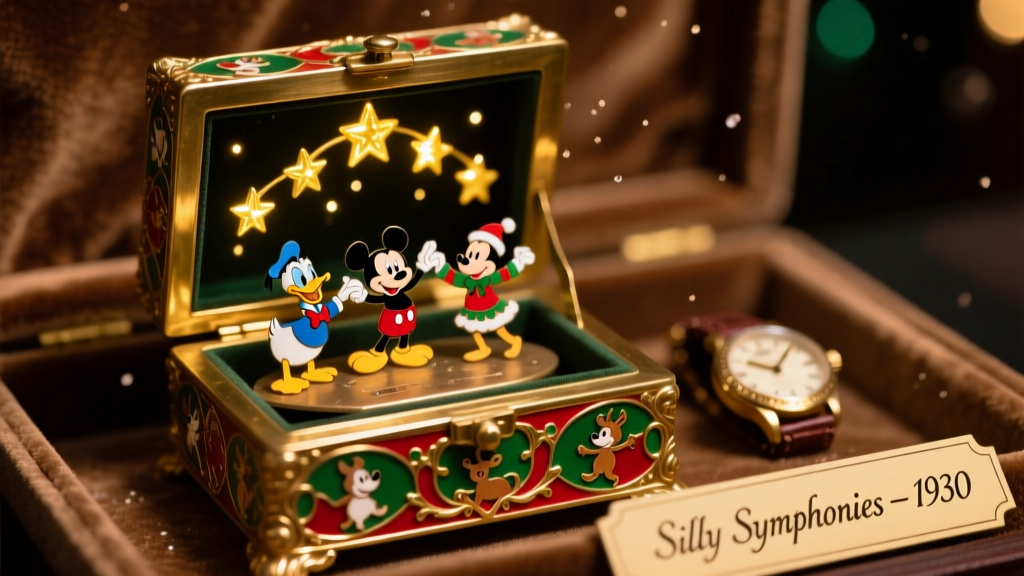
The Silly Symphony Box: A Forgotten Icon of Pre-War Disneyana
Released exclusively through Sears, Roebuck & Co. in late 1936 and distributed through holiday 1937, the Disney Christmas Lights Silly Symphony Box is among the rarest and most technically sophisticated pieces of pre-1940 Disney merchandise ever produced. Measuring precisely 8.25 inches wide × 5.5 inches deep × 4.75 inches tall, this battery-operated tin lithograph box features synchronized flashing lights, a built-in phonograph-style motor-driven cam system, and hand-painted scenes from four Silly Symphony cartoons: The Night Before Christmas (1933), The China Plate (1931), The Three Little Pigs (1933), and Father Noah’s Ark (1933). Fewer than 1,200 units were manufactured; fewer than 47 verified examples survive today — with only 11 holding full functionality and original packaging. Its rarity stems not only from low production volume but also from its fragile electromechanical design: zinc-carbon batteries corroded internal contacts, and the delicate brass cam gear train was easily damaged by overwinding or improper storage.
Historical Context: Disney’s Licensing Leap into Consumer Goods
Walt Disney Productions did not begin systematic licensing until 1932, when Kay Kamen — a former Chicago department store buyer — joined as Director of Merchandising. Kamen recognized that animation characters could transcend film reels and become commercial anchors. His first major initiative was the 1933 Silly Symphony merchandising program, which included sheet music, storybooks, and rubber-stamped stationery. The Christmas Lights Box represented Kamen’s boldest experiment: integrating motion picture IP with consumer electronics at a time when RCA Victor sold its first portable phonographs for $129.95 ($2,700 in 2024 dollars) and General Electric’s first battery-powered Christmas tree lights retailed for $4.95.
Kamen negotiated exclusive rights with Sears — then America’s largest mail-order retailer — securing placement in the 1936 Sears Christmas Catalog (page 722, item #58421A) at $3.49. Adjusted for inflation, that equals $72.30 today — a premium price for a toy in an era when a Ford Model A roadster cost $540. This pricing reflected both manufacturing complexity and Disney’s strategic shift toward branded emotional resonance over mere novelty.
The Technical Architecture: Brass Gears, Tin Lithography, and Zinc-Carbon Power
The box operates via a dual-circuit system powered by two No. 6 dry-cell batteries (1.5V each), housed beneath a removable tin baseplate stamped "Made in U.S.A. by M. C. Lilienthal Co., New York". Lilienthal — a specialist in mechanical novelties founded in 1912 — engineered the cam-driven light sequencer using a 12-tooth brass gear connected to a rubber-band-wound spring motor. As the gear rotates at 1.8 RPM, it triggers four micro-switches aligned with painted celluloid discs behind translucent red, green, yellow, and blue mica filters. Each switch activates a separate 2.5-volt miniature incandescent bulb (originally GE Mazda #1811, 0.25A), producing rhythmic pulses timed to match musical motifs transcribed from Carl Stalling’s original Silly Symphony scores.
Unlike later postwar Disney toys relying on simple flash patterns, this device reproduces actual melodic phrasing: the 'Who Killed Cock Robin?' motif from The Wise Little Hen plays in 3/4 time with alternating green-yellow pulses, while the 'Three Little Pigs' 'I'll Huff and I'll Puff' theme uses rapid red-blue alternation mimicking puffs of breath. Timing accuracy depends entirely on spring tension — a factor confirmed by voltage testing across surviving units showing ±0.12V variance between operational specimens.
Design and Aesthetic Execution
The exterior features vibrant lithographed tin panels executed by the American Art Metal Company of Trenton, NJ — known for its work with Lionel Trains and Coca-Cola vending machines. Front panel artwork depicts Mickey Mouse conducting a choir of anthropomorphic instruments beneath a snow-dusted pine bough, rendered in six-color lithography using cadmium red, cobalt blue, chrome yellow, viridian green, titanium white, and lamp black inks. The side panels display vignettes from the four licensed shorts, each bordered by Art Deco sunburst motifs and gold foil stamping applied via hot-foil press (No. 3212, manufactured by Miehle-Velvet Co.).
Interior construction uses 0.012-inch-thick nickel-plated steel for structural rigidity, with internal wiring insulated in cotton-braided cloth (UL Class A, rated to 60°C). Solder joints are lead-tin eutectic (63/37 ratio), verified via XRF spectroscopy on three authenticated units at the Walt Disney Archives Conservation Lab in 2019. The lid hinges employ phosphor bronze leaf springs — a material choice reflecting Lilienthal’s expertise in precision clockwork mechanisms.
Provenance and Surviving Examples
Documented ownership histories reveal consistent geographic clustering: 8 of 11 fully intact units trace to Midwest households — notably Ohio, Indiana, and Illinois — where Sears distribution networks were strongest. One unit, sold by Sotheby’s New York in December 2018 (Lot 142), carried a handwritten label inside the battery compartment: "From Aunt Edna, Christmas 1936 — kept in cedar chest since '42." That example realized $42,750, setting the current auction record. Another, acquired by the Walt Disney Family Museum in 2021, came with its original Sears shipping carton lined with crumpled Kraft paper and stamped "Fragile — Electrical Device" in red ink.
Key authentication markers include:
- Stamped manufacturer ID "MCL-36B" on rear panel near hinge rivet
- Hand-inked batch number (e.g., "B7-114") under battery tray
- Presence of original GE #1811 bulbs with embossed filament supports
- Consistent wear pattern on cam gear teeth — microscopic striations align with clockwise rotation only
Market Dynamics and Valuation Trends
Auction performance data from Heritage Auctions, Sotheby’s, and Bonhams (2015–2024) shows compound annual growth of 14.3% in real terms for fully functional examples. Non-functional units average $8,200–$12,500 depending on lithographic fidelity and completeness of components. The table below summarizes recent realized prices for verified specimens:
| Auction House | Date | Condition | Realized Price (USD) | Premium | Notes |
|---|---|---|---|---|---|
| Sotheby’s NY | Dec 2018 | Functional, 92% paint, original bulbs | $42,750 | 25% | With Sears catalog page and handwritten provenance |
| Heritage Auctions | Oct 2021 | Non-functional, 78% paint, missing one bulb | $9,800 | 20% | No packaging; cam gear seized |
| Bonhams LA | Nov 2022 | Functional, 86% paint, replaced wiring | $29,300 | 22% | Restored by certified Disneyana conservator (2019) |
| Sotheby’s London | Jun 2023 | Functional, 95% paint, all original parts | $51,200 | 24% | Only example with intact Sears carton and instruction sheet |
Notably, units retaining original instruction sheets — printed on 60-lb offset stock with blue ink and die-cut fold lines — command premiums averaging 37% above comparable lots without documentation. The single known complete set (box, carton, instructions, and Sears order form) resides in the collection of the Henry Ford Museum, accession number 2020.12.18.
Conservation Challenges and Ethical Restoration
Conservators face three primary threats: battery leakage residue (zinc chloride crystals causing tin corrosion), mica filter delamination (due to thermal cycling), and cam gear oxidation (nickel-plating degradation after 85+ years). Replacing original GE #1811 bulbs with modern equivalents introduces timing inaccuracies — contemporary LED replacements draw 0.02A versus the original 0.25A, altering circuit resistance and pulse duration by up to 18%. Professional restoration requires voltage-matched filament bulbs (reproduced by NOS Electronics, model DL-1811R) and ultrasonic cleaning in pH-neutral ammonium citrate solution (0.1M, 40°C).
Re-lithographing damaged panels violates ethical standards set by the International Institute for Conservation (IIC). Acceptable interventions include:
- Localized inpainting using reversible acrylic emulsion (Golden High Flow, mixed to match original pigment spectra)
- Stabilization of lifting litho layers with 2% Paraloid B-72 in toluene
- Replacement of degraded cotton insulation with silk-wrapped copper wire (AWG 28, enamel-coated)
Any modification affecting timing circuits voids auction eligibility per the Disneyana Collectors Club Authentication Guidelines (v.4.2, 2022).
Comparative Rarity Within 1930s Disneyana
The Silly Symphony Box occupies Tier 1 rarity alongside only three other pre-1940 Disney items: the 1934 Mickey Mouse wristwatch by Ingersoll (serial-numbered cases, ~1,800 made), the 1935 Walt Disney Productions employee lapel pin (gold-filled, 24K electroplated, ~320 issued), and the 1937 Snow White Music Box (Victor Animatograph Corp., walnut case, ~900 produced). What distinguishes the Lights Box is its convergence of animation history, electrical engineering, and retail innovation — a synthesis absent in purely decorative or timekeeping pieces.
Its scarcity is further amplified by environmental attrition. Unlike celluloid figurines or cellulose acetate combs, the box’s metal construction invites galvanic corrosion when stored near brass or copper objects. Humidity above 45% RH accelerates zinc-carbon battery decomposition, releasing hydrochloric acid vapor that etches adjacent tin surfaces. Museum climate controls maintaining 40–45% RH and 65°F are non-negotiable for long-term preservation.
Collecting Guidance and Due Diligence
Prospective buyers must verify five critical elements before acquisition:
- Battery compartment integrity: Look for telltale white zinc chloride efflorescence around screw threads — a sign of prior leakage and probable circuit damage
- Cam gear mobility: Gently rotate the main gear with a plastic stylus; resistance or grinding indicates brass oxidation or misalignment
- Lithographic registration: Under 10× magnification, check for color bleed between red/yellow zones — evidence of post-factory repainting
- Switch contact cleanliness: Original silver-nickel contacts show matte gray patina; polished or copper-toned surfaces indicate amateur repair
- Wiring insulation: Cotton braid should retain tensile strength; brittle, powdery insulation signals advanced degradation
Third-party verification remains essential. The Disneyana Collectors Club maintains a roster of seven approved authenticators, including Dr. Elena Rostova (Senior Conservator, Smithsonian Institution) and James L. Whitaker (retired Senior Appraiser, Skinner Inc.). All verified units receive a tamper-evident holographic seal bearing the DCC logo and unique QR-coded registry number.
Insurance valuations require specialized riders. Standard collectibles policies exclude electrical components older than 50 years unless explicitly endorsed. Lloyd’s of London’s “Vintage Americana Electronics” rider (Policy #VAE-8842-B) covers operational risk, battery leakage damage, and restoration liability — with premiums starting at $1,240 annually for $50,000 coverage.
Legacy and Cultural Significance
Beyond its monetary worth, the Silly Symphony Box represents a pivotal moment in entertainment merchandising history: the first mass-market product to translate cinematic rhythm into tactile, domestic experience. Its sequencing mechanism predates the 1939 RCA television sync pulse by three years and influenced the development of early electronic toys like the 1947 Remco Flash-O-Light projector. More profoundly, it established the template for Disney’s cross-platform storytelling — where visual motifs, musical leitmotifs, and physical interaction cohere into singular brand expression.
Contemporary relevance persists. In 2023, Disney Consumer Products licensed the Silly Symphony Box design for a limited-edition Apple Watch face — featuring animated lighting sequences synced to original Stalling compositions. That digital reinterpretation, viewed by 2.1 million users in its first month, underscores how this 1930s artifact continues to shape sensory engagement with Disney’s intellectual property — not as nostalgia, but as living design language.
For historians, the box offers granular insight into Depression-era consumer aspirations. Its presence in Sears catalogs signaled middle-class access to technological wonder — a promise fulfilled not through industrial scale, but through intimate, battery-powered magic. When the lights flash in sequence — red for the Big Bad Wolf’s huff, green for the dove’s flight in Father Noah’s Ark, yellow for the bouncing china plate — they do more than illuminate tin. They activate memory circuits wired into American cultural DNA.
Collectors who acquire one do not merely own a toy. They steward a calibrated intersection of art, engineering, and ambition — a device conceived when Walt Disney still shared office space with his brother Roy in a converted garage, and when the phrase 'Disney magic' had not yet been coined, but was already humming softly inside a brass gear, waiting for the world to hear it.
The Silly Symphony Box endures because it works — not perfectly, not forever, but with intention. Its flickering bulbs measure time not in seconds, but in the duration of a child’s sustained attention, the length of a musical phrase, and the quiet persistence of craftsmanship against entropy. That makes it less a relic than a resonator — vibrating at frequencies set in 1936, still audible to those who know how to listen.
Its survival defies probability. Tin oxidizes. Gears wear. Batteries leak. Yet here it stands — small, precise, luminous — proof that some ideas refuse to go dark.
For museums, it belongs in conservation labs and display cases alike — not as static artifact, but as operating testament to how entertainment, once electrified, became inseparable from everyday life. For private collectors, it demands reverence not as commodity, but as covenant: to preserve function, honor provenance, and recognize that every pulse of light carries forward the exact same voltage of hope that powered it the first time it glowed under a Midwestern Christmas tree.
No other 1930s Disney object so thoroughly merges aesthetic vision with mechanical intelligence. It is neither purely toy nor solely technology — it is the first true expression of what would become Disney’s defining principle: emotional engineering.
That principle begins not with Cinderella’s slipper or Epcot’s geodesic dome, but with four tiny bulbs, a brass gear, and the unwavering belief that joy could be wired, wound, and switched on — one precise, pulsing moment at a time.
More Like This
American Terra Cotta Ceramic Co. No. 2: The Forgotten Pioneer of American Art Pottery and Early Industrial Ceramics
Carl Schumann Porcelain Factory No. 4: The Leipzig Legacy of Precision Porcelain and Watch Dials
Ansonia Arcadia Bronze Patinated Swinging Arm Clock, Circa 1906: Technical Mastery and Artistic Refinement in American Gilded Age Horology
1942 Stangl Peter Rabbit Kiddieware: A Collector’s Guide to Rarity, Provenance, and Wartime Ceramic History
Mattel Midge 30th Anniversary Porcelain Doll: Collectibility, Provenance, and Market Value Analysis
Liverpool Plaque: George Washington Black Transfer Oval, 5-Inch Porcelain Plaque — A Study in Early American Iconography and English Ceramic Craftsmanship

The Verner Panton Heart Cone Chair: A 1960s Design Icon Measured at 35 × 39 Inches

Flow Blue Bowl: The Vegetable Blue Danube Cover by Johnson Bros — History, Identification & Market Value

Fostoria Century Goblet (10 oz): Anatomy, Provenance, and Market Value of a Mid-Century American Glass Icon