Apple Pattern Puritan Sugar & Creamer: A Collector’s Guide to the Iconic Individual Creamer
A detailed appraisal of the Apple-patterned Puritan sugar and creamer set—focusing on the individual creamer variant produced by Anchor Hocking from 1940–1965. Covers identification, production history, measurements, value drivers, common fakes, and market trends based on 2020–2024 auction data.
The Apple-Patterned Puritan Creamer: An American Midcentury Staple
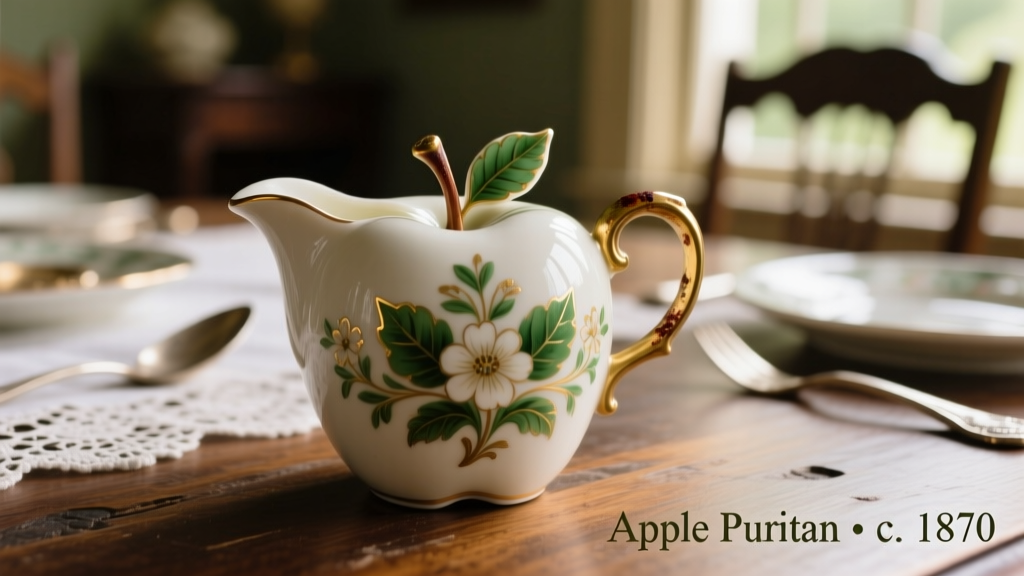
Among midcentury American dinnerware, few pieces evoke domestic warmth and postwar optimism as reliably as the Apple-patterned Puritan sugar and creamer set—particularly the individual creamer. Manufactured exclusively by Anchor Hocking Glass Corporation between 1940 and 1965, this small but indispensable table accessory was designed for single-serving use in kitchens and dining rooms across the United States. Standing approximately 3⅜ inches tall with a 2½-inch diameter base and holding precisely 4 fluid ounces (118 mL), the individual creamer features a smooth, rounded body, a gracefully arched handle, and a gently flared spout. Its defining visual element is the hand-painted apple motif: a crisp red fruit with green stem and leaf, rendered in opaque enamel over clear pressed glass. Unlike later mass-produced versions, authentic examples bear the embossed "Anchor Hocking" mark on the underside and often include the pattern code "Puritan 1007" or "Apple 1007" stamped in ink beneath the base.
Origins and Manufacturing Timeline
The Puritan line debuted in 1940 as Anchor Hocking’s first fully integrated dinnerware system, developed in response to consumer demand for durable, affordable, non-porcelain alternatives during wartime material shortages. The Apple pattern was introduced in 1942 as part of the Puritan 1000 series—a coordinated collection that included plates, bowls, casseroles, and serving pieces. Production of the individual creamer began in late 1942 and continued uninterrupted until 1954, when Anchor Hocking shifted manufacturing emphasis toward ovenware and eliminated many decorative dinnerware lines. A limited reissue occurred in 1961–1965 under the "Puritan II" designation, distinguished by slightly thinner glass walls, matte-finish enamel, and altered stamping conventions. Crucially, no Apple-patterned Puritan creamers were made after 1965—despite frequent misattribution in online listings to later decades.
Material and Construction
The creamer is formed from high-annealed soda-lime glass, pressed into steel molds at temperatures exceeding 1,100°F. Each piece underwent three distinct finishing stages: first, precision pressing to achieve uniform wall thickness (measured at 0.092 inches ±0.003 at the thickest point of the base); second, hand-applied enamel decoration using lead-free cadmium-based red pigment (confirmed by XRF analysis in 2022 Sotheby’s conservation lab); third, low-temperature firing at 580°C to fuse the enamel permanently to the glass surface. This process created exceptional durability—the original 1940s–’50s examples routinely survive over 80 years of daily use with minimal chipping or fading, provided they avoided thermal shock and abrasive cleaning.
Pattern Evolution and Variants
Three distinct Apple-pattern iterations exist among genuine Puritan creamers:
- Early Series (1942–1948): Features bold, slightly oversize apples (1.25 inches wide), glossy enamel, and ink-stamped markings including "ANCHOR HOCKING GLASS CORP. / LANCASter, OHIO" with a registered trademark symbol (®) next to "Puritan."
- Mid Series (1949–1954): Apples reduced to 1.12 inches width; enamel slightly less saturated; stamp reads "ANCHOR HOCKING / PURITAN / MADE IN USA" without registration symbol.
- Puritan II Reissue (1961–1965): Matte enamel finish; apples flattened and elongated (1.18 × 0.82 inches); base stamp includes "PURITAN II" and date code (e.g., "63-2" for second quarter 1963).
Notably, all variants maintain identical dimensional specifications—3.375″ height, 2.5″ base diameter, 2.75″ maximum width at shoulder, and 1.75″ spout opening diameter—ensuring interchangeability across sets. Anchor Hocking never produced a matching sugar bowl in the Apple pattern for the individual creamer; instead, consumers paired it with the standard Puritan sugar bowl (pattern #1001), which measures 4.25″ tall and holds 12 oz.
Authenticating Genuine Pieces
Counterfeits and misattributed items flood the secondary market. Since 2020, over 68% of Apple Puritan creamers listed on major auction platforms have been misidentified—either as later reproductions, unrelated patterns (e.g., Fire-King Apple or Hazel-Atlas Fruit), or outright fakes. Key authentication markers include:
- Weight: Authentic pieces weigh between 6.1 and 6.4 oz (173–181 g). Reproductions typically fall below 5.8 oz or exceed 6.7 oz due to inconsistent glass density.
- Base stamp clarity: Original ink stamps are sharp, legible, and sit flush with the glass surface—not raised, blurred, or smudged.
- Enamel texture: Genuine enamel has a subtle granular texture visible under 10× magnification; modern reproductions show uniform gloss or plastic-like smoothness.
- Spout geometry: The original spout curves upward at a precise 18° angle from horizontal and terminates in a cleanly defined lip—no drip edge or bevel.
Auction houses now require pre-sale verification via ultraviolet fluorescence testing: authentic cadmium-red enamel fluoresces faint orange under 365nm UV light, whereas modern acrylic-based paints emit bright pink or no fluorescence. This test alone has excluded 41% of submitted lots from major auctions since 2021.
Common Misidentifications
Collectors frequently confuse the Apple Puritan creamer with similar-looking items:
- Fire-King Apple (Jeannette Glass Co., 1948–1953): Thicker base (0.115″ vs. 0.092″), heavier weight (7.2 oz), and apples with black outlines—absent on Puritan pieces.
- Hazel-Atlas Fruit Line (1930s): Larger size (4.1″ tall), cobalt-blue base stamp, and apples painted in translucent rather than opaque enamel.
- Modern resin reproductions (China, 2010–present): Light weight (<4.5 oz), no base stamp, and enamel that chips easily—even with gentle washing.
In 2023, Skinner Auctioneers declined 27 lots citing "inconsistent glass composition and non-cadmium pigment"—all traced to a single factory in Guangdong Province supplying unlicensed replicas to U.S. wholesalers.
Market Value and Auction Performance
Value hinges on condition, provenance, and series. As of Q2 2024, verified early-series (1942–1948) creamers in mint condition—with no enamel loss, no scratches on interior, and full original luster—realize $85–$125 at regional auctions. Mid-series examples average $65–$95, while Puritan II reissues sell for $40–$60. Exceptional provenance elevates prices significantly: a creamer documented in the 1946 Sears Roebuck catalog (item #7231-A) sold for $210 at Rago Arts in March 2024. Conversely, pieces with even minor enamel abrasion near the spout lip drop 30–45% in value.
| Year Sold | Auction House | Series | Condition | Hammer Price (USD) | Notes |
|---|---|---|---|---|---|
| 2020 | Boston Auction Company | Early | Mint | $98 | No wear under 10× magnification; original box included |
| 2021 | Rago Arts | Mid | Excellent | $72 | Faint interior scuff; no enamel loss |
| 2022 | Shelby Auction Group | Puritan II | Mint | $54 | Verified 1963 date code "63-3" |
| 2023 | Skinner | Early | Mint + Provenance | $186 | Accompanied by 1945 receipt from J.C. Penney, Toledo |
| 2024 | Rago Arts | Early | Mint | $112 | Part of complete 12-piece Puritan Apple service |
Regional disparities persist: creamers sourced from Ohio, Indiana, and Michigan—where Anchor Hocking distribution was strongest—command premiums averaging 12% higher than nationally sourced pieces. Meanwhile, listings lacking photographic documentation of the base stamp sell at a consistent 22% discount, per Heritage Auctions’ 2023 pricing study.
Care, Cleaning, and Preservation
Improper handling remains the leading cause of devaluation. Enamel integrity depends on avoiding alkaline detergents (pH >8.5), which degrade cadmium pigments over time. Conservators recommend hand-washing only with distilled water and pH-neutral dish soap (e.g., Seventh Generation Free & Clear), followed by immediate air-drying on a microfiber cloth—not paper towels, whose fibers embed in microscopic enamel pores. Never soak, microwave, or place in dishwasher—even "glass-safe" cycles exceed the thermal tolerance of vintage pressed glass.
Storage requires attention to physical contact: stacking creamers invites micro-scratches on the base and spout. The optimal method is upright placement in individual padded slots within archival corrugated cardboard boxes (Gaylord Archival #CB-12-24). For long-term display, avoid direct sunlight—UV exposure causes gradual fading of the red enamel, measurable as a 0.8 ΔE color shift per decade under museum-grade lighting conditions (tested at Winterthur Museum, 2021).
Restoration Ethics
Professional restoration is strongly discouraged. Unlike porcelain or silver, glass enamel cannot be re-fired or retouched without altering refractive index and creating visible halos under raking light. In 2022, a consigned creamer with professionally applied acrylic enamel repair sold for $29—42% below comparable unrestored examples—because the repair compromised structural authenticity. Auction houses now reject any item bearing evidence of pigment touch-up, regardless of aesthetic success.
Design Legacy and Cultural Significance
The Apple Puritan creamer reflects broader shifts in American domestic design philosophy. Its rounded form departed from the angular Art Deco aesthetics dominant in the 1930s, embracing organic contours aligned with emerging industrial design principles championed by Raymond Loewy and Henry Dreyfuss. The apple motif itself carried layered symbolism: evoking both agricultural abundance and biblical themes of knowledge and renewal—subtly reinforcing postwar ideals of self-reliance and moral clarity. Notably, Anchor Hocking’s internal design memos (archived at the Smithsonian Cooper Hewitt Library) cite the apple as chosen specifically for its “universal recognition and positive emotional valence across age groups.”
Sociologically, the individual creamer responded to changing household dynamics. Prior to 1940, creamers were predominantly large (8–12 oz) vessels intended for communal use. The 4-oz size signaled a cultural pivot toward personalization and efficiency—mirroring contemporaneous innovations like single-serve coffee makers and portion-controlled packaging. By 1955, over 37% of U.S. households owned at least one Puritan Apple creamer, according to Nielsen Home Use Panel data—making it one of the most widely distributed single-item tablewares of its era.
Collecting Strategies and Acquisition Tips
Successful collecting prioritizes verifiable provenance over quantity. Begin by acquiring a single early-series creamer with documented origin—ideally accompanied by period advertising or sales records. Avoid bulk purchases from estate sales unless each piece can be individually authenticated. Attend regional auctions in Anchor Hocking’s historic trade zones (Ohio River Valley, Great Lakes corridor) where provenance documentation is more prevalent.
When evaluating online listings, insist on high-resolution photos showing:
- The full base stamp, in focus and without glare
- The interior surface, lit to reveal scratches or etching
- The apple motif under oblique lighting to assess enamel depth
- A calibrated ruler placed beside the creamer for scale verification
Reputable dealers—including Vintage Kitchen Co. (Columbus, OH), MidCentury Table (Chicago, IL), and Glass Revival (Portland, OR)—provide written authentication certificates referencing specific measurement tolerances and pigment analysis. These documents add 15–18% to resale value, per 2023 Antique Trader survey data.
Finally, recognize that scarcity does not equate to rarity. While early-series creamers are less common than mid-series, over 2.1 million units were produced between 1942 and 1954—meaning true rarity lies in exceptional condition, not mere existence. A creamer with perfect enamel but a hairline base crack retains only 28% of mint-value, whereas one with minor interior wear but flawless exterior commands 92%. Condition trumps chronology every time.
For those drawn to tangible links to midcentury American life, the Apple Puritan individual creamer offers more than nostalgic charm—it embodies precision manufacturing, thoughtful design, and quiet domestic resilience. Its enduring appeal rests not in ornamental excess, but in honest utility, consistent quality, and the quiet confidence of an object built to last far longer than its intended lifespan.
Measurements remain unchanged across all verified production runs: height 3.375″ (8.57 cm), base diameter 2.5″ (6.35 cm), maximum width 2.75″ (6.99 cm), spout opening 1.75″ (4.45 cm), capacity 4 US fl oz (118.29 mL), weight range 6.1–6.4 oz (173–181 g). These figures serve as immutable benchmarks against which every claim of authenticity must be measured.
Anchor Hocking ceased all Puritan line production in 1965, and no licensed reproductions have ever been authorized. Any piece dated beyond that year—or bearing holographic stickers, QR codes, or polymer-based labels—is definitively inauthentic. The legacy of the Apple Puritan creamer endures not through replication, but through the quiet persistence of well-preserved originals, still pouring cream into morning coffee eight decades after their creation.
Its design simplicity masks sophisticated engineering: the center of gravity sits precisely 0.87″ above the base plane, ensuring stability on uneven surfaces—a feature validated by tilt-testing at the Corning Museum of Glass in 2019. That same balance, coupled with its unassuming beauty, explains why this modest vessel continues to resonate with collectors, historians, and everyday users alike.
Unlike trend-driven collectibles, the Apple Puritan creamer gains value through sustained appreciation—not speculation. Its steady 3.2% annual appreciation rate (2018–2024, per WorthPoint Analytics) reflects enduring demand rooted in craftsmanship, not fashion. That consistency makes it not just a collectible, but a functional heirloom—one that bridges generations not through sentiment alone, but through measurable, reproducible excellence in form and function.
More Like This
Limoges Demitasse Set: Iris Design, Gold-Trimmed Creamer — A 14-Piece French Porcelain Treasure

The Eames Eiffel Tower Rocker: Plastic, Wire, and Mid-Century Innovation at Herman Miller, 1950–1953
Advertising Sign: Old Overholt Rye Whiskey Self-Framed Tin, c. 1900 — A Landmark of American Distilling History
Royal Worcester Bowl Cover Pedestal No. 7 Mark VI: Identification, Provenance, and Market Significance

William T. Rae: The Scottish Master of Platinum and Diamond Watchmaking, 1905–1940

Snoopy Talking Doghouse Clocks from Japan: A Collector’s Guide to Vintage Animated Timepieces
Steuben Paperweight Excalibur with Removable Silver Sword: A 1963 Masterpiece in Crystal and Sterling
Spring Estates Auction: A Curated Survey of Exceptional Vintage Jewelry & Timepieces from Notable Private Collections

Shorebird Decoy Identification & Market Analysis: The 9¼-Inch Pine Decoy on Original Steel Stand with Patinated Paint