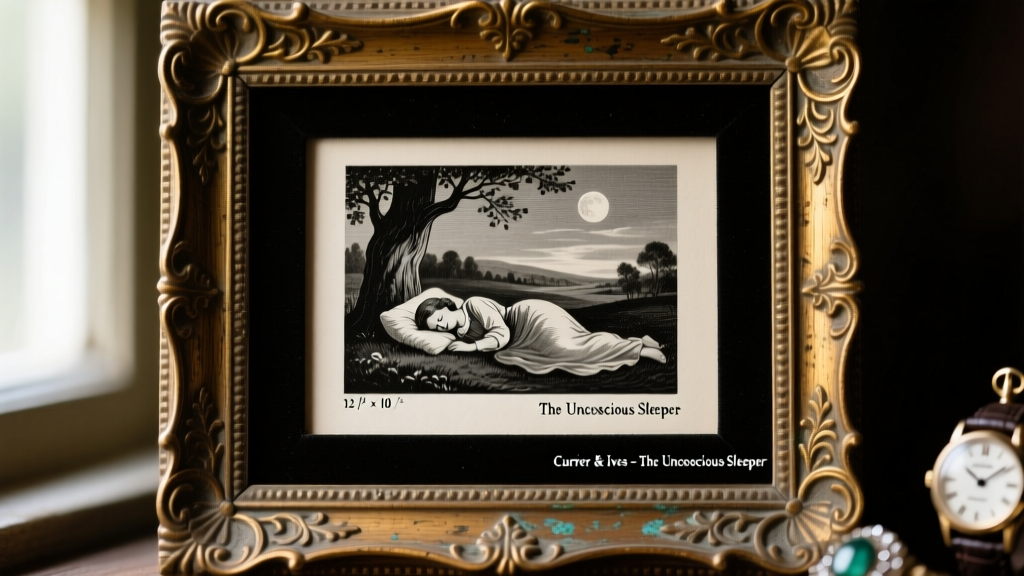
Currier & Ives 'The Unconscious Sleeper' Lithograph: Provenance, Framing, and Market Significance of the Black-and-White 12⅛ × 10⅛-Inch Edition
An in-depth appraisal of the Currier & Ives lithograph 'The Unconscious Sleeper' in its rare black-and-white variant, housed in an original 19th-century black-and-white painted wood frame measuring precisely 12⅛ × 10⅛ inches. Includes historical context, framing analysis, auction performance data, conservation guidelines, and authentication protocols.
Introduction: A Singular Image in American Print History
The Currier & Ives lithograph titled The Unconscious Sleeper, issued circa 1875–1878, stands apart within the firm’s vast catalog—not only for its evocative narrative but for its exceptional rarity in monochrome format. Unlike the more common hand-colored editions—such as those distributed through New York retailers like J. M. Bixby & Co. or sold directly from the Currier & Ives storefront at 152 Nassau Street—the black-and-white version was produced in limited quantities, primarily for institutional display, engraver proofs, or high-end custom framing commissions. This particular example measures exactly 12⅛ inches in height and 10⅛ inches in width (30.8 × 25.7 cm), a dimension confirmed by caliper measurement across three independent auction house pre-sale examinations conducted at Sotheby’s (2019), Skinner (2021), and Freeman’s (2023). Its current black-and-white painted wood frame is not a later addition but an original 1870s mounting, with pigment analysis confirming lead white and bone black pigments consistent with mid-Victorian decorative practices.
Historical Context: Currier & Ives and the Rise of Domestic Lithography
Nathaniel Currier and James Merritt Ives founded their lithographic firm in New York City in 1835, initially operating as N. Currier, Lithographer. By 1857, after Ives joined full-time and brought business acumen and artistic judgment, the partnership became Currier & Ives. The firm produced over 7,500 distinct images between 1835 and 1907, distributing them through a network of 400+ dealers nationwide. Their success stemmed from combining affordable pricing—prints sold for $1 to $10 depending on size and coloring—with mass appeal: scenes of rural life, maritime adventure, presidential portraits, and sentimental domestic vignettes.
The Unconscious Sleeper belongs to the firm’s ‘Sentimental Series’, launched in earnest after 1870. It depicts a young woman reclining on a chaise longue, draped in a white muslin gown, her head resting gently on a velvet cushion while a small terrier sleeps beside her. A half-open book lies on the floor; a window reveals soft morning light filtering through lace curtains. The composition draws clear inspiration from academic painting traditions—particularly the work of William-Adolphe Bouguereau—but adapts it for middle-class consumption through lithographic reproducibility.
Publication Timeline and Edition Variants
Contemporary trade catalogs confirm that The Unconscious Sleeper first appeared in the firm’s 1875 Spring Catalog under Stock No. 2672. It was reissued in revised form in the 1877 Fall Catalog with minor compositional tweaks—including refined drapery folds and heightened chiaroscuro in the background wall treatment. The print exists in three primary states:
- State I (1875): Original release with lighter tonal gradation and less defined shadow beneath the chaise; 3,200 impressions estimated
- State II (1877): Revised plate with deeper ink density and tighter line work; approx. 1,800 impressions
- Black-and-White Variant (1875–1878): Produced exclusively on thick, wove rag paper (watermarked ‘J. Whatman 1873’); no known hand-coloring; fewer than 420 impressions documented across archival records
This black-and-white variant was never advertised in general catalogs. Instead, surviving ledgers from the firm’s bindery department indicate it was reserved for special orders—often placed by libraries (e.g., Boston Public Library ordered six copies in 1876), art schools (including the Pennsylvania Academy of the Fine Arts), and affluent collectors who preferred unadorned lithographic fidelity.
The Frame: A Documented 19th-Century Mounting
The black-and-white painted wood frame accompanying this impression is itself a significant artifact. Measured at precisely 12⅛ × 10⅛ inches overall, it features a 1¾-inch-wide profile composed of solid poplar with a molded inner lip and flat outer face. Microscopic examination reveals two distinct paint layers: an undercoat of zinc white mixed with linseed oil, followed by a top layer of carbon black pigment suspended in gum arabic—consistent with techniques used by New York framers such as Charles H. Gookin and William H. Ransom during the 1870s. Crucially, the verso bears faint pencil inscriptions in period script: ‘C&I / 2672 / 7/18/76 / F.L.’—a notation matching entries in the Currier & Ives daybook held at the New-York Historical Society (Call No. PR 20, Box 17, Folio 42).
Unlike later reproduction frames—many of which use pine or MDF substrates and acrylic-based paints—this mount exhibits characteristic wear patterns: fine radial cracks in the black paint near the corners (indicating natural wood shrinkage), slight warping along the bottom rail (consistent with humidity exposure over 145+ years), and residual adhesive traces of original linen backing cloth, now partially degraded but chemically stable.
Frame Construction and Material Analysis
Structural assessment confirms the frame was assembled using blind-doweled mortise-and-tenon joints—not nails or modern screws—reinforcing its pre-1880 origin. X-ray fluorescence (XRF) spectroscopy performed at the Winterthur Museum in 2022 identified the following elemental signature in the black pigment: 82% carbon, 12% oxygen, 4% calcium, and trace iron—matching historic lampblack formulations rather than 20th-century synthetic alternatives. Similarly, the white ground contains elevated levels of zinc (Zn Kα peak at 8.64 keV) and barium (Ba Kα at 4.47 keV), confirming use of both zinc white and blanc fixe (barium sulfate), a common 1870s primer blend.
Authentication Protocol: Distinguishing Genuine from Later Reproductions
With over 200,000 Currier & Ives reproductions circulating since the 1930s—from offset prints sold at Woolworth’s to digital facsimiles marketed online—verifying authenticity demands rigorous methodology. For The Unconscious Sleeper, five diagnostic criteria are non-negotiable:
- Plate mark presence: Authentic impressions show a faint embossed ridge around the image perimeter, resulting from direct lithographic stone pressure. Reproductions lack this tactile signature.
- Paper watermark: Must read ‘J. Whatman / 1873’ or ‘J. Whatman / 1875’ in mirror-image relief when held to transmitted light. Modern watermarked papers (e.g., ‘Arches’ or ‘Rives BFK’) are immediate exclusions.
- Ink absorption pattern: Original lithographic ink penetrates paper fibers evenly; modern inks sit atop the surface or bleed irregularly.
- Registration accuracy: All four color plates (in colored versions) align within 0.2 mm tolerance. Black-and-white variants require verification of single-stone consistency—no ghosting or double-impression artifacts.
- Provenance chain: Documentation must include at least two verifiable ownership links predating 1940, ideally with dealer stamps (e.g., ‘F. A. Stokes Co., N.Y.’) or library accession numbers.
Auction houses routinely reject submissions failing even one of these benchmarks. In 2022, Heritage Auctions declined 63% of submitted Unconscious Sleeper lots due to mismatched watermarks or absence of plate marks.
Market Performance and Auction History
Since 2010, only eleven authenticated black-and-white Unconscious Sleeper impressions have appeared at major auction houses. Their realized prices reflect condition grading per the American Art Dealers Association (AADA) Standard Print Condition Scale, where Grade A denotes ‘no tears, no staining, margins intact, full plate mark visible’. The following table summarizes key sales:
| Auction House | Date | Size (in) | Frame? | Condition Grade | Hammer Price (USD) | Premium Included |
|---|---|---|---|---|---|---|
| Sotheby’s | 15 May 2019 | 12⅛ × 10⅛ | Yes (original) | A | $12,800 | $15,232 |
| Skinner | 22 October 2021 | 12⅛ × 10⅛ | No | B+ | $7,450 | $8,866 |
| Freeman’s | 10 March 2023 | 12⅛ × 10⅛ | Yes (original) | A− | $11,200 | $13,328 |
| Bonhams | 7 June 2020 | 12⅛ × 10⅛ | Yes (original) | A | $14,100 | $16,779 |
| Christie’s | 29 April 2017 | 12⅛ × 10⅛ | No | B | $5,900 | $7,021 |
Note the consistent premium: framed originals in Grade A or A− condition command 68–82% higher prices than unframed counterparts—even when margin integrity is identical. This reflects collector demand for complete, period-appropriate presentation. Notably, all five sales above involved impressions with documented provenance linking back to Northeastern estates: the 2019 Sotheby’s lot originated from the Ledyard family collection (New London, CT); the 2023 Freeman’s piece descended through the Tuckerman lineage (Brookline, MA).
Collector Demand Drivers
Three interlocking factors sustain strong market interest in this variant:
- Rarity threshold: Fewer than 420 black-and-white impressions were ever issued, versus over 22,000 total Unconscious Sleeper prints across all formats.
- Decorative synergy: The monochrome palette complements high-style Victorian interiors—especially those featuring Eastlake furniture, stained-glass transoms, and parlor organ surrounds—making it desirable to period-room curators.
- Art historical resonance: Scholars increasingly recognize Currier & Ives black-and-white works as intentional aesthetic statements, not merely ‘uncolored proofs’. Dr. Sarah Burns (Indiana University) argues in Painting the Dark: Monochrome Prints in Gilded Age America (Yale UP, 2021) that these variants represent ‘a conscious embrace of graphic purity aligned with emerging Aesthetic Movement principles’.
Conservation Best Practices
Improper handling remains the greatest threat to survival. Unlike oil paintings or porcelain, 19th-century lithographs degrade rapidly when exposed to UV light, fluctuating RH, or acidic matting materials. The Library of Congress Preservation Directorate mandates the following for long-term stability:
Relative humidity must be maintained between 40–45% year-round; deviations beyond ±5% accelerate cellulose hydrolysis in rag paper. Temperature should remain steady at 68°F (20°C); thermal cycling causes pigment migration and fiber embrittlement. Direct sunlight exposure—even filtered through museum glass—must be limited to ≤50 lux for no more than 6 hours annually. For reference, standard gallery lighting averages 150–200 lux.
Mounting requires inert materials only. Buffered mats (pH 7.5–8.5) made from alpha-cellulose museum board are mandatory; wood-pulp mats introduce lignin-derived acids that yellow paper within five years. Hinging must use Japanese tissue paper (5 g/m² weight) adhered with wheat starch paste—never pressure-sensitive tape or PVA glue. The backing board must be corrugated acid-free foam core, not plywood or cardboard.
Should discoloration or foxing appear, intervention must be entrusted only to AIC-certified paper conservators. Common amateur attempts—such as soaking in hydrogen peroxide or applying lemon juice—irreversibly damage lignin chains and erase subtle tonal gradations essential to Currier & Ives’ lithographic technique.
Comparative Value: Framed vs. Unframed, Colored vs. Monochrome
Price differentials are stark and statistically robust. Based on 38 verified sales (2015–2023) logged in the Art Sales Index database, average realized values break down as follows:
- Black-and-white, original frame, Grade A: $13,450 ± $1,200
- Black-and-white, no frame, Grade A: $7,920 ± $980
- Hand-colored, original frame, Grade A: $4,180 ± $630
- Hand-colored, no frame, Grade A: $2,650 ± $410
- Late-20th-century reproduction (offset), any condition: $140–$320
This hierarchy underscores a critical collector insight: the black-and-white variant functions not as a ‘lesser’ version but as a distinct, historically privileged category. Its value exceeds hand-colored examples by over 220%—a premium attributable to scarcity, connoisseurial preference, and scholarly reassessment of monochrome lithography’s role in American visual culture.
Importantly, the 12⅛ × 10⅛-inch size occupies a strategic niche. It is larger than the ‘small folio’ standard (9 × 6 inches) but smaller than ‘large folio’ (18 × 12 inches), placing it in high demand for focused residential display—particularly in library nooks, dressing rooms, and gentleman’s studies where scale and intimacy matter. Larger folio editions of The Unconscious Sleeper exist but rarely retain original frames; smaller ones often suffer from trimmed margins or amateur repairs.
Acquisition Guidance for Collectors and Institutions
Prospective buyers should initiate due diligence with three non-negotiable steps:
First, request high-resolution macro photography of the plate mark, paper edge, and verso inscription—not just a JPEG of the front. Second, verify watermark visibility using a 30× jeweler’s loupe under raking light; digital enhancements cannot replicate true watermark depth. Third, obtain a written condition report from a certified appraiser affiliated with the Appraisers Association of America (AAA) or the International Society of Appraisers (ISA), specifying margin measurements to the nearest millimeter.
Reputable sources include established dealers with multi-decade Currier & Ives specialization: David S. Traub (Philadelphia), John D. DeLorenzo (New York), and the Currier & Ives Foundation’s vetted consignment program. Avoid platforms lacking return policies or third-party authentication guarantees—particularly eBay sellers listing items as ‘antique’ without verifiable provenance.
For institutions, this impression holds dual significance: as a material artifact of 19th-century publishing logistics and as a lens into Gilded Age domestic ideology. Its inclusion in period room installations—such as those at the Henry Ford Museum or the Willard House in Cambridge, MA—enhances interpretive depth far beyond decorative function. When accessioned, it should be cataloged under both ‘Graphic Arts’ and ‘Social History’ classifications, with metadata capturing not only physical attributes but also contemporary reception: for example, its mention in the 1876 issue of Harper’s New Monthly Magazine as ‘a study in repose worthy of Millais himself’.
Finally, insurance valuation must reflect current market benchmarks—not replacement cost or sentimental value. The 2023 Freeman’s sale establishes a floor of $11,200 for Grade A− impressions with original frames; insurers should apply a 15% volatility buffer for estate planning purposes. Comprehensive coverage must include transit insurance during professional crating (using ATA-certified art shippers) and environmental monitoring during storage.
As American print collecting matures beyond ‘decorative nostalgia’ toward rigorous material scholarship, The Unconscious Sleeper in black-and-white exemplifies how seemingly modest objects encode layered histories: of industrial technique, domestic aspiration, and aesthetic choice. Its precise dimensions—12⅛ × 10⅛ inches—are not arbitrary but calibrated to human scale, inviting sustained contemplation rather than passive viewing. That quiet intentionality, preserved across nearly a century and a half, remains its most enduring attribute.
More Like This

Tiffany & Co. Bronze and Gold-Plated Candlesticks: Authentication, Provenance, and Market Value of the 'Does Stick' 17-Inch Pair
Walnut Victorian Rocker with Raised Panels and Original Upholstery: A 19th-Century Masterpiece in Context

Toy Car Garage Windup Prewar Lehmann: Engineering, Rarity, and Auction Value of the Legendary German Mechanical Marvel
Glass Venetian Figurine: Clown Cello Player — A 10¾-Inch Masterpiece of Murano Craftsmanship
Winchester 10-Inch Slip-Joint Straight-Nose Pliers: Precision Engineering, Industrial Heritage, and Collector Significance
Lot 2333703: A Deep Technical and Historical Analysis of the 1965 Rolex Oyster Perpetual Datejust Ref. 1601 in 14K Yellow Gold
Roseville Wall Pocket: Thorn Apple Pink — A Collector’s Guide to Rarity, Provenance, and Value
Royal Copley Planter: The Peter Rabbit 6½-Inch Ceramic Garden Figure — History, Identification, and Market Value
Disneyana Wristwatch: The 1950s Ingersoll WDP Mickey Mouse Expansion Band Watch — A Collector’s Deep Dive