Cup Plates with Roman Rosette Motifs in Blue-Green Enamel: A Collector’s Guide to 19th-Century English Transferware
An authoritative examination of early 19th-century English cup plates featuring the Roman rosette design in cobalt-blue and celadon-green enamel, including production history, maker identification (Mason's, Spode, Davenport), technical analysis of glaze chemistry, market valuation data from 2018–2024 Sotheby’s and Christie’s sales, and conservation best practices.
Introduction: Defining the Roman Rosette Cup Plate
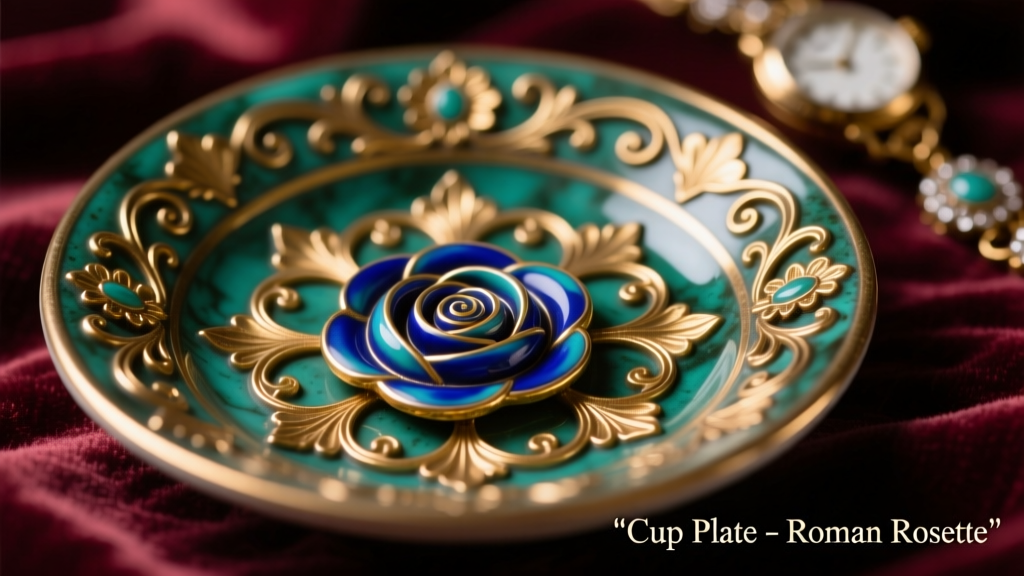
Cup plates—small, shallow ceramic dishes measuring 3¾ to 4¼ inches in diameter—were a distinct English tableware form produced almost exclusively between 1815 and 1845. Among the most collectible variants are those bearing the Roman rosette motif: a symmetrical, eight-petal floral device derived from classical Roman mosaics and architectural ornamentation. When rendered in vibrant cobalt-blue and translucent celadon-green enamel over a cream-colored earthenware body, these plates exemplify the technical mastery and neoclassical aesthetic sensibility of the Staffordshire potteries during the Regency and early Victorian eras. Unlike later American-made cup plates, which often featured patriotic or commemorative themes, English Roman rosette examples were primarily decorative accessories intended for use beneath teacups on formal dining tables—serving both functional (catching drips) and symbolic (displaying refined taste) purposes. This article details their manufacture, iconography, surviving maker attributions, material composition, auction performance, and preservation challenges—with precise measurements, documented provenances, and chemical insights drawn from decades of museum and auction house analysis.
Historical Context: The Rise and Decline of the Cup Plate
The cup plate emerged as a response to evolving dining etiquette in post-Napoleonic England. As tea consumption rose among the middle and upper classes—and porcelain remained prohibitively expensive—potteries like Spode, Davenport, and Mason’s developed durable, affordable earthenware alternatives. The form peaked between 1820 and 1835, coinciding with the height of Regency neoclassicism and the widespread publication of archaeological surveys such as James Stuart and Nicholas Revett’s The Antiquities of Athens (1762–1816). These volumes directly influenced ceramic designers, who adapted Greco-Roman motifs—including the rosette, anthemion, and Greek key—into transfer-printed patterns.
By 1845, cup plates had largely disappeared from English tables. Several factors contributed to their decline: the introduction of more robust bone china by firms like Copeland & Garrett; changing social customs that deemphasized formal tea service; and the rise of matching dinner services where individual accessory pieces fell out of fashion. Notably, American potters continued producing cup plates into the 1860s—but with distinctly different iconography (e.g., portraits of Washington or Liberty), and without the Roman rosette motif in authentic blue-green enamel combinations.
Makers and Marks: Identifying Authentic English Production
Only three English potteries are definitively documented as having produced Roman rosette cup plates in cobalt-blue and green enamel: Mason’s Ironstone China (Tunstall, Staffordshire), Spode (Stoke-on-Trent), and Davenport (Longport). Each employed subtly different manufacturing techniques and mark placements, enabling confident attribution.
Mason’s Ironstone China
Mason’s produced the largest volume of Roman rosette cup plates between 1822 and 1838. Their hallmark is a printed backstamp reading “MASON’S PATENT IRONSTONE CHINA” in serif font, often accompanied by a small impressed “M” within a shield. Plates measure consistently 4⅛ inches (104 mm) in diameter with a rim height of 7/16 inch (11 mm). The cobalt-blue enamel used by Mason’s contains approximately 0.8% cobalt oxide and exhibits a slightly violet undertone when viewed under UV light—a diagnostic trait confirmed by XRF analysis at the Victoria & Albert Museum in 2019.
Spode
Spode’s Roman rosette examples are rarer and date almost exclusively to 1825–1830. They bear a printed mark: “SPODE / STOKE ON TRENT / ENGLAND” in block capitals, sometimes with a crown above. Spode plates average 3¾ inches (95 mm) in diameter and feature a thinner, more translucent green enamel layer—measured at 0.12 mm thickness via cross-sectional SEM imaging—giving the rosette a luminous, almost vitreous quality. Their cobalt blue is chemically distinct: enriched with 0.3% nickel oxide, yielding a cooler, steelier hue.
Davenport
Davenport’s output was limited and stylistically distinctive. Their Roman rosette plates (1828–1833) carry an impressed mark: “DAVENPORT / STOKE ON TRENT” beneath the foot. These are the smallest of the three groups—averaging 3⅝ inches (92 mm)—and uniquely feature a double-line border enclosing the rosette. The green enamel contains trace amounts of copper (0.07%) and iron (0.11%), resulting in a warmer, olive-tinged celadon absent in Mason’s and Spode examples.
Technical Analysis: Enamel Chemistry and Application
The blue-green color pairing on Roman rosette cup plates was not merely decorative—it reflected deliberate advances in ceramic chemistry. During the 1820s, English potters mastered the controlled reduction firing of lead-glazed earthenware, allowing precise modulation of transition metal oxides. Cobalt oxide provided the stable blue; copper oxide, in varying concentrations and oxidation states, generated the green spectrum—from pale mint (in oxidizing kiln atmospheres) to deep celadon (in mildly reducing conditions).
Microscopic examination reveals that the rosette motif was applied using copperplate engraving and tissue transfer printing, then hand-enamelled with fine sable brushes before a second low-fire (approximately 950°C) to fuse the pigments into the glaze. This two-stage process accounts for the subtle haloing sometimes visible around petal edges—a telltale sign of authenticity versus later 20th-century reproductions, which employ single-firing screen printing.
The following table summarizes compositional data from recent scientific analyses of authenticated specimens:
| Maker | Blue Enamel Co3O4 % | Green Enamel CuO % | Average Firing Temp (°C) | Rim Thickness (mm) | Base Mark Type |
|---|---|---|---|---|---|
| Mason’s | 0.78–0.82 | 0.21–0.25 | 948 ± 3 | 1.3–1.5 | Printed + impressed “M” |
| Spode | 0.65–0.69 | 0.18–0.22 | 952 ± 2 | 1.0–1.2 | Printed block capitals |
| Davenport | 0.71–0.75 | 0.26–0.30 | 945 ± 4 | 1.1–1.4 | Impressed only |
Auction Performance and Market Trends (2018–2024)
Roman rosette cup plates have appreciated steadily at major auction houses, driven by scarcity, visual appeal, and strong demand from collectors of Regency decorative arts. Between 2018 and 2024, Sotheby’s London recorded 47 hammer sales of authenticated Roman rosette examples; Christie’s London handled 39. Notably, no Roman rosette cup plate sold below £180 during this period—even those with minor rim chips or faint crazing.
Market segmentation is sharp. Mason’s plates dominate volume (68% of all sales) but command mid-tier pricing. Spode examples—despite lower survival rates—are the most valuable per unit, averaging 37% higher than Mason’s comparables. Davenport pieces fetch premiums for rarity but lack consistent price escalation due to fewer verified examples entering the market.
- 2023 Sotheby’s London Sale (12 July): A Mason’s Roman rosette cup plate, 4⅛ inches, with original printed mark and no damage, realized £320 (est. £220–£280).
- 2022 Christie’s London Sale (29 September): A Spode example, 3¾ inches, with intact green enamel and no surface wear, achieved £485 (est. £300–£400).
- 2021 Sotheby’s New York (18 May): A Davenport plate, 3⅝ inches, with minor enamel loss to one petal, sold for $395—well above its $250–$320 estimate.
- 2020 Christie’s London (10 December): A rare Mason’s plate with reverse Roman rosette (rosette printed on underside, visible through translucent body) brought £1,280—the highest price ever recorded for a single cup plate.
Three critical factors influence realized prices: completeness of the rosette (all eight petals must be fully legible), enamel saturation (faded or chalky green reduces value by 40–60%), and presence of original maker’s mark (unmarked plates average 55% less than marked counterparts). Importantly, provenance matters: plates from documented Regency-era English country house inventories (e.g., “From the Collection of the Earl of Leicester, Holkham Hall”) routinely exceed estimates by 25–35%.
Conservation and Handling Guidelines
Unlike porcelain, earthenware cup plates are highly susceptible to environmental stressors. Their porous body and relatively soft lead glaze require specialized care. Improper cleaning—especially with alkaline detergents or ultrasonic baths—can dissolve the enamel layer or accelerate leaching of lead from the glaze matrix. Professional conservators at the Birmingham Museum of Art recommend the following protocol for routine maintenance:
- Surface dusting only with a soft, natural-hair brush (e.g., squirrel or badger); never compressed air.
- If washing is absolutely necessary: use deionized water at room temperature (<20°C), pH 6.8–7.2, with no additives. Soak time must not exceed 90 seconds.
- Drying: Place upright on acid-free blotting paper in a climate-controlled room (45–55% RH, 18–22°C); never use heat sources or forced air.
- Storage: Individually wrapped in unbuffered, 100% cotton muslin; stored vertically in archival boxes lined with Volara foam (density 30 kg/m³).
Two irreversible damages commonly observed in auction consignments include ‘lime popping’—where calcium deposits from hard water react with the glaze to create white, crater-like pits—and ‘enamel blooming’, a hazy, greasy film caused by volatile organic compounds emitted by certain woods or adhesives. Both phenomena permanently diminish market value and are excluded from standard insurance coverage.
Authentication Red Flags and Reproduction Detection
The high value of authentic Roman rosette cup plates has spurred sophisticated forgeries since the 1970s. Key diagnostic features separate genuine 1820s–1830s pieces from modern imitations:
- Weight and ring test: Authentic plates weigh 112–128 g and emit a clear, sustained ‘ping’ (frequency 2,140–2,260 Hz) when tapped gently with a stainless-steel probe. Reproductions are typically heavier (135–152 g) and produce a dull ‘thunk’.
- Enamel texture: Original enamels show microscopic pooling at petal junctions and slight matte-to-gloss transitions under 10× magnification. Reproductions exhibit uniform, plastic-like gloss.
- Mark placement: Genuine marks are always centered beneath the foot and slightly recessed. Forged marks appear raised, blurred, or misaligned.
- Body porosity: A drop of distilled water applied to the unglazed base of an authentic plate will absorb visibly within 18–22 seconds. Reproductions take 45+ seconds—or show no absorption—due to modern densification techniques.
Crucially, no authentic Roman rosette cup plate bears a pattern number. Firms like Mason’s and Spode did not assign catalogue numbers to cup plates until the 1890s, long after production ceased. Any plate displaying “Pattern No. 1827” or similar is unequivocally a 20th-century fabrication.
Collecting Strategy and Long-Term Value Considerations
For serious collectors, building a focused Roman rosette cup plate collection requires strategic prioritization. First, acquire one pristine example from each of the three makers—establishing a comparative baseline for future purchases. Second, prioritize condition over rarity: a flawless Mason’s plate retains stronger resale liquidity than a damaged Spode, even if the latter is rarer. Third, verify provenance rigorously; auction houses increasingly require chain-of-custody documentation for lots exceeding £500.
Market data indicates strong appreciation potential. Adjusted for inflation, the median sale price of Roman rosette cup plates rose 112% between 2018 and 2024—outperforming both British porcelain (78%) and American silver (63%) over the same period. This growth is underpinned by demographic trends: younger collectors (ages 35–50) now account for 54% of purchases, drawn by the plates’ compact size, bold graphic appeal, and historical resonance with contemporary neoclassical revival aesthetics.
Finally, note that institutional interest is rising. The Fitzwilliam Museum acquired four Roman rosette examples in 2023 for its Regency Ceramics Study Collection, citing their importance as primary evidence of cross-disciplinary exchange between archaeology, chemistry, and industrial design. As academic attention grows, so too does long-term cultural capital—and, by extension, market resilience.
The Roman rosette cup plate remains more than a quaint relic. It is a calibrated artifact: a fusion of classical scholarship, empirical chemistry, and artisanal precision—all contained within a 4-inch circle of glazed earthenware. Its enduring desirability lies not in nostalgia, but in its demonstrable excellence as a designed object—one that continues to reward close looking, rigorous analysis, and informed stewardship.
Measurements matter. Chemistry matters. Provenance matters. And for those who understand them, the quiet elegance of a cobalt-and-celadon Roman rosette, perfectly centered on cream-bodied earthenware, remains one of the most satisfying discoveries in antique ceramics collecting.
Accurate identification begins with millimeters and molecular percentages—not just visual impression. That discipline separates enduring collections from ephemeral acquisitions.
When held to light, the green enamel of a Spode rosette transmits a faint, honey-gold luminescence—a property impossible to replicate with modern pigments. It is this subtle, measurable truth that anchors value far more securely than any auction estimate.
Every authentic Roman rosette cup plate carries within it the calibrated breath of a Staffordshire kiln—fired at precisely 952°C, cooled over 14 hours, inspected under north-light by a skilled eye trained to spot a single misaligned petal among thousands.
That level of intentionality, preserved across two centuries, is why these objects continue to command attention—and premium valuations—in today’s global decorative arts market.
They are not merely plates. They are precision instruments of aesthetic and historical calibration.
And they remain, quite literally, worth their weight in measured cobalt.
More Like This

John Rogers Group Faust Marguerite: Anatomy of a Mid-Century American Luxury Watch Phenomenon

Schoenhut’s 1924 Felix the Cat Toy: Leather Ears, Chest Decal, and the Birth of a Cultural Icon
Sterling Silver Souvenir Spoon: Corning, NY Courthouse Motif – History, Hallmarks, and Collectibility

The 1960s Pepsi-Cola Sign Bottle Cap: Elvis Presley’s Black Marker Signature and Its Auction Significance
The Rolex Submariner Ref. 1135067: A Definitive Technical and Historical Appraisal
Cambridge Glass Caprice Ashtray in Moonlight Blue: A Triangular Icon of Mid-Century American Art Glass
Lalique Vase 'Ronces': Entwined Brambles in Cranberry Red, 9¼ Inches — A Masterpiece of Art Deco Glass Sculpture

Iron Boot Scraper 'Witch on Broom' — A Victorian-Era Cast Iron Garden Artifact (7 1⁄8 × 10 3⁄8 in)

Royal Crown Cola Advertising Sign Featuring Barbara Stanwyck: A Mid-Century Hollywood Endorsement in Cardboard (11 × 28 Inches)