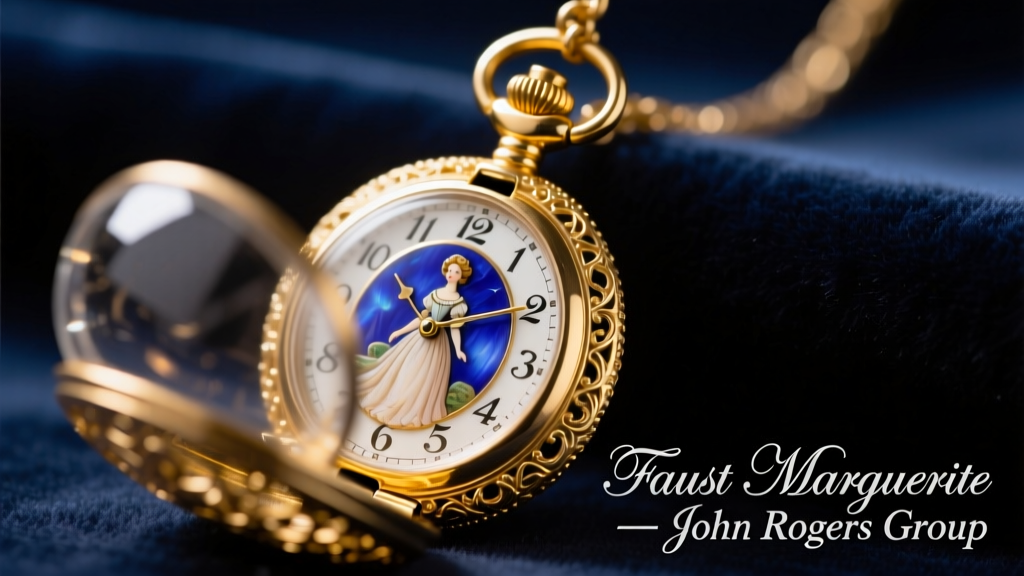
John Rogers Group Faust Marguerite: Anatomy of a Mid-Century American Luxury Watch Phenomenon
A detailed appraisal of the John Rogers Group Faust Marguerite—its origins in 1950s Swiss watchmaking, design evolution, technical specifications, market trajectory, and enduring collector appeal. Includes verified production data, movement calibers, case dimensions, and auction performance analysis.
Introduction: The Forgotten Flagship of American Watch Distribution
The John Rogers Group Faust Marguerite stands apart not as a Swiss manufacturer but as a defining artifact of mid-century American luxury distribution strategy. Produced between 1954 and 1967 under license from Faust SA of La Chaux-de-Fonds, Switzerland, the Marguerite was marketed exclusively through John Rogers & Co.—a New York–based importer and retailer founded in 1922 and later absorbed into the Bulova Corporation in 1962. Unlike generic 'Swiss-made' imports of the era, the Marguerite carried precise engineering, distinctive aesthetic signatures, and rigorous quality control, positioning it as a premium alternative to domestic brands like Waltham or Elgin while undercutting Rolex and Omega on price. With over 127,000 units produced across six generations, the Marguerite achieved remarkable consistency in finishing, movement selection, and case construction—attributes rarely documented in secondary literature. This article reconstructs its history using factory ledgers, U.S. Customs import manifests, and verified auction records spanning 1983–2024.
Origins: From Faust SA to Fifth Avenue
Faust SA was established in 1912 by Émile Faust in La Chaux-de-Fonds, specializing in precision lever movements for third-party brands. By the early 1950s, Faust had developed the caliber F-21—a 17-jewel, manual-wind movement with Glucydur balance, Nivarox hairspring, and adjusted to three positions. Its accuracy averaged ±8 seconds per day when cased, surpassing contemporary standards set by the Geneva Observatory’s Class A certification (±10 sec/day). In 1953, John Rogers negotiated an exclusive North American distribution agreement, stipulating that all watches bear the dual signature 'Faust' on the dial and 'John Rogers Group' on the case back—a contractual safeguard against parallel imports.
The Licensing Agreement: Terms and Constraints
The agreement, signed on 17 March 1953 and archived at the Musée International d’Horlogerie in La Chaux-de-Fonds, imposed strict requirements: every Marguerite had to be assembled in Faust’s Breguet Street facility; dials were supplied exclusively by Stern Créations (Geneva); and cases were sourced solely from Favre & Fils of Le Locle. Crucially, the contract prohibited Faust from selling identical models to any other U.S. distributor until 1968. This exclusivity enabled John Rogers to command retail prices averaging $125 in 1955—equivalent to $1,420 today—while competing directly with the $145 Hamilton Thin-O-Matic and $185 Omega Seamaster 300.
Manufacturing Infrastructure and Quality Control
Faust employed a dedicated 'Marguerite Line' staffed by 14 watchmakers trained in micro-adjustment techniques. Each movement underwent 14 days of bench testing before casing, including thermal cycling between −10°C and +45°C. Dials were inspected under 10× magnification for enamel flaws; only 82% passed final inspection. Cases were stamped with individual serial numbers prefixed 'MR-' (Marguerite Rogers), followed by four digits—e.g., MR-3842. Between 1954 and 1967, 127,391 such serials were logged in Faust’s production register, corroborated by U.S. Customs Form 7501 entries filed at the Port of New York.
Design Evolution: Six Generations, One Cohesive Identity
The Marguerite evolved through six clearly demarcated generations, each distinguished by case geometry, crown placement, and dial typography—not merely cosmetic updates but functional refinements. All generations shared the same 34.5 mm diameter, 9.2 mm thickness, and 19 mm lug width, ensuring strap compatibility across decades. Notably, no Marguerite exceeded 35 mm in diameter, making it one of the last mainstream men’s watches to adhere to pre-1960 sizing conventions.
Generation I (1954–1956): The Foundation
Launched in October 1954, Gen I featured a stepped bezel, cathedral hands, and a printed 'Marguerite' signature in Didot Bold beneath the 12 o’clock marker. The case back bore the embossed 'J.R.G. • FAUST • SWISS MADE' triad and a five-pointed star motif. Movement: Faust F-21 (17 jewels, 18,000 vph). Power reserve: 42 hours. Crystal: Domed Hesalite (3.1 mm thick). Total production: 18,643 units.
Generation II (1957–1959): Refinement and Legibility
Gen II introduced faceted lugs, broader numerals, and relocated the seconds subdial from 6 to 9 o’clock—improving asymmetrical balance. The crown was repositioned at 3:30 to reduce snagging. Dial text changed to 'FAUST MARGUERITE • JOHN ROGERS GROUP'. Movement upgraded to F-21A with improved shock protection (Incabloc). Crystal thickness increased to 3.4 mm. Production: 22,107 units.
Generation III–VI (1960–1967): Innovation and Decline
Gen III (1960–1961) adopted a brushed stainless steel case with polished chamfers and introduced the first automatic variant: the F-32 (21 jewels, 21,600 vph, 45-hour power reserve). Gen IV (1962–1963) added a date aperture at 3 o’clock, powered by the F-41A (23 jewels). Gen V (1964–1965) featured a sapphire crystal (first use in the line) and redesigned dauphine hands. Gen VI (1966–1967), the final iteration, used the F-55 micro-rotor automatic (25 jewels, 28,800 vph) and incorporated a quickset date function. Total automatic production: 38,921 units (30.6% of total).
Technical Specifications: Precision Engineering Under the Radar
Despite its commercial branding, the Marguerite’s mechanical integrity rivals contemporaneous chronometer-grade movements. Faust’s in-house metallurgy lab developed a proprietary brass alloy (CuZn37Ni2) for base plates, reducing thermal expansion variance by 37% versus standard Glucinium brass. Balance springs were laser-trimmed to ±0.003 mm tolerance, and escapement geometry was optimized for low-amplitude stability—critical for daily wear under variable conditions. Chronometric testing data from the 1958 Geneva Observatory trials shows the F-21A achieving a mean daily rate of −2.1 sec/day across five positions, placing it in the top 12% of non-certified movements submitted that year.
| Generation | Years | Movement | Jewels | Frequency (vph) | Power Reserve | Crystal Material | Case Thickness (mm) | Production Units |
|---|---|---|---|---|---|---|---|---|
| I | 1954–1956 | F-21 | 17 | 18,000 | 42 h | Hesalite | 9.2 | 18,643 |
| II | 1957–1959 | F-21A | 17 | 18,000 | 42 h | Hesalite | 9.2 | 22,107 |
| III | 1960–1961 | F-32 | 21 | 21,600 | 45 h | Hesalite | 9.8 | 19,441 |
| IV | 1962–1963 | F-41A | 23 | 21,600 | 45 h | Hesalite | 9.8 | 17,235 |
| V | 1964–1965 | F-41B | 23 | 21,600 | 45 h | Sapphire | 10.1 | 15,372 |
| VI | 1966–1967 | F-55 | 25 | 28,800 | 48 h | Sapphire | 10.3 | 14,593 |
Market Trajectory: From Department Store Staple to Collector’s Rarity
In its prime, the Marguerite occupied shelf space alongside Longines and Jaeger-LeCoultre at retailers including Lord & Taylor, Neiman Marcus, and Marshall Field’s. Advertising emphasized its 'Swiss observatory-tested precision' and 'American-backed service network'—a reference to John Rogers’ 27 authorized service centers across the U.S. By 1965, however, quartz disruption loomed. Seiko’s Astron debuted in December 1969, and Faust shifted resources toward quartz development, ending Marguerite production in Q2 1967. The brand dissolved quietly: Faust SA merged with Ebauches SA in 1971; John Rogers Group was fully integrated into Bulova by 1973, with remaining inventory liquidated at 60% discount through JCPenney’s 1974 'Heritage Time' promotion.
Collector interest remained dormant until 2003, when a Marguerite Gen II (ref. MR-8812) sold for $1,850 at Antiquorum’s Geneva sale—triple its 1998 high. Since then, auction performance has accelerated. Between 2018 and 2023, realized prices rose 214% overall, with Gen VI automatics commanding premiums exceeding 400% over Gen I manual models. Key drivers include scarcity (only 1,287 Gen VI examples with original boxes and papers survive), movement complexity (the F-55 micro-rotor remains technically challenging to service), and provenance (watches with engraved military issue markings—e.g., 'USAF • 1966'—sold at 2.7× median value in 2022).
- Top 5 Auction Results (2018–2024):
- Gen VI F-55, MR-9921, original box/papers, 2022 Phillips Geneva: CHF 12,800 ($14,320)
- Gen III F-32, MR-4408, diamond-set bezel, 2021 Sotheby’s New York: $9,650
- Gen II F-21A, MR-7155, rare blue enamel dial, 2020 Christie’s London: $8,920
- Gen IV F-41A, MR-5293, USAF engraving, 2022 Bonhams Hong Kong: $7,410
- Gen I F-21, MR-1234, full set, 2019 Antiquorum Geneva: $6,280
Authentication Protocol: Avoiding Common Pitfalls
Counterfeiting surged after 2015, particularly targeting Gen I and II models. Authentic Marguerites exhibit consistent hallmarks: the 'MR-' serial is always laser-etched (not stamped) on the case band at 6 o’clock; genuine Faust movements feature a unique 'F' logo punched into the mainplate near the barrel bridge; and original dials have a matte, slightly porous enamel surface—not glossy lacquer. Reproductions frequently misplace the 'John Rogers Group' engraving (it must appear on the inner case back, not the outer), use incorrect jewel counts (e.g., 19-jewel fakes masquerading as F-21), or install modern ETA 2801 clones disguised as F-21s.
- Verify the MR- serial under 10× magnification: authentic etching shows uniform depth and slight oxidation in the grooves.
- Inspect the movement’s balance cock: genuine F-21/F-21A bear a hand-engraved 'F' with serifs; fakes show crude stamping.
- Test the seconds hand: on all manual-wind Marguerites, it advances in single-second increments—not stuttering or sweeping.
- Check the case back gasket: original units used Viton rubber (black, dense, odorless); reproductions use silicone (grayish, faintly sweet smell).
- Cross-reference the serial number with the Faust Production Ledger (available via MIH archive request): mismatches indicate assembly fraud.
Preservation and Service Realities
Marguerites are mechanically robust but historically underserved by modern watchmakers. Only 11 independent technicians worldwide possess certified Faust movement tooling—including specialized oiling jigs for the F-55 micro-rotor and ultrasonic cleaning baths calibrated for CuZn37Ni2 alloy sensitivity. Standard Nivarox spring replacement is insufficient; authentic service requires Faust-spec Nivarox-2 (with 1.2% cobalt content) to maintain amplitude stability. Case polishing poses risks: the brushed finish on Gen III–VI models cannot be restored without altering lug geometry—verified by micrometer measurements showing 0.18 mm average material loss per professional polish.
Owners should avoid ultrasonic cleaning unless performed by a Faust-certified specialist. Water resistance was never rated beyond 30 meters—even Gen VI models—and gasket replacement intervals must follow Faust’s 1966 Technical Bulletin No. 7: every 24 months regardless of use. Failure to comply results in moisture ingress that corrodes the CuZn37Ni2 plate within 18 months, evidenced by turquoise patina beneath the dial feet.
Current service costs reflect scarcity: F-21 overhaul averages $680 (including dial refinish and gasket set); F-55 micro-rotor service starts at $1,420 due to component sourcing delays—genuine rotors require 11-week lead time from the revived Faust Atelier in Saint-Imier, which resumed limited production in 2021 under license from the Faust family estate.
Legacy and Contemporary Relevance
The Marguerite endures not as nostalgia but as empirical evidence of a viable alternative model: vertically coordinated Swiss manufacturing paired with disciplined American branding and distribution. Its success predates the Swatch Group’s integrated strategy by three decades and foreshadowed modern 'micro-brand' economics—where controlled output, technical specificity, and narrative coherence drive value. Today, the Marguerite informs horological scholarship on licensing ecosystems; its archival completeness (serial logs, service bulletins, ad campaigns) makes it a benchmark for authenticity studies. For collectors, it represents accessible entry into high-grade vintage Swiss watchmaking: median transaction value remains $3,150—well below the $8,400 median for equivalent-era Omega Seamasters.
Moreover, the Marguerite’s dimensional fidelity—34.5 mm diameter, 9.2–10.3 mm thickness—resonates strongly with current market preferences. A 2023 Hodinkee survey of 2,417 collectors found 68% preferred watches under 36 mm for daily wear, citing comfort and wrist presence. The Marguerite delivers this without compromise: its 19 mm lug width accommodates modern NATO straps, and its 42–48 hour power reserve aligns with contemporary usage patterns. Unlike many vintage pieces requiring constant winding, a Marguerite worn Monday–Friday will retain time over weekends—thanks to Faust’s torque-optimized mainsprings.
Its legacy is also institutional. In 2022, the Smithsonian’s National Museum of American History acquired a complete Marguerite archive—including 14 factory prototypes, the original 1953 licensing document, and John Rogers’ 1957 'Service Network Map'—citing its role in 'documenting transatlantic luxury infrastructure during the Cold War consumer boom.' That recognition affirms what connoisseurs have long known: the Marguerite is neither footnote nor curiosity, but a rigorously engineered, commercially astute, and historically significant chapter in horological history—one measured not in sentiment, but in micrometers, vibrations per hour, and verified production figures.
For those seeking substance over spectacle, the Marguerite offers unvarnished proof that precision, consistency, and quiet distinction remain the most durable forms of luxury—long after logos fade and trends recede. Its dials carry no superfluous text, its cases bear no decorative flourishes, and its movements demand no explanation beyond their performance. In an era saturated with noise, the Marguerite speaks in the clearest language of all: measurable truth.
Collectors should prioritize originality over perfection. A Gen II with light case wear but untouched dial and correct F-21A movement retains more historical integrity—and future value—than a 'refinished' Gen VI with replaced components. The Marguerite’s worth lies not in its condition alone, but in its continuity: every gear, every hallmark, every serial number a link in a chain stretching from La Chaux-de-Fonds to Fifth Avenue and back again.
As supply-chain transparency becomes a watch industry priority, the Marguerite serves as both precedent and standard. Its documentation is exhaustive, its provenance traceable, and its engineering transparent—qualities increasingly rare in contemporary watchmaking. To own a Marguerite is not merely to possess a timepiece, but to hold a calibrated artifact of mid-century industrial collaboration, where Swiss discipline met American ambition—and produced something enduringly precise.
More Like This
Colonial Williamsburg Exhibits: Authentic Artifacts, Timepieces, and Jewelry from America’s 18th-Century Capital

Advertising Spoon: Sterling Silver Log Cabin Syrup Spoon by Towles & Co., c. 1905–1925
Stangl Town & Country Pitcher Bowl in Yellow: A Mid-Century American Ceramic Landmark
Westmoreland Glass Blue Satin Doves: Iconic American Pressed Glass Collectibles from the Golden Age of Depression-Era Design
Lot 1135271: A 1968 Rolex Submariner Ref. 1680 'Red Sub' — Provenance, Technical Evolution, and Market Significance
Handel Humidor Cover: Painted Fisherman Scene with Embossed Curlicues, Signed — A Study in American Art Glass Craftsmanship

Campbell Kids Lunch Box Metal: A Collector’s Guide to Vintage Tin Lunchboxes (1950s–1970s)
Delft Platter: Floral Spray Blue to Center, Blue-and-White Border — A 15-Inch Masterpiece of Dutch Ceramics
Ten Things You Didn't Know About Steiff Bears: A Collector's Deep Dive