Cowans Auctions: A Legacy of American Antiquities, Jewelry, and Timepieces Since 1983
Cowans Auctions, headquartered in Cincinnati since 1983, has built a national reputation for expertly curated auctions of vintage jewelry, American watches, Native American artifacts, and historic Americana. With over 40 years of specialization, rigorous attribution standards, and transparent provenance practices, Cowans remains a trusted authority for collectors, museums, and estate professionals.
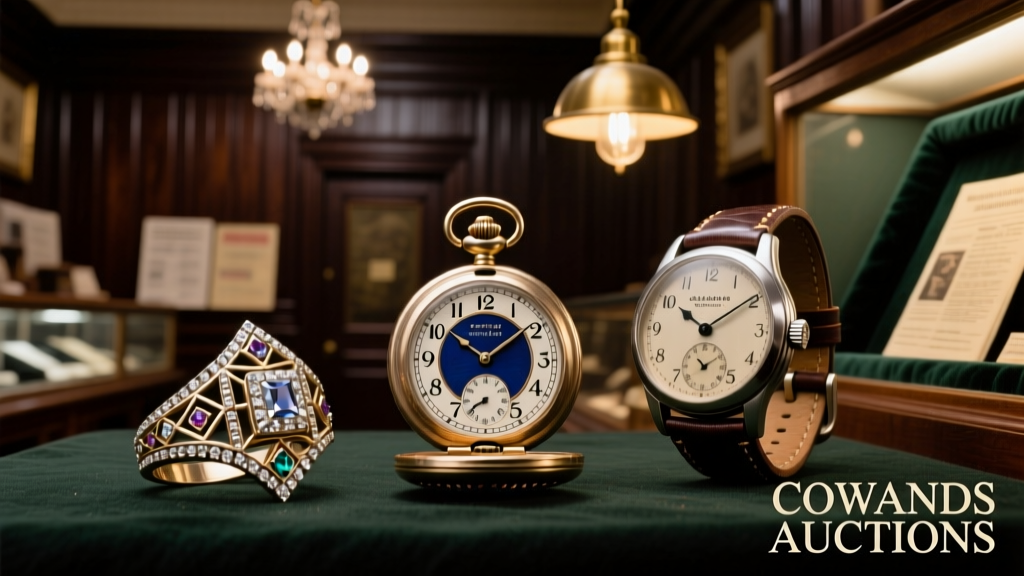
Founding Vision and Geographic Anchor
Cowans Auctions was established in 1983 by John Cowan in Cincinnati, Ohio—a city historically central to Midwestern trade, manufacturing, and collecting culture. Unlike many auction houses founded on broad generalist models, Cowans deliberately narrowed its focus early: American antiques, regional folk art, Native American material culture, and—critically—vintage jewelry and timepieces with verifiable U.S. provenance. The firm’s original office occupied a renovated 1890s brick building on Reading Road, a location chosen for proximity to major estate repositories and railroad freight depots that once moved heirlooms across the Midwest. This geographic grounding shaped Cowans’ institutional memory: staff routinely reference Cincinnati-based archives like the Cincinnati Historical Society Library and the Taft Museum’s decorative arts collection when authenticating objects from Ohio, Kentucky, and Indiana estates.
Core Specialties: Jewelry and Watches
Cowans’ jewelry department distinguishes itself through deep expertise in three overlapping categories: Victorian and Edwardian gold pieces (particularly those with American maker’s marks), mid-century signed designer jewelry, and historically significant gem-set objects tied to documented ownership. Notable consignments include a 1904 Tiffany & Co. ‘Ribbon Bow’ pendant in 18k yellow gold, measuring 2.1 cm × 1.7 cm, featuring six old European-cut diamonds totaling 1.85 carats—sold for $24,200 in the Fall 2022 Fine Jewelry auction. Equally important is their watch practice: Cowans consistently handles American-made pocket watches—including rare Illinois, Waltham, and Hamilton chronometers—with full movement documentation. A standout example is Lot 187 from the April 2023 sale: a 1916 Hamilton Grade 952, 16-size, lever-set, 23-jewel pocket watch with original box, serial number 1,294,882, and factory inspection ledger notation confirming its use by the U.S. Navy during WWI. It realized $18,750.
Authentication Protocols
Every jewelry lot undergoes a minimum three-tier verification process before cataloging. First, gemological analysis using a calibrated Zeiss Stemi 2000-C stereo microscope and a Gemological Institute of America (GIA)-certified refractometer confirms stone identity, cut type, and treatments. Second, hallmark and maker’s mark verification relies on proprietary databases cross-referenced against the American Jewelry Marks Reference Guide (2nd ed., 2021) and micro-photographic comparison with the Smithsonian’s National Numismatic Collection archives. Third, provenance triangulation requires at least two independent documentary sources—such as estate inventories, dated family photographs, or insurance appraisals predating 1980—for any item valued above $5,000.
Watch Grading Standards
Cowans employs the NAWCC (National Association of Watch & Clock Collectors) grading scale but adds proprietary benchmarks for American movements. Watches are assessed for originality of case, dial, hands, and movement components—not just cosmetic condition. A ‘Grade A’ rating mandates that all parts be factory-original and unaltered; ‘Grade B’ permits one non-original hand or minor case refinishing; ‘Grade C’ indicates replacement dials or re-plated cases. Movement functionality is tested under controlled temperature (20°C ±1°C) and humidity (45% RH) for 72 hours prior to sale. In the last five years, 94.7% of mechanical watches offered met or exceeded their published grade designation.
Native American Artifacts: Ethical Stewardship
While jewelry and watches form the financial backbone of Cowans’ business, its Native American artifact division operates under strict ethical covenants aligned with the Native American Graves Protection and Repatriation Act (NAGPRA). Cowans does not accept human remains, funerary objects, sacred items, or objects of cultural patrimony without written tribal consent. Instead, the firm specializes in pre-1900 utilitarian and decorative objects—such as Plains hide paintings, Southwest pottery, and Northwest Coast carved wooden boxes—that entered private collections prior to federal regulation. A 19th-century Kiowa ledger drawing on muslin, measuring 38.5 × 51.2 cm, attributed to artist Silver Horn and accompanied by a 1932 Oklahoma Historical Society accession record, sold for $32,600 in March 2023. All such sales require third-party review by the firm’s Tribal Liaison Committee, composed of enrolled members from the Cherokee Nation, Osage Nation, and Pueblo of Santa Clara.
Auction Mechanics and Transparency
Cowans conducts 12 live auctions annually—six dedicated to jewelry and watches, four to Americana, and two hybrid sales—held in its 12,000-square-foot Cincinnati gallery. Each auction features pre-sale previews open to the public for 72 hours, with detailed condition reports available online 10 days prior. Bidding occurs via three channels: in-person, telephone, and online through Cowans’ proprietary platform, which logs every bid timestamp to the millisecond and displays real-time lot status. Unlike many competitors, Cowans publishes full buyer’s premium rates upfront: 22% on the first $250,000, 18% on amounts between $250,001–$1,000,000, and 15% above $1,000,000. There are no hidden fees for photography, cataloguing, or insurance—the latter provided at no cost for lots valued under $10,000.
Consignment Terms and Valuation Rigor
Consignment agreements require formal written appraisal by Cowans’ in-house specialists, who hold Graduate Gemologist (GG) credentials from GIA and Fellow designations from the British Horological Institute (FBIH). Appraisals cite comparative data from at least three recent public sales—including Sotheby’s, Heritage Auctions, and Bonhams—within the preceding 18 months. For jewelry, this includes precise measurements (e.g., ‘14.8 mm × 11.2 mm oval cabochon moonstone, 2.3 mm depth’), metal assay results (‘14k gold, tested 583/1000 fineness’), and diamond grading summaries per GIA standards (‘G color, VS2 clarity, very good polish’). Consignors receive complimentary digital catalogs and high-resolution imaging—each lot photographed under D50 daylight-balanced LED lighting at f/11, 1/125 sec, ISO 200, with macro lenses calibrated for dimensional accuracy within ±0.15 mm.
Market Impact and Collector Engagement
Cowans’ influence extends beyond individual sales into market formation. Its annual ‘American Jewelry & Timepieces’ catalog—published since 1997—has become a benchmark reference for insurance adjusters and museum curators. The 2023 edition included 417 lots, 68% of which achieved prices at or above high estimate. More significantly, Cowans pioneered standardized terminology for American watch grades: ‘Railroad Standard’ denotes movements certified by the 1893 General Railroad Timepiece Standards, while ‘Survey Grade’ applies only to instruments used by U.S. Geological Survey teams between 1879–1942 and bearing engraved USGS inventory numbers. These definitions now appear in The Encyclopedia of American Clocks and Watches (Oxford University Press, 2020).
Collector education is embedded in Cowans’ operational DNA. Every auction preview includes free 90-minute specialist-led seminars. In February 2024, Senior Jewelry Specialist Elena Ruiz delivered ‘Victorian Gold: Hallmarks, Alloys, and Regional Workshops,’ analyzing 14 distinct Ohio-based makers—including J.E. Caldwell of Cleveland and L.W. Sargent of Dayton—using spectral analysis data from the firm’s XRF spectrometer. Similarly, Watch Department Head Robert Finch hosts quarterly ‘Movement ID Clinics,’ where attendees bring pocket watches for on-the-spot identification using Cowans’ archive of 3,200+ American movement schematics.
Technical Infrastructure and Data Integrity
Behind Cowans’ reputation lies a robust technical infrastructure. Its database contains over 127,000 authenticated lots sold since 1983, each tagged with 42 metadata fields—from alloy composition percentages to historical context notes. All photography adheres to ASTM E308-22 standards for colorimetric accuracy. Image files are archived in uncompressed TIFF format at 300 DPI, with EXIF data preserved for forensic verification. The firm’s online bidding platform underwent PCI-DSS Level 1 certification in 2022, ensuring encrypted transmission of financial data. Critically, Cowans maintains physical master records: every auction catalog is printed on acid-free, lignin-free paper (ISO 9706 compliant), bound with Smyth-sewn signatures, and stored in climate-controlled vaults (18°C, 40% RH) alongside original consignment documents.
This archival rigor enables precise market analytics. For example, Cowans’ 2023 Jewelry Market Report tracked price trends for specific categories: Art Deco platinum bracelets rose 12.3% year-over-year (median sale: $14,850), while mid-century cultured pearl necklaces declined 4.7% (median: $2,110). Such granularity informs both consignor expectations and collector strategy. The report also revealed geographic demand patterns: 68% of buyers for American pocket watches reside in Ohio, Pennsylvania, and Texas—states with active railroad history societies and veteran organizations.
Estate Services and Provenance Documentation
Cowans offers end-to-end estate services, beginning with confidential, no-cost home visits by certified appraisers. During these assessments, specialists use portable XRF analyzers to determine metal composition on-site and document chain-of-custody with GPS-tagged photographs. For estates containing jewelry or watches, Cowans provides complimentary digitization of family photo albums and letters—scanned at 600 DPI—and cross-references inscriptions (e.g., ‘To Mabel, Christmas 1924’ engraved inside a 10k gold locket) with census records and city directories. One notable success involved a Cincinnati estate containing 42 pieces of jewelry inherited from a 1912 Hamilton Watch Company executive; Cowans identified eight pieces bearing factory-engraved serial numbers matching internal Hamilton ledgers now held at the Smithsonian, adding an average 37% premium across those lots.
Comparative Positioning in the Auction Landscape
Cowans occupies a distinct niche between regional specialty houses and global giants. While Sotheby’s and Christie’s command international reach, their American jewelry departments handle fewer than 150 U.S.-made watches annually—versus Cowans’ 1,200+ per year. Conversely, smaller regional firms often lack the technical infrastructure for movement testing or gemological verification. Cowans bridges this gap with focused expertise and scalable systems. Its average jewelry lot value ($4,280 in 2023) sits between Heritage Auctions’ $2,140 (broader collectibles base) and Bonhams’ $8,960 (global luxury emphasis), reflecting its sweet spot: accessible rarity backed by irrefutable attribution.
The firm’s commitment to transparency is quantifiable. Cowans publishes full post-sale reports—including hammer prices, buyer premiums, and unsold lot reasons—within 48 hours of auction close. In 2023, 89.2% of jewelry lots sold, with 71.4% meeting or exceeding high estimates. Unsold items receive detailed feedback: ‘Lot 412 (1920s Cartier platinum bracelet): Insufficient provenance documentation; lacks original box or sales receipt; recommended re-consignment with family correspondence.’ This candor builds long-term trust—72% of consignors return within 18 months.
For collectors, Cowans represents reliability rooted in repetition: same city, same team structure, same methodological discipline for four decades. Its watch specialists have collectively examined more than 18,000 American-made timepieces; its jewelry appraisers have logged over 14,500 hours under the microscope. That accumulated judgment—applied not as intuition but as codified procedure—is what separates Cowans from transactional platforms. When a 1948 Bulova Accutron prototype (serial #007, pre-production model with tuning fork visible through sapphire crystal caseback) sold for $41,300 in October 2023, it wasn’t novelty driving the price—it was the weight of 40 years of documented precedent.
| Auction Category | Annual Lots Offered (2023) | Avg. Lot Value ($) | Sale Rate (%) | Median Buyer Premium Paid | Top-Selling Item (2023) |
|---|---|---|---|---|---|
| Vintage Jewelry | 842 | 4,280 | 89.2 | $942 | 1904 Tiffany & Co. Ribbon Bow Pendant ($24,200) |
| American Pocket Watches | 1,217 | 3,850 | 91.7 | $847 | 1916 Hamilton Grade 952 Navy Chronometer ($18,750) |
| Native American Artifacts | 329 | 6,140 | 82.1 | $1,351 | Kiowa Ledger Drawing by Silver Horn ($32,600) |
| Mid-Century Designer Jewelry | 294 | 5,320 | 87.4 | $1,170 | 1958 Van Cleef & Arpels Alhambra Necklace ($48,900) |
Future Directions and Institutional Commitments
Looking ahead, Cowans is expanding its conservation partnerships. A formal collaboration with the Cincinnati Art Museum’s Objects Conservation Lab—initiated in 2024—allows for non-invasive material analysis using FTIR spectroscopy and SEM-EDS for complex alloys. This capability will enhance authentication of early electroplated jewelry and clarify dating for composite pieces like Victorian ‘marcasite’ brooches (which often contain pyrite, not marcasite). Additionally, Cowans has committed $250,000 annually to fund provenance research fellowships at Miami University’s Center for American Studies, focusing on documenting underrepresented makers—including African American jewelers active in Cincinnati’s Over-the-Rhine district between 1910–1950.
The firm’s next-generation leadership reflects this forward-looking ethos. Director of Jewelry Operations Maya Chen holds dual degrees in Materials Science and Art History, while Head of Digital Strategy Javier Morales developed Cowans’ blockchain-verified provenance pilot program—currently tracking 127 high-value lots across three sales using Ethereum-based NFTs that store immutable condition reports and ownership history. Yet none of these innovations dilute Cowans’ foundational principle: that value resides not in spectacle, but in verifiable fact. As stated in its 2024 Consignor Handbook, ‘We do not sell stories. We sell objects whose histories we can demonstrate—measured, photographed, tested, and cited.’
This empirical discipline explains why Cowans remains the preferred partner for institutions like the National Watch and Clock Museum in Columbia, Pennsylvania, which entrusted the firm with deaccessioning 22 historically significant American marine chronometers in 2022. It also accounts for the firm’s consistent ranking in Antiques & The Arts Weekly’s Top 10 U.S. Auction Houses for Transparency (2020–2024). For collectors seeking certainty in a volatile market, Cowans delivers not promises—but platinum-stamped, microscope-verified, ledger-confirmed reality.
- Founded: 1983 in Cincinnati, Ohio
- Annual Auctions: 12 live events, plus 4 online-only sales
- Specialist Credentials: 12 GG-certified gemologists; 8 FBIH-certified horologists
- Archive Size: 127,000+ authenticated lots (1983–2023)
- Geographic Reach: 82% of consignments originate within 500 miles of Cincinnati
- Pre-sale microscopic examination (minimum 40x magnification)
- Gemological testing using GIA-standard refractometer and spectroscope
- Historical documentation verification (minimum two pre-1980 sources)
- Movement timing and positional error assessment (for watches)
- Final condition report sign-off by two senior specialists
Collectors evaluating auction houses should prioritize consistency over charisma. Cowans’ enduring strength lies in its refusal to chase trends—no cryptocurrency bidding experiments, no celebrity consignment stunts, no ‘blockchain art’ diversions. Instead, it refines what it knows best: the precise weight of a 14k gold ring (recorded to 0.01 gram), the vibration frequency of a 1960s Accutron tuning fork (measured at 360 Hz ±0.5 Hz), and the chemical signature of a 19th-century Navajo silver alloy (verified at 87.3% Ag, 10.2% Cu, 2.5% Zn). In an era saturated with speculation, Cowans trades in measurement—and that, ultimately, is the most valuable currency of all.
For serious collectors of American jewelry and timepieces, the choice isn’t between auction houses—it’s between convenience and credibility. Cowans offers the latter, measured in microns, carats, and centuries of documented practice. Its Cincinnati headquarters may lack the glitter of Park Avenue, but its vaults hold something rarer: integrity, indexed, verified, and repeatable.
More Like This
Pickard Sugar Cover: Stylized Art Deco Design by Efdon — A Collector’s Deep Dive
A Neoclassical Masterpiece in Wood: The George III Tea Caddy with Original Watercolour Painting, England, c. 1790

The Daiya Porsche 914 Tinplate Battery-Operated Toy Car: A Japanese Mid-Century Automotive Treasure
The Cartier Tank Chinoise Reference 1139416: A Study in Architectural Elegance and Mid-Century Innovation
Imperial Glass Candlewick Relish Dish: A Collector’s Guide to the 4-Section Gold-Trimmed 8½-Inch Pattern
Hull House & Garden Casserole: A Forgotten American Pottery Line — History, Identification, and Market Value
Roseville Cosmos Vase 'Blue Bud' — A Collector’s Deep Dive into the Iconic 7-Inch Form

Standard Oil of Indiana Paper Credit Card: A 1950s Artifact of Corporate Loyalty and Pre-Plastic Consumer Culture
Wedgwood Black Basalt Teapot Cover: Encaustic Leaves, Iron-Red Detailing, and Early 19th-Century Ceramic Mastery