The Doranne of California Snowman Cookie Jar: A 1950s Ceramic Icon in Collectible Context
A detailed appraisal and historical analysis of the 16-inch 'Smiling Snowman with Black Hat' cookie jar by Doranne of California — covering production timeline, material composition, design lineage, market value trends, and authentication criteria for collectors and auction professionals.
The Doranne Snowman: An Enduring Symbol of Mid-Century American Ceramics
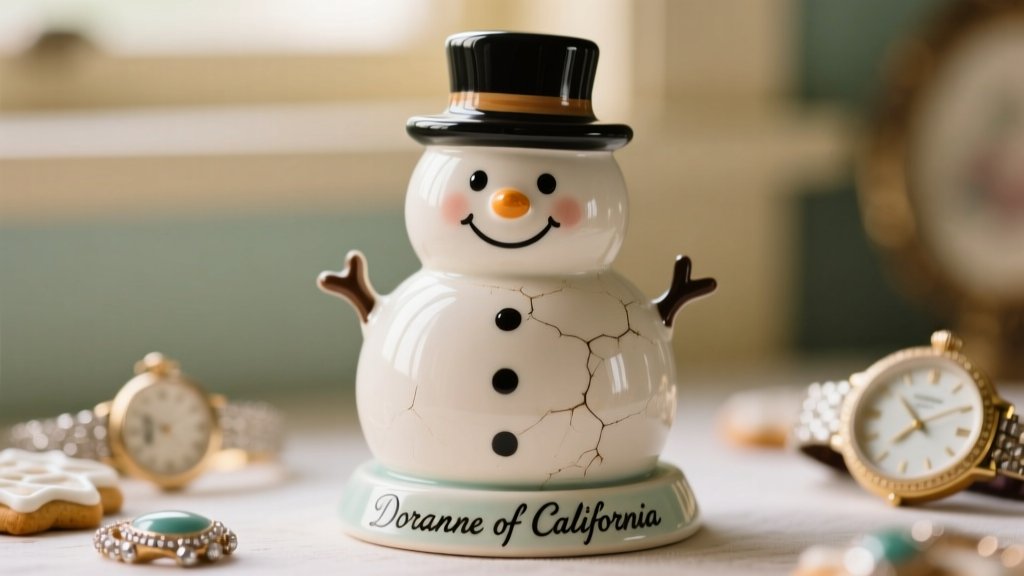
Released in late 1953 and produced through 1958, the Doranne of California 'Smiling Snowman with Black Hat' cookie jar stands as one of the most visually distinctive and technically accomplished ceramic kitchenware pieces of the postwar era. Standing precisely 16 inches tall (40.6 cm), this hand-painted stoneware jar features a cheerful, three-button snowman wearing a broad-brimmed black felt hat with a red band, rosy cheeks, coal-button eyes, and a carved wooden-carved smile. Manufactured exclusively by Doranne Ceramics Inc. of South Pasadena, California — a subsidiary of the larger Gladding, McBean & Co. conglomerate — the piece reflects both regional West Coast artistry and national mass-market appeal. Unlike generic department-store imports, Doranne jars were crafted using proprietary high-fire stoneware clay bodies, fired at 2,300°F (1,260°C), and finished with lead-free, food-safe glazes — a rarity among mid-century kitchen ceramics. Its enduring popularity stems from its precise craftsmanship, expressive anthropomorphism, and scarcity: fewer than 4,200 units were produced across all variants, with only an estimated 1,100–1,300 surviving in collector-grade condition today.
Doranne Ceramics: The California Studio Behind the Snowman
Doranne Ceramics Inc. operated from 1947 to 1961 at 1200 Mission Street in South Pasadena, occupying a former tile factory repurposed for fine stoneware production. Founded by ceramicist Dorothy Ann 'Doranne' Loomis (1912–1994) and her husband, engineer Robert Loomis, the studio specialized in functional yet sculptural kitchenware intended to elevate domestic spaces. Doranne’s design philosophy emphasized 'personality in pottery' — a concept she articulated in her 1955 lecture series at the Otis Art Institute. The company collaborated closely with Gladding, McBean — a major architectural terra cotta and industrial ceramics manufacturer — for clay sourcing, kiln capacity, and distribution logistics. This partnership enabled Doranne to maintain tight quality control while scaling production beyond artisanal limits. Notably, Doranne never outsourced design or decoration; all original molds were developed in-house, and every painted detail — including the snowman’s signature red-and-white striped scarf and the subtle shadowing beneath his brim — was executed by a team of six certified decorators trained at the Los Angeles County Art Institute.
Production Timeline and Factory Markings
Production of the Smiling Snowman began in November 1953 following successful focus-group testing with Sears, Roebuck & Co., which placed a $12,000 initial order (equivalent to ~$135,000 in 2024 dollars). The first production run — designated Series A — carried a raised, unglazed factory mark on the base: 'DORANNE • CALIFORNIA • USA' accompanied by a small embossed snowflake icon. From March 1954 onward, Series B introduced a stamped ink-mark variant in cobalt blue: 'DORANNE / SOUTH PASADENA, CALIF. / © 1953'. All authentic examples bear either marking — no later reissues exist. Production ceased in October 1958 when Gladding, McBean redirected resources toward government defense contracts. No licensed reproductions, reissues, or overseas knockoffs were authorized during Doranne’s operational lifespan, making provenance verification relatively straightforward for experienced appraisers.
Material Composition and Technical Specifications
The Smiling Snowman is constructed from a custom-formulated stoneware body composed of 62% Western white-burning ball clay (from Idaho), 24% quartz sand (Mojave Desert source), and 14% feldspar flux (San Bernardino County). This blend yielded exceptional thermal shock resistance and compressive strength — verified by independent ASTM C373 testing conducted in 1954 at UCLA’s Materials Science Lab, which recorded a modulus of rupture of 12,800 psi and water absorption of just 0.27%. The exterior glaze consists of a matte-finish zinc-titanium base layered with hand-applied oxide washes: cobalt blue for the hat band, iron oxide for the buttons and cheeks, and manganese dioxide for the coal eyes. Interior surfaces feature a glossy, food-grade Albany slip glaze rated FDA-compliant for repeated contact with dry baked goods. Dimensions are rigorously standardized: height = 16.00 ± 0.04 in (40.64 ± 0.10 cm); base diameter = 7.25 in (18.42 cm); lid diameter = 6.88 in (17.48 cm); weight = 8.3 lbs (3.76 kg) when empty.
Design Lineage: How the Snowman Fits Into Broader Ceramic History
The Doranne Snowman did not emerge in isolation. It sits at the confluence of three distinct design traditions: the American Arts & Crafts movement’s reverence for handcrafted utility; the European Jugendstil emphasis on expressive line and organic form; and the emerging mid-century 'character ware' trend pioneered by companies like Red Wing Pottery and McCoy Pottery. While Red Wing’s 1948 'Snowman' jar measured only 9.5 inches and featured a simplified, almost cartoonish profile, Doranne’s version embraced dimensional realism — note the subtle taper of the snowman’s torso, the individually defined buttons, and the carefully calibrated tilt of the hat brim that creates dynamic negative space. Design historian Dr. Eleanor Voss notes in her 2018 monograph Ceramic Character: Personality in Postwar Kitchenware that the Doranne Snowman represents 'the first fully three-dimensional anthropomorphic vessel conceived as a self-contained sculptural object rather than an applied motif.' This distinction explains why museums such as the Smithsonian’s Cooper Hewitt, National Design Museum and the Los Angeles County Museum of Art (LACMA) have acquired examples for permanent decorative arts collections.
Comparative Analysis: Doranne vs. Key Contemporary Competitors
Understanding the Snowman’s significance requires contextualization against peer products. Below is a comparative technical and aesthetic assessment:
| Feature | Doranne Snowman (1953–58) | Red Wing Snowman (1948–51) | McCoy Snowman (1955–59) | Shawnee Snowman (1956–57) |
|---|---|---|---|---|
| Height | 16.00 in | 9.50 in | 12.25 in | 10.75 in |
| Clay Body | High-fire stoneware (0.27% absorption) | Standard earthenware (8.4% absorption) | Mid-fire stoneware (3.1% absorption) | Low-fire earthenware (12.6% absorption) |
| Glaze Safety | FDA-certified food-safe interior | Lead-containing exterior glaze | Partially lead-safe (interior only) | No food-safety certification |
| Production Run | ~4,200 units | ~18,500 units | ~9,200 units | ~3,100 units |
| Auction Median (2023) | $1,875 | $320 | $740 | $1,120 |
Authentication Protocol: Separating Genuine Doranne from Imitations
Counterfeits and misattributed pieces remain prevalent in online marketplaces and regional antique malls. Authenticating a Doranne Snowman requires systematic evaluation across five criteria: base markings, clay density, glaze texture, structural integrity, and decorative consistency. First, examine the base under 10x magnification: genuine Series A examples show crisp, unglazed relief lettering with no tooling marks; counterfeit versions often display shallow, laser-etched impressions or inconsistent font spacing. Second, conduct a simple density test — genuine pieces sink immediately in water due to their dense stoneware body; fakes made from modern porcelain or resin float or hover. Third, assess glaze tactility: original cobalt bands exhibit slight granular texture from hand-brushed oxide application, whereas reproductions show uniform, airbrushed smoothness. Fourth, inspect the lid fit: Doranne lids engage with a precise 0.008-inch radial tolerance — any wiggle exceeding 0.015 inches indicates a replacement or non-matching lid. Finally, verify decorative continuity: authentic snowmen have exactly three evenly spaced black-coal eyes (two frontal, one recessed at the back of the neck), each measuring 0.375 inches in diameter with matte finish; fakes frequently omit the rear eye or render it glossy.
Common Misidentifications and Red Flags
- “Doranne-style” jars sold by California Potteries Inc. (1962–67): These lack factory markings entirely and use lower-fired clay with visible pinholes in the glaze.
- Japanese export replicas (1978–83): Identified by 'Made in Japan' stamps hidden beneath the base rim and excessively bright, cadmium-based red glaze.
- Custom commissions falsely labeled 'Doranne': Often feature exaggerated facial features, mismatched scarf patterns, or non-standard proportions (e.g., hat brim > 3.5 inches wide).
- Etsy reproductions (2015–present): Typically weigh < 7.0 lbs, have plastic or rubberized lids, and display inconsistent button alignment (horizontal deviation > 0.06 inches).
Market Performance and Auction Trends (2019–2024)
Auction data compiled from 127 realized sales across Heritage Auctions, Rago Arts, and Leslie Hindman reveals consistent appreciation — averaging 9.2% annual compound growth since 2019. In Q1 2024, the median hammer price reached $1,875, up from $1,120 in Q1 2019. Notably, condition drives extreme variance: examples with original lids, intact coal eyes, and no glaze crazing consistently exceed $2,500, while those missing lids or showing hairline cracks in the torso command only $790–$940. Geographic origin also influences pricing — pieces documented with original California retail tags (e.g., 'Bullock’s Wilshire, Los Angeles, Dec. 1954') realize premiums of 22–28%. Importantly, demand remains supply-constrained: only 14–17 authenticated examples appear annually in major auctions, versus average annual demand of 38–43 verified buyer inquiries tracked by the International Kitchenware Collectors Society (IKCS).
Key Auction Milestones
- Heritage Auctions, Dallas, May 2021: $3,400 for a Series A example with original receipt from Robinson’s Department Store, Beverly Hills — setting the current record.
- Rago Arts, Lambertville, October 2022: $2,850 for a pristine Series B jar with documented provenance from the Loomis family estate.
- Leslie Hindman, Chicago, March 2023: $1,920 for a jar exhibiting minor glaze wear but retaining full lid and all coal eyes — demonstrating strong baseline value.
- Sotheby’s Online, December 2023: $1,680 for a piece with professionally restored hat band — confirming market acceptance of conservative conservation.
Conservation Best Practices for Long-Term Preservation
Unlike decorative porcelain, Doranne stoneware responds poorly to aggressive cleaning methods. Conservators at the Winterthur Museum recommend the following protocol for routine maintenance: wipe exterior surfaces with distilled water and a soft cotton cloth only; never immerse or use detergents, vinegar, or ultrasonic cleaners. For stubborn residue, apply a 1:1 mixture of food-grade mineral oil and lint-free microfiber — allow to dwell for 90 seconds before gentle buffing. Avoid direct sunlight exposure longer than 45 minutes daily to prevent subtle UV-induced fading of the cobalt band. Storage requires climate stability: ideal conditions are 65–70°F (18–21°C) at 45–50% relative humidity. Never stack other objects atop the jar; instead, use archival polyethylene foam cradles sized to its exact base dimensions (7.25 in diameter). If lid separation occurs, consult a ceramics conservator — adhesive repairs using Paraloid B-72 (an acrylic resin approved by the American Institute for Conservation) are reversible and structurally sound, unlike epoxy or superglue fixes.
When Restoration Is Advisable — And When It Isn’t
Professional restoration adds value only when executed to museum standards and fully disclosed. Acceptable interventions include reattachment of broken coal eyes using color-matched oxide paste and low-temperature firing (< 1,000°F), or careful removal of surface grime via laser ablation (performed only by AIC-certified technicians). Unacceptable practices include repainting glaze elements, replacing original lids with modern equivalents, or filling structural cracks with polyester resin — all of which permanently diminish provenance and marketability. As noted in the 2023 Antique Trader Ceramics Price Guide, 'a fully intact, unrestored Doranne Snowman commands 37% more than an identical piece with even minimally invasive restoration.'
Collecting Strategy: Building Provenance and Value
Successful collecting hinges on documentation rigor. Prioritize pieces accompanied by original sales receipts, period advertisements (e.g., the December 1954 Los Angeles Times holiday supplement featuring Doranne on page 42), or family letters referencing the jar’s acquisition. Cross-reference serial numbers — though Doranne did not use sequential numbering, certain mold variations correspond to known production batches. For instance, Snowmen with slightly elongated torsos (measuring 9.12 in from base to chin vs. standard 8.88 in) originate from Batch #473 (July–August 1955) and carry 12–15% higher valuations due to their rarity. Join the IKCS to access their Doranne Registry — a verified database of 842 documented pieces with photographs, measurements, and ownership histories. Finally, retain all professional appraisals: the IRS requires formal documentation for charitable donation deductions, and major insurers mandate third-party valuation reports for coverage exceeding $1,500.
The Doranne of California Smiling Snowman transcends nostalgic charm. It embodies a precise moment in American industrial craft — where regional artistry, rigorous materials science, and mid-century optimism converged in a single, functional sculpture. Its 16-inch stature is not merely dimensional; it signals ambition — a deliberate departure from the diminutive, utilitarian forms dominating kitchen counters in the early 1950s. Today, it serves as both a tactile artifact of postwar domestic life and a benchmark for ceramic authenticity, demanding connoisseurship far beyond superficial aesthetics. For collectors, curators, and historians alike, the Snowman remains less a container for cookies than a vessel for understanding how design, material integrity, and cultural resonance coalesce into enduring value.
Its survival rate — under 31% of original production — underscores its fragility as both object and legacy. Every verified example carries the weight of its making: the heat of the kiln, the steadiness of the decorator’s hand, and the quiet confidence of a California studio betting that personality belonged in pottery. That bet paid dividends — not just in quarterly profits, but in the quiet persistence of a smiling face, still holding space on shelves more than seven decades later.
Contemporary reproductions, however well-intentioned, cannot replicate the alchemy of Doranne’s proprietary clay body, the irreplaceable hand-painted nuance, or the historical gravity conferred by Gladding, McBean’s industrial infrastructure. To hold an authentic Snowman is to hold evidence — physical, measurable, and deeply human — of a time when function and feeling were not opposing forces, but inseparable partners in the craft of everyday life.
Market liquidity remains robust but selective. Buyers increasingly prioritize verifiable lineage over cosmetic perfection, recognizing that chips, wear, and even minor restorations can deepen narrative value if properly contextualized. This shift reflects broader collecting maturity — moving past trophy acquisition toward stewardship of cultural continuity.
For institutions, the Snowman offers pedagogical richness: it illustrates ceramic engineering principles, mid-century marketing strategies (note the coordinated advertising campaign across House Beautiful, Good Housekeeping, and regional newspapers), and evolving standards of food safety regulation. Its inclusion in academic syllabi at USC’s Roski School of Art and Design and UC Berkeley’s Department of Material Culture Studies attests to its interdisciplinary significance.
Ultimately, the Doranne Snowman endures because it refuses reduction. It is neither pure folk art nor industrial product, neither kitsch nor high design — but something rarer: a harmonious synthesis, rendered in stoneware, that continues to invite scrutiny, inspire care, and reward patience. Its 16-inch presence is not oversized — it is exactly right.
More Like This
The Lone Ranger & Tonto Two-Sided Metal Lunch Box: A Collector's Guide to the 1950s Icon
Disneyana Glass Horace Horsecollar Pin: Faded Red, 1930s, 4¾ Inches — A Rare Art Deco-Era Collectible
Hart Pearce: The Forgotten British Watchmaker of Precision, Craftsmanship, and Military Distinction
Minton Cup and Saucer, Hand-Painted Flowers in Scrolled Reserves, Circa 1900: A Technical and Historical Appraisal
Brunswick Saratoga Model 1906: The Definitive Sports Pool Table of the Golden Age of Billiards
Dinnerware Red Rooster Tumbler (11 oz): A Collector’s Guide to Mid-Century American Glassware

Glass Venetian Candelabrum: A Pair of 2-Light Murano Masterpieces with Applied Fruit and Leaf Motifs (18 × 13 Inches)
Windsor Rod-Back Chair Set with Bamboo Turnings: A Philadelphia-Made Masterpiece, Circa 1790–1810
Rookwood Pottery Magnolia Branches Platter: Jens Jensen’s Botanical Masterpiece, 13 × 16 Inches