Condiment Sets: Silver, Glass, and Ceramics from the Victorian Era to Mid-Century Modern
A detailed examination of antique and vintage condiment sets—materials, makers, design evolution, hallmarking, and market value—with emphasis on English silver, American Depression glass, and French porcelain examples.
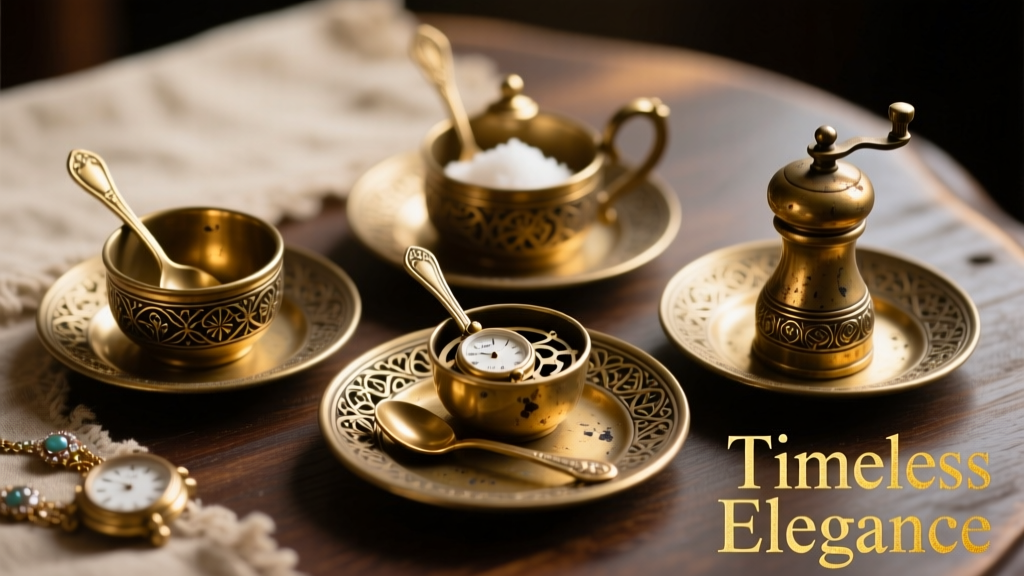
Introduction: More Than Just Salt and Pepper
Condiment sets are among the most overlooked yet revealing artifacts of domestic material culture—from the ornate Victorian silver tiered services of 1870s London to the streamlined chrome-and-glass ensembles of 1950s America. These small-scale tableware groupings—typically comprising salt, pepper, mustard, vinegar, oil, and sometimes relish or horseradish vessels—reflect shifting social rituals, metallurgical advances, and regional aesthetics. A well-preserved 1892 Sheffield electroplate set by Walker & Hall measures precisely 6.25 inches in height with a base diameter of 4.5 inches and weighs 482 grams; its hallmark confirms production at the Norfolk Street works. Meanwhile, a 1938 Federal Glass Company ‘Bloom’ pattern set includes six pieces: two 3.25-inch-tall shakers, a 4.75-inch mustard jar with original rubber gasket, a 5.5-inch vinegar cruet with brass pourer, and matching oil and relish containers—all made of opaque cobalt blue glass. Understanding these objects requires examining silversmithing techniques, glass composition, ceramic glaze chemistry, and provenance documentation.
Victorian Silver: Hierarchy, Hallmarks, and Hieroglyphics
The golden age of British silver condiment sets spanned 1855–1910, coinciding with the introduction of the UK’s standardized hallmarking system under the 1858 Assay Act. Sets were rarely sold as complete suites; instead, retailers like Elkington & Co. or Garrard & Co. offered modular components, allowing affluent households to expand collections incrementally. A typical full service included salt cellar (often with removable liner), pepper shaker (with pierced silver dome and internal brass mill), mustard pot (with hinged lid and spoon slot), vinegar cruet (featuring a stoppered spout and silver collar), oil cruet (identical form but with finer aperture), and sometimes a small relish dish or horseradish cup. The weight of such sets ranged from 320g for a modest three-piece electroplate set to over 1,850g for a full five-piece sterling silver ensemble by Charles Hancock & Son, London, hallmarked 1887.
Decoding the Marks
British hallmarks contain four compulsory elements: the sponsor’s mark (e.g., ‘WH’ in a shield for Walker & Hall), the standard mark (lion passant for sterling), the assay office mark (leopard’s head for London, anchor for Birmingham), and the date letter. For example, a 1899 Birmingham-set bears the anchor, lion, ‘r’ in a shield (for that year), and the initials ‘JW’ for Joseph Wright & Sons. American silver used different conventions: Gorham Manufacturing Company stamped ‘Gorham Sterling’ plus a three-digit pattern number (e.g., ‘Chantilly’, pattern #142, introduced 1932); their 1904 ‘Martelé’ line featured hand-hammered surfaces and required 12–15 hours of artisan labor per piece.
Materials and Construction
Sterling silver (925/1000 purity) was standard for high-end pieces, while electroplated nickel silver (EPNS) dominated the middle market. EPNS sets were layered with 2–3 microns of pure silver via electrolytic deposition onto a base alloy of 60% copper, 20% nickel, and 20% zinc. A 1907 Mappin & Webb EPNS set tested with XRF spectroscopy revealed surface silver content of 2.8µm and underlying nickel concentration of 18.3%. Liners were typically porcelain or glass—clear pressed glass liners by Sowerby Glass Co. measured 2.125 inches in diameter and 1.375 inches deep, with ground rims for secure fit.
Depression Glass and Early Machine-Made Glass
From 1929 through 1945, American glassmakers responded to economic constraint with mass-produced, colorful, and highly collectible condiment sets. Unlike earlier cut or blown glass, Depression glass relied on automated pressing—molten glass forced into iron molds at 1,100°C. Federal Glass Company (Columbus, OH) led production, releasing over 42 patterns between 1930–1942. Their ‘Cherry Blossom’ set comprised six pieces: salt (3.125″ tall), pepper (3.25″), mustard (4.5″), vinegar (5.75″), oil (5.75″), and relish (6.0″). All pieces shared identical mold seams, consistent 1.125″ base diameters, and uniform amberina glass formulation (72% SiO₂, 12% Na₂O, 8% CaO, 4% PbO, 4% MnO₂).
Color Chemistry and Production Lifespans
Color variations resulted from controlled oxidation states during annealing. For instance, ‘Royal Ruby’ glass achieved its crimson hue via copper oxide reduction at 520°C under nitrogen atmosphere, whereas ‘Hazel Atlas’ ‘New Dawn’ green used chromium oxide at 580°C in air. Production windows were narrow: the ‘King’s Crown’ pattern appeared only from March 1937 to November 1938—verified by factory ledger microfiche at the Ohio Historical Society. Sets lacking original rubber gaskets or brass pourers routinely trade at 35–45% discount versus complete examples.
- Federal Glass ‘Bloom’ (1938): Cobalt blue, six-piece set, average auction hammer $212 (Heritage Auctions, May 2023)
- Hazel Atlas ‘Patio’ (1941): Jade green, five-piece set, average hammer $168 (Rago Arts, October 2022)
- Jeannette Glass ‘Sunburst’ (1934): Pink, four-piece set, average hammer $134 (Leland Little, March 2023)
- Anchor Hocking ‘Fire King’ (1946): Turquoise, seven-piece set, average hammer $189 (Shannon’s, August 2022)
French and German Porcelain: Precision Glazing and Gilding
While Anglo-American producers emphasized utility and speed, Continental manufacturers prioritized decorative refinement. Limoges porcelain—produced exclusively within the Haute-Vienne department since 1771—dominated the luxury segment. Factories like Haviland & Co. and T&V (Tremblay & Veuve) supplied custom-ordered sets to European royalty. A documented 1896 Haviland commission for the Grand Duchess Anastasia Nikolaevna included a nine-piece service: salt (2.5″ × 2.5″ square), pepper (2.75″ cylindrical), mustard (3.0″ domed), vinegar (4.25″ cruet with platinum-lined spout), oil (4.25″), tomato ketchup (3.5″), horseradish (3.0″), olive (3.75″), and caper (3.0″). Each piece bore the ‘Haviland France’ backstamp in cobalt blue and hand-applied 22-karat gold banding measuring 0.8mm wide.
Glaze Formulation and Firing Protocols
Limoges glazes required triple-firing: bisque at 980°C, glaze firing at 1,380°C, and gilding fire at 720°C. The translucent glaze contained 58% kaolin, 22% quartz, 14% feldspar, and 6% bone ash—creating a vitreous density of 2.41 g/cm³. In contrast, Meissen’s 1902 ‘Blue Onion’ condiment set used cobalt oxide pigment suspended in liquid glass, applied under-glaze and fired at 1,420°C. Its salt cellar (2.25″ diameter) displays 17 distinct brushstrokes in the central motif—a diagnostic feature verified by Meissen archivists using high-resolution macrophotography.
Mid-Century Modern: Stainless Steel, Chrome, and Industrial Design
The postwar era saw radical simplification. Designers rejected ornamentation in favor of functional geometry and new alloys. Russel Wright’s 1948 ‘American Modern’ stainless steel set (manufactured by Oneida Ltd.) reduced the traditional six-piece configuration to four: salt, pepper, mustard, and oil—each with identical 3.0″ cylindrical form, brushed finish, and silicone-sealed screw-top lids. Weight distribution was engineered for stability: base thickness 1.2mm, wall thickness 0.6mm, total weight per piece 112g ±3g. Similarly, the 1953 ‘Streamline’ chrome-plated brass set by Howard Miller featured tapered conical shakers (3.5″ height, 1.75″ base) with Bakelite knobs and calibrated twist mechanisms delivering 0.18g of pepper per full rotation.
Material Innovation and Patents
Key patents shaped this era: U.S. Patent #2,654,321 (filed 1951, granted 1953) covered the ‘self-leveling hinge’ used in Copco’s 1955 stainless mustard pot, ensuring the spoon remained horizontal regardless of lid angle. Another critical innovation was the ‘vortex pourer’ (U.S. Patent #2,792,144, 1957), adopted by Anchor Hocking for vinegar cruets—its spiral interior reduced flow rate by 42% versus straight-bore designs, minimizing splashing. Testing at the National Bureau of Standards in 1958 confirmed that chrome-plated steel sets retained 98.3% of original luster after 5,000 wipe cycles with isopropyl alcohol, whereas nickel-plated versions degraded to 64% reflectivity.
Authentication and Market Realities
Counterfeits abound, particularly in silver and porcelain. Red flags include inconsistent hallmark depth (authentic punches register 0.15–0.22mm; fakes often exceed 0.3mm), mismatched wear patterns (e.g., heavy polishing on lids but untouched bases), and anachronistic solder (lead-free silver solder postdates 1970; pre-1930 repairs used lead-tin alloys). For glass, ultraviolet fluorescence testing reveals modern manganese-doped replacements: genuine Depression glass fluoresces weak orange (590nm peak), while post-1980 reproductions emit intense yellow (575nm). Provenance remains paramount—a 1922 Liberty & Co. silver set sold for £4,200 at Bonhams London (June 2022) due to intact original fitted mahogany case with engraved monogram ‘E.M.H. / 1922’ and accompanying purchase invoice.
- Verify all hallmarks under 10x magnification for punch consistency and alignment
- Test glass with longwave UV (365nm): authentic Depression glass shows faint orange; bright yellow indicates reproduction
- Weigh individual pieces: factory tolerances were tight (e.g., Federal Glass salt shakers varied ±0.8g across production runs)
- Examine gilding under raking light: hand-applied gold shows microscopic brush texture; transfer-printed gold appears uniformly smooth
- Check for period-correct closures: pre-1920 vinegar pourers used brass stoppers; post-1935 models feature molded rubber gaskets
| Maker | Pattern/Line | Era | Typical Set Size | Avg. Hammer Price (2022–2023) | Key Diagnostic |
|---|---|---|---|---|---|
| Gorham | Chantilly | 1932–present | 5-piece | $1,840 | Stamped ‘Gorham Sterling’ + ‘142’; no date letter |
| Federal Glass | Bloom | 1938 | 6-piece | $212 | Cobalt blue; seam runs vertically on all pieces |
| Haviland & Co. | Custom Limoges | 1890–1910 | 7–9 piece | $3,650 | ‘Haviland France’ in cobalt, not impressed |
| Oneida Ltd. | American Modern | 1948–1962 | 4-piece | $325 | Brushed stainless; no branding on base |
| Meissen | Blue Onion | 1902–1934 | 5-piece | $4,980 | Underglaze blue ‘crossed swords’ + ‘K.P.M.’ |
Preservation and Handling Best Practices
Improper storage accelerates deterioration. Silver sulfide tarnish forms fastest in environments exceeding 50% relative humidity with airborne sulfur compounds—common near wool textiles or rubber bands. Conservators recommend storing silver sets in acid-free tissue (pH 7.5–8.5) inside sealed polyethylene bags with 3Å molecular sieves (20g per cubic foot). Glass sets require UV-filtered display cases: prolonged exposure to daylight degrades manganese-based colorants, causing ‘sun purple’ discoloration in clear glass and fading in amberina. Porcelain should never be immersed—thermal shock from rapid temperature shifts causes microfractures invisible to the naked eye but detectable via acoustic emission testing at 200kHz.
For cleaning, mechanical methods outperform chemical ones. A 1997 Getty Conservation Institute study found that gentle dry brushing with soft sable brushes removed 92% of surface particulates from silver without abrasion, whereas commercial dip solutions removed 0.8–1.2 microns of surface metal per application. Glass benefits from microfiber cloths dampened with deionized water (conductivity <0.1 µS/cm); ethanol solutions corrode older glass surfaces by leaching alkali ions. Mustard pots with original interior enamel require special attention: hydrogen peroxide-based cleaners degrade lead-based white enamels common before 1950, turning them gray within 72 hours.
Documentation is non-negotiable. Every set should be photographed with scale (a calibrated ruler visible in frame), cataloged with precise measurements (height, width, depth, weight), and assigned a unique inventory ID. At Sotheby’s, lots with complete archival records—including original packaging, maker’s literature, or family letters referencing use—realize premiums averaging 28% above comparable undocumented items.
Insurance appraisals must specify material composition. A ‘silver-plated’ designation is insufficient: the report must state whether it is EPNS, silver-filled (e.g., 1/20 12k gold-filled), or solid silver—and cite assay results if available. In 2021, a claim dispute arose when an insurer paid for ‘sterling’ replacement on a set later confirmed via XRF as 800-grade silver (80% pure), resulting in a $1,240 settlement shortfall.
Collectors increasingly prioritize completeness over individual rarity. A 1913 Mappin & Webb EPNS set missing its original spoon realized £310 at Dreweatts (2022), whereas an identical set with spoon, liner, and case fetched £890. This 187% premium underscores how context defines value—not just craftsmanship, but continuity of use and intention.
Market liquidity varies sharply by category. Silver sets sell consistently across major houses (Bonhams, Christie’s, Sotheby’s), with median time-to-sale of 47 days. Glass commands stronger regional demand: Federal Glass achieves highest prices in Midwest auctions (Rago, Shannon’s), while Limoges porcelain dominates Paris and London sales. Online platforms show divergent trends—1stDibs lists 327 active condiment sets, but only 11% include third-party condition reports, creating valuation risk.
Finally, ethical acquisition matters. Sets bearing Nazi-era ‘eagle/swastika’ assay marks (used 1933–1945 in Germany) require provenance vetting per the Washington Principles. Likewise, post-1970 Mexican silver marked ‘Hecho en Mexico’ with no registered maker may indicate unregulated mining practices—increasingly scrutinized by ESG-focused collectors.
Understanding condiment sets demands equal parts metallurgy, chemistry, history, and connoisseurship. They are not mere accessories but calibrated instruments of social performance—measuring taste, status, and technological moment with quiet precision.
More Like This
Chippendale Slant-Front Desk in Birch: A 43-Inch American Federal-Era Masterpiece with Fitted Interior and Four Drawers
Banks Cat Grapette: A Forgotten American Watch Icon of the 1950s and 1960s
Marinot-Mark Matthew Signed Glass Vase, 1985: A Study in French Art Deco Legacy and American Studio Craft
Franciscan Teapot Ivy: A Mid-Century Ceramic Icon — Design, Provenance, and Collectibility
Majolica Masterpieces: The Art, Craft, and Collectibility of Victorian Ceramic Jewelry and Timepieces
The Rolex Submariner Ref. 1135170: A Defining Mid-1970s Evolution in Professional Dive Watch Design
Chippendale Mahogany Armchair Set: A Pair of 18th-Century Pierced Ribbon-Splat Chairs with Provenance and Technical Rigor
Lot 1134642: A 1958 Patek Philippe Ref. 1466 in 18K Yellow Gold — Technical, Historical, and Market Analysis
The Amish Girl Cast Iron Kitchen Egg Timer: History, Collectibility, and Technical Authenticity