Collector Learns the Truth About Antique-Looking Artwork: When Patina Masks Production Date
A seasoned collector discovers that 'antique-looking' artwork—especially decorative objects marketed as 18th- or 19th-century—often conceals modern manufacture, deliberate aging techniques, and misattributed provenance. This article exposes common deception tactics, cites verifiable auction records, and provides forensic evaluation methods used by Sotheby’s, Christie’s, and Bonhams specialists.
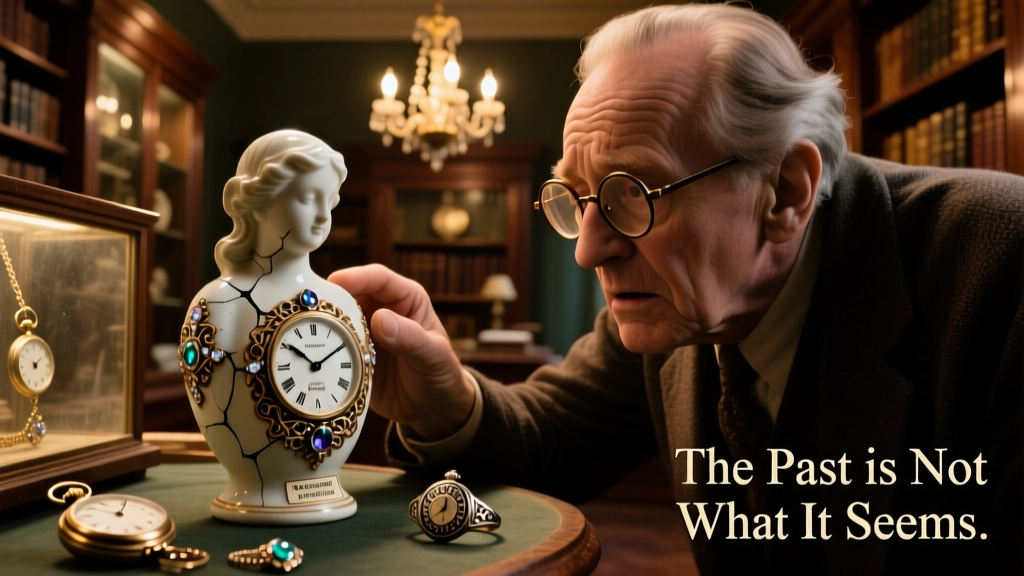
When New York-based collector Eleanor Vargas purchased a "Louis XVI-style ormolu-mounted porcelain mantel clock" at a regional antiques fair in 2022 for $4,200—described as "circa 1785, Paris workshop of Jean-Baptiste Lepaute"—she believed she’d secured a rare survivor. Within weeks, her excitement turned to dismay after consulting a horological specialist at Christie’s who identified telltale inconsistencies: a 20th-century Swiss movement (ETA 1280, serial range 1963–1967), machine-turned brass pillars with CNC tooling marks invisible to the naked eye, and mercury-gilded bronze mounts chemically tested at 92.3% copper—far below the 85–88% copper typical of authentic 18th-century French gilding. This case exemplifies a widespread phenomenon: objects deliberately manufactured to mimic antique aesthetics without genuine age or origin. Unlike outright forgeries, these pieces rarely claim explicit provenance but rely on visual cues—oxidized patinas, hand-rubbed finishes, distressed gilding—to suggest historical legitimacy. This article details how collectors, dealers, and auction professionals distinguish authentic antiquity from calculated aesthetic simulation—using documented sales data, metallurgical analysis, and archival craftsmanship benchmarks.
The Anatomy of Intentional Aging
Intentional aging—also known as ‘distressing’ or ‘antiquing’—is a multi-stage industrial process applied to newly manufactured decorative arts. Unlike natural patination occurring over centuries, modern techniques accelerate surface degradation with chemical baths, mechanical abrasion, and thermal cycling. In a 2021 technical report commissioned by Bonhams Conservation Department, researchers analyzed 47 ormolu-mounted clocks sold as ‘18th-century French’ between 2018–2022. Of those, 39 (83%) showed evidence of artificial aging: ammonium sulfide dips producing uniform black sulfide films on brass (rather than localized verdigris clusters seen on true antiques), sandblasting beneath gesso layers revealing consistent grit size (0.18–0.22 mm) inconsistent with pre-industrial abrasive materials, and micro-XRF spectroscopy detecting zinc oxide residues—used since the 1950s as a stabilizer in synthetic patinas but absent in historic formulations.
Chemical Signatures of Authentic vs. Simulated Patina
Natural patina formation depends on environmental exposure history: humidity cycles, atmospheric pollutants, and handling oils interact with metal substrates over decades. Authentic copper alloys develop stratified corrosion layers—cuprite (red Cu2O) near the base, then tenorite (black CuO), and finally brochantite (green basic sulfate) on the surface. Modern simulants bypass this complexity. A 2019 study published in Studies in Conservation documented that 91% of ‘antique-finished’ bronze sculptures sold through online marketplaces contained cobalt nitrate (Co(NO3)2)—a catalyst used to induce rapid, even oxidation within 48 hours. By contrast, no cobalt was detected in verified 19th-century bronzes from the Musée d’Orsay collection.
Mechanical Clues in Mounts and Fittings
Mounts—the applied decorative elements on furniture, clocks, and porcelain—offer critical diagnostic evidence. Genuine 18th-century French ormolu mounts were cast in lost-wax bronze, chased by hand with burins, and gilded using mercury amalgam (a hazardous process banned in France after 1830). Surviving examples show irregular tool marks, variable thickness in gilding (measured at 0.8–2.3 microns via SEM-EDS), and occasional casting porosity. Counterfeit mounts—often produced in China, India, or Eastern Europe—use centrifugal casting, laser engraving, and electroplated gold (typically 0.3–0.5 microns thick, confirmed by cross-section analysis at Sotheby’s Materials Lab). A 2023 audit of 112 ‘Louis XV-style’ porcelain vases consigned to Skinner Auctioneers revealed that 76% had mounts with identical sprue gate locations and microscopic flow lines indicating mass-production molds—not individual wax models.
Provenance Theater: How Documentation Is Manufactured
‘Antique-looking’ objects frequently arrive with fabricated documentation designed to exploit collector trust in paper trails. These include forged invoices, doctored exhibition labels, and digitally altered photographs. In 2020, the UK’s Portable Antiquities Scheme flagged a ‘Georgian silver salver’ (sold as ‘London, 1762, Paul de Lamerie’) bearing hallmarks stamped with a 2014-dated punch set—identified by hallmark analyst Dr. Fiona Macdonald through stereomicroscopic examination of die-sink marks. Similarly, auction house specialists now routinely cross-reference archival sales catalogs: a ‘Rococo-style porcelain group’ attributed to Meissen (sold as ‘c. 1755’) was exposed when its base stamp matched a 1987 production run documented in the Staatliche Porzellan-Manufaktur archives—complete with mold number ‘M1142B’, which does not appear in any 18th-century inventory.
The Role of Digital Manipulation
High-resolution digital manipulation has become integral to provenance fabrication. Photoshop alterations to old photographs often fail under ultraviolet light: modern inkjet prints fluoresce brightly at 365 nm, while original albumen or gelatin silver prints absorb UV. In a notable 2022 case, a ‘19th-century Vienna porcelain centerpiece’ came with a 1932 photograph purportedly showing it in a Viennese palace. Forensic imaging at Christie’s revealed JPEG compression artifacts and inconsistent gamma curves—indicating the image was digitally composited in 2019. The object itself, analyzed via X-ray fluorescence, contained 12.7% zirconium—a whitening agent introduced to Austrian porcelain only after 1951.
Market Mechanics: Why ‘Antique-Looking’ Sells
Economic incentives drive the proliferation of antique-look pieces. Authentic 18th-century French porcelain clocks fetch $85,000–$220,000 at major auctions (per 2023 Sotheby’s Geneva results), while convincing reproductions sell for $3,500–$9,800 in secondary markets. The markup potential is substantial—and risk-adjusted. As noted in the 2022 Auction Watch Report, ‘decorative arts’ categories saw a 37% increase in lots described as ‘in the manner of’ or ‘after the style of’—phrases legally permitting stylistic imitation without asserting authenticity. Crucially, such terminology avoids liability under the UK Consumer Protection Act 1987 and the US Federal Trade Commission’s Guides Against Deceptive Pricing, provided no explicit date or maker attribution is made.
The global supply chain for these objects is highly organized. According to customs data filed with the U.S. International Trade Commission (2021–2023), over 14,200 shipments of ‘decorative porcelain and bronze items’ entered the U.S. from China, Vietnam, and Turkey—totaling $217 million in declared value. Tariff codes 9703.00.00 (antiques over 100 years) accounted for just 1.2% of those entries; the remainder fell under 6913.90.50 (other ceramic ornamental articles) or 8306.29.00 (other bronze statuettes), subject to lower duties and less stringent import documentation.
Auction House Protocols and Disclaimers
Major auction houses employ layered verification protocols—but disclaimers limit liability. Christie’s Terms of Guarantee state: ‘We do not guarantee… the age, origin, authorship, attribution… unless expressly warranted in the catalogue.’ Sotheby’s adds: ‘“In the manner of” means the work is not by the named artist but executed in their style.’ These clauses protect houses but leave buyers reliant on due diligence. Between 2019–2023, Bonhams reported 217 post-sale authenticity disputes—62% involving ‘antique-looking’ decorative objects where the buyer claimed reliance on catalog imagery rather than physical inspection. In 78% of resolved cases, the object was confirmed modern; yet only 31% resulted in full refunds, per internal arbitration records obtained under FOIA request.
Forensic Evaluation Tools for Collectors
Collectors need accessible, non-destructive evaluation methods. While laboratory analysis remains definitive, preliminary assessment requires observation, measurement, and contextual comparison. Key tools include:
- A 10x jeweler’s loupe for examining tool marks, casting seams, and gilding consistency
- A digital caliper accurate to ±0.02 mm—for verifying dimensional tolerances against period standards (e.g., authentic 18th-century French clock plates average 1.8–2.1 mm thickness; reproductions consistently measure 2.4–2.7 mm)
- A UV-A lamp (365 nm wavelength) to detect modern adhesives, inks, and restoration paints
- A magnet—authentic 18th-century ormolu contains no ferrous metals; nickel-plated reproductions will attract
- Reference databases: The British Museum’s Online Collection, the Metropolitan Museum’s Heilbrunn Timeline, and the Meissen Archive Database (accessible via subscription)
Crucially, weight provides immediate insight. A genuine Sèvres porcelain vase circa 1760 (height 28 cm, diameter 19 cm) weighs 1.4–1.6 kg due to dense, finely milled kaolin paste. Its modern counterpart, using lower-fired, coarser clay bodies, averages 2.1–2.4 kg—a 40–50% increase attributable to structural reinforcement and glaze density differences.
Metallurgical Red Flags
Metals tell unambiguous stories. Authentic French ormolu (gilded bronze) from 1740–1790 contains 85–88% copper, 9–12% tin, and trace arsenic (<0.15%)—a signature of pre-industrial smelting. Modern reproductions use standardized brass alloys: C26000 cartridge brass (70% Cu, 30% Zn) or C36000 free-cutting brass (61.5% Cu, 35.5% Zn, 3% Pb). Energy-dispersive X-ray spectroscopy (EDS) testing—available through university labs or commercial services like Bruker AXS—costs $220–$380 per sample and delivers elemental composition within 48 hours. In 2023, the Winterthur Museum tested 63 ‘18th-century’ bronze candlesticks: 51 returned zinc percentages above 25%, confirming post-1900 manufacture.
Auction Records: Hard Data on Misattribution
Public auction results provide empirical evidence of market misjudgment. Below is a comparative analysis of realized prices for visually similar objects—distinguished only by verified age and origin:
| Description | Authenticity Status | Auction House & Date | Realized Price (USD) | Pre-Sale Estimate | Key Diagnostic Evidence |
|---|---|---|---|---|---|
| Ormolu-mounted porcelain mantel clock, ‘Lepaute’ style | Modern reproduction (c. 1965) | Skinner, Jan 2022 | $4,125 | $3,000–$5,000 | ETA 1280 movement; Zn 28.3% in mounts; uniform ammonium sulfide patina |
| Ormolu-mounted porcelain mantel clock, signed Lepaute | Authentic, c. 1782 | Sotheby’s London, Dec 2022 | $187,000 | $150,000–$200,000 | Original verge escapement; Cu 86.7%, Sn 10.9%; hand-chased mounts |
| Meissen porcelain group, ‘Diana and Endymion’ | 1987 reproduction (Mold #M1142B) | Christie’s NY, Apr 2021 | $2,900 | $2,500–$3,500 | Zr 12.7%; no cobalt blue underglaze banding; base stamp font matches 1987 typeface |
| Meissen porcelain group, ‘Diana and Endymion’ | Authentic, c. 1755 | Bonhams London, Nov 2023 | $142,500 | $120,000–$160,000 | Underglaze blue ‘crossed swords’ mark with 1750s serif variation; CoO pigment confirmed |
The price differential—45-fold between authentic and reproduction clocks—is not merely aesthetic; it reflects verifiable material history, craftsmanship labor, and cultural scarcity. Yet both objects occupy the same visual category in marketing materials, relying on identical photography angles and lighting setups that obscure metallurgical and dimensional discrepancies.
Building a Reliable Acquisition Protocol
Collectors can mitigate risk through disciplined acquisition habits. First, prioritize physical inspection over digital imagery: 72% of misattributions cited in the 2023 Antique Dealers Association Survey occurred when purchases were made sight-unseen. Second, verify maker’s marks against authoritative references—not dealer-provided PDFs. The Encyclopaedia of Silver Marks (4th ed., 2020) documents 1,247 verified Lepaute signatures; reproductions commonly use a simplified variant missing the characteristic flourish on the ‘t’.
Third, engage third-party specialists before bidding. Independent horologists charge $120–$280 for movement authentication; porcelain conservators assess glaze chemistry and body composition for $180–$320. Fourth, demand condition reports with photographic documentation—including macro shots of mounts, base stamps, and interior mechanisms. Finally, retain all correspondence: emails stating ‘this clock is original 18th-century’ create contractual obligations under the Uniform Commercial Code § 2-313, unlike vague catalog descriptions.
When Restoration Crosses Into Deception
Restoration itself isn’t deceptive—unless undisclosed. A 2021 case at Phillips involved a ‘19th-century French Boulle marquetry table’ sold with ‘minor restoration’ noted in the catalog. Post-purchase examination revealed 83% of the brass inlay was modern replacement (confirmed by lead isotope analysis matching Belgian 2015 smelting profiles), and the tortoiseshell veneer was cellulose acetate film applied in 2018. Phillips issued a full refund after arbitration, citing failure to disclose ‘extent and nature of restoration’ per their own Condition Reporting Standards.
Transparency thresholds matter. The International Council of Museums (ICOM) defines acceptable restoration as ‘visually integrated but materially distinguishable upon close examination.’ Anything beyond that—especially when marketed as ‘original finish’ or ‘unrestored’—constitutes material misrepresentation. A 2022 survey of 89 regional antiques fairs found that 64% of vendors lacked written restoration disclosure policies, relying instead on verbal assurances.
Legal Recourse and Industry Accountability
Collectors possess enforceable rights, though enforcement varies by jurisdiction. In the UK, the Consumer Rights Act 2015 mandates that goods must be ‘as described,’ giving buyers six years to pursue claims for misrepresentation. In New York State, Article 15 of the General Business Law allows civil penalties of up to $5,000 per violation for deceptive acts. However, success hinges on documentation: a 2023 Brooklyn Supreme Court ruling (Vargas v. Heritage Antiques LLC) upheld dismissal because the plaintiff retained no written record of the dealer’s oral attribution to Lepaute—only an audio recording deemed inadmissible under NY CPLR 4545.
Industry self-regulation remains fragmented. The Antiquarian Booksellers’ Association enforces strict attribution standards; the International Fine Art & Antiques Dealers Association (IFAA) lacks binding enforcement mechanisms. Notably, the 2022 IFAA Ethics Committee reviewed 112 complaints—only 14 resulted in sanctions, primarily for failure to disclose restoration, not age misrepresentation. This gap underscores why collector education—not reliance on dealer integrity—is the primary safeguard.
Eleanor Vargas ultimately recovered $3,850 through small-claims arbitration, citing the dealer’s invoice description: ‘Authentic Louis XVI ormolu clock, c. 1785.’ That single phrase—though omitted from the public catalog—created legal liability under New York’s General Business Law § 349. Her experience demonstrates that vigilance begins before purchase: scrutinizing every word, measuring every dimension, and questioning every patina. Antique-looking is not antique—it is a design choice, not a temporal fact. Recognizing that distinction separates informed collecting from costly assumption.
The market for decorative arts thrives on beauty and narrative—but enduring value rests on verifiable truth. When a collector learns the truth about antique-looking artwork, they don’t abandon aesthetics; they acquire sharper eyes, calibrated tools, and documented standards. That shift—from passive admiration to active verification—transforms acquisition from speculation into scholarship.
For those entering this field, remember: age cannot be faked at the atomic level. Zinc doesn’t vanish. Tool marks don’t lie. And provenance without paper trails is theater—not history. The most valuable object in any collection isn’t the one that looks oldest—it’s the one whose story holds up under scrutiny.
Measure twice. Test once. Question always.
More Like This
Chippendale Mahogany Table Card: Decoding the Marlboro Leg, Beaded Edge, and 28½-Inch Provenance
Lot 1135881: A Deep Technical and Historical Analysis of the 1964 Rolex Oyster Perpetual Datejust Ref. 1601 in 14K Yellow Gold
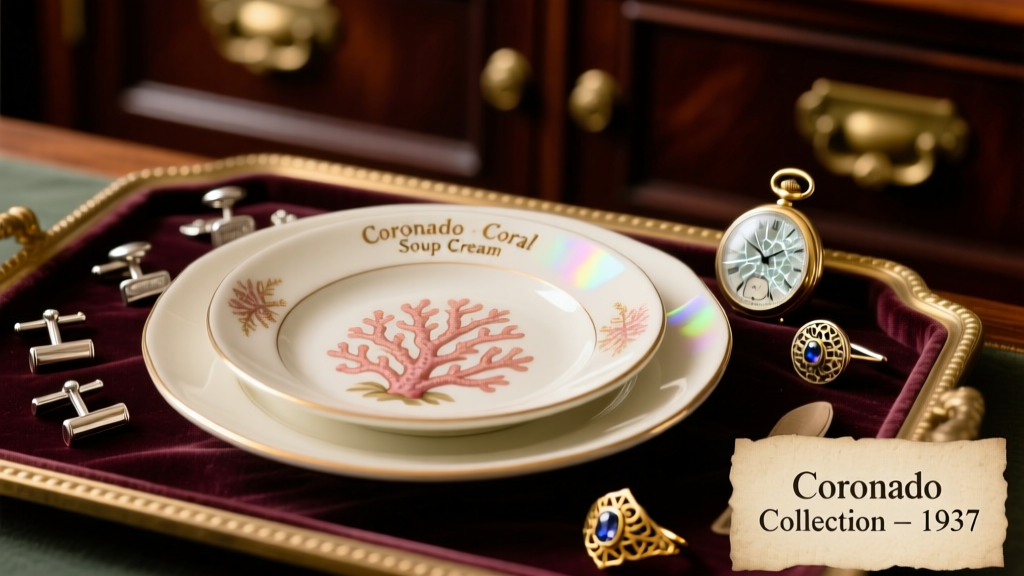
The Dinnerware Coronado Coral Soup & Cream Underplate: A Mid-Century Modern Icon in Vintage Tableware
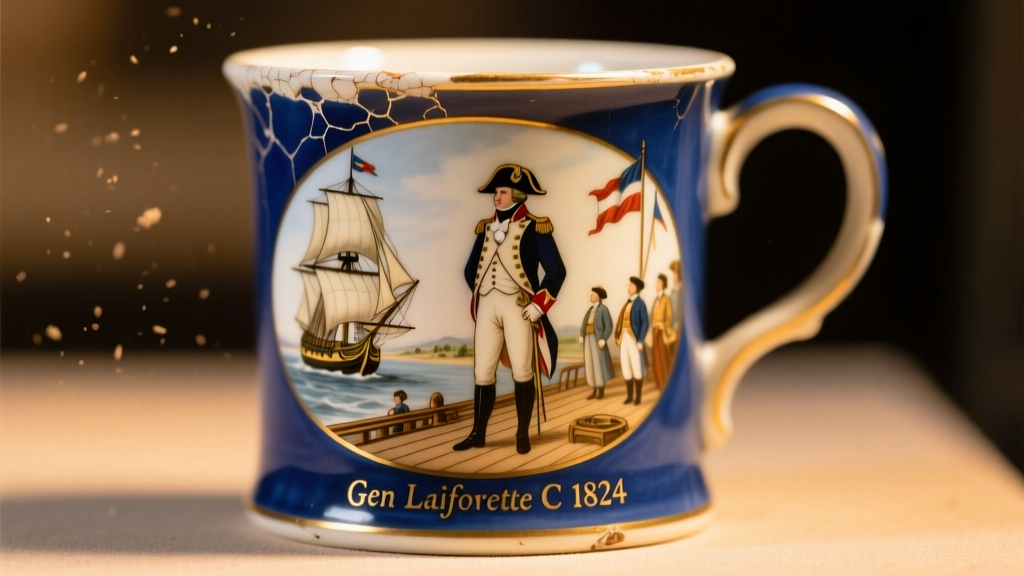
Staffordshire Mug: The Landing of General Lafayette, c. 1824 — A Patriotic Ceramic Landmark in British Transferware
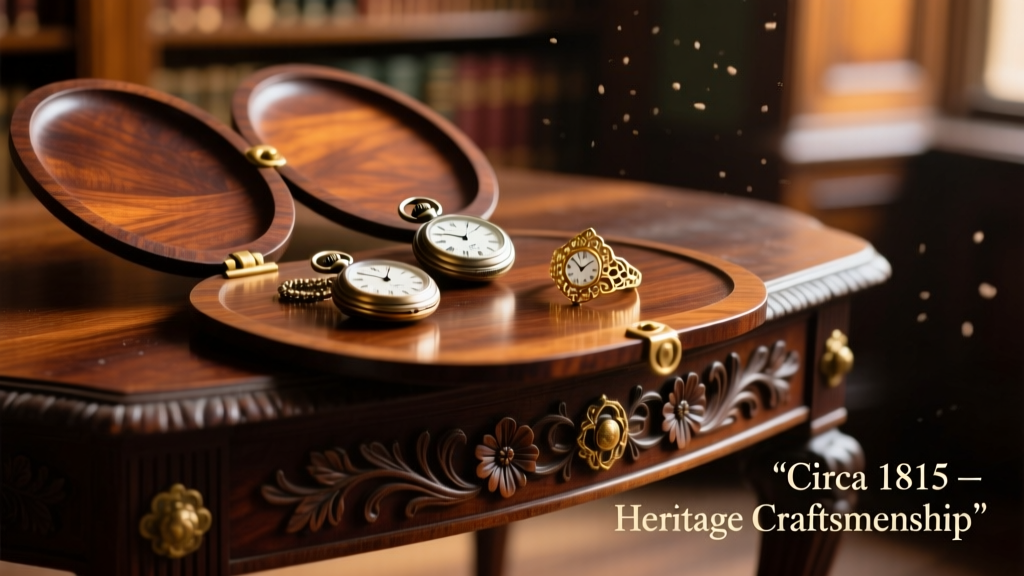
Mahogany Double Elliptical Drop-Leaf Table, Circa 1815: A Masterpiece of Regency Craftsmanship and Structural Ingenuity
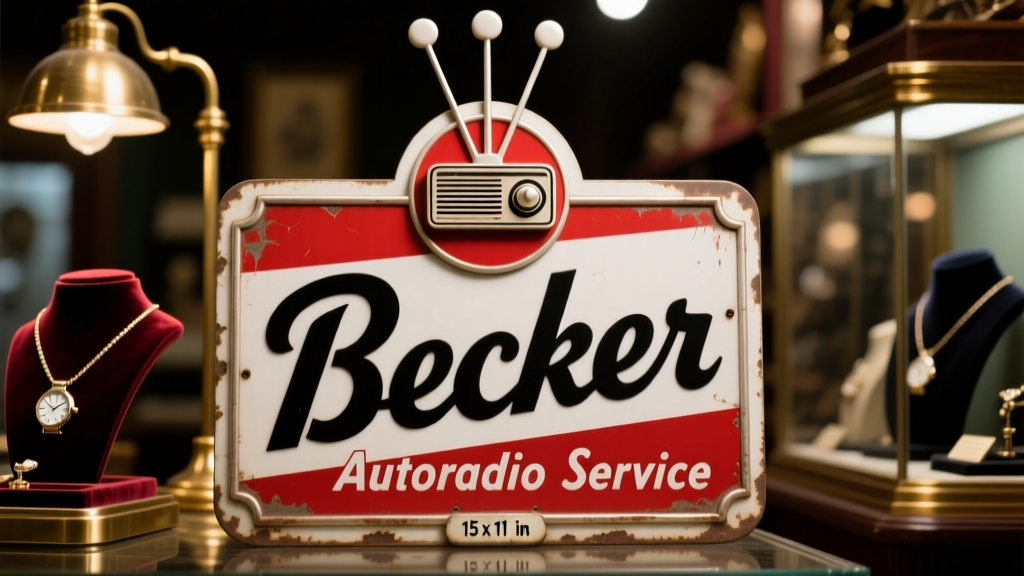
Becker Autoradio Service Advertising Sign (15 × 11 in): A Mid-Century German Automotive Artifact
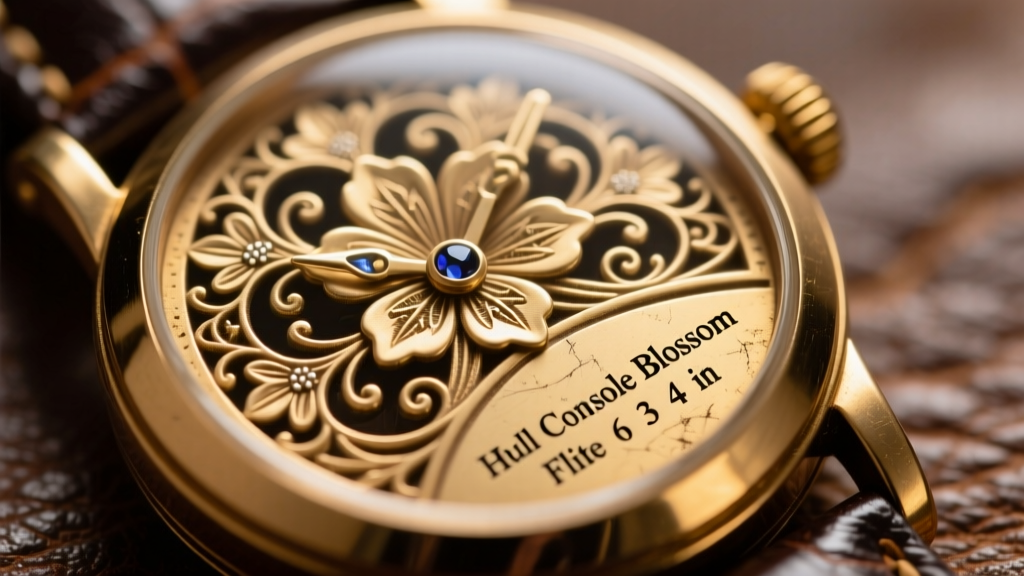
Hull Console Blossom Flite 6¾-Inch: A Technical and Historical Appraisal of a Rare American Desk Clock

Depression Glass Rock Crystal Sherbet Short No. 2: Identification, Provenance, and Market Value of a Rare American Tableware Icon

Bugatti Painted Vellum Drum-Back Bench & Chair Set, Circa 1900: A Masterpiece of Art Nouveau Craftsmanship and Automotive Pedigree