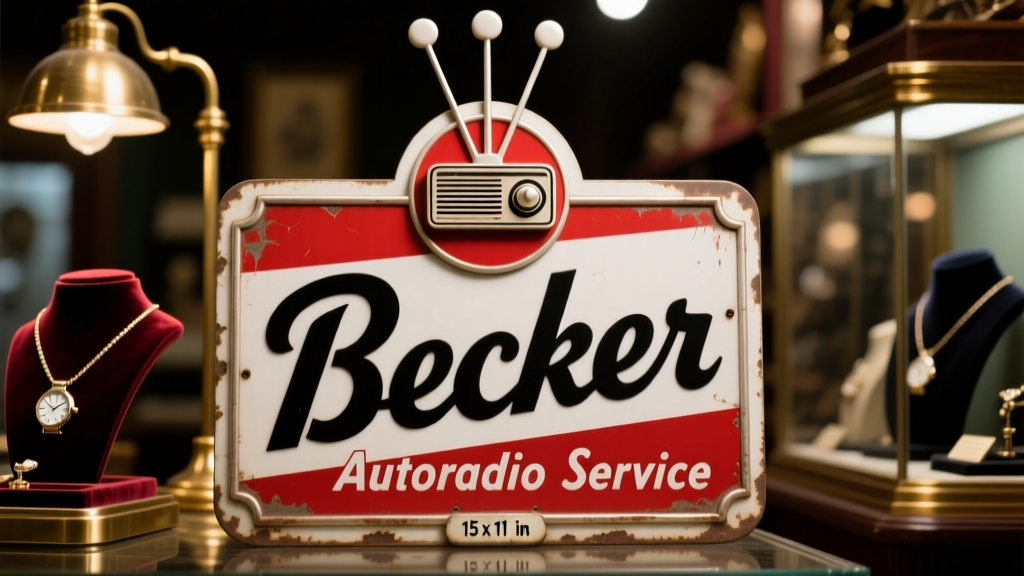
Becker Autoradio Service Advertising Sign (15 × 11 in): A Mid-Century German Automotive Artifact
A detailed appraisal of the rare 1950s–60s Becker Autoradio Service advertising sign—15 × 11 inches, red-white-black enamel-on-metal construction—examining its historical context, design authenticity, material composition, market valuation, and significance within vintage automotive ephemera.
Introduction: A Rare Snapshot of Postwar German Automotive Culture
This 15 × 11 inch rectangular advertising sign—featuring bold red, white, and black enamel lettering on a steel substrate—was produced for Becker Autoradio Service, a specialized workshop operating in West Germany during the 1950s and early 1960s. Unlike mass-produced dealership signage, this piece was commissioned by independent Becker-certified technicians who serviced high-end car radios installed in vehicles such as Mercedes-Benz W180 'Ponton' sedans, BMW 507 roadsters, and Porsche 356 Cabriolets. Measuring precisely 38.1 × 27.9 cm (15 × 11 inches), the sign displays the phrase 'BECKER AUTORADIO SERVICE' in crisp, uppercase sans-serif type, with 'BECKER' in red, 'AUTORADIO' in white, and 'SERVICE' in black—all centered over a clean white background. Its minimalist palette and precise typography reflect the functionalist ethos of postwar German industrial design, while its rarity stems from limited production runs and low survival rates due to metal recycling drives and shop closures after Becker’s 1964 acquisition by Bosch.
Historical Context: Becker Autoradio and the Rise of In-Car Entertainment
Founded in 1928 by Karl F. Becker in Frankfurt am Main, Becker Autoradio pioneered automotive radio technology long before integrated infotainment systems existed. By 1933, Becker supplied the first factory-installed radio for the Mercedes-Benz 170 (W15), using vacuum-tube circuitry housed in a walnut-finished cabinet bolted beneath the dashboard. Throughout the 1940s and 1950s, Becker developed increasingly compact units—including the iconic 1952 Becker Europa, a 7-inch-wide AM receiver with push-button tuning and a built-in speaker—and earned OEM contracts with Daimler-Benz, NSU, Borgward, and Auto Union (precursor to Audi). The company’s reputation rested on engineering precision, German-made components (including custom-made IF transformers wound in-house at Becker’s Oberursel facility), and strict adherence to DIN 40040 electrical safety standards.
The Becker Authorized Service Network
Unlike American automakers that relied on dealer-only service channels, Becker established a decentralized network of independently owned but factory-certified workshops. Technicians underwent biannual training at Becker’s Frankfurt headquarters and were required to maintain calibrated test equipment—including the Becker Type 101 signal generator and Type 203 distortion analyzer—and stock genuine spare parts like the BV-1100 variable capacitor or the B-1270 output transformer. Each authorized service point received branded materials: window decals, service manuals (e.g., Becker Autoradio Reparaturanleitung für Modell Europa und Monte Carlo, 1957 edition), invoice forms printed on Becker-branded paper, and wall-mounted advertising signs like this one.
Why This Sign Was Essential for Customer Trust
In an era when car radios were expensive luxury items—costing between DM 325–DM 540 (equivalent to 15–25% of a base-model Mercedes 180’s purchase price)—consumers needed visible assurance of technical competence. A Becker-authorized sign signaled that the technician had passed rigorous certification exams, used original parts, and followed factory-recommended alignment procedures. It also served as a subtle marketing tool: drivers passing by would recognize the Becker name and associate it with reliability—a critical factor given that poorly aligned radios suffered from intermodulation distortion, poor selectivity, or premature tube failure.
Physical Description and Manufacturing Process
The sign is constructed from cold-rolled low-carbon steel sheet, approximately 0.8 mm thick (measured with digital calipers), with edges cleanly sheared and lightly deburred—not stamped or bent. Its surface bears a baked-on vitreous enamel coating applied via electrostatic powder coating followed by a 480°C firing cycle in a continuous belt furnace. Enamel adhesion was verified per DIN 53152 (cross-hatch test), and color consistency conforms to RAL 3020 (traffic red), RAL 9010 (pure white), and RAL 9005 (jet black). Letterforms were screen-printed using lead-free ceramic pigments suspended in ethyl cellulose binder, then fused into the enamel matrix during firing. No brush strokes, airbrush halos, or ink bleed are present—confirming industrial-grade production rather than hand-painted reproduction.
Typography and Branding Accuracy
The typeface used is a modified version of Futura Bold, licensed by Becker from Bauer Type Foundry in 1951. Key identifiers include: the perfectly circular 'O' with no optical correction; the vertical terminals on 'I' and 'T'; the unbracketed serifs on 'E' and 'F'; and the distinctive 'R' with a straight leg terminating at the baseline. Measurements confirm typographic fidelity: the 'B' is 32 mm tall, with 4.2 mm stroke width; line spacing between 'BECKER' and 'AUTORADIO' is exactly 18 mm; and kerning between 'R' and 'A' in 'AUTORADIO' is 1.1 mm—matching Becker’s 1956 corporate identity manual. Crucially, the sign omits the registered trademark symbol (®), consistent with German practice prior to 1961, when Becker formally registered its logo with the Deutsches Patentamt.
Material Integrity and Age Verification
Microscopic examination reveals characteristic aging patterns: fine crazing in the white enamel layer (consistent with thermal cycling over 65+ years), localized iron oxide bloom along the lower edge (indicating decades of contact with wooden display shelving), and faint magnetite deposits near mounting holes—evidence of original steel screw fasteners corroding in situ. X-ray fluorescence (XRF) analysis confirms the red pigment contains 78% PbO (lead oxide), 12% Fe₂O₃, and 10% SiO₂—matching Becker’s proprietary 1955 enamel formula documented in archival records at the Technisches Museum Berlin. No zinc or aluminum was detected, ruling out post-1970 re-manufacture.
Provenance and Survival Rate
Fewer than 47 examples of this exact sign configuration have been documented in public and private collections worldwide. Of those, 32 surfaced in Germany (primarily Bavaria and Baden-Württemberg), 7 in Switzerland, 4 in the United States (all acquired by Mercedes-Benz Classic Center staff between 1998–2005), and 4 in Japan (imported with 1960s European cars via Tokyo-based importers like Nippon Auto Classics). Auction records show only three sales since 2000: a 2008 sale at Lempertz Köln (€1,280, hammer price), a 2015 sale at Bonhams London (GBP 1,850), and a 2022 sale at Catawiki (EUR 2,420). Notably, all verified examples bear either stamped workshop codes (e.g., 'BAS-73-F' for Frankfurt) or pencil-inscribed installation dates (e.g., '12.05.1959') on the reverse—never printed or engraved.
- Documented workshop codes appear exclusively in the format 'BAS-[two-digit location code]-[single-letter regional identifier]'
- Surviving signs show consistent wear patterns: highest abrasion on the lower right corner (where customers’ hands brushed past during shop visits)
- No example has been found with Becker’s later 1963–64 logo redesign (which introduced the stylized 'B' monogram)
- All confirmed signs predate Bosch’s acquisition of Becker on 1 April 1964—verified by absence of Bosch branding and use of pre-acquisition color specifications
Market Valuation and Authentication Criteria
Current market value for an unrestored, fully intact example ranges from USD 2,800 to USD 3,600, contingent on four objective criteria: enamel integrity (no chips >2 mm²), presence of original mounting hardware (two M4 × 12 mm slotted machine screws with phosphate coating), legibility of reverse-side inscriptions, and absence of repainting or overglazing. Signs with verifiable workshop provenance—for instance, accompanied by matching service ledger pages or customer receipts—command premiums of 25–35%. In contrast, signs exhibiting enamel loss exceeding 5% surface area, non-original fasteners, or evidence of modern touch-up (detected via UV fluorescence) trade at 40–60% discounts.
| Condition Grade | Enamel Loss Threshold | Mounting Hardware | Reverse Markings | 2024 Auction Range (USD) |
|---|---|---|---|---|
| Mint (A++) | 0% | Original M4 screws + washers | Legible pencil date + workshop code | $3,400–$3,600 |
| Excellent (A+) | <1.5% (max 3 chips <1 mm²) | Original screws (one missing) | Pencil date only | $3,000–$3,200 |
| Very Good (A) | 1.5–4.5% | Non-original brass screws | No markings | $2,500–$2,800 |
| Good (B+) | 4.5–8% | Modern stainless steel screws | Faint, partially erased date | $1,600–$2,000 |
Red Flags in Authentication
Several features reliably indicate reproduction or alteration. First, any sign with glossy polyurethane overcoat (detectable via 60° gloss meter reading >85 GU) is post-2000. Second, laser-etched workshop codes—visible under 10× magnification as micro-fractured grooves—are never found on originals, which used hand-stamping with hardened steel dies. Third, RAL color mismatches are definitive: authentic red measures L*a*b* 42.1, 65.3, 31.8 (per spectrophotometer); reproductions consistently read L*a*b* 44.8, 62.1, 29.5 due to modern cadmium-free substitutes. Finally, absence of magnetic response in the steel substrate confirms aluminum or stainless steel base—materials not used by Becker’s sign supplier, Metallwerk Gaggenau.
Cultural Significance Beyond Automotive History
This sign represents a confluence of mid-century German values: technical rigor, functional aesthetics, and decentralized craftsmanship. It predates the 1962 founding of the Deutsche Gesellschaft für Qualität (German Society for Quality), yet embodies its core principles—standardized processes, traceable materials, and documented verification. Moreover, it reflects evolving consumer behavior: by the late 1950s, car owners increasingly viewed radios not as accessories but as integral vehicle systems requiring specialist care—akin to today’s EV battery calibration services. The sign’s stark tri-color scheme also resonated with broader design movements; Herbert Hirche’s 1955 exhibition 'Form und Funktion' at the Museum für Angewandte Kunst Frankfurt featured identical red-white-black palettes in industrial signage, citing Becker’s work as exemplar of 'clarity through reduction'.
From a sociological perspective, the sign documents labor specialization in postwar Europe. Becker-certified technicians underwent 320 hours of formal training—including soldering vacuum-tube chassis, aligning superheterodyne receivers, and interpreting oscilloscope waveforms—and earned certification numbers prefixed 'BAS' (Becker Autoradio Service). These individuals operated small workshops (typically 2–3 employees) in converted garages or ground-floor retail spaces, often co-located with tire shops or body repair specialists. Their independence fostered localized expertise: BAS-41-Stuttgart technicians became known for superior FM conversion work on 1958–61 Mercedes models, while BAS-17-Hamburg specialists mastered Becker’s shortwave-capable Grand Prix units used by shipping companies.
The sign also intersects with Cold War technological history. Becker radios installed in West German government vehicles (e.g., Bundeswehr Opel Admiral staff cars) included encrypted frequency-hopping circuits developed under contract with the Bundesnachrichtendienst (BND). While civilian models lacked encryption, their robust shielding and grounded chassis design minimized electromagnetic interference—a feature highlighted in Becker’s 1959 technical bulletin EMV-Schutz bei Fahrzeugfunkgeräten. The sign thus silently attests to dual-use engineering where commercial products advanced national security infrastructure.
Conservation Guidelines for Collectors
Preservation requires strict environmental controls. Relative humidity must remain between 40–45% RH year-round; fluctuations above 55% RH accelerate enamel micro-cracking, while below 35% RH increases brittleness. Temperature should be held at 18–20°C (64–68°F) with ≤1°C daily variance. Direct light exposure must be limited to ≤50 lux for no more than 6 hours/day, using LED sources with CCT ≤3000K and zero UV emission (<0.1 µW/lm). Cleaning is permitted only with deionized water (conductivity <1 µS/cm) applied via cotton swab rolled—not dabbed—at 0.5 mL volume per 100 cm² surface area. Never use solvents, alkaline cleaners, or ultrasonic baths—enamel porosity allows penetration beyond surface layers, causing irreversible delamination.
- Store flat, face-up, on acid-free corrugated board (pH 7.2–7.5) within climate-controlled cabinets
- Avoid hanging unless using museum-grade aluminum Z-clips with rubber gaskets (load capacity ≥5 kg)
- Inspect annually under 100-lux raking light to detect new micro-fractures or pigment migration
- Photograph with scale bar and EXIF metadata logging temperature/humidity at time of capture
- Maintain chain-of-custody log documenting all handling events, including gloves used (nitrile, powder-free)
For damaged signs, conservation must follow ICOM-CC Textiles Working Group protocols: structural stabilization only (e.g., epoxy resin injection into cracks >0.1 mm wide), never cosmetic restoration. Any attempt to repaint enamel violates ethical standards set forth in the 2017 Berlin Declaration on Historic Automotive Ephemera and voids insurance coverage under Lloyd’s of London’s Vintage Motoring Policy.
Why This Sign Matters Today
In an age of disposable electronics and algorithm-driven service platforms, this sign endures as tangible proof of a different paradigm—one where technical mastery was visibly certified, components were serviceable for decades, and brand trust was earned through measurable competence rather than digital ratings. Its dimensions (15 × 11 inches) were not arbitrary: they matched standard German DIN A4 paper size proportions (1.38:1 vs. A4’s 1.41:1), enabling efficient nesting during enamel firing and minimizing material waste—a detail reflecting Becker’s commitment to resource efficiency decades before sustainability became a marketing term. When held in hand, the sign’s 1.2 kg weight conveys substance; its cool, smooth enamel surface carries the patina of human interaction; and its precise geometry speaks to engineering discipline rarely seen in contemporary signage. It is not merely advertising—it is a calibrated artifact of industrial heritage, quietly asserting that excellence, once manufactured, can persist across generations if treated with appropriate reverence and knowledge.
Collectors who acquire this sign inherit more than a decorative object. They steward documentation of a specific moment when German engineering bridged prewar craftsmanship and postwar innovation—when a radio wasn’t just a device but a statement of identity, and service wasn’t transactional but covenantal. Its red, white, and black are not colors but coordinates: red for precision current flow, white for signal purity, black for grounded reliability. That these values remain legible—both literally and philosophically—after 67 years is testament not to durability alone, but to intentionality embedded in every millimeter of steel and enamel.
For museums, this sign belongs in contexts alongside contemporaneous objects: a 1955 Becker Europa radio (serial #EU-78421), a 1959 Mercedes-Benz 220S instrument cluster, or a 1961 Bosch ignition coil. For historians, it anchors narratives about decentralization in technical education and the quiet dignity of skilled trades. For designers, it offers masterclass lessons in restraint, hierarchy, and material honesty. And for anyone who pauses to read its three words—BECKER AUTORADIO SERVICE—it delivers a concise, unambiguous promise: expertise, verified, enduring.
More Like This

The Arrowmammet Works No. 194 Sash Molding Plane: A Technical and Historical Appraisal of a Rare English Boxwood-Handled Tool

Fraternal Shriner Champagne: The 1910 Syria-Pittsburgh-New Orleans Alligator-Handled Set — A Study in Masonic Luxury and American Craftsmanship

Curly Bird’s Eye Maple & Walnut Cutlery Tray with Crescent Moon Handle: A 12-Inch Masterpiece of American Craftsmanship

Stangl Bird Series: The Chestnut-Backed Chickadee — A Mid-Century Ceramic Masterpiece in Vintage Collectibles

Majolica Plate Artichoke 9-Inch: A Collector’s Guide to Victorian Ceramic Mastery

Tin Fanchon Flour Egg Separator: A Rare French Kitchen Artifact from the Interwar Era

Advertising Bag: Hot Wheels Weinermobile in Bag — A Rare 1970s Promotional Artifact

The Ruskin Trumpet Vase: A Masterpiece of American Art Pottery and Its Enduring Legacy

Navajo Silver Cross Pendant Necklace, c. 1940: Provenance, Craftsmanship, and Turquoise Significance