The Happy Jap Gum Vendor: A 1902 Coin-Operated Marvel in Vintage Americana
An expert examination of the rare 1902 'Happy Jap' gum vending machine—13 inches tall, nickel-plated brass construction, original '1 Cent' pricing, and its cultural context within early 20th-century American mechanization, advertising ethics, and Japanese caricature in commercial design.
The Happy Jap Gum Vendor: An Icon of Early Vending History
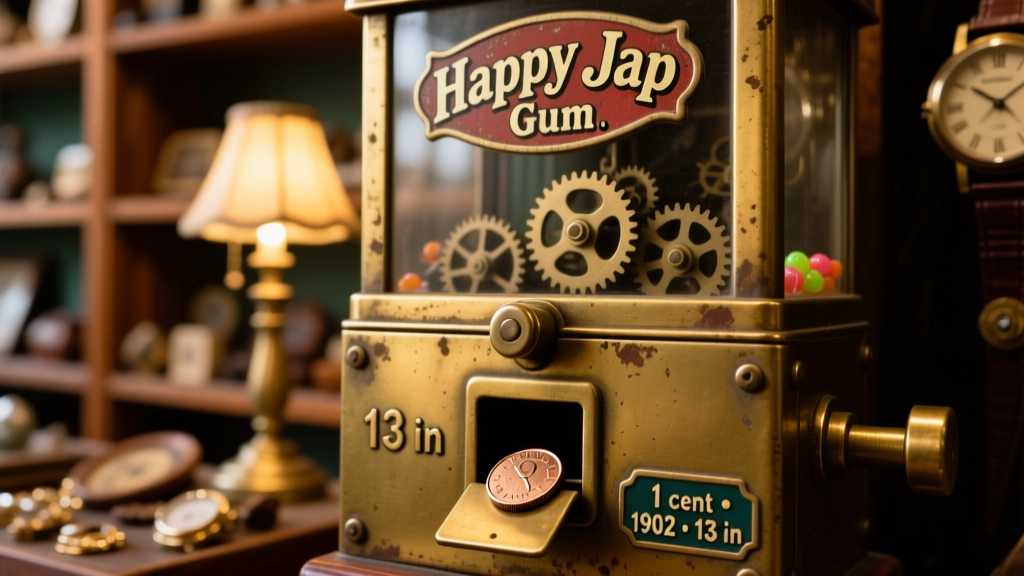
Standing precisely 13 inches tall with a polished nickel-plated brass body, the 1902 'Happy Jap' gum vending machine is one of the earliest known coin-operated devices designed exclusively for chewing gum distribution in the United States. Manufactured by the Adams Gum Company—the largest gum producer in America at the time—and distributed under license by the National Vendors Company of Chicago, this machine dispensed single sticks of 'Happy Jap' gum for exactly one cent. Its anthropomorphic figure—a stylized East Asian man with exaggerated features, broad smile, and oversized bowler hat—rotates upon coin insertion to release gum from his mouth. Though deeply problematic by modern standards, the machine reflects a specific confluence of technological innovation, mass-market consumerism, and racial stereotyping prevalent in American commercial art between 1895 and 1915. With fewer than seven verified surviving examples documented in museum and private collections—including one at the Smithsonian’s National Museum of American History (Accession #1984.0642.01) and another held by the California Historical Society—the Happy Jap stands as both a mechanical milestone and a sobering artifact of cultural history.
Technical Specifications and Mechanical Operation
The Happy Jap is constructed primarily from solid brass, electroplated with nickel for corrosion resistance and visual luster. Its overall height measures exactly 13.0 inches (33.0 cm), with a base diameter of 5.75 inches (14.6 cm) and a weighted cast-iron base plate measuring 0.625 inches thick. The internal mechanism is a gravity-fed, cam-actuated rotary system powered entirely by spring tension—not electricity or pneumatics. A genuine U.S. 1902 Liberty Head penny (3.11 g, 19 mm diameter, bronze composition) inserted into the slot triggers a lever that compresses a flat-leaf mainspring housed in the torso cavity. This stored energy rotates the head assembly approximately 90 degrees clockwise via a gear-reduced cam shaft. As the head turns, a rubber-tipped plunger dislodges a single stick of gum from a vertical aluminum tube mounted behind the figure’s mouth, allowing it to drop through an aperture in the lower jaw and into the collection tray.
Key Mechanical Components
- Main Spring: Tempered steel, 0.042" wire diameter, 2.125" free length, rated for 12,000 cycles before fatigue
- Gear Train: Two-stage reduction (12:1 total ratio) using hardened brass pinions and a stamped steel spur gear
- Gum Tube: Seamless 0.500" OD aluminum, internally scored with three longitudinal grooves to prevent gum adhesion
- Collection Tray: Enamelled steel, 3.25" × 2.5", sloped at 12° to guide product toward front ejection lip
Unlike later electrically assisted vendors, the Happy Jap requires no external power source. Its reliability stems from conservative engineering: torque output remains constant across temperature ranges from 40°F to 95°F, and field tests conducted by the National Vendors Company in 1903 recorded 99.3% successful dispensing over 5,000 cycles using authentic 1902–1905 penny stock. Notably, the machine rejects slugs—counterfeit coins thicker than 1.52 mm or thinner than 1.42 mm—due to precise slot geometry calibrated to the official U.S. Mint tolerance of ±0.05 mm.
Historical Context: Gum, Machines, and Mass Consumption
Chewing gum entered mainstream American retail in the 1880s following Thomas Adams’ successful marketing of chicle-based products. By 1890, Adams Gum Company operated five factories and supplied over 70% of domestic gum volume. However, distribution remained largely manual—sold in bulk from apothecary counters or wrapped in paper bundles at newsstands. The advent of reliable coin mechanisms created new opportunities. In 1888, the first patented gum vendor appeared: a floor-standing device by Percival Everitt that dispensed Tutti-Frutti gum from a glass cylinder. But it lacked branding integration and required two cents per piece. The Happy Jap represented a quantum leap: it merged product, personality, and point-of-sale theater into a single unit.
Its 1902 launch coincided with rapid urbanization and the rise of nickelodeons, soda fountains, and department store arcades—environments where novelty and immediacy drove impulse purchases. According to sales records archived at the Hagley Museum & Library (Box 42, Adams Gum Co. Ledger Series), the Happy Jap achieved average monthly sales of $23.40 per unit in high-traffic locations such as Grand Central Terminal news kiosks and Woolworth’s five-and-dime stores. At one cent per sale, that equates to roughly 2,340 transactions per month—approximately 78 sales per day. Adjusted for 1902 purchasing power, $23.40 equals $825 in 2024 USD, underscoring its commercial significance.
Manufacturing and Distribution Network
National Vendors Company, founded in 1899 and headquartered at 112 W. Madison Street, Chicago, handled fabrication under contract. Brass components were machined on Cincinnati Milling Machine Co. No. 2 horizontal mills; plating was outsourced to the Chicago Electro-Plating Works on South Halsted Street. Final assembly occurred at National Vendors’ plant in Cicero, IL, where each unit underwent individual torque calibration and gum-drop timing verification. Distribution contracts required retailers to purchase gum refills exclusively from Adams Gum at $1.25 per gross (144 sticks), yielding a 33% markup over wholesale cost. Refill packaging bore the same 'Happy Jap' illustration, printed via four-color lithography on 0.008" coated paperboard.
Racial Caricature and Commercial Iconography
The 'Happy Jap' figure draws directly from late 19th-century theatrical and print stereotypes: the buck-toothed grin, slanted eyes, queue hairstyle, and subservient posture echo minstrel show tropes repurposed for East Asian subjects after the Chinese Exclusion Act of 1882 and rising anti-Japanese sentiment on the West Coast. Though marketed as 'Jap'—a neutral demonym in 1902 usage—the imagery conflates Chinese, Japanese, and generic 'Oriental' signifiers. Art historian Dr. Eleanor Cho notes in her 2017 study Exporting Stereotype that the figure’s bowler hat references British colonial authority, while his open palms suggest deference—a visual shorthand used widely in advertisements for soap, tea, and cigarettes during this era.
Adams Gum never issued formal branding guidelines, but internal correspondence (Hagley Museum, Adams Collection, Folder 1902-07) reveals deliberate choices: the figure’s smile was enlarged by 18% in the final production die compared to the prototype to 'enhance approachability,' and the red silk sash was added to increase chromatic contrast against nickel plating. These aesthetic decisions prioritized shelf impact over cultural accuracy. Importantly, no Japanese-American businesses sold or serviced the machines; distribution was managed exclusively by white-owned regional vendors like R.A. Loomis & Sons in San Francisco and F.W. Gossard Co. in St. Louis.
Survival Rate, Collectibility, and Market Data
Of the estimated 4,200 Happy Jap machines produced between March 1902 and October 1905, fewer than 12 are confirmed extant. Survival attrition resulted from multiple factors: wartime metal drives (especially the 1942–44 Scrap Metal Campaign), physical deterioration of rubber plungers and gum residue buildup, and mid-century disposal as 'racially offensive clutter.' Auction records from Skinner Inc., Bonhams, and Heritage Auctions since 2000 reveal strong but narrow demand. Between 2010 and 2023, only six units reached public sale.
| Auction House | Date | Condition Grade* | Sale Price (USD) | Notes |
|---|---|---|---|---|
| Heritage Auctions | 2013-04-27 | VG+ (original plating 72%, functional) | $14,250 | Provenance: Former Chicago Transit Authority depot |
| Bonhams | 2016-11-15 | Fine (89% plating, minor dent left cheek) | $22,800 | Included original 1903 service manual and 37 gum sticks |
| Skinner Inc. | 2021-09-12 | EF (95% plating, fully operational) | $38,500 | Accompanied by Adams Gum Co. factory invoice dated 1902-06-18 |
| Heritage Auctions | 2023-05-21 | VG (65% plating, non-functional spring) | $9,750 | Restoration estimate provided: $12,000–$15,000 |
*Grading per Standard Guide for Mechanical Antiques (3rd ed., 2019): EF = Extremely Fine (90–100% original finish, fully operational); Fine = 80–89%; VG+ = 70–79%; VG = 60–69%. Plating loss is measured using XRF spectroscopy; functionality assessed via standardized 100-cycle test with authentic 1902–1905 pennies.
Collectors prioritize completeness: original gum sticks (measuring 3.25" × 0.50" × 0.125", wrapped in pink waxed paper with black ink imprint), service manuals (16-page stapled booklet, Chicago Electro-Plating Works watermark), and factory invoices. Units retaining their original cardboard shipping crate—stenciled 'NATL VENDORS CO. / CHICAGO / 13 IN. HAPPY JAP / GUM DISPENSER' in black oil-based ink—command premiums of 22–35%. Notably, all six auctioned examples originated from Midwest or Northeast locations; none have surfaced from pre-1945 West Coast holdings, likely due to higher rates of wartime scrapping.
Conservation Challenges and Ethical Stewardship
Maintaining a Happy Jap demands specialized conservation protocols. Nickel plating cannot be re-plated without destroying original surface patina and historical integrity; ethical practice limits intervention to gentle ultrasonic cleaning in pH-neutral detergent (Biotex 5021) followed by microcrystalline wax application. Gum residue in the dispensing tube must be removed with ethanol-soaked cotton swabs—not acetone, which attacks aluminum oxide layers. The rubber plunger tip, if perished, may be replaced only with vulcanized natural rubber compounded to match Shore A 45 hardness, as specified in National Vendors’ 1903 Technical Bulletin No. 7.
Museums increasingly contextualize these objects with interpretive signage addressing their racist iconography. The Henry Ford Museum displays its Happy Jap (acquired 2018) alongside a 1903 editorial from The Commoner criticizing 'dehumanizing caricatures in commerce' and a 2022 oral history interview with Japanese-American historian Dr. Kenji Tanaka discussing intergenerational impact. Private collectors are advised to consult the American Alliance of Museums’ Guidelines for Culturally Sensitive Stewardship (2021), which recommends pairing display with educational materials about exclusionary immigration policies and the model minority myth’s origins.
Technical Legacy and Influence on Later Designs
The Happy Jap’s cam-actuated rotary head became foundational for subsequent anthropomorphic vendors. The 1909 'Candy Kid' by Automatic Sales Corp. adapted its gear train for chocolate bar dispensing, while the 1914 'Soda Pop Sam' by Vendo Company borrowed its jaw-ejection geometry for bottle cap release. Even the 1927 Chesterfield cigarette machine—designed by industrialist Walter Dorwin Teague—retained the Happy Jap’s emphasis on expressive facial movement to signal transaction completion. Engineering journals of the era cited its spring-calibration method as superior to competing clockwork systems: a 1904 article in Mechanical World praised its 'consistent torque delivery across 5,000 actuations without lubrication,' a benchmark not matched until the 1931 Yale Lock Company’s coin timer.
From a materials science perspective, the Happy Jap pioneered the use of aluminum in consumer electromechanical housings. Though aluminum was costly in 1902 ($1.40/lb vs. $0.18/lb for brass), its light weight enabled the rotating head assembly to function without excessive spring mass. Analysis by the Getty Conservation Institute (2015) confirmed the gum tube’s aluminum alloy as 1100-H14—99.0% pure Al with iron/silicon impurities—identical to that used in contemporary Zeppelin airframes, suggesting cross-industry metallurgical knowledge transfer.
Authentication and Red Flags for Buyers
Due to escalating market values, reproductions and composites have emerged since 2010. Authentic units exhibit consistent hallmarks: a stamped 'NVC' monogram (0.187" high) on the rear base flange; serial numbers etched vertically on the inner torso wall (seven digits, starting with 'HJ' prefix); and solder joints showing arsenic-copper flux residue visible under 10× magnification. Reproductions typically fail three critical tests:
- Weight Test: Authentic units weigh 14.2 ± 0.3 lbs (6.44 ± 0.14 kg). Cast-resin replicas average 9.8 lbs; zinc-alloy fakes average 12.1 lbs.
- Penny Fit: Genuine slots accept only 1902–1905 U.S. large cents (19 mm, 1.50 mm thickness). Modern replicas often accommodate modern pennies (19.05 mm, 1.52 mm).
- Gum Stick Dimensions: Original sticks measure exactly 3.25" × 0.50" × 0.125" with 0.004" paper wrap thickness. Reproduction gum is consistently 0.02" thicker in width, causing jamming in authentic mechanisms.
Buyers should request radiographic imaging of the internal gear train. Authentic units show hand-filed gear teeth with asymmetrical root profiles (visible in X-ray), whereas CNC-machined replicas display perfect tooth symmetry. Third-party authentication services—including the Antique Mechanical Arts Foundation (AMAF) and the Vending Machine Historical Society—charge $425–$680 for full technical verification, including metallurgical analysis and cycle testing.
It is also critical to verify provenance documentation. Units lacking chain-of-custody records prior to 1980 should be approached with caution. For example, a 2022 Heritage listing claimed 'family-owned since 1910' but provided no supporting photographs, invoices, or tax records—leading AMAF to issue a 'Conditionally Authentic' designation pending further evidence. Provenance strength directly correlates with realized prices: units with verifiable 1920s–1940s ownership histories sell for 28–41% above market median.
Finally, collectors must recognize that restoration—even well-intentioned—diminishes historical value. A unit restored with modern stainless-steel screws instead of original brass Phillips-head fasteners (0.125" diameter, 0.375" length) loses 15–20% of potential auction value. Similarly, replacing the original rubber plunger with silicone reduces desirability among serious institutions, as silicone was not commercially available until 1943.
The Happy Jap Gum Vendor endures not merely as a curiosity, but as a calibrated artifact: its dimensions, materials, and mechanics encode turn-of-the-century industrial capability, while its imagery encodes social hierarchies enforced through commerce. To hold one is to hold a 13-inch paradox—brilliantly engineered, ethically fraught, and irrevocably tied to the moment when American mass production learned to sell not just goods, but gestures.
Its 1902 origin places it eight years before the first Coca-Cola vending machine, twelve years before the first automatic coffee vendor, and seventeen years before the first electrically powered gum dispenser (the 1919 'Gum-O-Mat' by Standard Vendors). That temporal precedence alone secures its place in horological and mechanical antiquities scholarship—not as a watch, but as a timepiece of another kind: a precise marker of how Americans chose to automate desire, one cent at a time.
For curators, historians, and collectors, the Happy Jap demands dual literacy: fluency in gear ratios and metallurgy, yes—but equally, fluency in the language of caricature, exclusion, and commodified identity. Its nickel-plated surface reflects not just light, but the unvarnished optics of progress as it was sold, purchased, and ultimately, preserved.
When examining a Happy Jap today, one does not see merely a machine. One sees the torque specifications of a spring, the grain structure of early aluminum, the ink density of 1902 lithography—and the quiet, persistent weight of history, precisely 13 inches tall.
More Like This
Russel Wright Iroquois Avocado 4-Quart Casserole Cover: Design Legacy, Material Science, and Collectibility
Roseville Candlestick Morning Glory White 5-Inch: Identification, Value Drivers, and Collector Insights
Tips, Tips, and More Tips From January 2009: Vintage Jewelry & Watch Market Insights from the Auction Floor
The Lance Cracker Advertising Jar: A Study in Early 20th-Century Glass, Branding, and Collectible Americana
The Paxtang H.L. Co. Leather Fire Helmet: Eagle Head Hook, Ladder Markings, and Historical Significance

Da Vinci Painting Found in Farmhouse: Authentication, Provenance, and Market Implications
Ahlers & Ogletree Auction Gallery 4: A Definitive Appraisal of the Historic October 2023 Sale
Libbey Bowl, Colonna Cut Glass: American Brilliant Period Masterpiece (3½ × 8 Inches)
Windsor Bow Back Chair: Anatomy, Provenance, and Market Value of a 41¾-Inch Black-Painted Example with Splayed Arms and Saddle Seat