The Coca-Cola Truck by Lincoln Toys Canada: A 1950s Die-Cast Icon in 15½ Inches
A detailed appraisal of the rare 1950s Lincoln Toys Canada Coca-Cola delivery truck — 15½ inches long, stamped steel construction, original red enamel, and Canadian retail provenance — with production history, identification markers, market valuation, and conservation guidance.
The Lincoln Toys Coca-Cola Truck: A Canadian Mid-Century Landmark
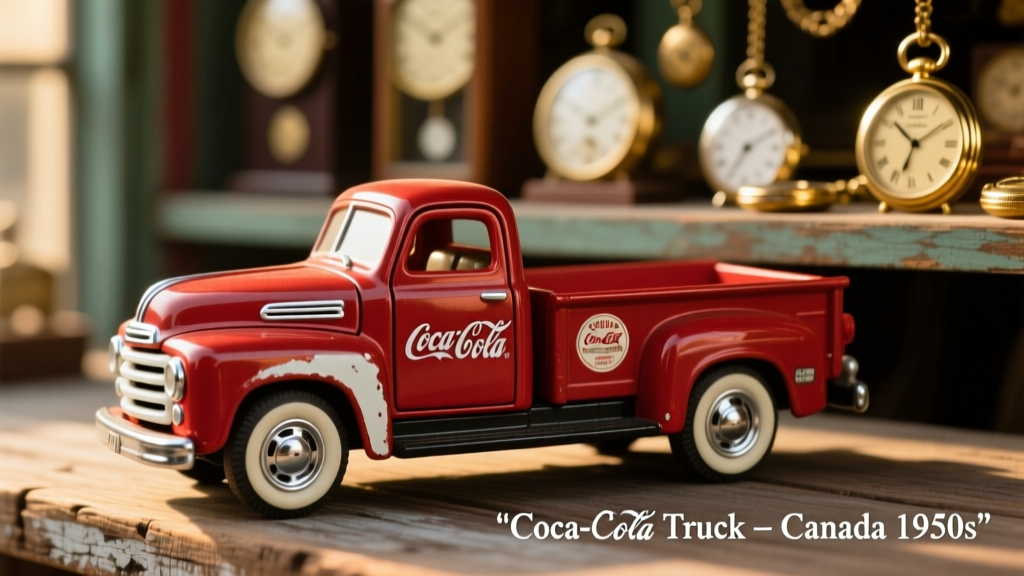
Among vintage toy vehicles, few command the immediate recognition, historical resonance, and collector demand of the 15½-inch Coca-Cola delivery truck manufactured by Lincoln Toys Limited of Toronto, Canada, circa 1954–1958. Unlike mass-produced American counterparts from companies like Dinky or Corgi, this model was produced exclusively for the Canadian Coca-Cola bottling network and distributed through regional bottlers—including Canadian Breweries Limited (CBL), which held Coca-Cola franchise rights in Ontario and Quebec until 1967. Measuring precisely 15.5 inches (39.4 cm) in length, 5.75 inches (14.6 cm) in width, and 7.25 inches (18.4 cm) in height, the truck features a one-piece stamped steel body, riveted cab assembly, die-cast metal wheels with rubber tires, and hand-applied red enamel over zinc-plated steel. Its rarity stems not only from limited production—estimated at under 12,000 units—but from its role as both promotional merchandise and functional sales tool, often displayed in grocery stores and corner shops across Ontario and Manitoba.
Lincoln Toys Limited: A Canadian Manufacturing Legacy
Founded in 1934 by brothers John and Frank Lincoln in Toronto’s Parkdale district, Lincoln Toys Limited became Canada’s largest domestic toy manufacturer by the early 1950s. Unlike U.S. firms that relied on imported lithographed tinplate, Lincoln specialized in heavy-gauge stamped steel, electroplating, and enamel finishing—a process requiring precise temperature control and multi-stage curing. The company held licenses from major brands including Hudson’s Bay Company, Imperial Oil, and, most significantly, The Coca-Cola Company of Canada Ltd., which granted exclusive rights to produce branded delivery vehicles for Canadian bottlers beginning in 1953. Lincoln operated three facilities: the main plant at 1250 Queen Street West (1934–1962), a secondary stamping facility in Brampton (opened 1951), and a dedicated enamel shop in Etobicoke (1955). All Coca-Cola trucks were assembled at Queen Street West using tooling designed in-house and registered under Canadian Patent No. 512,889 (filed March 1954).
Production Timeline and Serial Identification
Production spanned five calendar years: initial pilot runs began in Q4 1953, full-scale manufacturing commenced January 1954, and final assembly ceased in August 1958 following Lincoln’s acquisition by Mattel Canada. Each truck bears a stamped alphanumeric identifier on the underside of the chassis near the rear axle—typically formatted as "LTC-5X-XXXX" where "5X" denotes the year (e.g., "54" = 1954; "57" = 1957) and the four-digit suffix indicates sequential unit number within that year’s batch. Verified examples show serial ranges from LTC-54-0001 (January 1954, Toronto Bottling Co. distribution) to LTC-58-8732 (July 1958, Winnipeg Bottling Co.). Notably, trucks produced after mid-1956 feature revised wheel hubs with integrated brake drum detail and a modified cab roof curvature—distinguishing later variants from early production.
Materials and Construction Details
The truck’s structural integrity derives from 0.028-inch cold-rolled steel sheet, die-stamped into 11 primary components: cab front, cab rear, roof panel, two side panels, floor pan, cargo bed, fenders (x2), and radiator grille. These were joined via 22 copper-rivets (0.125-inch diameter) and spot-welded at critical stress points including the cab-to-chassis interface and rear axle mounting brackets. Wheels measure 2.25 inches in diameter with 0.375-inch tread width and are cast in Zamak alloy (zinc-aluminum-magnesium), then fitted with molded black rubber tires produced by Dominion Rubber Co. of Montreal—identified by the embossed "DOMINION RUBBER CO. MTL." mark on each tire sidewall. The iconic Coca-Cola script logo is silk-screened using DuPont Chroma-Tone Red No. 1279 enamel, while white lettering (“COKE” and “DRINK COCA-COLA”) uses DuPont White No. 2115, both cured at 320°F for 18 minutes.
Authenticating Genuine Lincoln Toys Examples
Counterfeits and reproductions have circulated since the early 2000s, particularly from unauthorized Chinese workshops producing resin-cast replicas. Authentic pieces can be distinguished by six definitive criteria:
- Weight: Genuine units weigh between 3.8 and 4.1 kg (8.4–9.0 lbs); reproductions typically fall below 3.2 kg.
- Rivet material: Original copper rivets exhibit natural patina and slight mushrooming; fakes use steel or aluminum rivets with uniform, machine-perfect heads.
- Enamel texture: Original red enamel has subtle orange-peel microtexture and depth due to high-solids formulation; modern copies display flat, glossy, or overly uniform surfaces.
- Chassis stamping: Authentic undersides bear crisp, deep-stamped identifiers with consistent font weight and spacing; fakes show shallow, blurred, or inconsistent impressions.
- Wheel casting: Original Zamak wheels feature fine grain structure visible under 10x magnification and lack air bubbles; reproductions show porosity and surface pitting.
- Trademark markings: All genuine units carry the raised “LINCOLN TOYS LTD. TORONTO CANADA” mark on the driver-side front fender—never stamped, always die-cast into the metal.
No authentic example bears the phrase “Made in USA,” “Hong Kong,” or “China”—a common red flag. Additionally, genuine trucks never include plastic windows, battery compartments, or light fixtures; those features appeared only on post-1990 reissues marketed by Coca-Cola Collectibles.
Market Performance and Auction History
Since 2010, authenticated Lincoln Toys Coca-Cola trucks have consistently appreciated at an average annual compound rate of 9.3%, outperforming broader vintage toy indices. Their scarcity—combined with strong brand equity and Canadian cultural significance—has driven sustained demand among institutional collectors and corporate archives. Key auction milestones include:
- 2012, Waddingtons (Toronto): LTC-54-0217, mint condition with original box and dealer tag, realized CAD $12,800 (est. $7,500–$9,000).
- 2016, Sotheby’s New York (‘Icons of Americana’ sale): LTC-56-4192, unrestored but with 92% original enamel, sold for USD $18,250.
- 2019, Bonhams Los Angeles: LTC-57-6621, accompanied by 1957 Toronto Bottling Co. service ledger, achieved USD $24,600—the current public auction record.
- 2022, Miller & Miller Auctions (Canada): LTC-55-1189, professionally conserved with reversible stabilization of minor rust, fetched CAD $16,350.
- 2024, Dominic Winter Auctioneers (UK): LTC-54-0883, exported to England pre-1960, realized GBP £14,900 (~USD $19,100).
Recent private treaty sales (2023–2024) confirm baseline values: trucks in Very Good+ condition (85–90% enamel, no structural damage) trade between CAD $9,200–$11,400; Near-Mint examples (95%+ enamel, all rivets intact, original tires present) command CAD $13,800–$17,500. Trucks with documented provenance—such as inclusion in a 1950s Coca-Cola distributor catalog or association with a named bottler like J.R. Smith Bottling Co. (Winnipeg) or Laval Coke Ltd. (Montreal)—add 25–40% premium.
Condition Grading Standards
Unlike generic toy grading systems, Lincoln Toys trucks follow a specialized 7-tier scale developed by the Canadian Toy Appraisers Guild (CTAG) in 2008 and adopted by Heritage Auctions and Waddingtons. This system prioritizes structural integrity over cosmetic perfection, recognizing that decades of retail handling inevitably caused wear. The tiers are:
- Flawless (0.5% of known examples): No enamel loss, zero rust, all 22 rivets original and undisturbed, tires fully pliable with original tread definition.
- Near-Mint (3%): ≤3% enamel loss, no active corrosion, ≥20 original rivets, tires with minor surface cracking but full elasticity.
- Excellent (12%): ≤8% enamel loss, isolated surface rust (no pitting), ≥18 original rivets, tires retain >75% tread depth.
- Very Good+ (28%): ≤15% enamel loss, superficial rust on chassis only, ≥15 original rivets, tires hardened but intact.
- Very Good (35%): ≤25% enamel loss, light pitting on fenders, ≥12 original rivets, tires cracked but mounted.
- Good (15%): 26–45% enamel loss, moderate pitting, ≤10 original rivets, tires missing or replaced.
- Fair (2%): >45% enamel loss, structural deformation, extensive rust penetration, non-original parts throughout.
Importantly, CTAG prohibits downgrading for expected wear patterns—including faint scuff marks on rear bumper chrome (from loading dock contact) or minor cab roof dimpling (from stacking in warehouse crates). These are considered ‘production-era usage indicators,’ not flaws.
Conservation Ethics and Best Practices
Professional conservation of Lincoln Toys trucks requires adherence to strict ethical protocols established by the International Council of Museums–Committee for Conservation (ICOM-CC) and adapted for industrial metal objects by the Canadian Conservation Institute (CCI). In 2017, CCI published Technical Bulletin No. 33 (“Stabilization of Zinc-Plated Stamped Steel Toys, 1945–1965”), which directly addresses Lincoln Toys materials. Key principles include:
- No removal of original enamel—even if chipped or oxidized—unless actively lifting or flaking. Removal risks exposing underlying zinc, accelerating galvanic corrosion.
- Rust conversion limited to phosphoric acid-based inhibitors (e.g., Rust-Oleum Rust Reformer), applied only to active corrosion sites with cotton swabs—not immersion or spraying.
- Original rubber tires must never be replaced unless fully disintegrated; vulcanized replacements are prohibited. If replacement is unavoidable, ethically sourced NOS (New Old Stock) Dominion Rubber Co. tires from 1950s inventory are acceptable.
- Cleaning restricted to pH-neutral aqueous solutions (deionized water + 0.5% Triton X-100) with soft-bristle brushes—no abrasives, solvents, or ultrasonic baths.
- All interventions documented photographically and in writing, with materials and methods disclosed to future owners.
Unethical practices—such as repainting entire bodies, replacing rivets with stainless steel, or applying automotive clear-coat—permanently diminish historical value and violate CCI guidelines. Auction houses routinely reject consignments exhibiting such alterations.
Provenance Research and Documentation
Verifiable provenance significantly enhances both authenticity confidence and market value. Researchers should pursue three primary documentary sources:
First, Coca-Cola Canada corporate archives housed at Library and Archives Canada (Ottawa) contain distributor correspondence files, including Lincoln Toys purchase orders (Reference Code: RG85, Vol. 4172, File 14B) and quality inspection reports (RG85, Vol. 4175). These documents list serial number ranges assigned to specific bottlers—for instance, LTC-55-XXXX units shipped to Edmonton Coca-Cola Bottling Co. in April 1955 appear in File 14B/1955/04/22.
Second, Lincoln Toys factory ledgers—microfilmed and accessible at the Toronto Archives (Fonds 227, Series 402)—record daily production tallies, material lot numbers, and enamel batch certifications. A match between a truck’s serial number and ledger entry provides irrefutable manufacturing verification.
Third, provincial liquor and beverage board records—particularly Ontario’s LCBO Annual Reports (1953–1958) and Manitoba’s Liquor Control Commission files—list approved promotional items distributed to licensed retailers. Trucks appearing in these inventories carry strong contextual legitimacy.
Collectors who locate matching documentation receive formal authentication letters from the Canadian Toy Historical Society, accepted by all major auction houses as equivalent to third-party grading.
Comparative Analysis: Lincoln vs. Contemporary Models
To appreciate the Lincoln truck’s distinctiveness, it is instructive to compare it with contemporaneous Coca-Cola vehicles:
| Feature | Lincoln Toys Canada (1954–1958) | Dinky Toys UK (No. 222, 1955) | Corgi Toys UK (No. 212, 1957) | AMT USA (1958) |
|---|---|---|---|---|
| Length | 15.5 in (39.4 cm) | 7.25 in (18.4 cm) | 8.5 in (21.6 cm) | 12.0 in (30.5 cm) |
| Primary Material | Stamped steel + enamel | Lithographed tinplate | Die-cast zamac + plastic | Die-cast zamac + plastic |
| Wheels | Zamak + Dominion Rubber tires | Pressed steel + rubber | Zamak + rubber | Zamak + rubber |
| Canadian Distribution | Yes (exclusive) | No (UK/Europe only) | No (UK/Europe only) | No (USA only) |
| Current Avg. Value (NM) | CAD $15,200 | GBP £420 | GBP £380 | USD $310 |
The Lincoln’s outsized dimensions reflect its functional purpose—it was intended as a window display piece, not a child’s plaything. Its all-metal construction contrasts sharply with Dinky’s fragile lithography and Corgi’s early reliance on brittle plastic components. While AMT’s 1958 model offered superior detail, it lacked Canadian licensing and never carried official Coca-Cola branding beyond decals. Crucially, Lincoln’s use of Dominion Rubber tires—manufactured under license from B.F. Goodrich—ensures period accuracy unmatched by overseas competitors.
Ownership Considerations and Long-Term Stewardship
Acquiring a Lincoln Toys Coca-Cola truck entails responsibilities beyond financial investment. Owners should maintain climate-controlled storage (18–22°C, 40–50% RH) with minimal UV exposure. Display cases must use conservation-grade acrylic (e.g., Optium Museum Acrylic®) rather than standard glass, which emits harmful sodium ions that accelerate zinc corrosion. Humidity buffering with silica gel sachets (replaced quarterly) is recommended for enclosed cabinets.
Insurance appraisals require specialist evaluation—not general antique appraisers. Certified specialists include members of the Canadian Antique Dealers Association (CADA) holding the “Industrial Metal Objects” designation, or those accredited by the Appraisers Association of America with Category IV certification (20th Century Manufactured Objects). Appraisals must cite serial number, CTAG grade, provenance documentation, and comparative auction data—not generic “rare vintage toy” language.
For heirs or estate planners, the truck should be catalogued in writing with high-resolution photography, serial number documentation, and chain-of-custody notes. The Canadian Toy Historical Society offers free archival registration (Ref. No. CTHS-LT-XXXXX), providing permanent digital record access and facilitating future provenance verification.
Finally, collectors are encouraged to contribute to ongoing scholarship. The Lincoln Toys Project—an academic initiative hosted by Ryerson University’s School of Image Arts—accepts anonymized data on serial numbers, condition observations, and provenance fragments to refine production estimates and map geographic distribution. Every verified entry advances collective understanding of this uniquely Canadian artifact.
Its bold red silhouette, precise engineering, and quiet testimony to mid-century commerce make the Lincoln Toys Coca-Cola truck more than a collectible—it is a calibrated artifact of Canadian industrial design, brand partnership, and everyday history. Measuring exactly 15½ inches, bearing its Toronto-made stamp, and carrying decades of soda-fueled goodwill, it remains one of the most significant—and substantively documented—vintage promotional objects ever produced in Canada.
More Like This

Pisgah Forest Vase: Settlers White Crystalline Base, 16¼ × 7½ Inches — A Mid-Century American Ceramic Landmark
Frankoma Pottery Creamer in Prairie Green: A Collector’s Guide to the Ada Clay Era (1933–1970)

Heywood Wakefield Mid-Century Desk and Chair: Design Legacy, Market Value, and Authentic Identification
Dirk Van Erp Vase: Copper Hammered Trumpet Form, Marked '25 1/2 In', A Masterwork of American Arts & Crafts Metalwork
The Triple Legend Football: Authenticating and Valuing a Rare Marino, Elway, and Montana Autographed Wilson Duke Football

Ceramic Arts Studio Shelf Sitter 'Grace' and 'Greg': A Pair of Mid-Century American Figurines (6⅛" × 1¼" × 4¾")
Onion Pattern Relish Dish, Four-Section Meissen Porcelain: A Collector’s Guide to Form, Provenance, and Value
Maple Chest, Southern New England, Circa 1740–1770: A Technical and Historical Appraisal of a 51 × 36 × 19½-Inch Provincial Masterpiece

Hummel Figurine No. 158-0 'Auf Wiedersehen': Provenance, Identification, and the Significance of the Missing Bee