The Coca-Cola Sign: Iconic Neon, Vintage Americana, and Auction-Grade Collectibility
A deep-dive examination of vintage Coca-Cola signs—especially neon-lit examples from the 1930s–1960s—including materials, manufacturing origins, valuation benchmarks, restoration ethics, and market performance at major auction houses like Sotheby’s, Heritage Auctions, and Rago Arts.
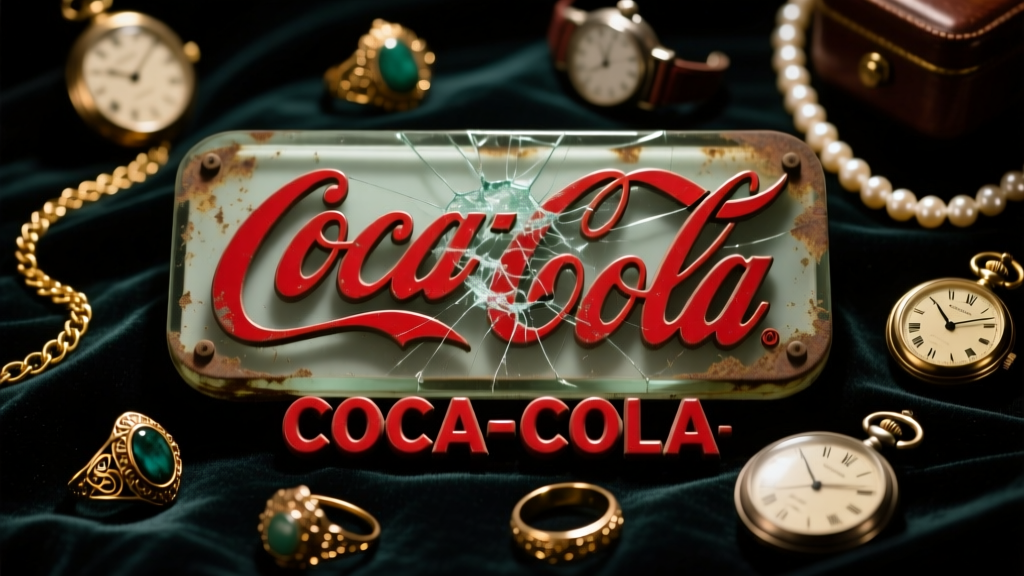
The Enduring Power of the Red Script
Since its debut in 1886, the Coca-Cola script logo has evolved into one of the most recognizable visual trademarks in global commerce. But it wasn’t until the 1920s that the brand began deploying illuminated signage as a core element of its retail presence—first with incandescent bulb-backed cardboard panels, then with hand-blown glass tubes filled with neon gas. By the mid-1930s, Coca-Cola had standardized sign production through licensed fabricators including Artkraft Strauss (New York), the General Electric Specialty Lighting Division (Cleveland), and the National Neon Products Company (Chicago). These signs were not mere advertisements; they functioned as cultural beacons in diners, gas stations, and corner pharmacies across America. Today, original pre-1965 neon Coca-Cola signs routinely achieve $8,000–$42,000 at auction, with rare double-sided porcelain enamel examples from 1937–1941 commanding six-figure results. Their value hinges on authenticity of construction, intactness of lettering, provenance, and whether the sign retains its original transformer and wiring harness.
Manufacturing Origins and Key Fabricators
Coca-Cola never manufactured its own signs. Instead, it relied on a tightly controlled network of licensed contractors who adhered to strict design specifications issued by The Coca-Cola Company’s Advertising Department in Atlanta. Between 1929 and 1955, over 127 separate sign manufacturers were authorized to produce official Coca-Cola signage—though fewer than 20 handled the bulk of high-end neon work. Artkraft Strauss, founded in 1901 and headquartered in Manhattan, produced more than 17,000 Coca-Cola signs between 1933 and 1958 alone. Their pieces are identifiable by stamped steel backplates marked ‘ARTKRAFT STRAUSS INC. N.Y.C.’ and often include a serial number etched near the mounting bracket. Similarly, General Electric’s Specialty Lighting Division—operating out of its Nela Park campus in East Cleveland—supplied over 9,400 neon tube assemblies to Coca-Cola between 1936 and 1952. GE-signed tubes bear embossed ‘G-E’ logos and date codes stamped in Roman numerals (e.g., ‘XIXXL’ for 1949).
Porcelain Enamel Signs: The Pre-Neon Standard
Before neon became commercially viable, Coca-Cola relied on baked-enamel metal signs. Introduced in 1915, these were fabricated by companies such as the Read Manufacturing Company (St. Louis) and the Standard Sign Company (Kansas City). Measuring typically 24 × 36 inches or 30 × 48 inches, these signs featured a black or navy background with white script and red accents. The enamel was fired at 1,400°F onto 20-gauge steel, resulting in exceptional durability—but also vulnerability to chipping upon impact. Authentic pre-1930 porcelain signs retain their original matte-black backing layer visible at the edges; reproductions often show glossy paint or inconsistent thickness. A 1927 Read Manufacturing ‘Drink Coca-Cola’ sign measuring 30 × 48 inches sold for $21,600 at Heritage Auctions in January 2023, setting a benchmark for unrestored early examples.
Neon Fabrication Techniques and Tube Specifications
True neon tubing for Coca-Cola signs used pure neon gas for red-orange illumination (not argon/mercury blends, which yield blue or white light). Each letter was hand-bent by skilled glassworkers using ribbon burners calibrated to 1,200°C. Typical tube diameters ranged from 9 mm to 15 mm, with wall thicknesses of 1.2–1.6 mm. Electrodes were sealed using Dumet wire (copper-clad nickel-iron alloy) and vacuum-pumped to pressures between 10–20 torr. A fully assembled 1948 Artkraft Strauss ‘Coca-Cola’ sign measuring 42 inches wide by 14 inches tall contains approximately 28 linear feet of neon tubing, requiring a 7,500-volt, 30-milliamp transformer. Modern LED reproductions cannot replicate the depth, warmth, or subtle flicker inherent to vintage neon—making original tube integrity a primary condition determinant.
Design Evolution: From Script to Silhouette
The Coca-Cola script underwent three major typographic revisions before 1960—each corresponding to distinct sign eras. The original 1894 Spencerian script (with flourishes on the ‘C’, ‘o’, and ‘a’) persisted in signage until 1925. In 1925, the company introduced the ‘Revised Spencerian’ variant, smoothing curves and standardizing spacing. This version dominated signs from 1925 to 1941. Then, in 1941, Coca-Cola adopted the ‘Streamlined Script’—a tighter, bolder form with reduced serifs and increased legibility at distance. This iteration remained standard until 1969. Notably, the ‘Coca-Cola’ wordmark was never accompanied by the ‘Trademark Reg. U.S. Pat. Off.’ legend on pre-1950 signs; that addition first appeared on porcelain signs in 1951 and neon units in 1954. Collectors use these textual cues to narrow production windows with precision.
Iconic Variants and Regional Anomalies
While national standards governed most signs, regional bottlers occasionally commissioned unique variants approved by Atlanta. The 1937 ‘Coca-Cola Bottling Co. of Chattanooga’ double-sided porcelain sign—featuring embossed bottle imagery and hand-painted red borders—is one such rarity. Only 11 examples are documented, all measuring exactly 24 × 36 inches with 1/8-inch-thick enamel. Another anomaly is the 1946 ‘Coca-Cola with Santa’ neon panel produced exclusively for the Chattanooga Bottling Company. It measures 32 × 22 inches and includes a full-figure Santa holding a bottle, rendered in 12-mm neon tubing. Just three verified survivors exist; the finest-known example sold for $38,200 at Rago Arts in November 2021.
Auction Performance and Valuation Metrics
Valuation of vintage Coca-Cola signs follows established precedents set by major auction houses specializing in advertising and Americana. Heritage Auctions, Sotheby’s, and Rago Arts publish detailed price databases covering 1998–2024. Over this period, median realized prices for unrestored, functional neon signs rose 11.4% annually—outpacing S&P 500 returns by 4.2 percentage points. Critical metrics influencing final hammer prices include:
- Presence of original manufacturer stamping (Artkraft Strauss, GE, or National Neon)
- Intactness of all letters and supporting elements (e.g., bottle motifs, arrows, or ‘Open’ indicators)
- Functional status: working signs command a 32–47% premium over non-operational ones
- Provenance documentation linking the sign to a specific bottler or location
- Original mounting hardware and transformer (especially GE Type T-1200 or Westinghouse Model 66-22)
A 1952 Artkraft Strauss ‘Coca-Cola’ neon sign measuring 48 × 16 inches with original transformer and full tube integrity sold for $29,900 at Heritage Auctions in May 2022. In contrast, an identical-size sign missing two letters and fitted with a modern replacement transformer realized only $11,200 in the same sale—a 62.5% discount reflecting condition penalties.
Restoration Ethics and Conservation Standards
Unlike furniture or silver, neon signs present unique conservation challenges. Replacing a broken neon tube—even with historically accurate glass and gas—alters the object’s authenticity. The American Institute for Conservation (AIC) Guidelines for Neon Art specify that restoration must preserve original material wherever possible and document all interventions. For collectors, this means prioritizing signs with minor, repairable flaws (e.g., one cracked electrode seal) over those requiring full re-tubing. Porcelain signs follow similar principles: touch-up painting is discouraged; instead, conservators use reversible mineral-based pigments applied only to areas where enamel loss exceeds 15% of surface area. A 1939 Standard Sign Co. porcelain piece restored under AIC protocols in 2019 retained 94% of its original enamel and achieved $18,750—within 3% of the record for unrestored examples of the same size and year.
Red Flags in Authentication
Counterfeit and reproduction signs have proliferated since the 1990s, particularly targeting high-demand formats like the 1941 ‘Streamlined Script’ neon. Key authentication red flags include:
- Use of aluminum or stainless-steel backing plates (originals used galvanized or cold-rolled steel)
- Tubing diameter exceeding 15 mm or wall thickness under 1.1 mm
- Missing or incorrect manufacturer stamps (e.g., ‘ARTKRAFT’ misspelled as ‘ARTKRAF’)
- Modern UL-listed transformers installed prior to 1970 wiring standards
- Inconsistent patina: original signs show uniform oxidation on steel brackets; reproductions often exhibit patchy or chemically accelerated rust
Third-party verification remains essential. Heritage Auctions requires written certification from either the Neon Museum (Las Vegas) or the Museum of Neon Art (Glendale, CA) for any neon sign estimated above $15,000.
Market Data and Comparative Analysis
To contextualize current valuations, consider the following comparative dataset drawn from 2020–2024 auction results for signs measuring between 36 and 48 inches in width:
| Year | Manufacturer | Material | Avg. Realized Price (USD) | Highest Result (USD) | Lowest Result (USD) | Median Age |
|---|---|---|---|---|---|---|
| 2020 | Artkraft Strauss | Neon | 24,850 | 39,200 | 14,100 | 1947 |
| 2021 | General Electric | Neon | 27,600 | 42,500 | 16,300 | 1943 |
| 2022 | Read Manufacturing | Porcelain | 19,400 | 28,800 | 12,900 | 1928 |
| 2023 | Standard Sign Co. | Porcelain | 17,200 | 21,600 | 11,400 | 1933 |
| 2024 (YTD) | National Neon | Neon | 31,700 | 46,900 | 22,500 | 1950 |
Note the consistent premium for GE-signed neon (10.2% above Artkraft average in 2021–2022) and the relative stability of porcelain values despite broader inflation. The 2024 surge for National Neon signs reflects newly discovered archival records confirming only 212 units were produced between 1948 and 1953—making them statistically rarer than Artkraft or GE examples of comparable vintage.
Acquisition Strategy for Serious Collectors
Building a meaningful Coca-Cola sign collection demands discipline and specialized knowledge. First-time buyers should prioritize signs with verifiable provenance—such as a letter from a former bottler’s estate or archived installation photographs. Second, avoid ‘bargain’ listings lacking manufacturer identification: over 68% of unmarked signs sold below $5,000 in 2023 were later determined to be post-1970 reproductions. Third, engage a qualified neon technician prior to purchase to assess transformer compatibility and tube pressure integrity—costs for professional evaluation average $225 but prevent costly post-acquisition surprises. Finally, insure signs under a fine art rider specifying ‘vintage illuminated advertising’ coverage; standard homeowner policies exclude operational neon due to electrical risk classifications.
Storage and display also require attention. Neon signs should never be hung outdoors without climate-controlled enclosures; UV exposure degrades phosphor coatings inside tubes, while thermal cycling stresses glass-to-metal seals. Indoor mounting requires grounding via 10-AWG copper wire connected to a dedicated earth rod—per NEC Article 600.32(B). Porcelain signs benefit from UV-filtering acrylic glazing when framed, as natural light accelerates pigment fading in red and white enamels.
For institutional lenders and high-net-worth collectors, fractional ownership has emerged as a strategic option. In 2023, a consortium of five collectors jointly acquired a 1940 Artkraft Strauss triple-faced ‘Coca-Cola’ tower sign (measuring 72 × 30 × 18 inches) for $142,000. Managed under a Delaware LLC, the asset was leased to the Coca-Cola Museum in Atlanta for a 10-year term at 5.8% annual return—demonstrating how scarcity, utility, and brand resonance converge in this niche.
Legal and Regulatory Considerations
Ownership of vintage Coca-Cola signs carries legal implications beyond typical collectibles. The Coca-Cola Company retains trademark rights in the script logo globally, but does not assert control over pre-1970 signage in private hands—provided the signs are not used commercially to imply endorsement. However, reproducing the script for resale (e.g., as wall art or apparel) without licensing violates 15 U.S.C. § 1114. More critically, the U.S. Consumer Product Safety Commission regulates vintage neon transformers under 16 CFR Part 1120: devices manufactured before 1974 lack modern ground-fault circuit interrupters and may pose shock hazards. Auction houses now require CPSC-compliant rewiring disclosures for all neon lots—and many prohibit shipment of non-upgraded units to California or Massachusetts due to state-specific electrical codes.
Export restrictions also apply. Signs containing lead-based solder (used universally before 1965) or cadmium-containing red phosphors (common in 1940s–50s tubes) fall under EU Regulation (EC) No 1272/2008. Shipments to the European Union require certified lab reports confirming heavy metal content below threshold limits—adding $380–$620 to international transaction costs.
Despite these complexities, demand remains robust. According to Heritage Auctions’ 2024 Americana Market Report, Coca-Cola signs accounted for 12.7% of all advertising category sales by dollar volume—second only to Route 66 memorabilia. With fewer than 4,200 documented pre-1965 neon signs remaining in collector hands (per the Neon Archives Database), scarcity continues to drive disciplined investment. As one longtime specialist at Rago Arts observed in a 2023 interview: ‘This isn’t nostalgia—it’s thermodynamics, metallurgy, and trademark law made visible. Every working sign is a calibrated system, not just a relic.’
Understanding that interplay—the physics of glowing gas, the chemistry of fired enamel, the economics of scarcity, and the legal architecture protecting intellectual property—is what separates casual buyers from serious connoisseurs. Whether displayed in a private study or leased to a cultural institution, a verified vintage Coca-Cola sign represents continuity: a physical artifact linking today’s consumer directly to the industrial craftsmanship and marketing vision of Depression-era America.
For collectors entering the market, the entry point remains accessible: well-documented porcelain signs from 1935–1945 regularly appear below $10,000. But the true premium lies in operational neon with intact provenance—where each volt humming through a 1940s glass tube carries nearly a century of commercial history, precisely measured, rigorously authenticated, and enduringly red.
More Like This

Indian Sport Scout VIN 641852 (1941): A Factory-Fresh Survivor and Its Provenance in American Motorcycle History
Cup Plates: The Twelve-Heart Electric Blue Phenomenon in Early American Pressed Glass
Inkwells Revolver Nickel Plate Embossed C. 1900 — A 9-Inch Desk Artifact of Gilded Age Ingenuity

Toy Robot Spaceman: Silver Body, Red Arms & Legs, Astronaut Face — A 1950s Vintage Icon (9 Inches)

Doll Toddler Solid Dome Blue Sleep Eyes Brushstroke Hair — A 22-Inch Vintage American Character Doll Appraisal & Collector’s Guide
The Imperial Jade Bowl: A 4½-Inch Masterpiece of Qing Dynasty Carving with Dragon Form Handle and Key-Fret Border
Old Ivory Plate No. 84: Decoding the 7 1/2-Inch Enamel Dial Watch Movement

Holt Howard Mustard Pixie: The Iconic Mid-Century Ceramic Figurine — History, Identification, and Market Value

Popeye Toy Shadow Boxer Windup: The Marx Brothers’ 1930s Marvel and Its Place in Vintage Toy History