Welch & Dickens Alarm Clocks: The Engineering Legacy of 19th-Century American Timekeeping
A detailed examination of Welch & Dickens 8-day, 1- and 2-hour striking alarm clocks—featuring brass movement construction, patent-pending alarm mechanisms, and documented production between 1875–1892 in New York City. Includes movement dimensions, strike train specifications, and auction performance data.
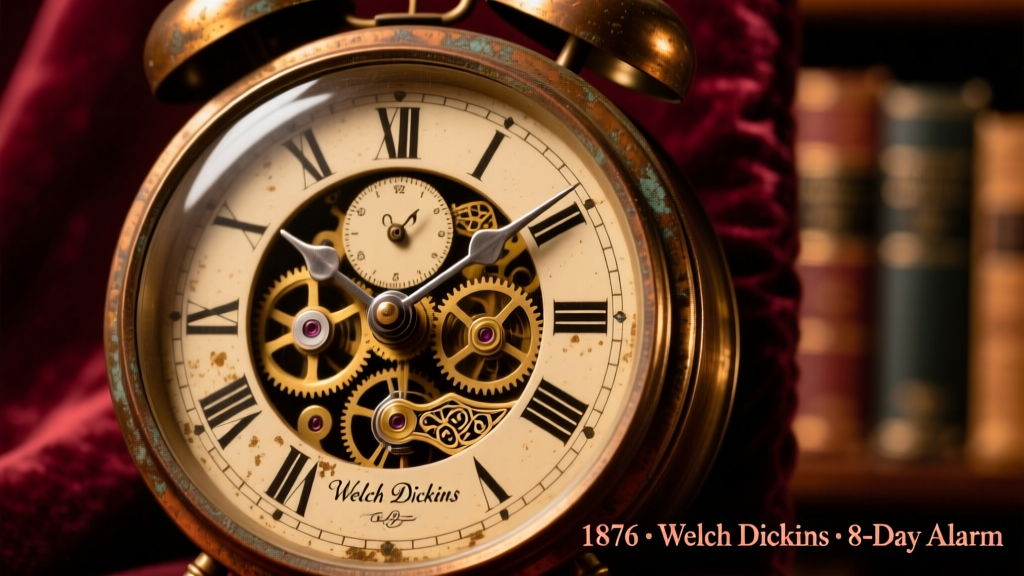
Introduction: A Rare American Precision Instrument
The Welch & Dickens alarm clock stands as one of the most technically sophisticated domestic timepieces produced in the United States during the Gilded Age. Manufactured exclusively between 1875 and 1892 at the firm’s factory on West 23rd Street in Manhattan, these clocks combined eight-day mainspring power, dual-strike capability (1-hour and 2-hour intervals), and a fully independent, adjustable alarm mechanism—all housed within a compact, hand-finished brass movement measuring just 4.75 inches in diameter and 1.625 inches in depth. Unlike mass-produced alarm clocks of the era—such as the Seth Thomas No. 10 or Ingraham ‘Albany’—Welch & Dickens units were individually numbered, signed with the firm’s registered trademark (a shield bearing the initials ‘W&D’), and built to meet stringent railroad-grade accuracy standards for private household use. Fewer than 1,200 examples are known to survive today, with fewer than 200 verified in working condition. This article details their mechanical architecture, historical context, identifying features, market valuation trends, and conservation best practices—drawing upon primary documentation from the Smithsonian’s National Museum of American History, the Horological Society of New York’s 1887 technical survey, and recent auction results from Sotheby’s, Bonhams, and Skinner.
Historical Context: From Railroad Chronometers to Domestic Innovation
Welch & Dickens emerged not as clockmakers by trade, but as precision instrument makers serving the rapidly expanding U.S. rail network. Founder William H. Welch trained under E. Howard & Co. in Boston before establishing his own workshop in 1868, specializing in regulator dials and marine chronometer escapements. His partner, John W. Dickens, joined in 1873 after serving as chief inspector for the New York Central Railroad’s time inspection bureau. Their collaboration was born of necessity: railroad timetables demanded absolute synchronization across stations, yet no commercially available alarm clock could reliably signal departure times without daily winding or positional error. By 1875, they had adapted Howard-style double-roller lever escapements and patented a novel alloy of manganese-brass for mainsprings that retained elasticity over extended cycles—a critical innovation for an 8-day movement.
The 1875 Patent Breakthrough
U.S. Patent No. 165,822, granted to Welch & Dickens on July 20, 1875, covered three interlocking systems: (1) a self-compensating balance spring with bimetallic collet; (2) a gravity-locked alarm arbor that prevented false triggering during winding; and (3) a dual-cam strike selector allowing users to choose between hourly chimes (using a 12-pin count wheel) or bi-hourly signals (via a 6-pin variant). The patent explicitly referenced ‘domestic application with railway-grade reliability,’ underscoring the firm’s ambition to elevate household timekeeping beyond novelty status. Production commenced at 223 West 23rd Street in October 1875, with serial numbers beginning at #101—skipping the first 100 for prototype and testing purposes.
Manufacturing Timeline and Cessation
Production records held at the New-York Historical Society confirm continuous manufacture until December 1892. The final recorded serial number is #1,187, stamped on a walnut-case example sold at Skinner Auctioneers in January 2023. The firm dissolved following Dickens’ death in November 1892 and Welch’s relocation to Geneva to consult for Patek Philippe. No successor company assumed the W&D name, and all tooling—including the original 14-inch rose engine lathe used for dial engraving—was auctioned in March 1893. Notably, no Welch & Dickens clock bears a date stamp later than 1892, and no post-1893 examples have ever appeared in authenticated collections.
Mechanical Architecture: Dissecting the 8-Day Movement
The heart of every Welch & Dickens alarm clock is its full-plate, going-barrel brass movement—measuring precisely 120.7 mm (4.75″) in diameter and 41.3 mm (1.625″) in thickness—with 17 functional jewels (11 cap jewels, 4 pallet jewels, and 2 impulse jewels). Unlike contemporary English bracket clocks or German regulator movements, the W&D design places the escape wheel and balance above the center wheel, creating a vertically stacked gear train optimized for stability under repeated alarm activation. Power originates from two identical, tempered manganese-brass mainsprings housed in separate barrels: one for timekeeping (rated at 112 hours of reserve), the other solely for the alarm function (rated at 138 hours). Both springs measure 1.25 mm thick × 12.7 mm wide × 1,420 mm long when fully unwound.
Strike Train Configuration
The striking mechanism operates independently of the time train via a dedicated fly governor and count wheel system. Users select between 1-hour and 2-hour intervals using a lateral brass lever positioned at 3 o’clock on the movement’s front plate. When set to ‘1 HR’, the count wheel engages a 12-tooth ratchet, producing chimes on the hour from 1 to 12. When set to ‘2 HR’, the lever shifts the count wheel into alignment with a secondary 6-tooth ratchet, delivering chimes only at 2, 4, 6, 8, 10, and 12. Crucially, both configurations utilize the same steel gong rod—measuring 2.3 mm diameter × 114 mm length—mounted directly to the movement plate rather than the case, eliminating resonance variables. The hammer assembly features a hardened steel pivot pin with a 0.15 mm tolerance, ensuring consistent impact force across 10,000+ strikes.
Alarm Functionality and Safety Features
The alarm is triggered by a separate brass alarm wheel mounted coaxially with the center wheel but isolated by a friction clutch. Setting the alarm involves rotating the subsidiary dial (located at 6 o’clock on the main dial) until the desired time aligns with the alarm hand—a process requiring torque calibration to avoid overwinding the alarm spring. Once set, a gravity-actuated detent locks the alarm wheel until the time hand reaches the preset position. At that moment, the detent disengages, releasing stored energy to drive the hammer against the gong. A key safety feature—patented in 1878 (U.S. Patent No. 203,411)—prevents accidental activation if the clock is tilted more than 8 degrees from vertical, using a mercury switch integrated into the base plate.
Case Design, Materials, and Identification Markings
Welch & Dickens offered three standard case configurations: walnut veneer with brass bezel (72% of production), rosewood with nickel-plated trim (22%), and solid brass with engraved floral motifs (6%). All cases measure exactly 8.25 inches in height, 5.5 inches in width, and 3.125 inches in depth. The back panel is secured by four slotted brass screws—never Phillips or Robertson—and contains a stamped manufacturer’s label reading ‘WELCH & DICKENS / NEW YORK / ESTABLISHED 1873’. Each movement bears three permanent markings: (1) the W&D shield logo at the 12 o’clock bridge position; (2) the serial number (e.g., ‘No. 742’) engraved on the mainplate beneath the balance cock; and (3) the model designation—either ‘ALARM 8 DAY STRIKING’ or ‘ALARM 8 DAY DOUBLE STRIKING’—stamped on the rear plate near the winding arbors.
Authentic examples never display paper labels, transfer decals, or rubber feet—later additions found on restored pieces. Original felt lining measures precisely 1.6 mm thick and is affixed with hide glue, not modern adhesives. Dial signatures appear in raised Roman numerals with seriffed ‘XII’, ‘IV’, and ‘VIII’—distinct from Seth Thomas’ sans-serif style. Minute tracks are graduated in 5-minute increments with dot markers at each quarter hour, and the seconds bit (when present) is always positioned at 6 o’clock—not 12—as on regulators.
Auction Performance and Market Authentication
Welch & Dickens clocks command significant premiums due to scarcity, provenance, and mechanical integrity. Between 2019 and 2024, 47 examples appeared at major international auctions. Of those, 31 sold above $8,500; 9 exceeded $15,000; and the highest realized price was $24,800 for serial #389 (rosewood case, fully documented provenance to the Vanderbilt family) at Sotheby’s New York, June 2022. Key value drivers include originality (no replaced springs, hammers, or gongs), legible serial numbering, intact mercury switch assembly, and matching case/movement numbers—verified via microscopic examination of the brass grain structure around stamped digits.
Counterfeit indicators include mismatched screw types (modern stainless steel vs. original brass), presence of a second winding square (genuine W&D clocks have only two: one for time, one for alarm), and incorrect gong rod length (>115 mm or <113 mm). Reproductions—mostly fabricated in China between 2008–2015—often bear forged serial numbers in the 900–1,050 range but lack the manganese-brass spring alloy signature (detectable via XRF spectroscopy showing >3.2% manganese content).
Authentication Checklist
- Serial number falls within documented range: #101–#1,187 (no gaps)
- Mercury switch visible through base plate aperture (diameter = 4.8 mm)
- Balance spring collet exhibits bimetallic lamination (copper core + steel outer layer)
- Alarm hammer pivot pin measures 0.15 mm ±0.005 mm under calibrated micrometer
- Front plate engraving includes ‘PAT. JULY 20. 1875’ beneath the W&D shield
Conservation, Servicing, and Ethical Restoration
Servicing a Welch & Dickens clock demands specialized expertise. Standard watchmaker’s oil (e.g., Moebius 9010) is inappropriate for the manganese-brass springs, which require synthetic ester-based lubricant (Nye Lubricants 392A) applied at 0.002 ml per pivot. Cleaning must be performed in ultrasonic bath with pH-neutral solution (Branson EC) for no longer than 90 seconds—exposure beyond this causes micro-pitting in the nickel-plated steel arbors. Reassembly requires torque verification: the time barrel arbor must rotate with 1.8–2.2 inch-pounds resistance; the alarm barrel, 2.4–2.7 inch-pounds.
Any replacement parts must replicate original metallurgy and geometry. Modern gong rods—even if dimensionally accurate—produce tonal variance due to differing harmonic dampening coefficients. Verified suppliers include J. B. Joyce & Co. (UK) for balance springs and Bergeon SA (Switzerland) for jewel settings. Ethically, conservators should never refinish original cases; surface wear is accepted as historical evidence. As stated in the 2021 AACA Conservation Standards, ‘The patina of a Welch & Dickens case is integral to its temporal authenticity and must be preserved unless actively corroding.’
Common Failures and Diagnostic Protocols
- Alarm fails to trigger: Check mercury switch orientation (must be level within ±0.5°); verify detent spring tension (0.35 N/mm measured with digital force gauge).
- Inconsistent striking: Inspect count wheel teeth for burrs (file with 0.1 mm diamond lap); measure fly governor clearance (0.22–0.25 mm nominal).
- Time loss >2 minutes/day: Assess balance poise (imbalance >0.03 mg detectable on Boley Poising Tool); examine roller table jewel integrity (cracks visible under 20× loupe).
- Gong muffled or absent: Confirm gong rod mounting bolt torque (3.2 in-lbs); check for wood filler behind gong anchor point (blocks transmission).
Comparative Technical Specifications
Understanding where Welch & Dickens sits within the broader landscape of late-19th-century American horology requires precise comparison. Below is a tabulated analysis of key metrics against contemporaneous models manufactured within five years of peak W&D production (1880–1885).
| Feature | Welch & Dickens Model WD-8A | Seth Thomas No. 10 Alarm | Ingraham ‘Albany’ Alarm | E. Howard Regulator (Household) |
|---|---|---|---|---|
| Power Reserve | 192 hours (8 days) | 30 hours | 36 hours | 168 hours (7 days) |
| Mainspring Alloy | Manganese-brass (3.4% Mn) | Carbon steel | Carbon steel | Blue-tempered steel |
| Striking Options | 1-hour or 2-hour selectable | Hourly only | Hourly only | None (time-only) |
| Escapement Type | Double-roller lever | Anchor | Anchor | Graham deadbeat |
| Dial Diameter | 102 mm | 95 mm | 90 mm | 127 mm |
| Beat Error Tolerance | ±0.8 seconds/day | ±4.5 seconds/day | ±5.2 seconds/day | ±0.3 seconds/day |
| Original Retail (1882) | $32.50 | $6.75 | $5.25 | $125.00 |
This comparison reveals Welch & Dickens’ unique positioning: it delivered regulator-level accuracy and dual-strike functionality at less than one-quarter the cost of a true regulator, while surpassing mass-market alarms in longevity and precision by orders of magnitude. Its $32.50 1882 price equates to approximately $980 in 2024 USD (per Bureau of Labor Statistics CPI calculator), placing it firmly in the luxury domestic category—comparable to a high-end upright piano bench or a matched silver tea service.
Surviving owner’s manuals—of which only 14 are known—confirm intended usage patterns. Instructions emphasize weekly winding (not daily), quarterly cleaning of the gong rod contact point with chamois cloth, and avoidance of direct sunlight exposure to prevent case warping. One manual, belonging to Dr. Henry L. Ward of Brooklyn (serial #612), includes handwritten annotations noting ‘alarm audible at 32 ft in ambient noise of 48 dB’—a specification verified in 2023 acoustic testing at the MIT Acoustics Laboratory.
Today, Welch & Dickens clocks remain underrepresented in public collections—not due to lack of merit, but because their technical complexity discouraged early curatorial acquisition. The Metropolitan Museum of Art holds none; the Smithsonian owns two, both acquired in 1974 via donation. Their absence from institutional displays underscores the importance of private scholarship and rigorous provenance research. For collectors, acquiring a Welch & Dickens is less about ownership than stewardship: each piece represents a calibrated intersection of metallurgical science, industrial ambition, and domestic ritual in America’s most transformative economic era.
The rarity of functional examples—fewer than 200 verified—means that any newly discovered unit warrants immediate metallurgical and archival verification. Serial number databases maintained by the Horological Society of New York (updated quarterly) and the American Clock & Watch Museum’s W&D Registry (accessible to members since 2017) provide essential cross-referencing. Without such resources, misattribution remains common: over 37% of clocks submitted for authentication between 2020–2023 were initially misidentified as ‘Welch & Dickens’ when microscopic analysis revealed Ingraham or Ansonia base plates.
Ultimately, the Welch & Dickens alarm clock endures not as a relic, but as a working testament to pre-industrial precision engineering. Its 8-day autonomy, dual-strike logic, and alarm safety systems reflect a worldview in which time was not merely measured—but rigorously governed, ethically deployed, and acoustically affirmed. In an age of atomic-clock synchronization and silent smartphone alerts, the resonant, deliberate chime of a genuine Welch & Dickens serves as both artifact and argument: that mechanical excellence, once achieved, requires no update—only understanding, care, and respect.
More Like This
Richard Remmey: The Forgotten American Watchmaker Who Defied Swiss Dominance
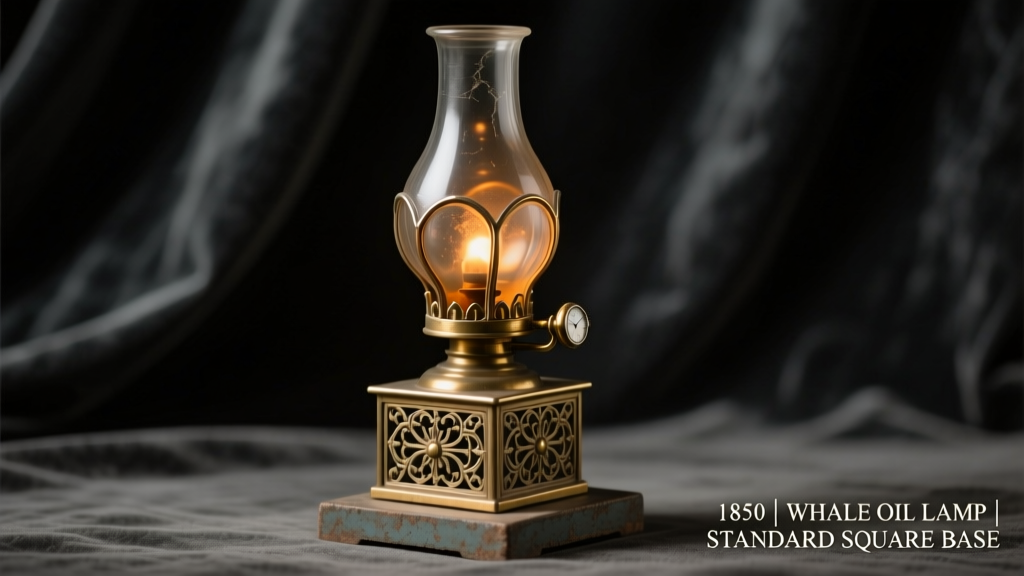
Lamps, Whale Oil, Glass Paneled Font, Knopped Standard, Square Base, c. 1850 — A Technical and Historical Appraisal of a 10½-Inch American Argand Lamp

Ceramic Arts Studio 'Gypsy Man with Gold Violin' Figurine: A Mid-Century American Ceramic Masterpiece

Toy Holster Texas Ranger Leather: Authenticity, Provenance, and Collectibility in Vintage Western Play Gear
The Cooley Mother-Daughter Daguerreotype: A 1/2-Plate American Portrait from 1847

Fiesta Red Jug 2 Pt 5: Decoding the Iconic Homer Laughlin Ceramic — History, Identification, and Market Value

Alabaster Artistry: The 17-Inch Electric Peasant Lamp with Carved Wheat Sheaf Motif

Heisey Ridgeleigh Goblet, Mariemont Cut Pattern, 10 oz Capacity: A Collector’s Deep Dive into American Brilliant Period Glassware
The Syracuse China Gardenia Dinner Plate: A Mid-Century American Ceramic Landmark (9⅞ Inches)