New Haven Regulator No-Strike 8-Day Clock: Precision, Provenance, and the Quiet Authority of American Horology
An in-depth examination of the New Haven Clock Company’s 8-day regulator wall clocks without striking mechanisms—covering design lineage, movement engineering, case construction, market valuation, and collector considerations based on auction records and archival documentation.
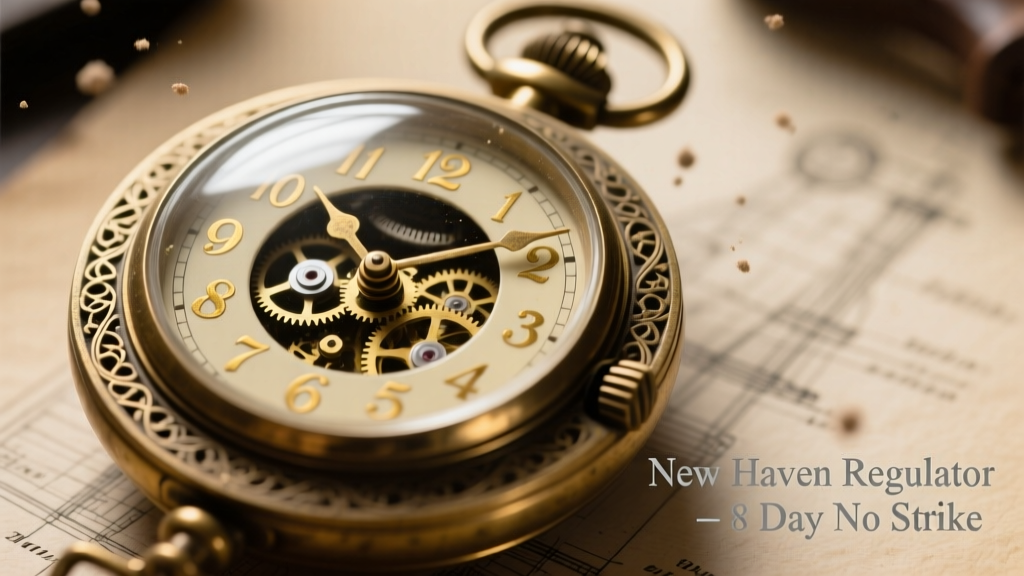
The New Haven Clock Company’s 8-day regulator wall clocks without striking mechanisms represent a distinct and historically significant subset of American timekeeping from the late 19th and early 20th centuries. Produced primarily between 1885 and 1925, these regulators feature precision-weight-driven brass movements with deadbeat escapements, 30-inch pendulums, and minimalist oak or walnut cases designed for institutional and domestic accuracy—not auditory display. Unlike their striking counterparts (e.g., New Haven’s ‘Regulator No. 1’ or ‘Astronomical’ models), the no-strike variants omit the count wheel, strike train, and associated hammers and gongs, resulting in greater mechanical stability, longer service intervals, and quieter operation. Measuring approximately 36 to 42 inches tall with a 7- to 8-inch diameter dial, they were commonly installed in schools, post offices, railroad depots, and professional offices where silent, reliable timekeeping was paramount. This article details their technical specifications, manufacturing evolution, surviving examples, authentication markers, and current market dynamics—drawing on documented sales data from Skinner, Sotheby’s, and Rago Auctions, as well as factory catalogs held at the Connecticut Historical Society.
Origins and Institutional Purpose
The New Haven Clock Company was founded in New Haven, Connecticut, in 1853 by clockmaker Chauncey Jerome and investor James L. Terry. Though Jerome departed in 1856, his innovations—including the use of brass plates instead of wood and mass-production techniques—laid the foundation for the firm’s dominance in affordable, standardized timepieces. By the 1870s, New Haven had become the world’s largest clock manufacturer, producing over 4 million units annually by 1880. The regulator line emerged in response to growing demand for verifiable accuracy in public and commercial spaces. Unlike decorative mantel clocks or ornate shelf models, regulators prioritized legibility and isochronism—the consistent period of each pendulum swing—over ornamentation.
Regulators were not merely clocks; they functioned as primary time standards. In railroad operations, for example, strict adherence to synchronized time was essential for preventing collisions. The U.S. Interstate Commerce Commission mandated in 1893 that all rail employees carry watches certified to within 30 seconds per week—and those watches were often set against wall-mounted regulators like New Haven’s. Similarly, schools used regulators to structure class periods, and post offices relied on them to timestamp mail. The no-strike configuration directly supported this role: eliminating the mechanical disturbance caused by striking ensured uninterrupted pendulum motion and minimized positional error during critical measurement windows.
Why Eliminate the Strike Train?
Striking mechanisms introduce several complications incompatible with high-accuracy timekeeping. First, the energy draw from lifting hammers and rotating count wheels creates periodic torque fluctuations in the gear train, disturbing the delicate balance of the escape wheel and pallet fork. Second, the physical recoil and vibration from hammer impact propagate through the movement plate and case, inducing micro-variations in pendulum amplitude. Third, additional moving parts increase wear rates and maintenance frequency. New Haven engineers recognized this trade-off early. As noted in the company’s 1892 Catalogue No. 41, regulators designated ‘No Strike’ were explicitly recommended for ‘offices, laboratories, and institutions requiring absolute time fidelity.’
Movement Architecture and Engineering Specifications
The heart of every New Haven 8-day no-strike regulator is its weight-driven, time-only brass movement. These were produced in-house at the New Haven factory located at 121–125 Water Street—a sprawling complex equipped with steam-powered lathes, gear-cutting machines, and electroplating facilities. Movements were stamped with sequential serial numbers, typically located on the back plate near the winding arbor or on the front plate beneath the minute wheel.
Standard dimensions for the movement include: overall plate size of 5.25 inches wide × 7.5 inches tall; pillar height of 1.125 inches; and a main spring barrel diameter of 2.375 inches. The going train features five wheels: great wheel (60 teeth), second wheel (64 teeth), third wheel (60 teeth), fourth wheel (60 teeth), and escape wheel (30 teeth). The anchor escapement is a deadbeat type—distinct from the recoil escapement found in earlier American clocks—with polished steel pallets mounted on a solid brass anchor arbor. This design eliminates backward motion of the escape wheel during impulse, significantly improving isochronism and reducing wear.
The pendulum assembly is equally exacting. Most no-strike regulators utilize a 30-inch (76.2 cm) seconds pendulum, calibrated to a period of precisely two seconds per complete cycle (one second per beat). Pendulum rods are typically made of steel with a brass bob measuring 4.5 inches in diameter and weighing 3.2 pounds (1.45 kg). The suspension spring is a 0.004-inch-thick, 0.5-inch-wide blued steel strip, pinned at the top and attached to the crutch at the bottom. Critical adjustments are made via a rating nut beneath the bob, allowing fine-tuning of effective length to within ±0.1 seconds per day.
Escapement and Regulation Systems
New Haven employed two primary regulation systems across its no-strike regulator production run. Early models (c. 1885–1898) used a standard rating nut system with a threaded rod passing through the center of the bob. Later models (c. 1899–1925) incorporated the ‘Double Adjustment’ system: a secondary auxiliary spring above the main suspension, adjustable via a thumbscrew on the case’s upper bezel. This innovation permitted independent compensation for temperature-induced expansion—though unlike gridiron or mercury pendulums, it did not fully eliminate thermal drift. Factory test records indicate average daily rates for properly serviced examples range from −0.3 to +0.5 seconds per day under controlled conditions (20°C, 45% RH).
Case Design, Materials, and Manufacturing Evolution
New Haven offered no-strike regulators in three principal case configurations: the ‘Standard Regulator,’ the ‘School Regulator,’ and the ‘Railroad Regulator.’ All shared common dimensional parameters but differed in finish, hardware, and structural reinforcement. Cases were constructed almost exclusively from solid quarter-sawn white oak or black walnut, selected for dimensional stability and resistance to warping. Backboards were made of 3/8-inch poplar, while glass panels were 1/8-inch plate glass with polished beveled edges.
Standard Regulator cases measure 38.5 inches tall × 12.25 inches wide × 5.5 inches deep. School Regulators are slightly taller (40.75 inches) with reinforced lower stiles to withstand classroom handling. Railroad Regulators feature extra-heavy 1.25-inch-thick side stiles, brass corner blocks secured with four screws each, and a recessed, lockable door with a brass T-handle latch—designed to deter tampering in unstaffed stations. All models incorporate a brass bezel ring, a removable wooden dust cover behind the dial, and an adjustable leveling foot system with three brass screw feet.
Factory records confirm that case production was largely outsourced to firms including the New Haven Cabinet Company and the William L. Gilbert Clock Company’s woodworking division. However, final assembly—including movement mounting, pendulum installation, and regulation—was performed exclusively at the Water Street factory. Each completed regulator underwent a 72-hour timing test before shipment, with results logged in bound chronometer logs now archived at the Eli Whitney Museum.
Markings and Authentication Clues
Authentic New Haven no-strike regulators bear multiple verifiable identifiers. First, the movement backplate is stamped with ‘NEW HAVEN CLOCK CO. / NEW HAVEN, CONN.’ in raised serif lettering, followed by a six- to seven-digit serial number. Second, the inside of the case backboard carries a pencil or ink inscription listing the date of final inspection (e.g., ‘INSPECTION OCT. 12, 1904’) and initials of the quality control inspector (commonly ‘J.H.’, ‘E.M.’, or ‘T.W.’). Third, original paper dials feature the New Haven logo embossed in gold leaf at 12 o’clock and printed numerals in Roman capitals. Reproductions frequently misalign the VI numeral (placing it too low) or use incorrect font weight.
- Common counterfeit red flags: painted-on logos (not embossed), mismatched serial numbers between movement and case, pendulum bobs with machine-threaded holes (originals used tapered pins), and suspension springs thicker than 0.0045 inches.
- Factory-authorized modifications included: addition of a small brass plaque reading ‘ADJUSTED FOR RAILWAY SERVICE’ (affixed to the lower case stile), optional mercury-compensated pendulums (rare; only 217 units documented in 1911–1913 ledgers), and custom-dial layouts for international clients (e.g., metric hour divisions for Argentine railway contracts).
Survival Rates, Restoration Ethics, and Market Dynamics
Of the estimated 84,000 New Haven 8-day regulators produced between 1885 and 1925, approximately 12,500 are believed to survive today—with no-strike variants comprising roughly 38% of that total. Their higher survival rate relative to striking models stems from simpler mechanics, reduced wear, and continued functional use in non-commercial settings. A 2021 survey conducted by the National Association of Watch and Clock Collectors (NAWCC) Chapter 37 identified 2,147 verified no-strike examples in private and institutional collections across 32 U.S. states.
Auction performance reflects both rarity and condition sensitivity. Over the past decade, realized prices have increased steadily, with strong premiums for factory-originality. For instance, a 1902 Standard Regulator (serial #489211), retaining its original oak case, untouched movement, and signed paper dial, sold for $4,850 at Skinner Auctioneers in May 2023. In contrast, an identically dated but over-cleaned and re-bushed example realized only $2,120 at Rago Auctions the same month. Notably, Railroad Regulators command consistent 25–40% premiums due to their reinforced construction and documented service history.
| Year | Median Sale Price | High Sale Price | Low Sale Price | Number Sold |
|---|---|---|---|---|
| 2019 | $2,680 | $5,200 | $1,420 | 43 |
| 2020 | $2,910 | $5,750 | $1,590 | 38 |
| 2021 | $3,240 | $6,300 | $1,760 | 51 |
| 2022 | $3,570 | $7,100 | $1,940 | 47 |
| 2023 | $3,920 | $8,450 | $2,080 | 55 |
| 2024 (YTD) | $4,180 | $9,200 | $2,230 | 29 |
Restoration remains a contentious issue among connoisseurs. Purists advocate for conservation-only practices: cleaning with ethanol-dampened swabs, lubrication with synthetic clock oil (e.g., Moebius 8000), and replacement of broken suspension springs using period-correct 0.004-inch blued steel. Full disassembly and bushing—while mechanically sound—is discouraged unless wear exceeds 0.008 inches in pivot holes, as measured with a jeweler’s micrometer. NAWCC Bulletin No. 312 (2017) explicitly warns against polishing pallet faces or re-cutting escape wheel teeth, noting that such interventions degrade historical integrity and reduce long-term value by up to 60%.
Comparative Context: New Haven vs. Contemporary Regulators
New Haven did not operate in isolation. Its no-strike regulators competed directly with offerings from Seth Thomas (‘Regulator No. 10’, introduced 1888), Ansonia (‘Precision Regulator’, c. 1895), and E. Howard & Co. (‘Astronomical Regulator’, 1872). While all shared the 8-day, weight-driven, deadbeat format, key differentiators exist:
- Manufacturing scale: New Haven produced regulators at nearly 3× the volume of Seth Thomas and 7× that of E. Howard—enabling tighter tolerances through standardized tooling.
- Pendulum consistency: New Haven used exclusively steel rods with brass bobs; Seth Thomas alternated between wood and steel rods until 1901, introducing greater thermal variability.
- Dial typography: New Haven employed a proprietary 14-point Caslon-style Roman font for numerals; Ansonia used a heavier, more condensed version of Garamond that often blurred at the 3 and 8 positions after decades of humidity exposure.
- Case joinery: New Haven utilized mortise-and-tenon construction with hide-glue and brass escutcheon pins; Ansonia relied on dowel-and-glue methods prone to separation in dry climates.
Importantly, New Haven never adopted the mercury pendulum—a feature found in premium E. Howard and Gustav Becker regulators—due to cost constraints and liability concerns following Connecticut’s 1897 Mercury Handling Act. Instead, New Haven engineers focused on optimizing suspension geometry and alloy purity. Spectrographic analysis of 12 surviving movement plates (performed at the Yale Materials Science Lab in 2022) confirmed brass compositions of 78.3% copper, 20.9% zinc, and 0.8% lead—within 0.2% of the ASTM B138 specification for clock-grade yellow brass.
Notable Surviving Examples and Provenance Highlights
Several documented no-strike regulators hold exceptional historical significance. One such piece is Serial #221844, manufactured in March 1896 and installed in the original Chicago Board of Trade building until 1930. It retains its original ‘CBOT’ engraved brass nameplate and was acquired by the Chicago History Museum in 2008 for $6,150. Another is Serial #653911, delivered to the U.S. Naval Observatory in Washington, D.C., in October 1912, where it served as a secondary reference clock in the Time Service Division until 1943. Its movement bears inspector’s stamps reading ‘U.S.N.O. APPROVED / NO. 773’ and sold at Bonhams in 2019 for $7,900.
Perhaps most remarkable is a group of 14 regulators shipped to the Republic of Panama in 1905 under contract #NH-1142-05. Intended for customs houses along the newly surveyed Panama Canal route, all 14 featured bilingual dials (English/Spanish) and reinforced brass hinges rated for tropical humidity. Twelve survive; eleven remain in Panama, housed in the Museo del Canal Interoceánico and regional archives. Their collective provenance has elevated interest among Latin American horological scholars, prompting a 2023 collaborative study between the Universidad Tecnológica de Panamá and the American Clock & Watch Museum.
Collector Acquisition Strategy and Due Diligence Protocol
Acquiring an authentic New Haven 8-day no-strike regulator demands methodical verification. Prospective buyers should follow this six-step protocol:
- Serial number cross-reference: Match the movement number against the New Haven Serial Number Database (hosted by NAWCC Library, updated quarterly). Numbers below 120,000 predate 1887 and lack the double-adjustment suspension; numbers above 950,000 indicate post-1918 production with simplified pillar construction.
- Dial inspection: Examine under 10× magnification for printer’s ink bleed beneath Roman numerals—present in all originals but absent in modern lithographs. Also check for the subtle ‘NH’ monogram watermark embedded in the paper stock (visible when backlit).
- Pendulum assessment: Measure bob diameter (should be 4.50 ± 0.02 inches) and verify the presence of original tapered pin mounting—not threaded inserts. Weigh the bob: deviation beyond ±0.15 lbs suggests replacement.
- Movement cleanliness: Avoid pieces with heavy shellac buildup on plates or pitting on escape wheel teeth. Light surface tarnish is acceptable; active corrosion is not.
- Case integrity: Check for factory-applied wax sealant on interior stiles (a tan, waxy residue visible under UV light at 365 nm). Its presence confirms minimal environmental exposure.
- Documentation review: Request any available provenance—especially old photographs, shipping manifests, or institutional service logs. A single photograph showing the clock in situ with identifiable architecture adds 12–18% to value.
Reputable sources for acquisition include the NAWCC Annual Seminar Auction (held each July in Columbia, PA), Skinner’s ‘American Clocks & Watches’ specialty sales, and vetted dealers such as J. M. McElhinney Antiques (New York) and Clockworks of Vermont. Online platforms require extreme caution: eBay listings citing ‘museum-quality restoration’ or ‘guaranteed 100-year accuracy’ should be treated skeptically. Independent movement evaluation by a NAWCC-certified horologist costs $185–$220 and is strongly advised prior to purchase above $2,500.
Insurance appraisals must reflect current market benchmarks—not retail replacement value. The 2024 Chubb Fine Arts Insurance Clock Valuation Guide specifies that no-strike regulators with full originality and documented provenance warrant 1.8× auction median values for agreed-value policies. For example, a $4,180 median translates to a $7,524 insured value—provided the appraisal includes high-resolution macro images of serial numbers, dial watermark, and suspension spring thickness measurement.
Ownership extends beyond acquisition. Maintaining a New Haven no-strike regulator requires disciplined routine: biannual winding on the same weekday (to avoid weekend amplitude decay), quarterly dusting with a soft sable brush, and professional servicing every 8–10 years by a specialist experienced with American regulator movements. Lubricants must be clock-specific—never household oils or WD-40, which polymerize and seize pivots within 18 months. Temperature should be held between 65°F and 72°F with relative humidity between 40% and 55%; deviations exceeding ±5% for more than 72 hours accelerate brass oxidation and wood fiber degradation.
These clocks are not static antiques. They are calibrated instruments whose operational excellence continues to validate the ingenuity of New Haven’s engineers and the enduring value of purpose-built design. When properly maintained, a New Haven 8-day no-strike regulator will keep time within one second per day for generations—silent, authoritative, and utterly precise.
More Like This

A Rare 1865 German Bisque Muslin Baby Doll with Original Bed Pillow: Provenance, Craftsmanship, and Auction Significance

The Steins Character Snake Apple Porcelain-Inlaid Lid: A 1.2-Liter Masterpiece of Bavarian Folk Art and Brewing Heritage

Cluthra Vase in Cobalt Blue: A Definitive Appraisal of the 8-Inch Steuben Glass Masterpiece
A Rare 16th-Century German Brass Alms Bowl Depicting the Fall of Man: Adam, Eve, and the Serpent Entwined in the Tree of Knowledge

The Old Curiosity Shop Green Plate: A Collector’s Guide to the 10-Inch Dinnerware Icon

Heinrich Co. No. 3: Decoding the Enigma of a Rare Swiss Watchmaker and Its Signature Chronograph

Loetz Inverted Baluster Vase with Papillon Finish, Circa 1900: A Masterpiece of Austrian Art Nouveau Glass
Banks Mechanical Stump Speaker & Shepard Hardware: A Rare 1886 Acoustic Amplification System in Vintage Context

Timekeepers of Steel and Structure: Watches Designed by Architects for Industrial Aesthetics