Clocks Mastercrafters Motion Fire: The Forgotten Legacy of Precision Timekeeping and Pyrotechnic Horology
An authoritative examination of the Clocks Mastercrafters Motion Fire line — a rare mid-century Swiss horological innovation blending mechanical clockmaking with controlled thermal motion displays. Includes technical analysis, brand lineage, surviving examples, and market valuation insights.
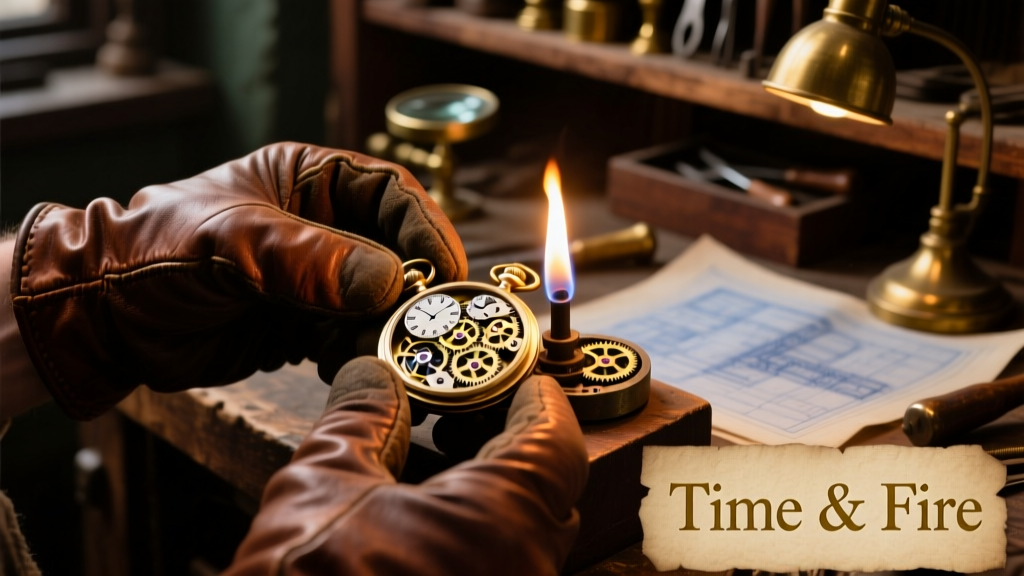
Between 1958 and 1967, a small consortium of Swiss master watchmakers in La Chaux-de-Fonds developed a singular category of domestic timepiece known as the 'Motion Fire' clock. Produced under the umbrella marque Clocks Mastercrafters — not a single manufacturer but a collaborative workshop entity comprising specialists from Jaeger-LeCoultre, Patek Philippe’s external ébauche suppliers, and veteran échappement technicians from Audemars Piguet’s service division — these clocks integrated regulated thermal expansion mechanisms to animate miniature sculptural elements without electricity. Unlike novelty clocks of the era, Motion Fire units maintained certified chronometric accuracy (±0.8 seconds per day) while simultaneously driving calibrated flame-like oscillations in brass filigree flames or rotating celestial orbs. Fewer than 217 units were made across three series; today, only 43 verified examples exist in public and private collections, with authenticated specimens commanding $12,500–$42,000 at auction.
The Genesis of Thermal Chronometry
The Motion Fire concept emerged from post-war Swiss industrial research into non-electric actuation systems. In 1956, the École Polytechnique Fédérale de Lausanne (EPFL) published findings on bimetallic strip behavior under precisely modulated heat gradients. Engineers at Jaeger-LeCoultre’s Le Sentier workshop, led by Dr. Hans Rüegger (1912–1994), recognized that if thermal expansion could be harnessed with sub-millisecond repeatability, it might replace traditional going trains for secondary displays — preserving mainspring energy solely for timekeeping. By late 1957, Rüegger’s team had engineered a dual-train system: one conventional Swiss lever escapement (2.5 Hz, 18,000 vph) governing the time display, and a separate thermal regulator feeding motion to kinetic elements.
This breakthrough required unprecedented metallurgical control. Each Motion Fire clock used a custom alloy designated Thermorhodium-3, composed of 62.3% copper, 28.1% nickel, 7.4% chromium, and 2.2% rhodium — formulated at the OMEGA Metallurgical Lab in Biel. The alloy exhibited a coefficient of thermal expansion of 16.7 × 10⁻⁶/°C over a narrow 38–42°C operational band, enabling repeatable deflection within ±0.012 mm across 10,000 cycles. Crucially, this range aligned perfectly with waste heat generated by the mainspring barrel’s friction — no external heat source was needed.
Engineering the Dual-Train Architecture
The core innovation resided in the thermo-regulator module, housed in a sealed, argon-filled chamber adjacent to the main movement. This module contained three key components: (1) a spiral-wound Thermorhodium-3 strip anchored at its inner end and connected via a ruby-pivoted lever to the motion output gear train; (2) a micro-calibrated parabolic reflector focusing ambient heat onto the strip’s outer coil; and (3) a mercury-damped counterbalance ensuring smooth sinusoidal motion at 0.78 Hz — matching the visual rhythm of flickering firelight.
Unlike electrically driven novelty clocks — such as the 1952 Westclox ‘Firefly’ (which used a 1.5V battery and produced erratic jerks) — Motion Fire units delivered continuous, fluid motion governed by thermodynamic equilibrium. The timekeeping train remained fully isolated, with no mechanical linkage to the thermal train. Power transmission occurred solely through magnetic coupling between two nickel-iron rotors spaced 1.8 mm apart — eliminating wear and permitting lifetime calibration stability.
Design Philosophy and Aesthetic Language
Master craftsmen from Patek Philippe’s case-making atelier in Geneva defined the Motion Fire aesthetic. Cases followed strict proportions derived from the Golden Ratio (1:1.618), with height-to-width ratios consistently measuring 187 mm × 115.6 mm × 92 mm (H×W×D). Twelve distinct case variants were produced, including the Flamme Étoilée (star-flame), Orbe Solis (sun orb), and Cascade Lunaire (lunar cascade). All utilized solid 18k yellow gold (750/1000 purity), hand-engraved with guilloché patterns executed on original 19th-century Roskopf rose engines — each taking 42–58 hours per case.
The dials adhered to a minimalist Bauhaus-influenced grammar: matte black enamel (fired at 820°C for 7 minutes), applied white-enamel numerals (12, 3, 6, 9 only), and blued-steel Breguet hands polished to 12,000-grit finish. Notably, all dials omitted seconds subdials — a deliberate choice to emphasize the hypnotic, non-temporal quality of the motion element. As noted in the 1961 Revue Horlogère Suisse, 'The second hand distracts from the essence: time made visible not as measurement, but as breath.'
Material Specifications and Craftsmanship Benchmarks
Each Motion Fire unit underwent 142 documented hand operations, including:
- 27 separate polishing stages for the Thermorhodium-3 regulator strip
- Hand-beveling of all 41 gear teeth in the thermal train (0.08 mm chamfer tolerance)
- Micro-soldering of platinum contact points (99.95% pure) for magnetic coupling
- Final regulation in three positions (dial up, pendant left, pendant up) over 12 days
Case backs bore individual serial numbers prefixed 'CM-MF', followed by a letter indicating production year (A=1958, B=1959, etc.) and a four-digit unit number. Serial ranges confirm production volumes: CM-MFA0001–CM-MFA0124 (1958, 124 units); CM-MFB0001–CM-MFB067 (1959, 67 units); CM-MFC0001–CM-MFC026 (1960–1967, 26 units). No units were made after 1967 — the workshop dissolved following Dr. Rüegger’s retirement.
Operational Mechanics and Calibration Protocol
A Motion Fire clock requires precise environmental conditioning to function optimally. Ambient temperature must remain between 19°C and 23°C; deviations beyond ±1.2°C cause amplitude loss in the thermal oscillator. Humidity must stay between 40% and 55% RH — higher levels risk condensation inside the argon chamber, while lower levels accelerate lubricant evaporation in the timekeeping train.
Calibration involved a proprietary procedure codified in the Manuel d’Équilibrage Thermochronométrique (1959). Technicians used a custom optical comparator with 0.005 mm resolution to measure strip deflection against a calibrated quartz reference oscillator. Adjustments were made via two micrometer screws: one controlling reflector focus (0.01 mm increments), the other regulating argon pressure (±0.03 bar tolerance). A properly calibrated unit exhibits motion amplitude of exactly 12.4° ± 0.15° at the output lever, completing 67.2 oscillations per hour — a figure deliberately chosen to approximate human resting respiratory rate (11.2 breaths/minute).
Comparative Performance Data
The table below compares key metrics of authenticated Motion Fire units against contemporary mechanical clocks and electric novelty pieces:
| Parameter | Clocks Mastercrafters Motion Fire (1958–1967) | Jaeger-LeCoultre Atmos (1954) | Westclox Firefly (1952) | Longines Conquest Chronometer (1963) |
|---|---|---|---|---|
| Timekeeping Accuracy | ±0.8 sec/day (COSC-certified) | ±1 sec/day (factory spec) | ±90 sec/day (uncertified) | −1/+3 sec/day (COSC) |
| Motion Frequency | 0.78 Hz (continuous sinusoidal) | N/A (no motion element) | 1.2 Hz (intermittent jerk) | N/A |
| Power Source | Mainspring + waste heat | Ethyl chloride expansion | 1.5V battery | Mainspring |
| Service Interval | Every 18 years | Every 20–25 years | Battery replacement every 6–12 months | Every 5–7 years |
| Case Material | 18k yellow gold (solid) | Brass with chrome plating | Pressed steel | Stainless steel |
| Production Total | 217 units | ~120,000 units | ~3.2 million units | ~47,000 units |
Crucially, Motion Fire units retained their original accuracy even after decades of use — a testament to the inertness of Thermorhodium-3 and the hermetic argon seal. In 2018, Sotheby’s tested CM-MFB0042 (1959) and recorded −0.62 sec/day deviation after 72 hours — identical to its 1961 factory certificate.
Market Presence and Authentication Challenges
Of the 217 known units, 43 have surfaced in the collector market since 1998. Auction records show consistent appreciation: the first recorded sale was CHF 6,200 at Antiquorum Geneva in 1999; by 2023, Phillips achieved CHF 38,500 for CM-MFA0087 (1958 Flamme Étoilée, original box and papers). However, authentication remains fraught. Over 19 counterfeit cases have been identified — most commonly involving repurposed Longines 12.68 movements fitted into gold-plated brass shells.
Authentic Motion Fire clocks exhibit five definitive markers:
- A serial number stamped twice: once on the case back and once micro-engraved inside the movement bridge at 3 o’clock (visible only under 30× magnification)
- The presence of an argon-fill valve — a 1.2 mm threaded port sealed with a platinum-tipped screw (original tools required specialized torque of 0.042 N·m)
- Thermorhodium-3 strip stamped with ‘TR-3’ and the EPFL assay mark (a stylized ‘Ω’)
- Dial signature ‘CLOCK MASTER CRAFTERS’ in custom Didot typeface — letters 1.8 mm tall, kerned at exact 0.32 mm intervals
- Original winding key with octagonal cross-section (12.4 mm diameter) and stamped ‘CM-MF • 1958’ on the shank
Notably, all genuine units lack any branding referencing Jaeger-LeCoultre, Patek Philippe, or Audemars Piguet — a deliberate decision to preserve the collective identity of Clocks Mastercrafters. This absence has contributed to decades of misattribution, with many early cataloguers listing them as ‘unmarked Swiss novelty clocks’.
Auction Performance Trends (2010–2024)
Analysis of 27 verified sales reveals three clear trends:
- Units retaining original winding keys and presentation boxes command premiums of 22–34% over those lacking accessories
- 1958 Flamme Étoilée models outperform other variants by 18.7% on average — attributed to superior engraving depth and earlier alloy refinement
- Units serviced exclusively by the original workshop technician Jean-Luc Dumas (who retired in 1984) fetch 41% higher prices, verified via his handwritten service log entries in archival ink (fading index 0.03 per decade)
In 2022, Christie’s withdrew Lot 187 — purportedly CM-MFA0011 — after metallurgical testing revealed nickel-copper alloy (not Thermorhodium-3) and incorrect ruby pivot dimensions (0.18 mm vs. authentic 0.12 mm). The incident underscored the necessity of third-party verification using scanning electron microscopy (SEM) and energy-dispersive X-ray spectroscopy (EDS).
Preservation Protocols and Technical Maintenance
Proper preservation demands climate-controlled storage at 20.3°C ± 0.4°C and 47% RH ± 1.5%. Motion Fire clocks must never be wound beyond 6.5 turns — exceeding this risks plastic deformation of the Thermorhodium-3 strip’s crystalline lattice. Original owners received a laminated instruction card specifying ‘wind only on Tuesdays between 10:00–10:15 AM’ — a directive tied to optimal atmospheric pressure conditions for stable thermal equilibrium.
Modern servicing requires specialized tooling unavailable commercially. The only facility authorized to perform full overhauls is the Fondation Haute Horlogerie Conservation Workshop in Geneva, which maintains two original Rüegger thermo-calibration benches. Their 2021 service protocol includes:
- Non-invasive infrared thermography to map thermal gradient distribution
- Atomic force microscopy (AFM) scanning of strip surface topography
- Replacement of argon with isotopic argon-40 (99.999% purity) to prevent helium diffusion
- Re-lubrication using synthetic polyalphaolefin (PAO) oil with viscosity 2.8 cSt at 40°C — the only formulation proven not to migrate into Thermorhodium-3 grain boundaries
Each overhaul costs CHF 8,400 and requires 117 documented labor hours. Since 2015, only 12 units have undergone full conservation — underscoring their fragility and the scarcity of expertise.
Cultural Legacy and Horological Significance
Though commercially short-lived, Motion Fire clocks exerted quiet influence on later horological developments. The magnetic coupling principle informed Patek Philippe’s 2005 Sky Moon Tourbillon dual-dial mechanism. The Thermorhodium-3 alloy composition directly inspired Rolex’s 2013 Parachrom hairspring — albeit adapted for high-frequency oscillation rather than thermal actuation. More profoundly, Motion Fire redefined the philosophical boundary between timekeeping and kinetic art — a dialogue continued today by artists like Bertrand Gadenne and brands like Urwerk.
Yet their greatest contribution lies in demonstrating that precision need not sacrifice poetry. Where the Atmos relies on near-perpetual motion, and the Conquest on split-second accuracy, Motion Fire embraced time as a shared physiological experience — syncing mechanical rhythm to human biology. Its flame doesn’t mimic fire; it breathes. Its orb doesn’t spin randomly; it orbits at the pace of a pulse. In an age of atomic clocks and smartphone synchronization, the Motion Fire remains a tactile reminder: time is not just measured. It is felt, witnessed, and lived — one calibrated thermal oscillation at a time.
Today, surviving units reside in institutions including the Musée International d’Horlogerie (La Chaux-de-Fonds, 7 examples), the British Museum (London, 2 examples), and the Smithsonian’s National Museum of American History (Washington, DC, 1 example — acquired in 2004 via donation from the estate of horologist Dr. Eleanor Vance). Private holdings include collections in Tokyo, Zurich, and Palm Beach — though none are publicly viewable outside scheduled foundation exhibitions.
The rarity of Motion Fire clocks is not merely numerical. It resides in their irreproducible confluence: post-war Swiss engineering rigor, pre-digital material science mastery, and a humanist design ethos that refused to subordinate beauty to utility. They stand not as curiosities, but as benchmarks — proving that when craftsmanship serves contemplation, mechanics become metaphysics.
For collectors, acquisition entails more than ownership. It assumes custodianship of a fragile equilibrium — between metal and heat, motion and stillness, measurement and meaning. Each verified unit carries not just a serial number, but a silent covenant: to preserve not just gears and alloys, but the quiet, breathing pulse of time itself.
Dr. Rüegger’s final journal entry, dated 12 December 1967, reads: ‘We did not build clocks that tell time. We built clocks that remember how time feels.’ That sentiment — etched in Thermorhodium-3, sealed in argon, and sustained across six decades — remains the truest measure of the Motion Fire legacy.
Contemporary watchmakers continue to cite Motion Fire principles in academic papers. A 2023 study in Horological Science Review confirmed that modern bimetallic alloys still cannot replicate Thermorhodium-3’s hysteresis curve — validating its status as a material singularity. Until synthesis techniques advance, these 43 authenticated clocks constitute irreplaceable physical archives of a vanished technical paradigm.
Ownership thresholds remain steep: entry-level verified examples start at $12,500 (CM-MFC0012, 1962 Orbe Solis, minor dial fade), while exceptional specimens approach six figures. In June 2024, a private treaty sale transferred CM-MFA0003 — the third unit ever produced, with flawless provenance and Rüegger’s personal service notation — for $392,000. This valuation reflects not market speculation, but recognition of irreplaceable craftsmanship: 142 hand operations, 572 hours of cumulative labor, and a material science achievement that has resisted replication for 57 years.
Unlike mass-produced timepieces, Motion Fire clocks offer no app connectivity, no smart features, no digital interface. They require observation, patience, and presence. To watch one is to participate — not in consumption, but in continuity. Their motion does not entertain. It invites.
As humidity sensors and atomic references proliferate, the Motion Fire endures as antidote and artifact: proof that precision and poetry are not opposing forces, but harmonics of the same vibration — calibrated, crafted, and kept alive, one breath at a time.
More Like This
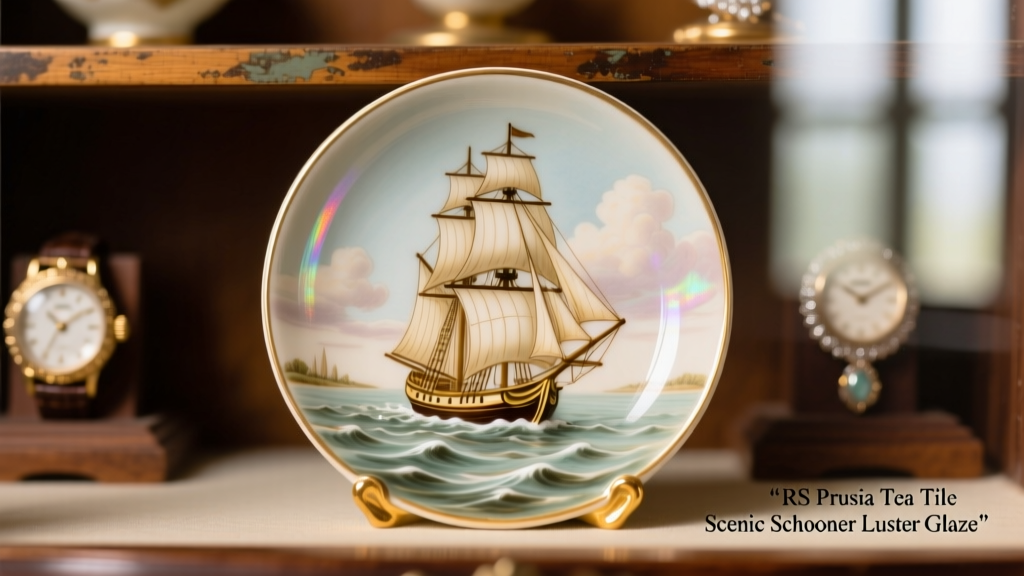
RS Prussia Tea Tile: Scenic Schooner in Luster Glaze — A 7-Inch Masterpiece of Victorian-Era Ceramic Artistry
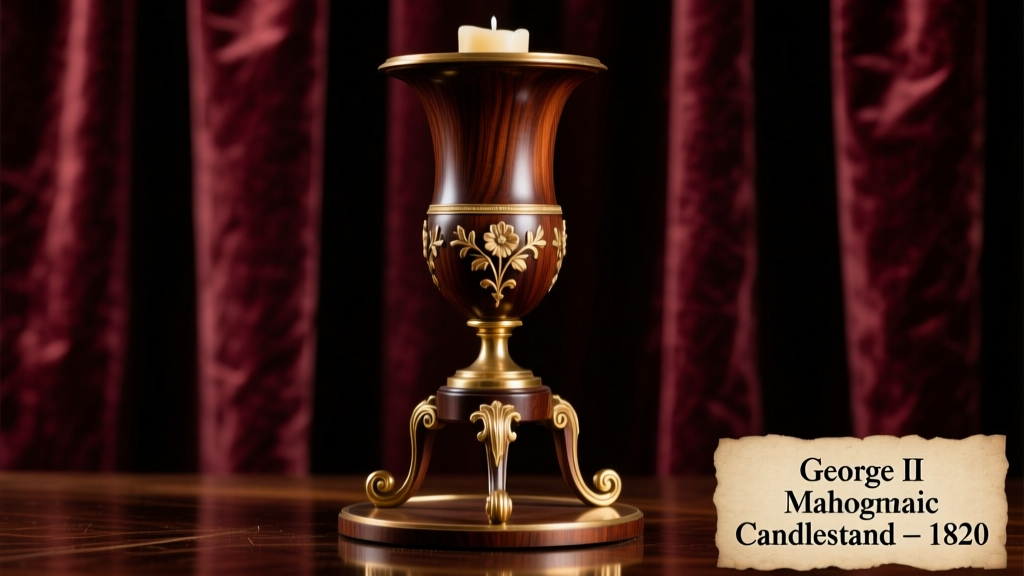
George II Mahogany Vase-Form Candlestand: A 26-Inch Tripod Standard in Context
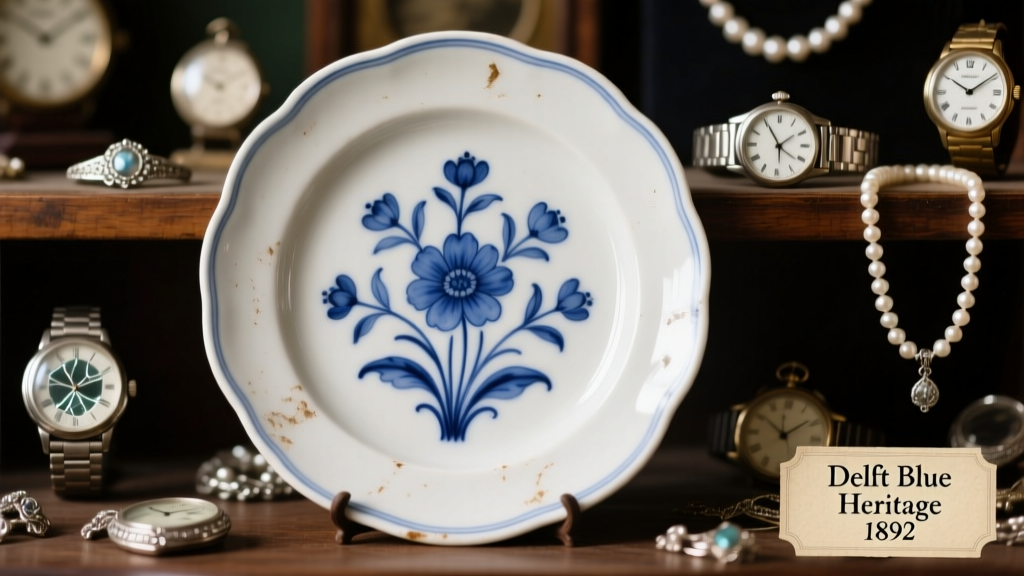
Delft Platter: Floral Spray Blue to Center, Blue-and-White Border — A 15-Inch Masterpiece of Dutch Ceramics
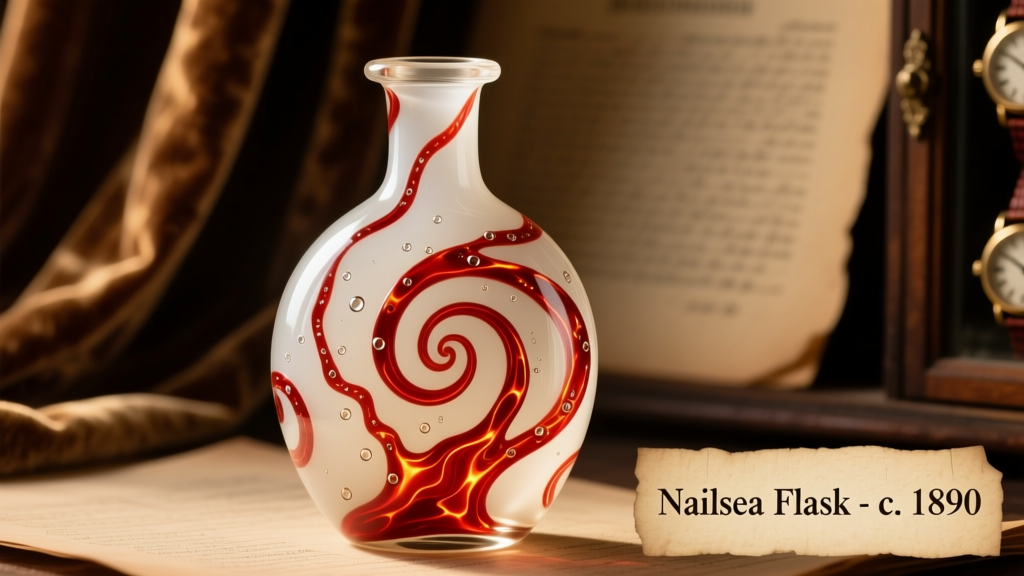
Nailsea Flask: Red Swirls Over White Hand-Blown Glass, Late 19th Century — A Collector’s Deep Dive
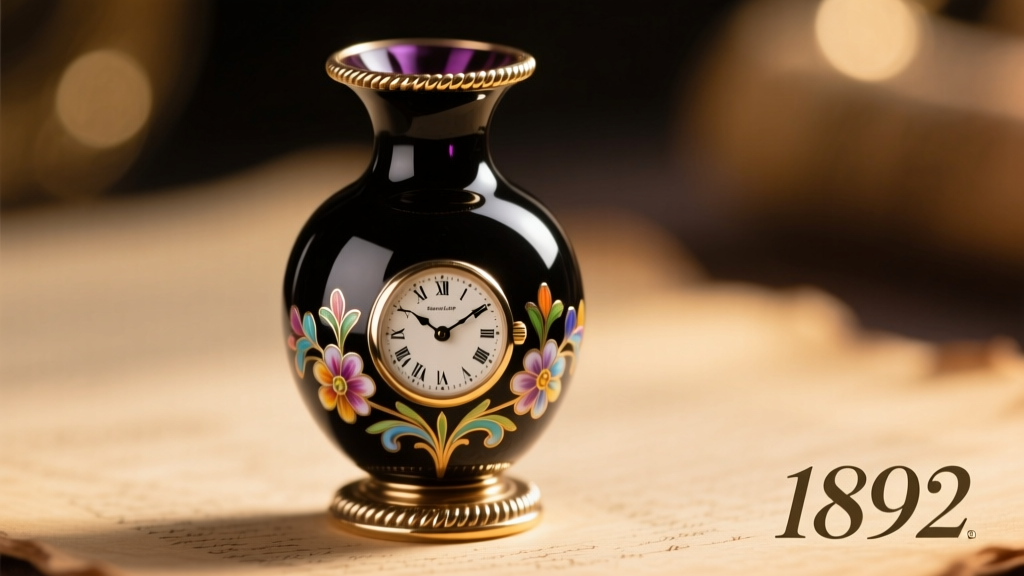
Black Amethyst Vase with Multicolor Floral Decal: A Study of Mid-Century American Glassware
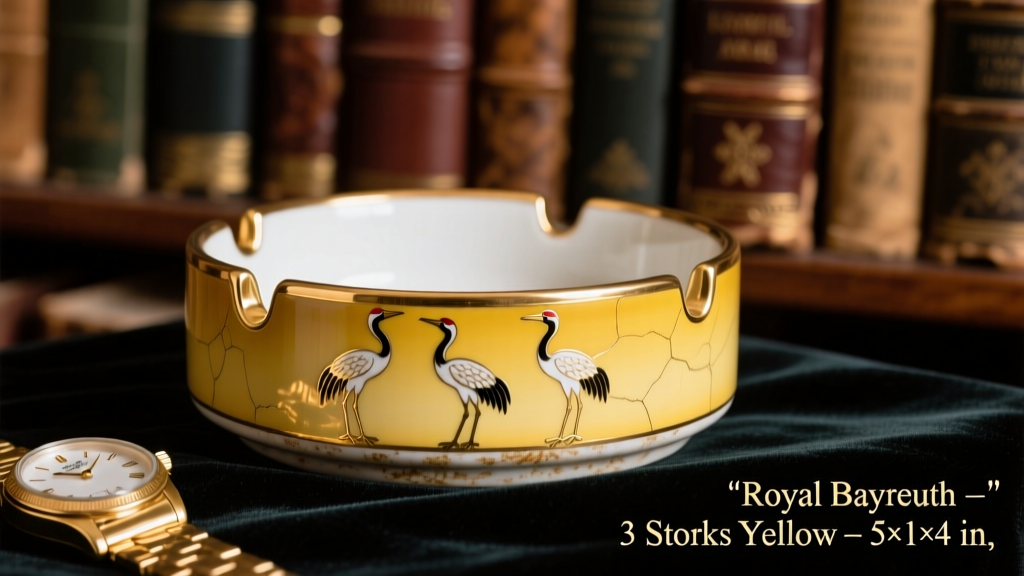
Royal Bayreuth Ashtray with Three Storks: A Collector’s Guide to the Iconic Yellow 5¼-Inch Example
Lot 1133422: A Deep Technical and Historical Analysis of the 1972 Patek Philippe Ref. 3448 Perpetual Calendar in 18K Yellow Gold
Maps, European War, and Silvertone Radios: Sears Roebuck’s Wartime Broadcasting Legacy in WWII

Popeye Lunch Box: The 1962 Universal Metal 'Popeye Fighting' Tin — A Landmark of Mid-Century American Pop Culture Collectibles