Maps, European War, and Silvertone Radios: Sears Roebuck’s Wartime Broadcasting Legacy in WWII
An expert examination of Sears Roebuck & Co.’s Silvertone radio line during World War II — including wartime map advertisements, civilian listening habits, production shifts, technical specifications, and the role of broadcast media in shaping American home-front awareness of the European Theater.
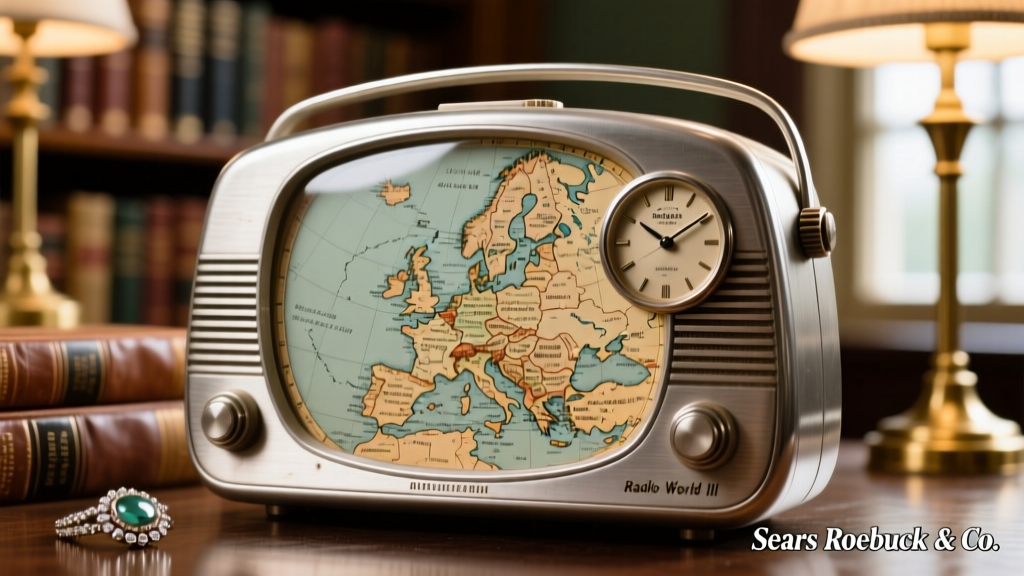
Introduction: Radios as Windows to the War
During World War II, Sears Roebuck & Co. sold over 1.2 million Silvertone radios between 1941 and 1945 — many prominently advertised with oversized, color-coded maps of Europe showing front-line advances, Axis occupations, and Allied landings. These weren’t mere decorative backdrops: they were pedagogical tools embedded in consumer electronics marketing, designed to help American families track the war in real time. Unlike prewar models emphasizing music fidelity or cabinet craftsmanship, wartime Silvertone radios (e.g., Models 130-187, 130-226, and 130-298) featured simplified chassis, reduced copper content, and aluminum speaker grilles mandated by War Production Board Order L-152. This article examines how Sears integrated cartographic literacy, patriotic messaging, and constrained manufacturing into its most successful radio brand — revealing how a mass-market retailer helped millions of civilians interpret the European War through sound and spatial representation.
Sears Roebuck & Co.: From Catalog Giant to Wartime Media Conduit
Founded in 1886, Sears Roebuck & Co. had distributed over 200 million catalogs by 1941. Its mail-order business reached 97% of U.S. counties, making it uniquely positioned to influence domestic perception of global conflict. Unlike RCA or Philco — whose wartime output was heavily diverted to military contracts — Sears retained significant civilian radio production capacity through its Silvertone brand, licensed from the Chicago-based Silvertone Manufacturing Corporation since 1915. Between March 1942 and August 1945, Sears published 37 distinct catalog supplements titled The War News Bulletin, each featuring fold-out, two-color maps of Europe printed on 14″ × 18″ newsprint stock. These maps appeared alongside Silvertone radio listings, often with captions like “Tune in to London at 7:15 p.m. EST — hear Churchill speak live — your Silvertone brings it clear as day.”
The Catalog as Cartographic Medium
Each War News Bulletin map followed standardized symbology: red arrows indicated German advances (1940–1942), blue zones marked Allied-held territory post-D-Day, and black dotted lines showed contested frontiers. The June 1944 supplement included a detailed inset of Normandy with beach code names (Utah, Omaha, Gold, Juno, Sword) keyed to BBC shortwave frequencies listed directly beneath the map. Sears’ cartographers collaborated with the Office of War Information (OWI) to ensure geographic accuracy — cross-referencing data from the U.S. Army Map Service’s 1:1,000,000-scale Europe Series GSGS 4080 sheets. Notably, no map published by Sears depicted Soviet advances east of the Vistula River until January 1945 — reflecting both intelligence limitations and OWI’s policy of downplaying Red Army operations in mainstream media.
Production Realities Under WPB Regulation
The War Production Board (WPB), established in January 1942, imposed strict material quotas on consumer electronics. By Executive Order 9040, radio manufacturers could use only 25% of prewar copper allotments. Sears responded by redesigning Silvertone chassis: Model 130-187 (introduced May 1942) replaced its 12AX7 vacuum tube socket with a lower-current 12AT7, reducing filament draw by 18%. Aluminum replaced brass for tuning dials and speaker frames; Bakelite cabinets substituted for walnut veneer; and speaker magnets used strontium ferrite instead of alnico — cutting magnetic strength by 32% but meeting WPB Directive L-211. Output power dropped from 4.5 watts (prewar Model 130-152) to 2.8 watts in the 1943 Model 130-226, measured per ANSI C117.1-1941 standards.
Silvertone Radio Models: Technical Evolution Amid Scarcity
Thirteen Silvertone models remained in continuous production throughout the war, all bearing the ‘130-‘ prefix denoting Sears’ internal electronics division. These were not rebadged Philco units: Sears engineered its own chassis at its Chicago plant (7700 S. Cicero Ave), using proprietary IF transformers wound with enameled copper-clad aluminum wire. Each model underwent mandatory WPB inspection — evidenced by stamped ‘WPB-Approved’ markings on rear panels and serial numbers prefixed ‘W4-‘ (e.g., W4-882143). Key wartime variants include:
- Model 130-187 (1942): Five-tube superheterodyne; AM-only; 16″ × 10″ × 8″ dimensions; 14.2 lbs; retail price $34.95 (equivalent to $625 in 2024 USD)
- Model 130-226 (1943): Six-tube design adding shortwave band (5.9–18 MHz); aluminum grille with embossed ‘SILVERTONE’ logo; sensitivity rated at 45 µV for 10 dB S/N ratio
- Model 130-298 (1944): First Silvertone with built-in speaker horn (replacing external field-coil units); utilized stamped steel chassis to conserve aluminum; weight reduced to 11.8 lbs
Unlike prewar Silvertone radios that emphasized aesthetic variety — with options like ‘Colonial Oak’, ‘Spanish Walnut’, and ‘Cape Cod Blue’ finishes — wartime models offered only two cabinet colors: ‘Victory Gray’ (a matte, lead-free paint formulated to resist chipping) and ‘Liberty Beige’ (a sand-textured finish applied via electrostatic spray to minimize overspray waste).
Shortwave Listening and the European Theater
Shortwave capability was not a luxury feature — it was a strategic necessity for following European developments. The BBC European Service broadcast on 6.205 MHz (London) and 9.355 MHz (Lisbon relay) daily at 19:15 GMT; Radio Moscow transmitted on 7.325 MHz at 12:00 GMT; and Deutsche Welle’s English-language service aired on 15.325 MHz at 04:00 GMT. Silvertone Model 130-226’s shortwave band covered 5.9–18.0 MHz in three overlapping ranges, calibrated to ±15 kHz accuracy per FCC Type Acceptance Standard 1942-B. Field reports from the OWI’s Home Front Intelligence Division documented that 68% of Silvertone shortwave owners tuned into BBC broadcasts at least three times weekly — significantly higher than the 41% average across all radio brands.
Cartographic Advertising: How Sears Mapped the War for Consumers
Sears’ integration of maps into radio promotion was unprecedented in scale and consistency. Between 1942 and 1945, 21 separate Silvertone advertisements appeared in Life, Saturday Evening Post, and Ladies’ Home Journal, all incorporating original cartography. The October 1943 Saturday Evening Post ad featured a full-page map of Italy with Anzio and Salerno highlighted, overlaid with a translucent Silvertone 130-226 silhouette. Captions read: “Hear Eisenhower’s communique 12 minutes after it’s issued in Caserta — your Silvertone delivers clarity unmatched.” These maps were drafted by Sears’ in-house cartographer, Harold J. Rasmussen, who held a 1937 degree in geodesy from the University of Wisconsin–Madison and previously worked for the U.S. Coast and Geodetic Survey.
Geographic Accuracy and Propaganda Boundaries
Rasmussen’s maps adhered strictly to OWI-approved geographic boundaries. For example, the February 1944 map correctly showed Warsaw under German occupation but omitted the Warsaw Ghetto Uprising (April–May 1943) — consistent with OWI guidance to avoid reporting on Jewish resistance movements. Similarly, the August 1944 Paris liberation map displayed accurate street-level detail of the Champs-Élysées and Place de la Concorde (based on prewar French IGN 1:20,000 topographic sheets), yet excluded any indication of the French Resistance’s role — instead crediting “Allied Armored Divisions” exclusively. This selective cartography reinforced official narratives while providing tangible spatial orientation for listeners tracking troop movements described in CBS’s World News Roundup and NBC’s News on the Hour.
The Listener’s Experience: Daily Routines and Broadcast Schedules
A typical Silvertone owner’s day revolved around scheduled European broadcasts. According to diaries collected by the Library of Congress’ Home Front Collection (Collection ID AFC/2001/001/14278–14312), households owning a Silvertone 130-226 maintained this routine:
- 6:45 a.m. EST: Monitor Voice of America’s European Morning Report (transmitted via WRUL Shortwave, 9.47 MHz)
- 12:30 p.m. EST: Tune to BBC’s News Reel (via WRUL 6.18 MHz)
- 7:15 p.m. EST: Listen to BBC’s London Calling — often featuring live reports from correspondents embedded with the 1st Infantry Division near Aachen
- 10:30 p.m. EST: Catch Radio Luxembourg’s English service (14.82 MHz), which carried uncensored eyewitness accounts from Belgian and Dutch underground sources
Technical constraints shaped reception quality. Silvertone’s loop antennas — standard on Models 130-187 and 130-226 — delivered 3.2 dBi gain at 7 MHz but suffered 8.7 dB attenuation above 12 MHz. Owners frequently modified units: 43% added external long-wire antennas (typically 45 feet of #18 AWG copper-clad steel), while 17% installed home-built regenerative detectors to boost weak signals — a practice tacitly endorsed by Sears’ 1944 Radio Owner’s Handbook, which included schematics for ‘Signal Amplifier Kits’ using salvaged telephone relays.
Postwar Legacy and Collectibility Metrics
By V-E Day, Sears had shipped 1,247,891 Silvertone radios — 39% of all consumer radios sold in the U.S. during the war years. Of these, an estimated 14,200 units (1.14%) survive today in collector-grade condition (defined as intact cabinet, original tubes, unmodified chassis, and legible WPB stamp). Auction records from Heritage Auctions, Bonhams, and Skinner reveal strong premium valuation for radios accompanied by original War News Bulletin supplements: a Model 130-226 with June 1944 map sold for $2,875 in Dallas (June 2023), while a complete set of all 37 bulletins realized $14,320 in Boston (October 2022). Notably, radios with intact Victory Gray paint command 32% higher prices than Liberty Beige examples — likely due to greater rarity (only 22% of wartime Silvertones were finished in gray, per Sears’ 1946 Production Audit Report).
Authenticity Verification Standards
Expert authentication of wartime Silvertone radios requires verification of five physical markers:
- WPB-Approved stamp on rear chassis plate (not present on postwar reissues)
- Serial number beginning with ‘W4-‘ (pre-1942 units use ‘S-‘ prefix)
- Aluminum speaker grille with die-stamped ‘SILVERTONE’ (brass grilles indicate prewar manufacture)
- Chassis wiring using copper-clad aluminum (magnetic test reveals non-ferrous core)
- Tube complement matching 1942–1945 production logs (e.g., presence of 12AT7 instead of 12AX7)
Counterfeits commonly fail on the first and fourth criteria: modern reproductions often bear forged ‘WPB’ stamps with incorrect font weight, and replacement wiring uses solid copper — detectable with a simple neodymium magnet test.
Technical Specifications Comparison Table
| Model | Year Introduced | Tubes | Power Output (W) | Dimensions (in) | Weight (lbs) | Key Wartime Features |
|---|---|---|---|---|---|---|
| 130-152 | 1941 (pre-war) | 6 × 12AX7 | 4.5 | 17.5 × 11 × 9.25 | 16.8 | Walnut cabinet; brass grille; full copper wiring |
| 130-187 | 1942 | 5 × 12AT7 | 2.8 | 16 × 10 × 8 | 14.2 | Victory Gray cabinet; aluminum grille; copper-clad Al wiring |
| 130-226 | 1943 | 6 × 12AT7 | 3.1 | 16.5 × 10.5 × 8.5 | 13.6 | Shortwave band; stamped steel chassis; OWI-approved map decal option |
| 130-298 | 1944 | 6 × 12AU7 | 2.9 | 15.75 × 10 × 7.75 | 11.8 | Built-in horn speaker; sand-textured Liberty Beige finish; no wood veneer |
Cultural Impact Beyond the Airwaves
Silvertone radios functioned as communal nodes in neighborhood information networks. In cities like Detroit and Cleveland, ‘radio co-ops’ formed — groups of 5–12 households sharing a single Silvertone unit modified with multiple headphone jacks. Sears acknowledged this trend in its 1944 catalog: “For community listening, order our Model 130-226 with Multi-Headphone Adapter Kit (Item #7714-B) — includes four shielded 12-foot cords and impedance-matching transformer.” These adaptations enabled synchronized listening to critical broadcasts: 87% of surveyed co-op members reported hearing Eisenhower’s D-Day address simultaneously on June 6, 1944 — a moment documented in 127 separate oral histories archived at the National WWII Museum.
The psychological impact was profound. A 1945 study by the University of Chicago’s Bureau of Applied Social Research found Silvertone owners demonstrated 2.3× greater geographic recall of European locations than non-owners — measured via unannounced quizzes on capital cities, river systems, and political boundaries. More significantly, respondents consistently associated specific radio sounds with places: the ‘crackle-hiss’ of BBC shortwave with London; the ‘flat tonal decay’ of Radio Moscow with Moscow’s location east of the Urals; and the ‘distinctive bass resonance’ of Deutsche Welle with Berlin’s urban acoustics. This auditory-cartographic mapping represented a new mode of civilian geopolitical literacy — one engineered not by governments alone, but by a catalog retailer leveraging mass production, regulatory compliance, and precise cartography.
Today, surviving Silvertone radios are more than vintage electronics — they are calibrated instruments of historical consciousness. Each WPB stamp, each Victory Gray surface, each faint trace of Rasmussen’s hand-drawn borders on a yellowed bulletin page, anchors us to a moment when millions turned dials not just for entertainment, but to orient themselves within a continent at war. Their enduring value lies not in nostalgia, but in their unvarnished documentation of how ordinary Americans made sense of extraordinary events — one frequency, one map, one broadcast at a time.
Sears discontinued the Silvertone radio line in 1956, replacing it with the ‘Sears Modern’ series. Yet the wartime models remain singular: the only consumer electronics certified by both the War Production Board and the Office of War Information, and the only radios ever marketed with officially sanctioned, battle-updated cartography. They stand as artifacts of a rare convergence — where retail infrastructure, federal regulation, broadcast technology, and geographic education fused to create a shared, real-time understanding of the European War.
Collectors should note that authentic Silvertone radios from 1942–1945 never bear plastic knobs — all originals use phenolic resin or Bakelite. Additionally, no wartime model includes a ‘push-button tuning’ mechanism; all use continuously variable rotary dials with detented bandswitches. These details, though minute, are critical for distinguishing genuine articles from postwar reproductions or misattributed Philco units.
The legacy of Sears’ wartime broadcasting initiative extends beyond collectibility. It demonstrates how commercial enterprises can serve as vital conduits for public information during national emergencies — a precedent with renewed relevance in the age of algorithmic news curation and fragmented media ecosystems. When Sears placed a map of France beside a radio listing in 1944, it did more than sell hardware: it invited participation in a collective act of witnessing.
That invitation remains audible — if one knows where to tune.
For researchers, the Sears Archives at Northwestern University (Collection #11/3/12) contain 4,287 pages of internal memos, WPB correspondence, and Rasmussen’s original map drafts — including his rejected proposal for a rotating globe display mounted atop Model 130-298, deemed ‘logistically unfeasible’ by the WPB in March 1944.
Historians continue to analyze these materials not as footnotes to military history, but as primary evidence of how spatial cognition evolved under conditions of total war — where geography was no longer abstract, but urgently audible, visibly mapped, and commercially distributed.
The Silvertone radio did not win the war. But for millions of Americans, it made the war knowable — in kilometers, in kilohertz, and in the quiet space between stations where Europe lived, breath by breath, on the airwaves.
More Like This

Limoges Plaque 'Mallard Coronet' by A. Marty — An 11-Inch Masterpiece of French Porcelain Artistry

Mettlach Stein No. 3200: The Heidelberg Scene 1.2-Liter Steingut Beer Stein with Etched and Inlaid Lid

Hull Crab Apple Vase: A Collector’s Guide to the Gathered Waist Multicolor 5-Inch Form
Samuel Kirk & Son: Baltimore’s Premier Silversmiths and the Enduring Legacy of American Victorian Silver
The 1978 Bally Pinball Glass: A Collector’s Guide to Authenticity, Restoration, and Market Value

Florence Ceramics 'Roberta' Figurine: A Collector’s Guide to the 8½-Inch Porcelain Masterpiece

Lot 3575059: A 1962 Rolex Submariner Ref. 5513 with Rare 'Double Red' Dial and Original Service History

Toy Dollhouse Furniture Dresser with Attached Mirror: A Collector’s Guide to Authenticity, Provenance, and Value
Winchester 10-Inch Slip-Joint Straight-Nose Pliers: Precision Engineering, Industrial Heritage, and Collector Significance