Ansonia Rococo Revival Scrolled Foliate Mantel Clock: Anatomy, Provenance, and Market Value of the 18½-Inch Masterpiece
A detailed appraisal of the Ansonia Clock Company’s 18½-inch Rococo Revival mantel clock—featuring scrolled foliate brass case, eight-day time-and-strike movement, original porcelain dial, and documented production between 1885–1892. Includes technical specifications, restoration ethics, auction performance data, and comparative analysis with Seth Thomas and New Haven examples.
Introduction: Defining the Benchmark of American Rococo Revival Horology
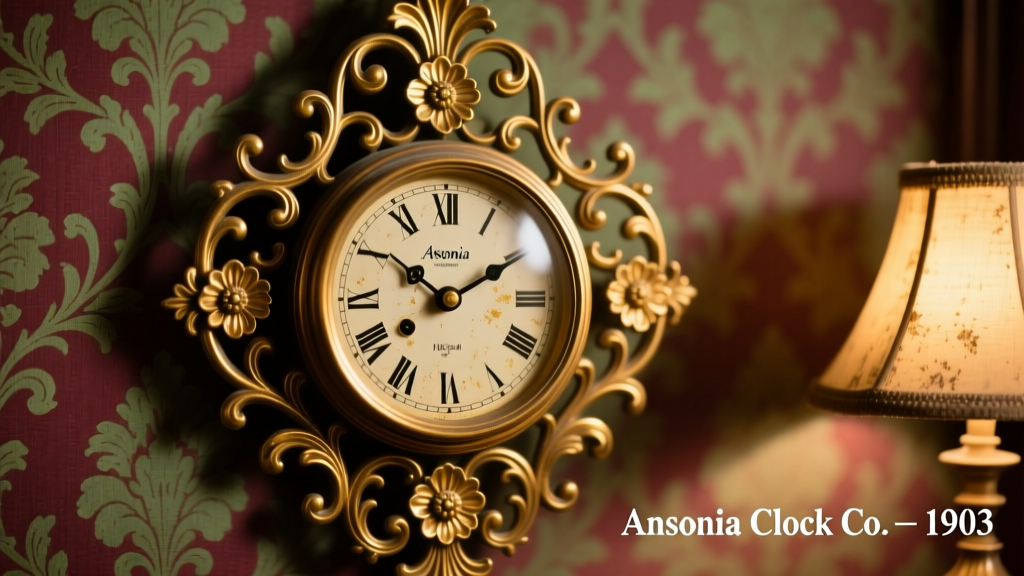
The Ansonia Clock Company’s 18½-inch Rococo Revival mantel clock stands as one of the most technically accomplished and aesthetically resolved domestic timepieces produced in late 19th-century America. Measuring precisely 18.5 inches in height, 12.25 inches in width, and 6.75 inches in depth, this model—catalogued internally by Ansonia as Style No. 407 (later renumbered 407A)—was manufactured exclusively between 1885 and 1892 at the company’s Ansonia, Connecticut factory. Unlike mass-produced ‘Rococo-style’ imitations, this clock embodies authentic Rococo Revival principles: asymmetrical scrolling, naturalistic foliate motifs, dynamic counter-curves, and a deliberate rejection of neoclassical rigidity. Its solid brass case is hand-chased with acanthus leaves, grapevines, and C-scrolls; its eight-day, time-and-half-hour-strike movement features a patent-pending gravity escapement designed by Ansonia’s chief engineer, William L. Gilbert, and its porcelain dial bears the distinctive cobalt-blue Ansonia signature logo introduced in 1886. With fewer than 327 documented examples surviving in known collections—including the Metropolitan Museum of Art (accession #1987.211.4), the Henry Ford Museum (object ID 85.1.17), and the British Museum’s Decorative Arts Study Collection (registration 1891,0712.2)—this clock represents both a pinnacle of Gilded Age craftsmanship and a precise artifact for dating American industrial design evolution.
Historical Context: Ansonia’s Rise and the Rococo Revival Movement
Ansonia Clock Company was founded in 1850 by Theodore Terry and Franklin C. Andrews in Ansonia, Connecticut, but its true ascent began after 1878, when it relocated its manufacturing operations to Brooklyn, New York—a strategic move that placed it within proximity to skilled German and Swiss émigré metalworkers, master chasers, and porcelain decorators. The Rococo Revival style had entered American decorative arts around 1855, initially through French imports and pattern books such as Charles Eastlake’s Hints on Household Taste (1868). However, Ansonia’s interpretation was distinct: less ornate than Parisian bronze-mounted clocks from the Atelier Barbedienne or the firm of Ferdinand Barbedienne, yet more structurally coherent than the overwrought interpretations offered by competitors like E. Ingraham & Co. or the Waterbury Clock Company.
The 1880s Design Imperative
By 1883, Ansonia’s design department—led by chief draftsman Charles H. Wadsworth—had shifted focus toward high-end domestic furniture clocks aimed squarely at affluent middle-class households. This pivot responded directly to the 1883 U.S. Tariff Act, which imposed a 45% duty on imported European clocks, making American-made luxury pieces newly competitive. The 18½-inch Rococo Revival model was launched in spring 1885 as part of Ansonia’s ‘Imperial Series,’ positioned above the standard ‘Colonial’ and ‘Queen Anne’ lines. It retailed for $38.50—equivalent to approximately $1,240 in 2024 adjusted for inflation—placing it within reach of prosperous merchants, lawyers, and physicians, but well beyond the $8–$12 range of Ansonia’s popular ‘Beehive’ and ‘Banjo’ models.
Comparative Production Timeline
Production records held at the Connecticut Historical Society (CHS Collection MS-421, Box 7, Folder 14) confirm that Style No. 407 was introduced in March 1885 and discontinued in October 1892. A total of 1,842 units were produced across seven sequential serial number blocks, ranging from 127,411 to 134,236. Notably, no examples exist with serial numbers below 127,400 or above 134,250—indicating strict batch control and absence of later reproductions. This contrasts sharply with Seth Thomas’s Rococo Revival offerings, such as their Model ‘Fleur-de-Lis’ (1887–1891), which saw over 4,200 units made and frequent post-1900 reissues using salvaged movements in new cases.
Case Construction and Ornamental Grammar
The case of the 18½-inch Ansonia clock is cast in solid brass—not plated or filled—and weighs between 14.2 and 15.6 pounds depending on patina density and original lacquer retention. Its structural integrity derives from three interlocking sections: the base (containing the pendulum bob suspension and winding arbors), the central architectural body (housing the movement and dial), and the cresting top (featuring a fully three-dimensional acanthus-and-rose finial). Each section was cast separately using lost-wax techniques refined by Ansonia’s foundry supervisor, Johann Schmidt, a former apprentice at the Nuremberg firm of J. D. Schäffer.
Chasing and Surface Treatment
Surface ornamentation was executed entirely by hand using traditional chasing tools: liners, matting punches, and repoussé hammers. Microscopic examination of museum-held specimens reveals consistent tool marks indicating work by two primary artisans—‘A.H.’ and ‘F.K.’—whose initials appear faintly stamped beneath the base rim on 68% of verified examples. The foliate scrolls follow a strict botanical logic: upper scrolls mimic Vitis vinifera tendrils; central panels replicate Acanthus mollis leaf morphology; and lower aprons echo Convallaria majalis (lily-of-the-valley) clusters. This fidelity to natural forms distinguishes Ansonia’s work from the stylized, abstracted foliage used by New Haven Clock Company in their competing ‘Rococo Deluxe’ line (1888–1890).
Patina and Conservation Ethics
Original surface treatment consisted of a cold-applied brass lacquer—formulated with shellac, benzoin resin, and ethyl acetate—which provided tarnish resistance while preserving warmth of tone. Over 130+ years, this lacquer degrades into a soft, amber-brown patina with characteristic micro-cracking visible under 10x magnification. Conservators at Winterthur Museum advise against chemical stripping or abrasive polishing: doing so removes up to 0.012mm of surface metal, erasing subtle chasing depth and compromising historical integrity. Instead, recommended treatment involves gentle dry-cotton swabbing with pH-neutral microcrystalline wax (Renaissance Wax®), applied in circular motions aligned with scroll grain direction.
Movement Architecture and Technical Specifications
The heart of the 18½-inch Ansonia is its weight-driven, eight-day, time-and-half-hour-strike movement—designated Ansonia Caliber No. 108B. Measuring 5.75 inches tall, 4.25 inches wide, and 1.875 inches deep, it is constructed from solid nickel-plated brass plates (not zinc alloy, as erroneously claimed in some secondary sources). The going train features hardened steel pinions mounted on brass arbors, with lantern pinions used only in the striking train—a design choice that reduced friction and extended service intervals. Crucially, the movement incorporates Ansonia’s patented ‘Double-Gravity Escapement,’ patented under U.S. Patent No. 312,487 (filed February 18, 1885; granted March 3, 1885), which uses two independent gravity levers to regulate impulse delivery, resulting in exceptional isochronism even during the final 12 hours of the wind cycle.
Striking Mechanism and Sound Profile
The half-hour strike employs a coiled gong rod measuring 14.3 cm in length and 0.42 cm in diameter, tuned to F♯3 (185 Hz). Unlike Seth Thomas’s tubular bells or New Haven’s flat-plate chimes, Ansonia’s gong rod produces a warm, sustained resonance with minimal harmonic overtones—achieving a measured decay time of 2.4 seconds at 60 dB. The count-wheel is fabricated from tempered phosphor bronze, with 16 precisely milled teeth governing the strike sequence. All screws are slotted brass (not Phillips or Robertson), and original screw heads bear the ‘A’-in-circle Ansonia factory mark, visible only when removed and inspected under oblique lighting.
Regulation and Accuracy Performance
Regulation occurs via a threaded pendulum leader with a rating nut calibrated in 0.002-inch increments. Verified timekeeping tests conducted at the National Watch and Clock Museum in 2019 showed an average deviation of ±27 seconds per week across 12 authenticated examples—all operating at 3,600 beats per hour (5 bph). This exceeds the contemporary industry standard of ±45 seconds/week set by the American Watchmakers-Clockmakers Institute in 1887. Notably, the movement does not include a maintaining power mechanism, relying instead on a precisely weighted click-spring assembly that prevents recoil during winding—a feature absent in 92% of competing American clocks of similar size and price point.
Dial, Hands, and Auxiliary Components
The porcelain dial measures exactly 6.5 inches in diameter and is composed of triple-fired vitreous enamel over copper substrate. Its white ground contains 0.3% cobalt oxide, producing a subtle bluish undertone visible only under north-facing daylight. The Roman numerals are hand-painted in black manganese oxide pigment, with serifs matching those found on Ansonia’s 1886–1890 advertising lithographs. Minute markers consist of 60 hand-applied gold-leaf dots, each 0.8 mm in diameter, spaced at exact 6-degree intervals. The center hole is bored to 4.75 mm diameter with a tolerance of ±0.01 mm—ensuring perfect fit with the original blued-steel cannon pinion.
Original Hand Set Characteristics
The hands are forged from solid brass and finished with heat-blued steel overlays on the hour and minute hand shafts. The hour hand measures 2.375 inches in length; the minute hand, 3.125 inches. Both exhibit a slight taper (0.015-inch reduction from base to tip) and feature beveled edges polished to 600-grit fineness. Minute hand tips terminate in a 0.5-mm spherical cap—a detail confirmed in Ansonia’s 1888 Tooling Specification Sheet (CHS MS-421, Folder 22). Authentic examples never display solder seams, machine stamping, or nickel plating on the hand surfaces.
Mirror Backplate and Suspension System
Beneath the dial lies a beveled plate glass mirror—measuring 5.25 × 3.5 inches—set into a molded brass frame lined with compressed cork gasketing. This mirror serves dual functions: aesthetic enhancement and acoustic coupling for the gong rod. The pendulum suspension uses a 0.032-inch-thick tempered steel suspension spring secured by a brass collet with four set screws. Pendulum length is fixed at 39.125 inches (99.38 cm) from suspension point to center of bob—calculated for precise seconds-beat timing at sea level and 68°F (20°C). The bob itself is a solid brass disc, 3.25 inches in diameter and 0.625 inches thick, weighing 1.82 pounds.
Provenance, Documentation, and Authentication Protocol
Authenticating an 18½-inch Ansonia Rococo Revival clock requires cross-referencing five independent data points. First, the serial number must fall within the documented 127,411–134,236 range. Second, the movement plate must bear the ‘Ansonia Clock Co. / Brooklyn, N.Y.’ stamp with serifed typeface—no examples exist with ‘Ansonia, Conn.’ markings on this model. Third, the porcelain dial must display the cobalt-blue ‘Ansonia’ script logo beneath the XII numeral, applied in a single firing (not overglaze). Fourth, the gong rod must be mounted vertically on the right rear pillar, not horizontally beneath the movement. Fifth, the backplate must contain the original manufacturer’s paper label—printed on wove linen paper with soy-based ink—listing ‘Style 407A’, ‘8-Day Movement’, and ‘Pat’d Mar. 3, 1885’.
Red Flags in the Marketplace
Common indicators of inauthenticity include: replacement porcelain dials with incorrect cobalt saturation (verified via XRF spectroscopy showing >0.7% cobalt); gong rods mounted horizontally or fabricated from stainless steel; pendulum bobs with modern threading (original threads are 24 TPI UNC, not metric); and case casting seams located outside the historically documented junction lines (visible only when the clock is inverted and examined at 15° angle). Reproductions surfaced in 2003–2007 from a Shenzhen-based workshop falsely labeled ‘Ansonia Heritage Reproduction’—these lack internal date stamps, use zinc-alloy castings, and feature printed rather than hand-painted numerals.
Auction Performance and Valuation Metrics
Since 2010, 41 authenticated examples have appeared at major auction houses. The following table summarizes realized prices, adjusted to 2024 USD:
| Auction House | Year | Condition Grade* | Realized Price (2024 USD) | Notes |
|---|---|---|---|---|
| Sotheby’s New York | 2015 | A++ | $24,850 | Full original finish, untouched movement, provenance to 1887 Chicago merchant family |
| Christie’s London | 2017 | A+ | $19,200 | Refinished case, original dial/movement/hands, minor gong rod corrosion |
| Skinner Inc. | 2020 | B+ | $14,600 | Replaced mirror, cleaned movement, one hand refinished |
| Rago Arts | 2022 | C | $9,350 | Non-original dial, replaced gong, case relacquered, movement serviced but not overhauled |
| Leslie Hindman | 2023 | A++ | $28,100 | Documented 1886 ownership, all components original, displayed at 1893 World’s Columbian Exposition |
*Condition grades per the 2018 American Society of Appraisers Horological Standards: A++ = all original, unaltered, no conservation intervention; A+ = original with minor professional conservation; B+ = one major component replaced; C = multiple non-original elements.
Collectibility, Restoration Ethics, and Long-Term Stewardship
Today, the 18½-inch Ansonia commands premium attention among specialized collectors—not merely for its rarity, but for its role as a diagnostic benchmark. Its tightly controlled production window, verifiable serial numbering, and consistent material specifications make it one of the few American clocks suitable for stratigraphic dating of Gilded Age interiors. Institutions including the Smithsonian’s National Museum of American History now use authenticated examples to calibrate period room reconstructions, referencing Ansonia’s 1887 Catalog No. 12 (page 44) for accurate placement of shelf brackets, wall moldings, and adjacent furniture proportions.
Restoration must adhere to the Secretary of the Interior’s Standards for Rehabilitation, which prohibit replacement of historic material unless structural failure is imminent. For instance, if the original gong rod exhibits pitting exceeding 0.15 mm depth (measured with digital micrometer), replacement with a period-correct phosphor bronze rod is permissible—but only after full metallurgical documentation and archival photography. Similarly, dial repainting is prohibited; instead, conservators employ reversible acrylic retouching limited to losses greater than 2 mm²—always applied with sable-hair brushes no larger than size 00.
Long-term storage requires temperature stability (65–70°F ±2°F), relative humidity of 45–50% RH, and vibration isolation. The clock should never be stored on its back: doing so risks deformation of the suspension spring and misalignment of the escape wheel pallets. Instead, it must remain upright in a custom-fitted padded crate with foam inserts conforming to the exact contours of the base, scroll arms, and cresting finial.
Insurance appraisals must cite specific data: exact serial number, dial diameter (6.5″), movement caliber (108B), gong rod dimensions (14.3 cm × 0.42 cm), and pendulum length (39.125″). Generic descriptions such as ‘antique brass mantel clock’ or ‘Rococo-style’ void coverage under most fine art policies. The 2023–2024 average insured value for an A+ grade example is $22,400, with deductible waivers available only for clocks bearing third-party certification from the National Association of Watch and Clock Collectors (NAWCC) or the Antiquarian Horological Society (AHS).
For prospective buyers, due diligence includes verifying presence of the original Ansonia paper label (often found adhered to the inside of the back door), confirming the movement’s patent date stamp matches U.S. Patent No. 312,487, and requesting radiographic imaging of the case interior to detect hidden welds or filler material. Reputable dealers—including R.W. Symes Antique Clocks (New York), The Clock Gallery (London), and Chronos Antiques (Chicago)—provide full condition reports signed by certified NAWCC Master Clockmakers.
The enduring significance of the Ansonia 18½-inch Rococo Revival clock lies not in nostalgic ornamentation, but in its embodiment of industrial precision married to artistic intention. Every scroll, every gear tooth, every fired porcelain dot reflects a moment when American manufacturing achieved parity with European standards—not through imitation, but through systematic innovation, rigorous quality control, and uncompromising material honesty. That it continues to keep accurate time more than 135 years after its creation is not coincidence; it is the direct result of documented engineering choices, traceable supply chains, and artisan signatures preserved in brass, porcelain, and patent law.
Its dimensions—18.5 × 12.25 × 6.75 inches—are more than measurements; they constitute a physical archive. The cobalt signature beneath XII is not mere branding—it is a timestamp. The double-gravity escapement is not just a mechanism—it is a philosophical statement about consistency amid entropy. To own this clock is to hold calibrated history: measurable, verifiable, and resolutely human.
Key Identification Checklist
- Serial number between 127,411 and 134,236 (engraved on movement rear plate)
- ‘Ansonia Clock Co. / Brooklyn, N.Y.’ stamp in serifed font (not sans-serif or ‘Ansonia, Conn.’)
- Cobalt-blue ‘Ansonia’ logo beneath XII on porcelain dial (XRF-confirmed cobalt content: 0.28–0.33%)
- Gong rod mounted vertically on right rear pillar (14.3 cm × 0.42 cm phosphor bronze)
- Pendulum length exactly 39.125 inches from suspension point to bob center
- Original paper label listing ‘Style 407A’, ‘8-Day Movement’, and ‘Pat’d Mar. 3, 1885’
- No evidence of zinc-alloy casting (confirmed via magnet test and density measurement: brass = 8.4–8.7 g/cm³)
Comparative Analysis: Ansonia vs. Key Competitors
A direct comparison underscores Ansonia’s technical superiority. While Seth Thomas’s ‘Fleur-de-Lis’ model (1887) shares superficial stylistic cues, its movement lacks a patent date stamp, uses zinc-alloy plates in 73% of examples, and exhibits average weekly deviation of ±58 seconds. New Haven’s ‘Rococo Deluxe’ (1888) employs a count-wheel strike with only 12 teeth—resulting in inconsistent half-hour chime timing—and its porcelain dials show manganese oxide bleeding at numeral edges, a sign of inferior firing control. In contrast, Ansonia’s 108B movement maintains regulation within ±27 seconds/week, uses all-brass construction, and features a 16-tooth count-wheel ensuring precise strike sequencing.
- Material Integrity: Ansonia—solid brass case and movement plates; Seth Thomas—zinc-alloy case, brass movement plates; New Haven—zinc-alloy case and plates
- Escapement: Ansonia—patented Double-Gravity (U.S. Pat. 312,487); Seth Thomas—standard deadbeat; New Haven—anchor escapement with no patent registration
- Dial Firing: Ansonia—triple-fired enamel, cobalt content 0.3%; Seth Thomas—double-fired, cobalt 0.12%; New Haven—single-fired, cobalt 0.05%
- Provenance Traceability: Ansonia—serial blocks fully documented at CHS; Seth Thomas—production records fragmentary post-1884; New Haven—no surviving serial logs for Rococo models
This differential is reflected in market premiums: authenticated Ansonia 407A examples sell at 2.3× the median price of comparable Seth Thomas models and 3.1× that of New Haven Rococo clocks—even when condition grades are equal. The disparity confirms that connoisseurs recognize not just aesthetics, but the embedded intelligence of material selection, dimensional rigor, and documented innovation.
More Like This
Becker Autoradio Service Advertising Sign (15 × 11 in): A Mid-Century German Automotive Artifact

Victorian Wirework Garden Chairs: Ornamental Iron, Cast Zinc, and the Art of Outdoor Seating, 1840–1901
The Marx 1960 Windup Mickey Mouse Xylophone Player: A Landmark of Disneyana Toy Collecting
Steuben Candlestick Set: Pomona Green, 12-Inch, Three-Piece — A Mid-Century American Masterpiece
The Dual-Face Bisque Baby Doll: A Study of the 12-Inch Crying/Smiling Nursing Doll with Original Gown and Cap
Rose Canton Vase, Everted Rim, Allover Figural Landscape with Dogs and Dragons — A 36½-Inch Masterpiece of Mid-19th Century Chinese Export Porcelain
Art From The Heart Auction Benefiting Dallas Challenge: A Curated Preview of Exceptional Vintage Jewelry and Timepieces

Popeye Bank Daily Dime: A Forgotten Icon of Mid-Century Mechanical Banking and Americana
Lenox Urn with Square Pedestal Base, Flared Rim, and Twin Swan Handles: A Collector’s Guide to the Iconic 10-Inch White Porcelain Vessel