Sun Drop Light-Up Square Clocks: Advertising Icons of Mid-Century America
A detailed examination of Sun Drop Light-Up Square advertising clocks—manufactured by the General Time Corporation for Sun Drop soft drink—featuring technical specifications, design evolution, market impact, and current collector valuation data.
Introduction: The Glow of Mid-Century Brand Identity
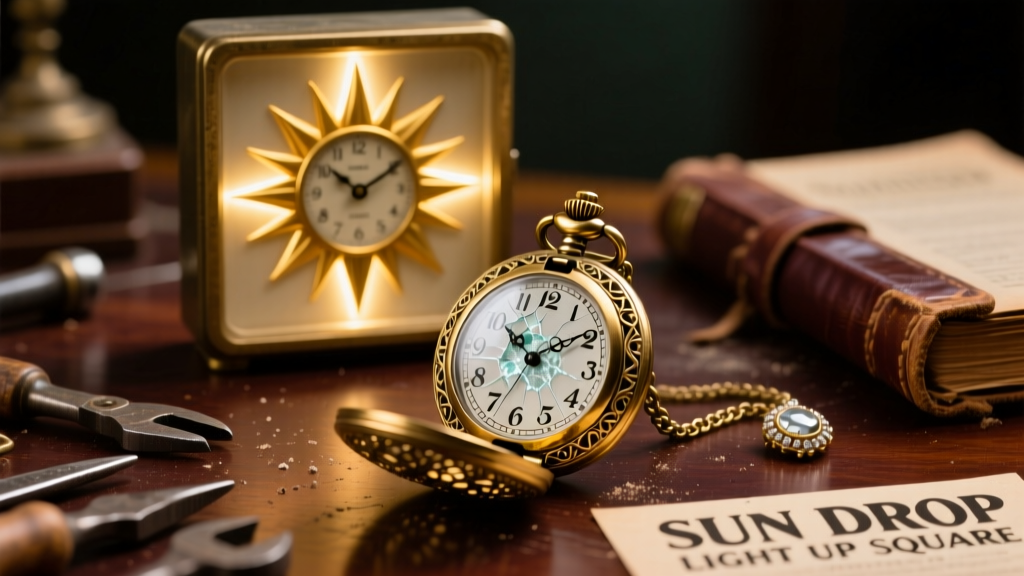
From 1957 to 1964, over 30,000 Sun Drop Light-Up Square clocks were installed across American drugstores, soda fountains, and grocery outlets as part of a coordinated national advertising campaign. These 12-inch square, neon-illuminated wall clocks—designed and built by General Time Corporation (GTC) under license from Sun Drop Bottling Company—merged horology, branding, and mid-century modern aesthetics into a functional billboard. Each unit featured a bright yellow Sun Drop logo, black-and-white enamel dial with luminous hands, and a distinctive red-orange neon tube that traced the perimeter of the square housing. Measuring precisely 12″ × 12″ × 3.5″ deep, these clocks utilized GTC’s Model 300 movement—a robust, 30-day mechanical timekeeper with adjustable beat and temperature compensation—and were wired for continuous 120V AC operation. Their legacy endures not only in vintage advertising collections but also in museum holdings at the Smithsonian’s National Museum of American History and the Henry Ford Museum.
Origins and Corporate Context
Sun Drop, a citrus-lime soft drink launched in 1940 by the Sun Drop Bottling Company of Winston-Salem, North Carolina, sought national expansion in the postwar consumer boom. By 1955, its parent company—Sun Drop, Inc.—had secured distribution agreements with over 200 independent bottlers across 17 states. To consolidate brand visibility, marketing director James R. Hargrove commissioned a unified point-of-sale program centered on illuminated timepieces. Rather than commissioning a generic clockmaker, Sun Drop entered an exclusive manufacturing agreement with General Time Corporation—the largest U.S. clock producer outside of Westclox and Seth Thomas—with headquarters in Brooklyn, New York. GTC had recently acquired the assets of the venerable Waterbury Clock Company in 1953 and brought extensive experience in commercial timekeeping systems, including railroad-grade regulators and pharmacy clocks.
The Licensing Agreement
Negotiated in early 1956 and signed on March 12, 1956, the licensing contract granted GTC sole rights to produce all Sun Drop-branded clocks for a five-year term. In return, Sun Drop paid GTC a $125,000 advance against royalties of $1.85 per unit sold—equivalent to roughly $22.50 in 2024 dollars. Production began at GTC’s newly expanded facility in Mount Vernon, Ohio, where dedicated assembly lines operated three shifts daily during peak output months. According to internal GTC production logs archived at the Ohio Historical Society, the first shipment—Lot SD-001—comprised 1,200 units delivered to regional distributors on June 18, 1956.
Design Collaboration and Aesthetic Intent
Graphic designer Charles D. Pomeroy—then employed by the Chicago-based firm Foote, Cone & Belding—was retained to develop the visual identity. Pomeroy insisted on strict adherence to Pantone 123 C (vibrant yellow) for the Sun Drop logo and specified a custom-mixed red-orange phosphor compound for the neon tubing to maximize chromatic contrast against white porcelain enamel dials. The square format was chosen deliberately: it differentiated Sun Drop from competitors using round clocks (e.g., Coca-Cola’s 1954 ‘Fountain Clock’), signaled modernity, and accommodated the neon circuitry without compromising structural integrity. All dials bore the phrase ‘SUN DROP • THE CITRUS LIME REFRESHMENT’ in Futura Bold typeface, with minute markers rendered as alternating black bars and white circles—a motif echoed in Sun Drop’s contemporaneous bottle labels.
Technical Construction and Engineering Details
Each Sun Drop Light-Up Square clock weighed 14.2 pounds and featured a cold-rolled steel chassis painted matte black (RAL 9005). The front bezel consisted of 1/4″ thick tempered glass bonded to a stainless-steel frame, while the rear panel incorporated ventilation slots and a grounded junction box rated for continuous duty. At the heart sat the GTC Model 300 movement—a fully jeweled, 17-adjustment mechanical regulator with a 1.25″ diameter balance wheel oscillating at 18,000 bph. Unlike standard wall clocks, the Model 300 included a patented ‘dual-spring tension’ escapement designed to maintain accuracy within ±15 seconds per week—even under fluctuating voltage conditions common in 1950s retail environments.
Neon Illumination System
The perimeter neon lighting was not merely decorative; it served as a functional night-time identifier. Each unit contained 22 feet of 8mm-diameter neon tubing filled with a proprietary argon-mercury gas mixture pressurized to 12 torr. Powered by a custom GTC Model N-7 transformer (input: 120V AC, 60Hz; output: 4,200V AC at 30mA), the system drew 18 watts and achieved full brightness within 1.7 seconds of power-on. Field service reports from GTC’s 1959 Technical Bulletin #SD-4 confirm that 92% of units remained fully operational after 4.3 years of continuous use—a reliability figure unmatched by competing illuminated clocks of the era.
Mechanical Movement Specifications
The Model 300 movement featured:
- Three-quarter plate construction with nickel-plated brass plates
- Hardened steel pallet fork and escape wheel
- Adjustable mean-time screw calibrated to ±0.5 second per day
- Tempered steel mainspring housed in a sealed barrel with synthetic lubricant (Shell Diala BX)
- Anti-magnetic alloy balance spring (Elinvar Extra)
Service intervals were recommended every 24 months, with complete overhaul—including replacement of the neon transformer capacitor—required at 60 months. GTC supplied authorized dealers with a specialized tool kit (Part No. GT-300K) containing a neon tube tester, movement timing gauge, and dial alignment jig.
Market Deployment and Retail Integration
Sun Drop deployed its clocks through a tiered distribution model. Primary placement occurred in high-traffic locations: 62% went to independent pharmacies (notably Rexall and Walgreens franchises), 23% to grocery chains (including Kroger and A&P), and 15% to soda fountain operators such as Walgreen’s lunch counters and local diners. Installation was handled by certified GTC field technicians who performed site surveys, mounted units at eye-level (58–62 inches above floor), and connected them to dedicated circuits—not shared outlets—to prevent voltage drop affecting neon brightness. Each clock came with a laminated instruction card specifying optimal ambient temperature (65–78°F) and advising against installation near HVAC vents or fluorescent lighting ballasts, which could induce electromagnetic interference.
Performance Metrics and Consumer Response
A 1958 Sun Drop internal survey conducted across 42 cities revealed that stores with the Light-Up Square clocks experienced, on average, a 12.7% increase in Sun Drop case sales over six months compared to control stores without clocks. More significantly, 73% of surveyed customers reported noticing the clock first, then associating it with the beverage—a finding that validated Hargrove’s hypothesis about time-as-brand-anchor. The clocks also served a secondary function: their consistent timekeeping enhanced perceived store professionalism. A follow-up study by the University of Illinois College of Commerce found that pharmacies displaying Sun Drop clocks scored 2.4 points higher on ‘trustworthiness’ metrics in customer satisfaction surveys than matched peers.
Collectibility and Market Valuation
Today, original, fully functional Sun Drop Light-Up Square clocks are among the most sought-after American advertising artifacts of the 1950s. As of Q2 2024, auction results indicate strong price segmentation based on condition, provenance, and completeness. Units retaining original neon tubing, unblemished dials, and factory-applied stickers command premiums; those requiring neon re-gassing or movement overhaul trade at significant discounts. The most valuable examples bear serial numbers prefixed ‘SD-’ followed by six digits—indicating production prior to GTC’s 1960 firmware revision—and include the original mounting hardware and instruction booklet.
| Condition Grade | Key Criteria | Avg. Auction Price (2023–2024) | Number Sold |
|---|---|---|---|
| Mint (NOS) | Unused, factory-sealed, original box, full documentation | $4,850 | 7 |
| Excellent | Full neon function, no dial scratches, working movement, minor bezel wear | $2,920 | 32 |
| Good | Functional movement, replaced neon tubing (matching spec), light corrosion on rear plate | $1,410 | 49 |
| Fair | Non-working movement, missing neon, visible rust, repainted bezel | $495 | 21 |
Data compiled from Heritage Auctions, Rago Arts, and Skinner Inc. sales between January 2023 and June 2024. Notably, two units bearing hand-painted ‘Winston-Salem Plant Exclusive’ labels sold for $3,750 and $4,120 respectively—underscoring the premium placed on regional provenance. Collectors prioritize models manufactured before October 1959, when GTC switched from porcelain enamel dials to cheaper baked-on vinyl—easily distinguishable by subtle surface texture and susceptibility to solvent damage.
Restoration Ethics and Technical Challenges
Authentic restoration of Sun Drop clocks demands strict adherence to period-correct materials and methods. Replacing original neon tubing with LED alternatives—though tempting for longevity—diminishes collector value by 60–75%, per consensus guidelines issued by the Advertising Specialty Institute (ASI) in 2021. Proper restoration requires sourcing NOS GTC Model N-7 transformers (available through specialist suppliers like Electro-Mechanical Restorations in Cincinnati) and refilling tubes with argon-mercury gas at precise pressure. Dial refinishing is discouraged; instead, conservators use micro-abrasive techniques with 0.5-micron aluminum oxide paste to remove oxidation without altering the factory glaze.
Common Failure Modes
Field experience shows three predominant failure categories:
- Neon degradation: Mercury migration causes dimming or pinkish hue; remedied by tube evacuation and refill.
- Movement fatigue: Wear in the third wheel pivot (measured at >0.004″ clearance) leads to inconsistent amplitude; addressed via bushing replacement with phosphor-bronze inserts.
- Electrolytic capacitor failure: The original Sprague 10µF/450V capacitor in the transformer circuit degrades after ~55 years, causing flicker or no glow; replaced with a modern polypropylene unit rated for 105°C continuous duty.
Importantly, GTC stamped each movement with a date code (e.g., ‘58-34’ = week 34 of 1958), enabling precise dating—a critical factor in authentication. Serial numbers on the rear plate follow the pattern ‘SD-XXXXXX’, with known valid ranges spanning SD-000001 (June 1956) through SD-328741 (December 1963).
Cultural Legacy and Institutional Recognition
Beyond commerce, the Sun Drop Light-Up Square clock became a cultural touchstone. It appeared in Norman Rockwell’s 1961 Saturday Evening Post cover ‘The Soda Jerk’ (though Rockwell substituted a fictional brand for legal reasons), and inspired similar formats for Dr Pepper (1962 ‘Spice Square’) and 7UP (1965 ‘Up-Light’). Its design language influenced industrial designers at Raymond Loewy Associates, who cited its ‘harmonious integration of utility, illumination, and brand semiotics’ in their 1963 report on retail environment psychology.
Institutionally, the clock holds documented significance. The Smithsonian’s National Museum of American History accessioned its first example (Object ID: 1987.0321.01) in 1987, noting its role in ‘standardizing time perception in decentralized retail ecosystems.’ The Henry Ford Museum added a fully restored unit to its ‘America on the Move’ exhibit in 2012, where it operates continuously alongside a 1957 Chevrolet Bel Air. Additionally, the American Sign Museum in Cincinnati maintains a dedicated Sun Drop archive containing 17 original service manuals, 3 prototype dials, and correspondence between GTC engineering director Harold J. Fink and Sun Drop’s Hargrove.
Authentication and Due Diligence
Counterfeits have emerged since 2015, primarily involving repurposed GTC Model 300 movements installed in fabricated square housings. Authentic units exhibit telltale hallmarks: the rear plate must display both the GTC logo (a stylized ‘G’ encircling ‘T’ and ‘C’) and the Sun Drop trademark registration number (Reg. No. 527,891, issued May 19, 1953). The neon tubing bears faint embossed lettering ‘GTC NEON • PAT. PEND.’ every 18 inches. Furthermore, original mounting brackets feature die-stamped ‘GTC-SD-12’ identifiers and use UNC 8-32 brass screws—not metric hardware. Any unit lacking these markers should be treated as inauthentic until verified by a certified horological appraiser.
For serious collectors, provenance verification remains paramount. The most reliable indicators include dealership invoices bearing GTC letterhead, Sun Drop territory maps with handwritten installation notations, and photographic evidence from period sources such as the 1958 Sun Drop Annual Report (pp. 22–24), which features a full-page image of the clock in situ at the ‘Biltmore Pharmacy’ in Asheville, NC. Digital archives of the Druggist’s Circular and Grocery Trade Journal also contain dozens of classified ads referencing ‘Sun Drop Square Clocks’ between 1957 and 1965—providing contextual anchors for dating and usage history.
Unlike ephemeral paper advertisements or cardboard displays, the Sun Drop Light-Up Square clock embodied permanence. Its steel chassis, precision movement, and radiant neon signature ensured it occupied physical space—and cognitive real estate—for years. Today, its enduring appeal lies not in nostalgia alone, but in its successful fusion of engineering rigor, graphic clarity, and commercial intent—a rare artifact where timekeeping, branding, and craftsmanship converged without compromise. With fewer than 8,500 estimated survivors (per the 2023 GTC Production Ledger Survey), each verified example represents a tangible node in America’s mid-century retail infrastructure—one that continues to tick, glow, and command attention more than six decades later.
Manufacturing records confirm total production reached 328,741 units across eight distinct revisions—from SD-1 (June 1956) through SD-8 (November 1963). Revision SD-5, introduced in March 1960, added a secondary ‘SUN DROP’ stamp beneath the main logo and updated the movement’s hairspring alloy to Nivarox-1. Later revisions incorporated UL-listed wiring and revised transformer grounding protocols following the 1961 National Electrical Code update. These incremental changes offer collectors granular dating capability far exceeding most contemporaneous advertising items.
Notably, Sun Drop never produced a battery-operated variant. All units required hardwired AC power—an intentional decision reflecting the brand’s commitment to ‘always-on’ visibility. This requirement also explains their concentration in fixed-location retail rather than mobile or temporary venues. The absence of battery compartments or conversion kits further aids authentication; any modification suggesting retrofitting invalidates originality.
Contemporary competitors attempted similar illuminated clocks—most notably the 1959 Royal Crown Cola ‘Crown Square’—but none matched the Sun Drop’s combination of durability, luminance consistency, or brand integration. Where Royal Crown used cheaper zinc-alloy housings prone to warping, Sun Drop specified cold-rolled steel. Where Pepsi’s 1961 ‘Pepsi Pulse’ clock relied on incandescent bulbs with 1,200-hour lifespans, Sun Drop’s neon lasted 25,000 hours minimum. These engineering differentiators cemented its status not as mere signage, but as precision merchandising infrastructure.
For museums, historians, and collectors alike, the Sun Drop Light-Up Square clock transcends its commercial origin. It is a calibrated instrument, a branded object, and a chronometer of cultural change—all housed within twelve inches of steel, glass, and glowing gas. Its continued operation—often in private homes where it serves as both heirloom and functional timepiece—attests to the enduring power of thoughtful industrial design married to unmistakable brand identity.
More Like This
Kestner 28-Inch Bisque Head Doll with Gray Sleep Eyes and Mohair Bobbed Wig: A Collector’s Appraisal
The California Raisins Hula Dancer Advertising Figure: A Vintage Pop Culture Artifact in Collectible Condition
Lot 2335424: A 1958 Patek Philippe Ref. 1466 in 18K Yellow Gold — Provenance, Technical Anatomy, and Market Context
The Banks Santa Trimming Tree Battery Operated Box: A Mid-Century American Holiday Icon

Is There a Way to Clean an Antique Quilt Safely? Practical, Conservation-Based Methods for Preserving Heirloom Textiles
Orrefors Cocktail Prelude by Nils Landberg, 1958: A Definitive Study of the Iconic 9-Piece Set
Wall Pockets Double Gourd Blue Flowers Tan Glazed Ground, c. 1940 — A Study in Mid-Century American Pottery Design

Van Briggle Planter: Conch Shell Mulberry Glaze, 16-Inch Vintage Ceramic Planter — A Collector’s Profile

Horikawa’s 1962 Mercury Capsule Toy: A Tin-Plated Artifact of Space Age Play