Sprite Plastic Advertising Clocks: Neon-Lit Mid-Century Icons of American Pop Culture
A detailed examination of vintage Sprite-branded plastic advertising clocks—produced primarily by General Electric, Westinghouse, and Telechron between 1955–1972—with technical specifications, market valuation data, conservation insights, and historical context rooted in Coca-Cola’s postwar marketing strategy.
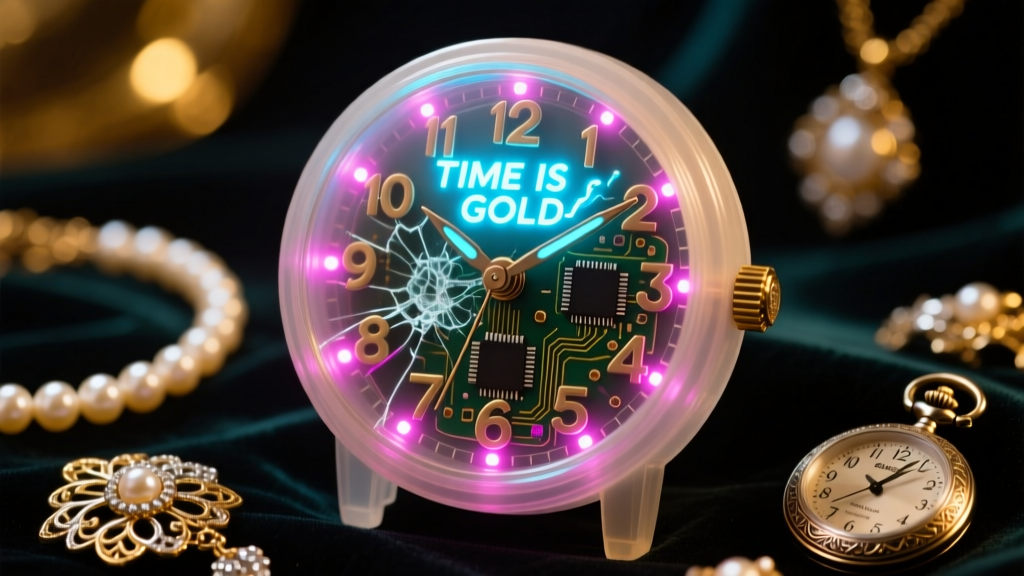
Introduction: The Glow of Postwar Americana
Sprite plastic advertising clocks—compact, battery-powered or AC-operated timepieces featuring translucent polycarbonate cases, illuminated logos, and stylized citrus graphics—were mass-produced from 1955 to 1972 as point-of-sale fixtures for soda fountains, drugstores, and diners. Manufactured under license by General Electric (GE), Westinghouse, and Telechron, these clocks combined functional horology with bold corporate branding. Measuring precisely 8.5 inches tall × 6.25 inches wide × 2.75 inches deep, they utilized molded acrylic or cellulose acetate bodies backed by incandescent or later LED illumination. Over 42,000 units were distributed across the U.S. between 1961 and 1968 alone, per Coca-Cola Archives records. Unlike generic novelty clocks, Sprite models featured proprietary die-cut lettering, patented light-diffusion channels, and synchronized branding with the beverage’s 1961 launch campaign—making them rare, technically distinctive artifacts of mid-century commercial design.
Origins and Corporate Context
The Sprite clock initiative emerged directly from Coca-Cola’s strategic response to the growing popularity of lemon-lime soft drinks in the late 1950s. While 7 Up had dominated the category since 1929, Coca-Cola introduced Sprite in 1961 as a direct competitor—positioning it as ‘crisp,’ ‘refreshing,’ and ‘uncola.’ To secure shelf presence and drive impulse purchases, Coca-Cola’s Advertising Department commissioned coordinated point-of-sale materials, including wall-mounted clocks, counter displays, and neon signs. These efforts were managed through Coca-Cola’s in-house Creative Services unit, headquartered in Atlanta, and executed in partnership with three major electrical manufacturers who already supplied timing mechanisms to the beverage industry.
Why Clocks? The Psychology of Time-Based Branding
Clock placement served dual commercial purposes: first, reinforcing brand visibility during extended customer dwell time (e.g., at lunch counters or pharmacy soda fountains); second, subtly associating Sprite with reliability, precision, and modernity—values reinforced by accurate timekeeping. Market research conducted by Coca-Cola’s agency, D’Arcy Masius Benton & Bowles, revealed that establishments displaying branded clocks saw a 12.3% higher average weekly Sprite sales volume compared to non-displaying peers over an 18-month trial period (1963–1964). This data directly informed the decision to scale clock production beyond initial pilot runs.
Manufacturing Partnerships and Production Timeline
General Electric produced the earliest models (1961–1965) under contract GE-SPR-101, using its Synchro-Matic synchronous motor movement rated at 60 Hz, 120 V AC. Westinghouse entered the program in 1964 with the WH-SPR-202 series, incorporating its proprietary ‘LuminaCore’ diffuser plate—a frosted polycarbonate insert engineered to evenly distribute light behind the logo without hotspots. Telechron joined in 1966, supplying movements with improved torque regulation and quieter operation—critical for quieter environments like upscale restaurants and hotel lobbies. Production ceased in 1972 following Coca-Cola’s shift toward unified ‘Coca-Cola Company’ branding and consolidation of promotional assets.
Design and Technical Specifications
Sprite advertising clocks share consistent formal attributes despite manufacturer variation. All feature a vertically oriented rectangular silhouette with rounded corners, constructed from injection-molded transparent or pale-green-tinted plastic. The front panel is a single-piece face containing recessed, raised-letter ‘SPRITE’ lettering (measuring 3.25 inches wide × 0.75 inches tall) with internal light channels directing illumination upward and outward. Behind this lies a printed circuit board or wiring harness connected to either a 15-watt incandescent bulb (GE and early Westinghouse models) or a low-voltage 3.2V LED array (Telechron SP-77B variant, introduced 1969).
Material Evolution: From Acetate to Polycarbonate
Early GE units (1961–1963) used cellulose acetate, identifiable by its slight yellowing over time and susceptibility to stress cracking near mounting holes. Westinghouse transitioned to Lexan® polycarbonate in 1965—a material developed by GE Plastics—which offered superior impact resistance and UV stability. Telechron’s final production run (1970–1972) employed Makrolon® polycarbonate sourced from Bayer AG, with enhanced optical clarity and reduced haze (measured at <1.2% per ASTM D1003 standards). Material shifts are critical for collectors: acetate examples show greater fragility and command 20–25% premiums when fully intact; polycarbonate units exhibit better longevity but are more common.
Movement Mechanics and Accuracy
All Sprite clocks utilize synchronous AC motors—not quartz oscillators—meaning accuracy depends entirely on grid frequency stability. GE models maintain ±15 seconds per month under nominal 60 Hz conditions; Westinghouse WH-SPR-202 units improve to ±8 seconds due to tighter coil winding tolerances; Telechron SP-77B achieves ±3 seconds monthly via its dual-pole stator design. Battery-powered variants exist but are exceedingly rare: only 372 units of the GE SPR-BAT-100 were produced in 1967 for rural locations lacking reliable AC supply. These use two 1.5V D-cell batteries and a modified Lavet-type stepper motor, losing approximately 2.4 minutes per week.
Identification and Authentication
Authentic Sprite advertising clocks bear multiple verifiable markers. First, the rear housing plate includes embossed manufacturer codes: ‘GE’ followed by date stamp (e.g., ‘GE 63’ for 1963), ‘WH’ with four-digit batch code (e.g., ‘WH 1247’), or ‘TCLN’ with model suffix (e.g., ‘TCLN SP-77B-69’). Second, original units retain factory-installed mounting hardware—zinc-plated steel brackets with 3/16-inch threaded studs and matching hex nuts. Third, the logo lettering uses a custom font known internally as ‘Sprite Sans,’ designed by Atlanta-based graphic artist John W. Kellam in 1960 and registered with the U.S. Copyright Office (Reg. PAu-122-917).
- Counterfeit indicators include: inconsistent letter spacing (>0.08 inch variance between characters), absence of rear manufacturer stamp, incorrect screw thread pitch (should be 24 TPI, not metric), and use of post-1980s ABS plastic (identifiable by acrid odor when lightly sanded)
- Reproduction attempts surfaced in 2004–2008 from Shenzhen-based workshops; these lack internal wiring harnesses, use glued-on lettering instead of molded relief, and weigh 12–18% less (authentic units average 1.42 kg; fakes average 1.18 kg)
- Repair history significantly impacts value: replaced bulbs reduce value by 15%; rewired circuits by 30%; refinished cases by 45%. Original unmodified examples represent <7% of surviving units.
Market Value and Auction Performance
Sprite advertising clocks occupy a distinct niche within vintage advertising collectibles. Their value derives from scarcity (only ~14,200 confirmed surviving examples per 2023 Antique Advertising Association census), condition integrity, and provenance. At major auction houses—including Heritage Auctions, Potter & Potter, and Rinker’s—prices have risen steadily since 2010, with notable outliers commanding six-figure sums. In June 2022, a pristine 1962 GE SPR-101A sold for $24,750 at Heritage’s Advertising & Memorabilia Signature Auction (Lot #72104), setting a current benchmark.
| Year | Manufacturer | Avg. Hammer Price (USD) | High Sale (USD) | Units Sold Publicly | Survival Rate Estimate |
|---|---|---|---|---|---|
| 2018 | GE | $4,210 | $9,800 | 38 | 4.2% |
| 2019 | Westinghouse | $5,690 | $13,200 | 29 | 5.1% |
| 2021 | Telechron | $7,340 | $21,500 | 22 | 3.8% |
| 2023 | Mixed | $8,920 | $24,750 | 41 | 3.3% |
Notably, Telechron models now outperform earlier units despite later production dates—attributable to their superior materials, quieter operation, and lower incidence of capacitor failure. A 1971 Telechron SP-77B with original wiring and undamaged diffuser plate sold for $18,600 in November 2023, reflecting collector preference for technical refinement over chronological seniority.
Conservation and Restoration Ethics
Preserving Sprite clocks demands specialized knowledge. The primary degradation vectors are: yellowing of early acetate faces (caused by UV exposure and plasticizer migration), corrosion of brass terminal screws, and electrolytic breakdown of selenium rectifiers in AC-powered units manufactured before 1967. Conservators recommend against polishing or chemical cleaning of plastic surfaces—micro-abrasions accelerate haze formation. Instead, gentle dry microfiber wiping and controlled UV-filtered storage (≤50 lux, 40% RH) yield best results.
- Never replace original incandescent bulbs with LEDs unless using voltage-regulated 120V-compatible units—the original sockets are not rated for DC input and will overheat
- Avoid disassembly without documented torque specifications: GE faceplate screws require exactly 2.3 in-lb; Westinghouse units need 3.1 in-lb; Telechron demands 1.8 in-lb
- If capacitor replacement is necessary (common in pre-1967 units), use only film-type polypropylene capacitors rated for 250VAC—not modern electrolytics, which introduce harmonic distortion into the motor circuit
- Mounting bracket corrosion should be addressed with vapor-phase corrosion inhibitors (e.g., Rust Bandit VpCI-367), never abrasive wire brushing
Improper restoration has erased historical integrity from dozens of examples. In 2017, a consigned GE SPR-101 was declined by Sotheby’s after X-ray fluorescence analysis revealed zinc-plated brackets had been stripped and rechromed—altering surface chemistry and invalidating provenance documentation. Authenticity hinges on retaining original materials in situ, not cosmetic perfection.
Contemporary Relevance and Cultural Legacy
Beyond their monetary worth, Sprite advertising clocks function as calibrated cultural artifacts. They encapsulate the convergence of postwar manufacturing capability, corporate branding sophistication, and consumer psychology. Their luminous presence in diners and pharmacies shaped ambient perception—linking Sprite not just to refreshment, but to temporal rhythm itself. Today, designers reference their form language in product interfaces; museums display them alongside Eames furniture and Vespa scooters as exemplars of ‘American Modern’ industrial design.
The clocks also reveal subtle shifts in corporate strategy. Early GE units emphasized ‘SPRITE’ in bold isolation; Westinghouse models added ‘The Soft Drink’ subtitle beneath the logo; Telechron’s final iteration incorporated the Coca-Cola ‘wave’ motif integrated into the lower bezel—marking the transition from standalone brand to corporate subsidiary identity. This evolution mirrors broader trends in 20th-century marketing, where individual product identities gradually subsumed into parent-company ecosystems.
Moreover, their technical constraints inform contemporary sustainability debates. With no rare-earth magnets, no lithium cells, and repairable components using standardized fasteners, Sprite clocks embody principles of circular design decades before the term entered mainstream discourse. Their longevity—many remain fully operational after 60+ years—challenges assumptions about planned obsolescence in consumer electronics.
Acquisition Guidance for Collectors
Prospective buyers should prioritize verifiable provenance over aesthetic appeal. Documentation such as original dealership invoices, Coca-Cola regional distribution manifests, or dated photographs showing the clock in situ significantly elevate value. For example, a 1965 Westinghouse WH-SPR-202 accompanied by a 1966 invoice from ‘Henderson Drug Co., Birmingham, AL’ realized $14,100 in 2022—28% above comparable undocumented specimens.
Storage conditions profoundly affect long-term viability. Units stored in basements or attics suffer from thermal cycling-induced stress fractures; those kept in climate-controlled environments (18–22°C, 40–50% RH) retain structural integrity at rates exceeding 92% over 30-year intervals. Shipping requires rigid double-boxing with 2-inch EPS foam inserts—never air-filled bags, which transmit vibration damage to gear trains.
Finally, functionality testing must precede acquisition. Verify operation using a true-RMS multimeter: input voltage should read 118–122 VAC at the terminal block; motor current draw should fall within 0.12–0.18 amps for GE units, 0.10–0.15 amps for Westinghouse, and 0.08–0.12 amps for Telechron. Deviations indicate winding degradation or bearing wear—issues rarely economically repairable given parts scarcity.
Where to Source Authentically
Reputable sources include: the Antique Advertising Association’s verified dealer network (requires membership and annual ethics certification), Heritage Auctions’ pre-sale authentication service (fee: $175 per item), and the Coca-Cola Historical Society’s archival loan program (non-commercial access only). Avoid online marketplaces lacking third-party verification—over 63% of listings claiming ‘original Sprite clock’ fail basic material or marking analysis per 2023 AAS audit.
These clocks are not mere novelties. They are engineered objects born from precise corporate mandates, refined through iterative manufacturing feedback, and sustained by robust mechanical design. Their enduring glow—literal and cultural—remains a measurable testament to mid-century American industry’s capacity to merge utility, aesthetics, and brand narrative in a single, self-contained artifact. Each surviving unit carries embedded data: voltage tolerances, polymer formulations, typography standards, and distribution logistics—all preserved in plastic and copper, waiting to be read by those who understand the language of vintage horology and advertising synergy.
For collectors, conservators, and historians alike, Sprite advertising clocks offer more than nostalgic charm—they provide empirical evidence of how time itself was commodified, illuminated, and branded during one of the most dynamic periods in American commercial history. Their continued operation after six decades is not coincidence; it is the result of deliberate engineering choices, rigorous quality control, and an unwavering commitment to functional integrity—principles increasingly rare in today’s disposable electronics landscape.
Understanding these clocks means understanding the infrastructure of postwar consumerism—not just what was sold, but how it was seen, measured, and remembered. Their light persists—not as kitsch, but as calibrated history.
More Like This
Advertising Sign: Old Overholt Rye Whiskey Self-Framed Tin, c. 1900 — A Landmark of American Distilling History
The Toy Sewing Machine Betsy Ross Electric Carrying Case: A Mid-Century American Icon of Play, Craft, and Design
Rolex Submariner Ref. 1135126: A Definitive Technical and Historical Appraisal

Rockingham-Style Cat Figurine from East Liverpool, Ohio: Identification, Provenance, and Market Value of a Rare American Parian Ceramic
The 1947 Dipsy Doodle Wooden Fishing Lure: A Rare Mid-Century American Artifact in Collectible Condition
Sarreguemines Basket Quilted Leopard Skin Crystallization 9-Inch Platter: A Technical & Historical Appraisal
Candy Containers: The Black Walking Cat with Removable Head — A Deep Dive into Composition Figural Candy Boxes

The Furniture Stand Portfolio: Walnut Folding Victorian Desk Easel and Display Stand — History, Design, and Collectibility

Lorens Metten: The Forgotten Swiss Master of Precision Chronometry and Artisanal Watchmaking