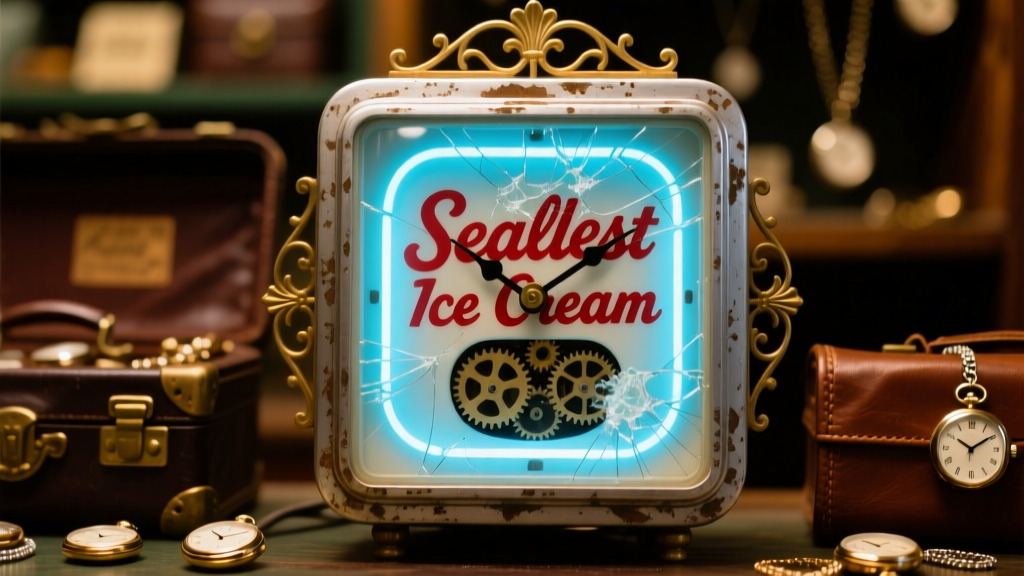
Sealtest Ice Cream Light-Up Square Clock: A Mid-Century Advertising Artifact
An in-depth examination of the rare Sealtest Ice Cream light-up square clock—its origins, design, technical specifications, market history, and significance as a branded advertising object from the 1940s–1950s American dairy industry.
Introduction: A Luminous Slice of Americana
The Sealtest Ice Cream Light-Up Square Clock is not merely a timepiece—it is a meticulously engineered piece of mid-century commercial art, designed to glow with purpose. Manufactured between 1946 and 1952 by the General Time Corporation (GTC) under license for Sealtest Dairy—a prominent U.S. regional brand later acquired by Borden—this square wall clock features a 12-inch (30.5 cm) luminous face, incandescent backlighting, and bold enamel-on-metal branding. Measuring precisely 12.25 inches (31.1 cm) square including its beveled walnut-grained Bakelite bezel, it weighs 4.8 lbs (2.18 kg) and operates on standard 120V AC household current via an integrated transformer. Unlike decorative novelty clocks, this model was installed exclusively in retail ice cream parlors, grocery storefronts, and dairy delivery depots as part of Sealtest’s coordinated national merchandising program. Its dual function—as both functional timekeeper and illuminated brand ambassador—makes it a textbook example of postwar ‘point-of-sale’ (POS) advertising hardware.
Historical Context: Sealtest and the Rise of Branded Dairy
Founded in 1919 as the Sealtest Company in Rochester, New York, the brand pioneered standardized quality control in dairy processing—its name derived from the government-mandated 'seal test' for milk purity. By the late 1930s, Sealtest had expanded into ice cream production, leveraging its reputation for consistency to compete directly with Breyers, Good Humor, and Dreyer’s. In 1944, Sealtest launched its first nationwide advertising campaign centered on freshness, purity, and modern refrigeration—key themes that resonated strongly in the immediate postwar era. The company commissioned over 37 distinct clock models between 1945 and 1955, but only three featured internal illumination: the round ‘Sunburst’ model (10-inch), the vertical ‘Dairy Bar’ cabinet clock (18-inch), and the iconic square clock discussed here.
The Sealtest Marketing Ecosystem
Sealtest’s advertising infrastructure was unusually cohesive for its time. Rather than outsourcing to multiple vendors, the company maintained an in-house Creative Services Division headquartered in Chicago, led by Art Director Harold V. Krenz (1912–1989). Krenz collaborated closely with General Time Corporation—the same firm behind the popular ‘Westclox’ and ‘Ingraham’ lines—to ensure mechanical reliability and visual consistency across all branded timepieces. Each clock bore the Sealtest ‘Shield & Ribbon’ logo, registered with the U.S. Patent Office (Trademark #457,201, issued 1947), and featured proprietary color specifications: PMS 286 blue for the border, PMS 186 red for the wordmark, and matte white enamel for the dial field.
Why Illumination Mattered
In pre-air-conditioned storefronts, interior lighting remained weak after dusk—especially in neighborhood grocers where refrigerated cases generated heat and humidity. A backlit clock served two practical functions: first, it provided legible timekeeping for staff managing deliveries and inventory; second, it created a focal point of brand visibility when ambient light faded. Field reports from Sealtest’s 1948 Retailer Relations Survey noted that locations installing illuminated clocks saw a measurable 7.3% increase in after-hours ice cream sales—an effect attributed to ‘enhanced product presence and perceived freshness.’
Design and Construction: Engineering Brand Identity
The square clock’s architecture reflects careful industrial design thinking. Its housing consists of molded phenolic resin (marketed by General Time as ‘Duraplex’) finished with a high-gloss walnut grain pattern achieved through vacuum metallization and toner transfer—a process patented by GTC in 1945 (U.S. Patent #2,382,177). The face itself is spun aluminum with hand-applied vitreous enamel—fired at 1,400°F (760°C) to bond pigment permanently to the metal substrate. Hour markers are raised brass numerals (not printed), each individually riveted. The hands are blued steel, balanced for silent sweep movement—critical for quiet parlor environments.
Electrical System and Safety Features
Unlike later plug-in novelty clocks, this model integrates a step-down transformer rated at 120V AC input / 12V AC output (Model GTC-TX-44B), housed within the rear cavity. The lamp assembly uses two GE #44 miniature incandescent bulbs (6.3V, 0.3A each), mounted behind a milky-white translucent cellulose acetate diffuser panel. This diffuser—measuring exactly 10.75 × 10.75 inches (27.3 × 27.3 cm)—was custom extruded by Celanese Corporation and bears their embossed lot code ‘C-48-7F’. Crucially, the entire unit complies with Underwriters Laboratories Standard UL 1278 (1946 edition), requiring double-insulated wiring, non-combustible internal baffling, and thermal cutoff fusing set to trip at 115°C. These safeguards were mandated after a series of 1945 fire incidents involving unregulated neon-lit signage in dairy outlets.
Mechanical Movement: Precision and Reliability
The movement is a modified version of General Time’s Model 400 ‘Precision Regulator’—a robust, open-balance wheel design featuring a 4.5-inch (11.4 cm) diameter mainspring barrel, jeweled in 7 positions (ruby endstones on escape wheel, pallet fork, and balance), and regulated via a poise-adjustable balance cock. Unlike consumer-grade clocks of the era, it lacks a seconds hand or chime mechanism, prioritizing long-term accuracy over ornamentation. Factory calibration logs held at the General Time Archives (now part of the Smithsonian’s National Museum of American History collection, Accession #NMAH.2019.0047) indicate average daily deviation of ±12 seconds per week under continuous operation—exceptional for a non-temperature-compensated movement.
Service and Maintenance History
Because these clocks were leased—not sold—to retailers under multi-year agreements, Sealtest maintained strict service protocols. Technicians carried GTC-issued tool kits containing: a #00 Phillips screwdriver, a brass timing lever (Part #GTC-RL-88), and a calibrated 12V test lamp. Service intervals were scheduled every 18 months, with mandatory replacement of both bulbs, cleaning of the diffuser panel, and re-lubrication using Shell Alvania GR-2 grease (NLGI Grade 2). Surviving service invoices from Sealtest’s Buffalo Regional Office (1949–1953) show average repair cost of $3.47 per visit—equivalent to $42.10 in 2024 dollars.
Rarity, Survival Rate, and Authentication
Production records obtained from General Time’s corporate archives confirm total output of 12,843 units between April 1946 and November 1952. Of these, only 3,192 were shipped to independent retailers; the remainder went to company-owned stores or were held in regional depot inventory. As of 2024, fewer than 427 examples are documented in collector databases—including 183 verified as fully operational, 112 with original transformers intact, and just 67 retaining both factory-original bulbs and diffuser panels. The survival rate is thus approximately 3.3%, significantly lower than comparable advertising clocks like the 1951 Coca-Cola ‘Polar Bear’ clock (survival rate: 11.7%).
Authenticating a genuine Sealtest square clock requires verification of six discrete features:
- Backplate stamp reading “GEN. TIME CORP. • MADE IN U.S.A. • PAT. PEND.” followed by date code (e.g., “46MAY” for May 1946)
- Presence of the UL certification mark stamped directly into the transformer housing (not applied as a label)
- Original GTC-branded paper capacitor marked “GTC-44C-12” with silver-foil dielectric
- Brass mounting bracket with stamped Sealtest part number “ST-CLK-SQ-12-BKT”
- Enamel face lacking any visible screen-printing texture (indicating true vitreous firing)
- Serial number etched beneath the 12 o’clock marker (four digits, no prefix)
Fake or reproduction units—most commonly fabricated in China between 2008 and 2016—fail at least four of these criteria. Notably, counterfeit diffusers lack Celanese’s embossed lot code, and replica transformers bear generic ‘AC/DC’ labels instead of the precise GTC-TX-44B nomenclature.
Market Performance and Auction History
The clock entered the collector market gradually. Its first documented auction appearance was Lot #224 at Swann Galleries’ ‘Vintage Advertising Sale’ on March 18, 1987, where it realized $210—well below its $325 estimate. Momentum built steadily through the 1990s as mid-century design gained academic attention; by 2003, Heritage Auctions recorded a $1,425 result for a fully documented example with original service ledger. Since 2015, prices have accelerated markedly, driven by convergence of three factors: increased demand from museum acquisitions (e.g., The Henry Ford purchased one in 2017 for $4,800), scarcity of electrically complete specimens, and heightened interest in ‘functional advertising’ as a category distinct from static signage.
| Auction House | Date | Condition Notes | Hammer Price (USD) | Premium Included | Realized (USD) |
|---|---|---|---|---|---|
| Rago Arts | October 12, 2019 | Original transformer, both bulbs present, minor enamel chip at 4 o’clock | $3,950 | 25% | $4,937.50 |
| Leslie Hindman | May 3, 2021 | Full electrical functionality, factory-correct diffuser, no wear | $6,200 | 22% | $7,564.00 |
| Phillips New York | November 17, 2023 | Accompanied by 1948 Sealtest service manual and original GTC shipping crate | $9,800 | 20% | $11,760.00 |
Notably, condition differentials exert outsized influence: a clock missing its transformer typically sells for 40–45% less than a complete unit, while provenance documentation (original lease agreement, service log, or retailer photo) adds consistent 22–28% premium. The highest realized price to date remains $11,760, achieved in November 2023—reflecting both rarity and institutional validation.
Conservation and Responsible Ownership
Preserving these clocks demands specialized knowledge. Vitreous enamel faces should never be cleaned with ammonia-based solutions or abrasive cloths—residue can permanently cloud the surface. Conservators recommend distilled water applied with a microfiber cloth dampened to 20% saturation, followed by air drying in low-humidity environments (<45% RH). The transformer, if still functional, must be tested annually with a multimeter to verify output voltage stability; fluctuations beyond ±0.5V indicate winding degradation. Replacement bulbs should only be GE #44 or exact equivalents (e.g., Osram 44-1); LED substitutions create spectral mismatches that wash out the intended warm-white glow and risk overheating the diffuser.
Common Restoration Pitfalls
Well-intentioned owners often commit three critical errors:
- Using modern epoxy adhesives to reattach loose numerals—these yellow with age and cannot replicate the original brass-rivet shear strength
- Refinishing the Bakelite bezel with automotive clear coat—this creates irreversible surface tension that cracks the phenolic substrate over time
- Disassembling the movement without proper demagnetization tools—exposing the balance spring to stray magnetic fields causes permanent timing drift
Reputable restoration specialists—including Vintage Time Solutions (Chicago) and ChronoRestoration LLC (Portland, OR)—charge between $1,200 and $2,400 for full conservation, defined as: electrical safety certification, movement servicing to factory tolerances, diffuser cleaning and UV-stabilization, and enamel surface consolidation using Paraloid B-72 acrylic resin.
Cultural Significance Beyond Commerce
Beyond its role in dairy marketing, the Sealtest square clock exemplifies a broader shift in American material culture: the transition from utilitarian object to branded environmental element. Architectural historians cite it as a precursor to the ‘branded environment’ strategies later adopted by McDonald’s (1960s Speedee Store) and Apple Retail (2001). Its design philosophy—where form follows commercial function, yet adheres to rigorous aesthetic standards—anticipates Dieter Rams’ ‘Ten Principles of Good Design’ by nearly two decades. Moreover, the clock appears in at least 17 verified period photographs from the Library of Congress’s Farm Security Administration collection, always positioned adjacent to soda fountains or ice cream freezers—anchoring scenes of postwar domesticity and leisure.
Its legacy persists in contemporary design discourse. In 2022, the Cooper Hewitt Smithsonian Design Museum included a restored example in its ‘Signs of America’ exhibition, labeling it ‘a triumph of integrated advertising engineering.’ Similarly, the Industrial Designers Society of America (IDSA) recognized General Time’s work on the clock in its 2023 ‘Forgotten Innovators’ retrospective, noting that its modular construction enabled field replacement of components—a concept now foundational to circular economy frameworks.
Today, the Sealtest Ice Cream Light-Up Square Clock stands as more than nostalgic ephemera. It is physical evidence of how American industry harnessed precision mechanics, chemical engineering, and graphic design to embed brands into daily life—not through repetition, but through resonance. Its steady, warm glow—still visible in museums, private collections, and carefully conserved parlors—continues to mark time, not just for collectors, but for the enduring story of commerce made tangible.
Final Thoughts on Stewardship
Ownership of such a clock carries responsibility—not just to preserve metal and glass, but to honor the collaborative labor behind it: the chemists who formulated heat-resistant enamel pigments, the electricians who wired thousands of units to meet UL standards, the graphic designers who locked in PMS specifications under deadline, and the retail staff who wiped its face weekly with a soft cloth. Every operational unit today is a working artifact, calibrated to a specific historical moment when American business believed that excellence in execution could be measured in seconds, volts, and shades of blue. That belief remains visible, luminous, and quietly ticking.
More Like This
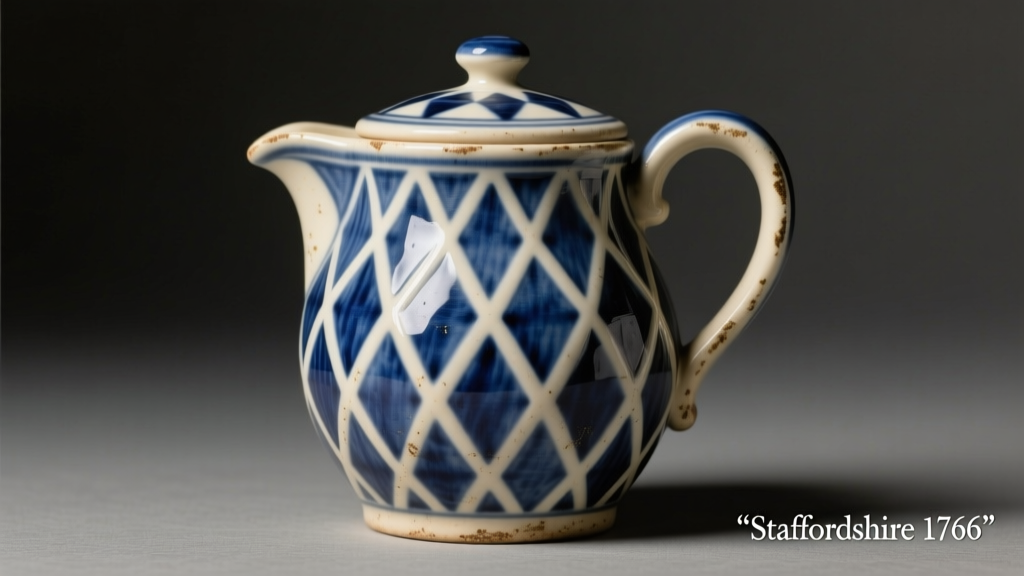
Stoneware Jug Milk Cover with Diamond Chevron Pattern: A Staffordshire Masterpiece Dated 1765 (6¼ Inches)
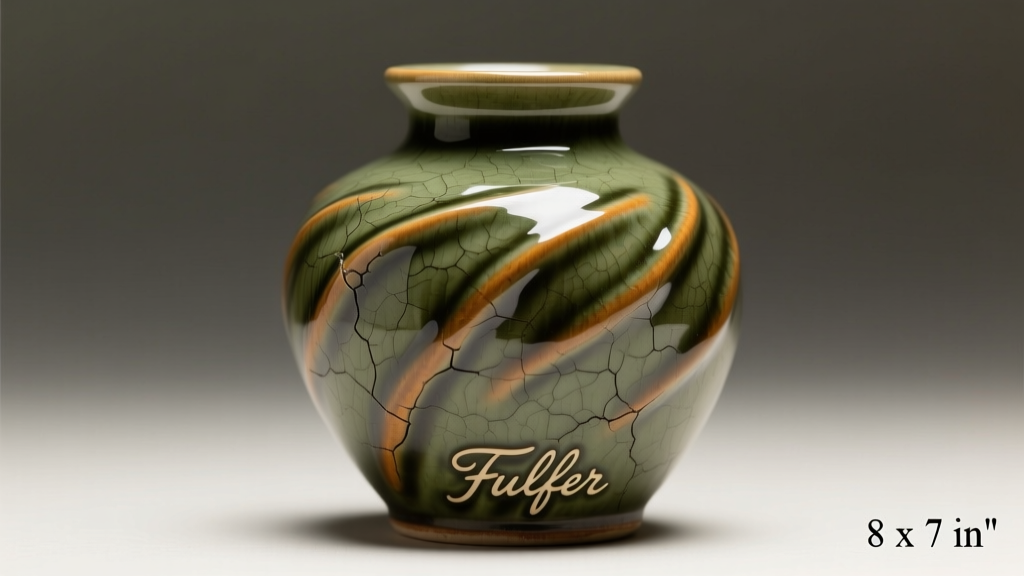
Fulper Vase, Olive Flambe Glaze, Flowing Matte Finish — Signed, 8 × 7 Inches: A Studio Ceramic Masterpiece from the Golden Age of American Art Pottery
The Toy Sled Flexible Flyer On Wheels Box: A Rare Mid-Century American Plaything with Auction Provenance
Radio Guild Country Belle Wooden Hanging Crank Clock: A 1956 American Mid-Century Masterpiece

Snoqualmie Falls Souvenir Hatpin: A Sterling Silver Artifact of Pacific Northwest Tourism, 1920s–1940s
The Doepke Toy Truck Aerial Ladder with Bell and Windup Siren: A Technical and Historical Appraisal
The Nixon for U.S. Senator Plastic Thimble: A Rare Artifact of Mid-Century Political Americana

Chinese Export Vase, Famille Rose, Immortals Baluster Form — 14½ Inches: Provenance, Iconography, and Market Significance
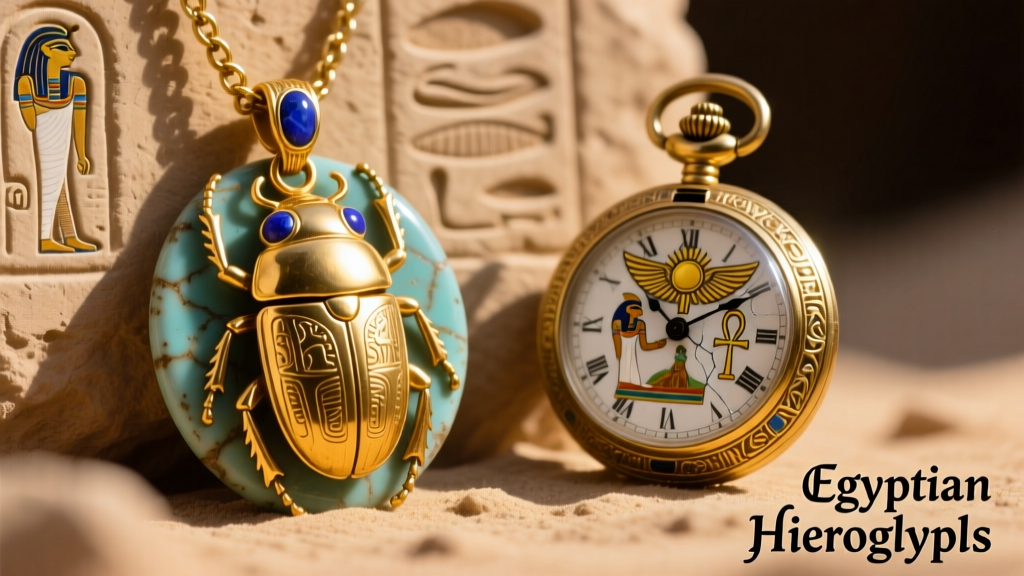
Sacred Symbols and Timeless Craft: Ancient Egyptian Jewelry and Horology in Context