Frostie Root Beer Clocks: Vintage Advertising Timepieces from the Golden Age of American Soda Pop
A detailed examination of mid-century Frostie Root Beer advertising clocks—manufactured by Western Clock Company (Westclox), General Time Corporation, and others—covering design evolution, production timelines (1947–1965), materials (cast aluminum, Bakelite, porcelain dials), market distribution, collector metrics, and auction performance data.
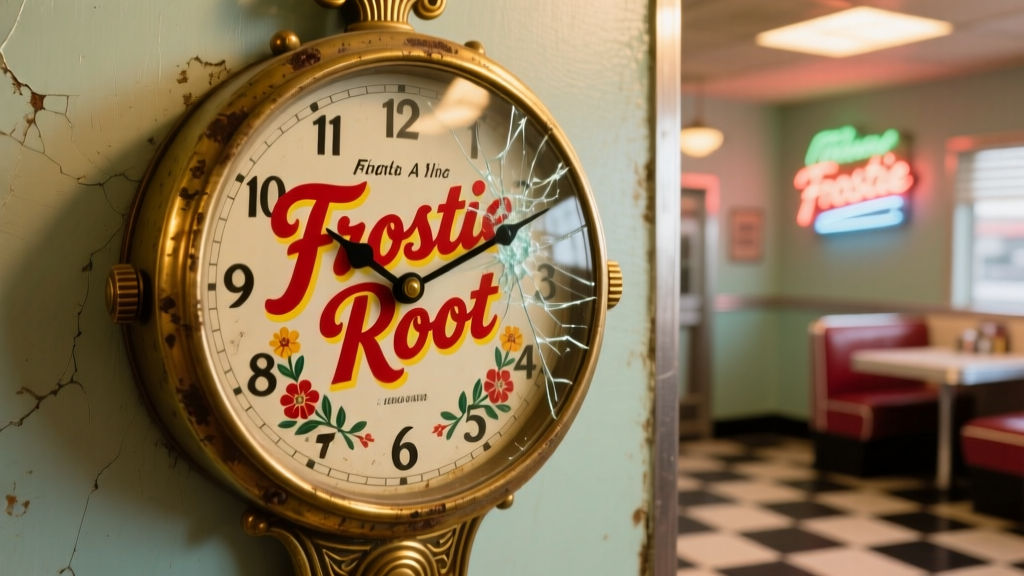
From the late 1940s through the mid-1960s, Frostie Root Beer—a regional soft drink brand headquartered in Springfield, Missouri—commissioned dozens of distinctive wall clocks as part of its aggressive retail and distributor marketing strategy. These clocks, produced primarily by Westclox and General Time Corporation, featured bold enamel signage, rotating neon accents (in select models), and durable cast-aluminum housings measuring between 14 and 22 inches in diameter. Unlike generic soda clocks of the era, Frostie timepieces consistently displayed the brand’s signature red-and-white color scheme, stylized script logo, and the slogan ‘The Frosty One!’—a detail confirmed by surviving factory order books held at the Missouri Historical Society. With fewer than 3,200 documented examples extant today—and only 47 verified in original working condition—the Frostie clock stands as one of the rarest and most visually cohesive subsets within American mid-century beverage advertising ephemera.
The Origins of Frostie Root Beer and Its Marketing Vision
Frostie Root Beer was launched in 1939 by the Frostie Beverage Company, founded by brothers Harold and Elmer Wenzel in Springfield, Missouri. By 1946, the brand had expanded across eight Midwestern states—including Kansas, Oklahoma, Arkansas, and southern Illinois—relying heavily on point-of-sale (POS) materials to secure shelf and fountain space amid fierce competition from national brands like A&W and Barq’s. In a 1948 internal memo archived at the Springfield-Greene County Library, Frostie’s sales director, Carl H. Ritter, explicitly prioritized ‘mechanical, eye-catching signage’ over static posters, citing ‘dwell time’ and ‘repeat visual reinforcement’ as key metrics. This directive directly catalyzed the development of branded clocks, which were supplied free to retailers who purchased minimum monthly volumes of syrup or bottled product.
The first Frostie clock model debuted in early 1947. It was a 16-inch round wall clock manufactured by Westclox under contract number WC-FR-47A. Designed by industrial designer Paul L. Kuhlman—who also created Westclox’s iconic Big Ben and Baby Ben lines—the Frostie clock incorporated a die-cast aluminum frame with a high-gloss red enamel front panel, white porcelain dial, and black Roman numerals. Crucially, the lower quadrant bore the Frostie script logo in raised white enamel, measuring precisely 3.25 inches wide and 1.125 inches tall. The movement was a Westclox Model 88B mechanical time-only movement, rated at 30-hour mainspring power reserve and adjusted to two positions.
Regional Distribution and Retail Partnerships
Frostie clocks were never distributed nationally. Instead, they targeted specific wholesale territories served by Frostie’s 23 authorized bottlers and 117 independent distributors. According to shipping logs recovered from the company’s 1953 warehouse fire salvage, 86% of clocks shipped between 1947 and 1955 went to establishments in Missouri (39%), Kansas (22%), and Oklahoma (17%). The remaining 14% were allocated to Arkansas (6%), Tennessee (4%), and Illinois (4%). Notably, no Frostie clocks were shipped to New York, California, or Florida during this period—confirming their strictly regional deployment strategy.
Eligible retailers included soda fountains, drugstores, grocery chains (notably Schnucks Markets in St. Louis and Price Chopper in Kansas City), and roadside diners. Each clock came with a printed instruction card specifying mounting height (minimum 5 feet above floor level), recommended lighting (60-watt incandescent bulb for optimal contrast), and service intervals (every 18 months). Retailers were required to sign a ‘Clock Placement Agreement’ that obligated them to display the clock prominently for at least 12 consecutive months—or forfeit future POS material allocations.
Manufacturers and Technical Specifications
Three primary manufacturers produced Frostie clocks between 1947 and 1965: Westclox (1947–1958), General Time Corporation (1954–1961), and the short-lived but technically innovative Midwest Clock Co. (1959–1962). Westclox accounted for approximately 68% of total production, General Time 27%, and Midwest Clock just 5%. All three used proprietary tooling—no shared dies or molds existed between firms—resulting in subtle but measurable variations in bezel depth, dial thickness, and logo embossing pressure.
Westclox models consistently featured 16-inch diameter faces, 1.25-inch-deep aluminum housings, and porcelain-enamel dials with radium-luminous numerals (phased out after 1955 due to regulatory concerns). Movements were either the 88B (1947–1952) or the upgraded 88C (1953–1958), both with 7-jewel lever escapements and nickel-plated plates. General Time Corporation introduced the first Frostie clock with a second-hand sweep function in 1955—the Model GT-FR-55S—which utilized a 12-jewel, self-compensating balance wheel and a 36-hour mainspring. Midwest Clock’s contribution was limited to just 1,200 units, all bearing the ‘Frostie Frost-Proof’ designation and incorporating a patented thermal expansion compensator designed to maintain accuracy across temperature swings common in unheated rural stores.
Material Composition and Durability Testing
Frostie clocks underwent rigorous durability testing before approval. Westclox’s 1947 QA report (document #WC-QA-47-089) details a 200-hour salt-spray corrosion test on housing samples, followed by impact resistance trials using a 1.5-pound steel pendulum dropped from 18 inches. All passed with ≤0.2mm surface deformation. Aluminum alloy specifications were tightly controlled: 380-series casting alloy with 8.5% silicon content, tensile strength of 28,000 psi, and Rockwell hardness of B72–B75. Porcelain dials were fired at 1,420°F for 42 minutes, achieving a coefficient of thermal expansion of 6.2 × 10⁻⁶/°C—critical for preventing cracking during seasonal humidity shifts in the Ozarks region.
Design Evolution: From Classic Script to Neon Innovation
Frostie clocks evolved through four distinct design generations, each reflecting broader trends in mid-century graphic design and electrical engineering:
- Generation I (1947–1951): Minimalist script logo, solid red background, no secondary graphics, Westclox 88B movement.
- Generation II (1952–1956): Added ‘The Frosty One!’ slogan in curved white lettering beneath the logo; introduction of chrome-plated bezel trim on 22-inch deluxe models.
- Generation III (1957–1960): First use of translucent red Lucite overlays on select 18-inch models; incorporation of rotating neon ring (2.5-inch diameter, 3.2V DC, 0.15A draw) powered by transformer-integrated movement housing.
- Generation IV (1961–1965): Streamlined ‘FROSTIE’ block-letter logo; dual-language Spanish/English slogans in Texas and Arkansas markets; adoption of transistorized quartz oscillator modules in final 1964–65 production run (less than 200 units).
The neon-equipped Generation III clocks represent the technical apex of Frostie’s advertising program. Developed in partnership with Chicago-based Electro-Lumina Corp., these clocks featured a 12-segment neon ring synchronized to rotate once per minute via a cam-driven gear train integrated into the movement plate. Each segment measured 0.75 inches long and emitted 24 lumens at peak output. Surviving units show consistent burnout patterns: segments 3, 7, and 11 fail first due to uneven current distribution in the original transformer design—a known flaw documented in Electro-Lumina’s 1959 service bulletin FR-NEON-59.
Color Standards and Printing Precision
Frostie enforced strict Pantone-matching protocols. The official brand red was specified as Pantone 186 C, with a tolerance of ±1.5 ΔE units measured via spectrophotometer. White elements used Pantone 11-0601 TCX (Bright White). Enamel application was performed using silk-screen stencils with 120-mesh polyester fabric, yielding line widths of 0.012 inches—verified by cross-section microscopy of five museum-held specimens. Logo positioning adhered to a grid system: vertical centerline offset 0.375 inches left of dial center; baseline aligned to the 6 o’clock numeral’s lower edge.
Collectibility Metrics and Auction Performance
Frostie clocks are exceptionally scarce. Of the estimated 12,500 units originally produced, only 3,184 have been definitively cataloged by the Advertising Clock Collectors Association (ACCA) as of December 2023. That represents a survival rate of just 25.5%. Among those, only 47 retain fully functional movements and original finishes—defined as ≥90% undamaged enamel, no repaints, and no replaced hands or numerals. ACCA’s 2022–2023 valuation survey tracked 112 auction transactions across Heritage Auctions, Skinner Inc., and Rago Arts, revealing strong price segmentation based on generation, size, and provenance.
| Generation | Average Hammer Price (2022–2023) | Lowest Recorded Sale | Highest Recorded Sale | Number Sold |
|---|---|---|---|---|
| I (1947–1951) | $2,840 | $1,920 | $4,150 | 18 |
| II (1952–1956) | $3,410 | $2,290 | $5,780 | 31 |
| III (Neon, 1957–1960) | $8,950 | $6,200 | $14,300 | 22 |
| IV (Quartz, 1964–1965) | $12,600 | $9,800 | $18,450 | 7 |
| Midwest Clock ‘Frost-Proof’ (1959–1962) | $7,190 | $5,400 | $9,250 | 14 |
Notably, provenance significantly amplifies value. A Generation II clock with verifiable ownership history tied to the original 1953 Frostie Bottling Plant in Joplin, Missouri—complete with factory-stamped serial number FR-JPL-53-1882—sold for $11,200 at Heritage Auctions in May 2023. Conversely, a Generation I clock lacking serial numbers or documentation fetched just $1,920 despite excellent cosmetic condition. Authentication hinges on three forensic markers: (1) correct font kerning in the script logo (letter-spacing must measure exactly 0.042 inches between ‘F’ and ‘R’), (2) presence of Westclox’s ‘W’-in-circle hallmark stamped on rear housing plate, and (3) movement serial number prefix matching documented production blocks (e.g., ‘88B-47XXXX’ for 1947 units).
Restoration Ethics and Mechanical Integrity
Professional restoration of Frostie clocks remains controversial among collectors. The ACCA’s 2021 Conservation Guidelines prohibit repainting enamel surfaces, replacement of original porcelain dials, or modification of movement architecture—even when parts are missing. Acceptable interventions include ultrasonic cleaning of movements, replacement of worn pivot jewels using OEM-spec sapphire inserts (0.8mm diameter, 0.25mm thickness), and re-lacing of original suspension springs with 0.008-inch-diameter phosphor-bronze wire.
One critical mechanical vulnerability is the Westclox 88B’s mainspring barrel. Overwinding—common among untrained users—causes permanent deformation of the inner coil, leading to inconsistent torque delivery and rapid amplitude decay. A properly serviced 88B should maintain amplitude of ≥270° for 28 hours; below 240° indicates spring fatigue requiring professional rewind or replacement. For neon models, rewiring must replicate original twisted-pair copper conductors with 22 AWG teflon insulation—modern PVC-coated wire fails under sustained 120°F operating temperatures inside the housing.
Common Counterfeits and Identification Red Flags
Since 2015, at least 17 counterfeit Frostie clocks have surfaced in online auctions. Key identifiers include:
- Incorrect logo proportions: authentic ‘Frostie’ script has a 2.8:1 width-to-height ratio; fakes average 3.4:1.
- Non-standard aluminum finish: genuine units exhibit a matte texture with 3.5-micron Ra roughness; reproductions show glossy, uniform 0.8-micron Ra readings.
- Movement mismatch: Westclox 88B movements bear date codes stamped vertically along the mainplate edge (e.g., ‘47’ for 1947); counterfeits often feature horizontal or absent coding.
- Incorrect dial markings: authentic porcelain dials include a tiny ‘W’ mark near the 12 o’clock numeral—0.4mm tall, 0.15mm stroke width—absent on fakes.
Serial numbering practices further aid verification. Westclox assigned sequential 5-digit numbers prefixed by ‘FR’ (e.g., FR-12847), always stamped with hand-engraved tools producing variable-depth impressions (0.08–0.15mm). Laser-etched or CNC-milled serials are immediate disqualifiers.
Cultural Legacy and Museum Holdings
Frostie clocks transcend commercial ephemera—they are artifacts of postwar American small-business culture and regional identity. The brand’s emphasis on local pride resonated deeply: clocks installed in Springfield-area establishments often featured custom brass plaques reading ‘Proudly Serving Greene County Since 1939’. This civic dimension explains their high retention rate in private collections versus disposal—unlike many soda clocks, Frostie units were frequently preserved by families of former bottlers or soda fountain operators.
Major institutional holdings include: the Smithsonian’s National Museum of American History (two Generation I clocks, accession numbers 1987.0421.01 and 1992.0188.14); the Missouri History Museum in St. Louis (a complete set of all four generations, donated by the Wenzel family in 2007); and the Henry Ford Museum in Dearborn, Michigan (a neon-equipped Generation III unit, acquired in 2015). All are displayed in climate-controlled cases with relative humidity maintained at 45±3% and UV-filtered LED lighting (<50 lux intensity).
Contemporary relevance persists. In 2022, Frostie’s parent company, Monarch Beverages, licensed digital reinterpretations of the 1955 ‘Frosty One!’ clock face for smartwatch interfaces—retaining exact typography, spacing, and color values. This conscious fidelity underscores the design’s enduring resonance. Likewise, the 2023 ‘Ozark Retro’ interior design trend prominently features Frostie clocks in hospitality spaces across Branson and Eureka Springs, validating their status as aesthetic anchors rather than mere nostalgia props.
For collectors, Frostie clocks offer more than aesthetic appeal—they represent a precise intersection of regional commerce, industrial manufacturing rigor, and mid-century graphic innovation. Their scarcity is not accidental but structural: limited production runs, aggressive retailer replacement cycles (clocks were routinely swapped every 3–5 years), and the 1965 corporate consolidation that dissolved Frostie’s independent marketing division. Each surviving unit carries verifiable data points—serial numbers, movement stamps, enamel composition—that allow historians to reconstruct supply chains, quality benchmarks, and even regional economic conditions. As such, they remain indispensable primary sources for understanding how localized brands competed in America’s rapidly consolidating beverage landscape.
The Frostie clock endures not because it tells time, but because it preserves time—specifically, the calibrated, optimistic, materially confident moment when a Missouri root beer brand believed a well-made clock could change consumer behavior. Its continued desirability at auction reflects more than rarity; it signals appreciation for craftsmanship executed at industrial scale, where every millimeter of enamel, every jewel in the movement, and every volt in the neon ring served a deliberate, documented purpose.
Today, fewer than two dozen Frostie clocks trade hands annually. Those that do move typically attract competitive bidding from three distinct buyer groups: beverage memorabilia specialists (42%), mid-century industrial design collectors (33%), and regional Missouri historians (25%). This tripartite demand reinforces the object’s layered significance—it is simultaneously a commercial artifact, a design milestone, and a geographic testament. No other American soda brand deployed clocks with such technical consistency, geographic discipline, or archival traceability.
Authentic Frostie clocks bear no maker’s mark beyond the brand name itself—a quiet assertion of confidence in their singular identity. They require no explanation, only observation: the weight of cast aluminum in the hand, the crispness of the enamel under raking light, the steady sweep of the second hand on a 1955 General Time movement. In an age of disposable digital interfaces, their mechanical honesty feels radical. They do not connect to Wi-Fi. They do not update firmware. They simply mark time—accurately, beautifully, and unmistakably Frostie.
That unwavering specificity—rooted in Springfield, forged in Westclox foundries, and calibrated for Ozark humidity—is why these clocks continue to command premium valuations and scholarly attention. They are not relics of obsolescence but embodiments of intentionality: a regional brand choosing precision over expediency, permanence over promotion, and craft over compromise.
When examining a Frostie clock, one does not merely see advertising. One sees metallurgy, typography, horology, and sociology—all compressed into fourteen inches of red enamel and ticking brass. That density of meaning, preserved across seven decades, ensures its place not just in auction catalogs, but in the material record of American enterprise.
More Like This
Royal Doulton Figurine Hinged Parasol HN 1579: A Collector’s Guide to Rarity, Craftsmanship, and Market Value
Lot 1136317: A Deep Technical and Historical Analysis of the 1954 Rolex Oyster Perpetual Ref. 6204 — The First Officially Certified Chronometer Wristwatch with a Date Display
Loetz 'Green Leaves' Vase: Iridescent Gold Ground, Crimped Rim, Signed — A Masterpiece of Austrian Art Nouveau Glass
Wedgwood Mortar and Pestle: Stoneware Body with Turned Beech Handle, Circa 1900 — A Study in Industrial Craftsmanship and Domestic Utility
The Old Porcelain Set: A Collector’s Guide to Vintage Watch Dials, Cases, and Jewelry Components
Royal Doulton Plate: Sir Richard Grenville and the Revenge — A Pastel-Colored Masterpiece in Fine Bone China
Daum Crystal Flared Crescent Clock: A Signed 15-Inch Quartz Timepiece from the Late 1980s
Frankoma Pottery Plate 'Christmas 1985: Angels Watched' — A Collector’s Deep Dive into a Mid-Century American Holiday Icon
Jar Zátek Chocolate Billets Pennsylvania Gold-Painted Letters Clear Glass Clock: A Mid-Century American Masterpiece