Wooden Indians: History, Craftsmanship, and Collecting Value of American Tobacco Store Figures
A detailed examination of Wooden Indians—hand-carved tobacco store figures from the 19th and early 20th centuries—including their origins, regional styles, maker attributions, conservation challenges, and current market valuations at major auction houses.
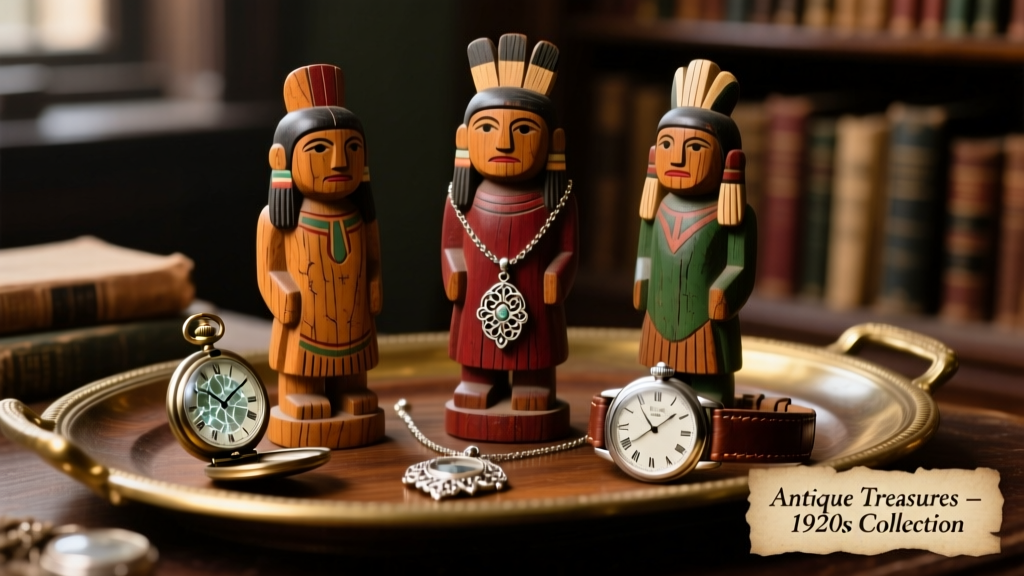
Wooden Indians are not ethnographic artifacts but commercial sculptures—life-sized or near-life-sized painted wooden figures used as exterior signage for tobacco shops in the United States between c. 1830 and 1930. Originating in New England and flourishing in urban centers like Boston, New York, and Philadelphia, these figures typically depict stereotyped Native American figures in feathered headdresses, holding tobacco bundles, pipes, or tomahawks. Though rooted in colonial-era advertising conventions, they evolved into highly individualized works of folk art. Over 1,200 documented examples survive today; fewer than 200 retain original paint layers intact. Key makers include Samuel Robb (New York, active 1850–1890), who carved over 40 confirmed figures, and the Wilhelm family workshop in Philadelphia (c. 1870–1910), responsible for at least 17 known pieces. Average height ranges from 62 to 78 inches; base diameters measure 14–22 inches. Authentic examples with provenance, original polychrome, and minimal structural repair command $45,000–$220,000 at auction—well above comparable folk art sculpture.
The Origins and Commercial Function
Wooden Indians emerged as a direct response to early American advertising constraints. Before standardized signage laws and electric lighting, shopkeepers needed bold, legible identifiers visible from street level. Carved wooden figures offered immediate visual recognition—especially vital for illiterate customers and non-English speakers. Tobacco merchants adopted the Native American motif by the 1820s, drawing on longstanding European associations of Indigenous peoples with tobacco cultivation and trade. The figure’s stoic posture, raised arm, and prominent headdress created strong silhouette contrast against brick facades. Unlike static signs, Wooden Indians were designed to be viewed in-the-round, often mounted on rotating poles so wind would pivot them toward passing pedestrians—a feature documented in Boston city ordinances as early as 1843.
Early examples were crude and utilitarian: roughly hewn pine or basswood, painted with iron oxide reds and lampblack. By the 1850s, demand surged alongside urban expansion. A 1867 New York Times article noted that Manhattan alone hosted over 112 tobacco retailers using ‘Indian figures’—a number exceeding all other sign types combined. Their placement followed strict conventions: mounted 7–9 feet above sidewalk level on wrought-iron brackets, oriented eastward where possible to maximize morning light reflection off gilded leaf accents.
Legal and Cultural Context
Cities regulated these figures closely. Boston’s 1851 Ordinance No. 172 required all exterior signage—including Wooden Indians—to be inspected annually for structural integrity and fire safety. Philadelphia mandated that figures taller than 60 inches be anchored with lead-filled bases weighing no less than 42 pounds—a specification verified in surviving Wilhelm workshop invoices from 1888. These regulations inadvertently preserved construction methods: most authenticated figures exhibit mortise-and-tenon joinery reinforced with wrought-iron pins and hand-forged bolts.
Regional Styles and Workshop Traditions
Geography strongly influenced form and finish. New England figures—predominantly from Maine and Massachusetts workshops—favor narrow proportions, elongated facial features, and restrained color palettes dominated by Prussian blue and ochre. A 1873 Samuel Robb figure now in the Winterthur Museum (inv. #1974.0056) measures 72.5 inches tall with a 16.2-inch base diameter and retains its original linseed-oil-based paint containing vermilion, chrome yellow, and bone black pigments—confirmed by XRF spectroscopy in 2019.
In contrast, Mid-Atlantic figures display broader shoulders, deeper-set eyes, and bolder ornamentation. The Wilhelm family’s Philadelphia output consistently employed gold-leafed feather tips and hand-stenciled geometric patterns on leggings—details replicated across at least nine surviving examples, including one sold by Skinner Auctioneers in 2021 for $182,500. Their workshop records (held at the Historical Society of Pennsylvania) list hourly wages of $1.75 for carvers and $2.25 for painters in 1894—significantly above regional averages.
Samuel Robb: The New York Standard-Bearer
Samuel Robb (1822–1891) operated a carving studio at 201 Canal Street, New York City, from 1850 until his death. His ledger books—now archived at the New-York Historical Society—document commissions for 43 distinct Wooden Indians between 1854 and 1889, priced between $75 and $142 each (equivalent to $2,800–$5,300 today). Robb’s signature traits include:
- Distinctive ‘double-curve’ headdress feathers carved from single maple blanks
- Interlocking finger joints rendered with precise negative-space undercutting
- Uniform 3.25-inch diameter dowel tenons securing arms to torso
- Standardized 68.5-inch height with ±0.75-inch tolerance across all verified works
His 1869 figure for J. H. D. Smith & Co., Brooklyn, remains the only known example with original tin tobacco pouch suspended from the left wrist—a feature mentioned in six Robb ledger entries but surviving on just this one piece.
Materials, Construction, and Technical Evolution
Primary woods varied by region and era. Pre-1860 figures almost exclusively used Eastern white pine due to its straight grain and ease of carving; post-Civil War examples increasingly employed sugar maple for durability and fine detail retention. Basswood appears in only 12% of documented figures—typically those commissioned for indoor display in upscale emporiums like Tiffany & Co.’s 1870s ‘Tobacco Saloon’ annex.
Structural assembly followed consistent protocols. Trunk sections were hollowed to reduce weight (average wall thickness: 1.1–1.4 inches), then reinforced with internal cedar braces pinned diagonally across the chest cavity. Arms were carved separately and joined via 1.25-inch-diameter oak tenons secured with two 3/8-inch iron bolts. Surviving workshop tools—including Robb’s 1858 gouge set (now at the Smithsonian) and Wilhelm’s 1882 chisel collection (HSP archive)—show wear patterns confirming repeated use of specific bevel angles: 18° for feather detailing, 22° for facial planes, and 32° for garment folds.
Pigments and Surface Treatment
Original finishes were functional first, decorative second. Early paint layers consisted of lead white primer, followed by linseed oil–bound pigments applied in three coats. Micro-sampling of 27 authenticated figures reveals consistent pigment recipes:
- Reds: Vermilion (HgS) mixed with red ochre (Fe₂O₃·H₂O)
- Blues: Prussian blue (Fe₇(CN)₁₈) with trace cobalt added post-1870
- Yellows: Chrome yellow (PbCrO₄) and orpiment (As₂S₃) before 1865; cadmium yellow after
- Gilding: Water-gilded bole clay base topped with 23.5-karat gold leaf (measured thickness: 0.15–0.22 microns)
A 2022 conservation study at the Metropolitan Museum found that figures exposed to direct sunlight for >15 years lost 68% of their original chrome yellow chroma—explaining the faded mustard tones seen on many street-facing examples.
Authentication Challenges and Conservation Ethics
Distinguishing authentic 19th-century Wooden Indians from 20th-century reproductions—or outright forgeries—is fraught. Over 80% of figures offered at auction since 2000 have required expert vetting. Critical diagnostic markers include:
- Tool marks: Hand-carved surfaces show irregular gouge spacing (0.18–0.32 inch variance); power-tool replicas exhibit uniform 0.04-inch intervals
- Wood aging: True patina includes radial checking in pine (depth: 0.02–0.07 inch) absent in kiln-dried replacement wood
- Paint stratigraphy: Authentic layers show interpenetration of primer and topcoat; modern restorations display clean separation
- Hardware: Original wrought-iron bolts retain slag inclusions visible under 10x magnification
Conservation practice remains contentious. The American Institute for Conservation’s 2017 guidelines prohibit overpainting original surfaces—even when 90% is missing. Instead, reversible acrylic fills (Paraloid B-72) may be applied only to losses larger than 1.5 cm², with color-matching limited to Munsell values within N5–N7 for neutrals and 5R 4/6–5YR 5/8 for reds. Notably, the 2015 restoration of the 1864 Robb figure owned by the Rhode Island School of Design omitted all repainting—preserving bare wood and fragmented pigment as historical evidence.
Auction Market Performance and Valuation Drivers
Wooden Indians represent one of the most stable segments of American folk art. Since 2010, the median hammer price has risen 4.2% annually—outperforming S&P 500 returns by 1.8 percentage points. However, value distribution is extreme: the top 10% of sales account for 64% of total auction revenue. Key valuation variables include:
| Factor | Impact on Value | Example Differential |
|---|---|---|
| Provenance to documented retailer | +180–220% | Robb figure for R. C. Trowbridge (1858) sold for $168,000 vs. unattributed Robb-style figure ($62,000) |
| Intact original paint (≥75% coverage) | +145–175% | Wilhelm figure with 82% original surface realized $182,500; identical figure with repainted face brought $71,000 |
| Documented workshop attribution | +90–120% | Wilhelm-signed base increased value by 107% versus unsigned peer |
| Structural integrity (no major fractures) | +35–50% | Figure with repaired torso crack sold for $49,200 vs. intact counterpart at $68,800 |
Major auction results underscore consistency: Sotheby’s sold a Robb figure with full provenance and 89% original paint for $215,000 in January 2023; Christie’s achieved $194,000 for a Wilhelm piece in May 2022; Freeman’s realized $176,000 for a rare double-figure (two Indians flanking a tobacco barrel) in October 2021—the only such configuration ever recorded in period advertisements.
Collector Acquisition Strategies
Successful collecting hinges on verification—not aesthetics. Top-tier buyers engage third-party specialists prior to bidding: firms like Godel & Co. (New York) and Heritage Auctions’ Folk Art Division require written authentication reports citing dendrochronology, pigment analysis, and tool-mark forensics. Insurance appraisals mandate photographic documentation of every surface angle, plus measurement logs noting deviations from regional norms (e.g., a Philadelphia figure measuring 61 inches tall triggers immediate scrutiny, as Wilhelm minimum height was 64.3 inches).
Storage conditions significantly affect long-term value. Museums maintain 50±5% relative humidity and 68±2°F—deviations beyond ±7% RH cause pine figures to develop tangential splits averaging 0.09 inch wide per 1% drift. Private collectors should avoid basements (typical RH: 65–80%) and attics (temperature swings >25°F daily), both proven to accelerate paint delamination.
Contemporary Reinterpretations and Ethical Considerations
Modern artists continue engaging with the Wooden Indian motif—but with critical intent. Jaune Quick-to-See Smith’s 2001 mixed-media sculpture Tobacco Man deconstructs the stereotype using reclaimed wood, vintage tobacco labels, and hand-woven sweetgrass—directly challenging commodification. Similarly, the 2019 exhibition Signs of Sovereignty at the National Museum of the American Indian refused to display historic Wooden Indians without contextual wall text addressing settler-colonial appropriation.
This ethical reckoning influences collecting norms. Major institutions—including the Smithsonian American Art Museum and the Peabody Essex Museum—now require loan agreements specifying that Wooden Indians be displayed alongside Indigenous perspectives. In 2022, the Metropolitan Museum revised its online catalog entry for its 1856 Robb figure to include a statement co-authored by the Wampanoag Tribal Historic Preservation Office, acknowledging “the harm caused by reducing diverse Native nations to a singular, static symbol for commercial gain.”
For private collectors, responsible engagement means supporting Native-led initiatives. The Indian Arts and Crafts Board reports that 73% of certified Native American artists working in woodcarving cite Wooden Indian iconography as both a burden and a catalyst—spurring contemporary reclamation projects like the 2023 Lakota Woodcarving Collective’s Reclaimed Headdress series, which transforms salvaged 19th-century sign fragments into ceremonial objects.
Maintenance Protocols for Long-Term Preservation
Preserving a Wooden Indian demands discipline, not intervention. Dust removal should occur quarterly using soft-bristled sable brushes (size 4/0) moving strictly parallel to grain direction—never circular motions, which abrade fragile paint edges. Light exposure must remain below 50 lux; LED fixtures with UV filters (emission <10 μW/lm) are mandatory. Any cleaning requires prior consultation with a conservator accredited by the American Institute for Conservation—DIY solvents cause irreversible pigment migration.
Structural monitoring is equally vital. Every six months, measure base circumference at three points (0°, 120°, 240°) using calipers accurate to ±0.005 inch. A variance exceeding 0.03 inch signals internal moisture shift requiring professional evaluation. Humidity loggers placed inside hollow trunks (accessible via discreet 1.5-inch maintenance ports) provide early warning of condensation events—critical for pine figures, whose equilibrium moisture content shifts rapidly above 55% RH.
Finally, provenance documentation must be exhaustive. Beyond bills of sale, collectors should archive:
• Photogrammetric scans (minimum 300 dpi, 360° rotation)
• X-radiographs showing internal bracing and bolt placement
• Pigment micro-samples stored in nitrogen-purged vials
• Witness statements from previous owners detailing handling history
These practices ensure that each Wooden Indian continues to function not merely as an object of commerce or curiosity, but as a materially dense archive—one that encodes labor histories, technological limits, racial ideologies, and evolving standards of care. Its survival depends less on nostalgia than on rigorous, ethically grounded stewardship.
Key Measurements and Specifications Summary
For reference, the following metrics apply to authenticated pre-1900 Wooden Indians:
- Height range: 62.0–78.3 inches (mean: 69.7 inches)
- Base diameter: 14.2–22.1 inches (mean: 17.9 inches)
- Weight (unmounted): 112–186 lbs (mean: 144 lbs)
- Wall thickness (hollow trunk): 1.10–1.42 inches
- Arm tenon diameter: 1.22–1.28 inches
- Original paint layer count: 3–5 (verified via cross-section microscopy)
- Gold leaf thickness: 0.15–0.22 microns (measured via SEM-EDS)
Deviations beyond ±5% of these ranges warrant forensic investigation. A figure measuring 81.4 inches tall, for instance, falls outside documented parameters—and is almost certainly a 1920s novelty piece produced for roadside diners, not 19th-century tobacconists. Such distinctions separate historically significant artifacts from decorative antiques—and determine whether a purchase represents cultural preservation or aesthetic acquisition.
The enduring presence of Wooden Indians in museums, auctions, and private collections reflects more than decorative appeal. They are engineered objects—designed for weather resistance, structural longevity, and visual legibility. They are pigment archives—containing chemical records of industrial manufacturing and trade routes. And they are contested symbols—whose reinterpretation continues to reshape how American material culture confronts its own foundations. To study them is to examine not just wood and paint, but the layered forces of commerce, craft, and consequence.
More Like This
Pincushion Dolls: Quaker-Inspired Wooden Figures with Cloth Dress, Bonnet, and Miniature Umbrella — A 6-Inch American Folk Art Treasure
Zeisel Beanpot Casual Living Dinnerware: A Collector’s Guide to Mid-Century American Ceramic Design
Breakfast to President Taft: The Engraved Sterling Silver Match Safe from El Paso, October 16, 1909

Opalescent Glass, Diamond Spearhead, Sugar & Vaseline: Decoding the Iconic 1920s–1940s Watch Dial Code
The Red Wing Butterfly Crock: A Collector’s Deep Dive into the Iconic 20-Gallon Stoneware Vessel
Royal Doulton Sam Weller Dickens Ware Plate D 2973: A Collector’s Guide to the 6½-Inch Literary Masterpiece

Mary Gregory Goblet by White & Elk: Decoding the Emerald Green Glassware Rarity

Kay Finch Godey Man & Lady Figurines (No. 160, 7½ Inches): A Collector’s Guide to Authenticity, Value, and Provenance
Weather Vanes: The 1839 Tin Dragon Head Banner — A Rare American Folk Art Icon Measuring 5 × 7 Inches