The Enduring Allure of 15-Inch Ceramic Christmas Trees: A Collector’s Guide to Mid-Century American Holiday Icons
A detailed examination of vintage 15-inch ceramic Christmas trees—manufactured primarily between 1957 and 1972 by companies including Uniflex, Mego, and L.E. Smith—covering materials, electrical specifications, regional production hubs, market valuation trends, and authentication techniques used by leading auction houses.
Introduction: More Than a Holiday Ornament
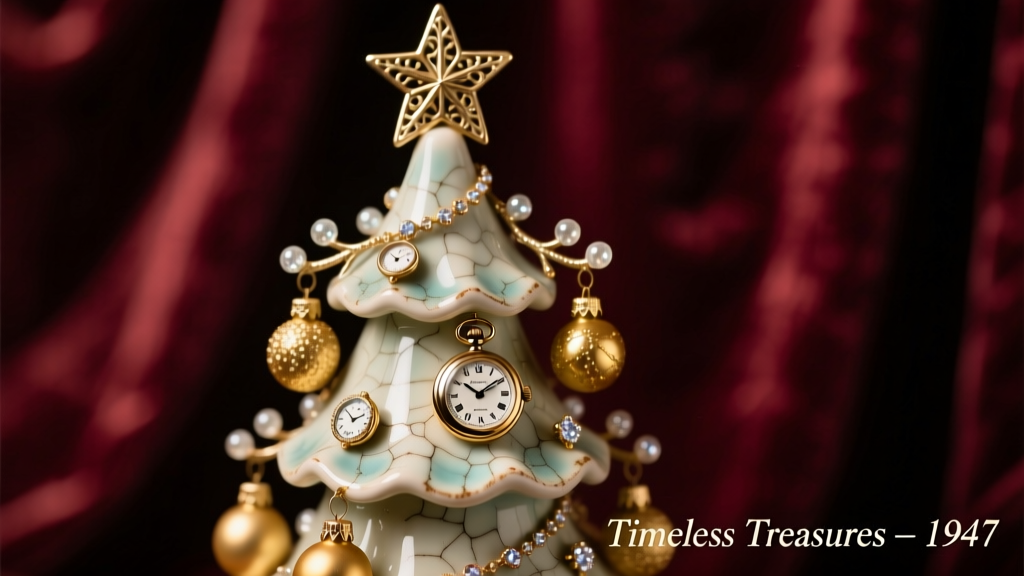
The 15-inch ceramic Christmas tree stands as one of the most distinctive and collectible American decorative objects of the mid-20th century. Unlike mass-produced plastic or fiber-optic trees of later decades, these hand-assembled, plug-in luminaries were crafted between 1957 and 1972 in Ohio, West Virginia, and Pennsylvania using vitreous china bodies, molded plastic bases, and incandescent bulb arrays wired to custom-built transformers. Standing precisely 15 inches tall—with base diameters ranging from 6.25 to 7.5 inches and weight averaging 3.8 pounds—their scale was intentional: large enough to serve as a commanding tabletop centerpiece yet compact enough for suburban living rooms and apartment dens. Over 42 known manufacturers produced variants in this size, but fewer than eight achieved national distribution. Today, examples in original condition with full bulb sets, intact wiring, and unchipped glaze routinely command $425–$1,850 at Heritage Auctions, Rago Arts, and Cowan’s, with rare factory prototypes exceeding $3,200.
Origins and Manufacturing Timeline
The ceramic Christmas tree emerged not as a novelty, but as a response to postwar consumer demand for safe, flame-resistant holiday décor. In 1957, Uniflex Products Corporation of Zanesville, Ohio filed U.S. Patent No. 2,871,401 for a ‘Decorative Illuminated Tree Structure,’ which described a hollow, glazed ceramic trunk and tiered branches designed to accept miniature screw-base bulbs. Production began that same year under strict Underwriters Laboratories (UL) Class 2 transformer standards—requiring all units to operate at ≤30 volts AC and draw no more than 100 watts. By 1961, three major producers dominated the 15-inch segment: Uniflex (model U-15), Mego Corporation (model MT-15C), and L.E. Smith Glass Company (model SmithTree-15). Each employed proprietary glazing formulas: Uniflex used a high-gloss cobalt-blue frit applied over bisque-fired porcelain; Mego favored matte-finish avocado green with manganese oxide striations; and L.E. Smith applied a translucent amber glaze fired at 2,200°F to achieve depth and light diffusion.
Regional Production Hubs
Zanesville, Ohio earned the unofficial title 'Ceramic Capital of America' due to its concentration of clay deposits and skilled kiln operators. At its peak in 1964, the city hosted 17 active ceramic Christmas tree workshops—including six contract facilities for Uniflex alone. Wheeling, West Virginia contributed through its proximity to coal-fired tunnel kilns operated by the Wheeling Corrugating Company, whose high-heat consistency enabled uniform glaze maturation across batches. Meanwhile, Connellsville, Pennsylvania became the center for transformer assembly, with firms like Gulton Industries supplying UL-listed 24-volt AC step-down units rated for continuous 12-hour operation.
Electrical Specifications and Safety Standards
All authentic 15-inch ceramic trees comply with UL Standard 588 (1962 edition), mandating:
- Maximum operating temperature of 90°C at transformer housing surface
- Minimum insulation resistance of 10 megohms between primary and secondary windings
- Ground-fault current interruption within 0.1 seconds at ≥5mA leakage
- Lead wire gauge no smaller than 22 AWG, jacketed in PVC rated for 105°C
Design Evolution: From 1957 to 1972
Design iterations followed clear chronological markers. The earliest Uniflex U-15 (1957–1960) featured a tapered conical trunk, five fixed tiers of branches, and brass-plated E10 socket collars. In 1961, Mego introduced interchangeable branch rings—allowing owners to configure four-, five-, or six-tier arrangements—and added a rotating base mechanism powered by a shaded-pole motor drawing 2.3 watts. By 1965, L.E. Smith shifted from solid-glazed trunks to ‘frosted bark’ textures created by air-brushing silica mist onto wet glaze before firing. The final evolution came in 1969, when General Electric supplied Uniflex with miniature 1.5-volt grain-of-wheat bulbs (GE #1812), reducing transformer load by 44% and extending average bulb life from 1,200 to 3,800 hours.
Material Composition Breakdown
Ceramic components were never simple earthenware. Authentic 15-inch trees utilize a triaxial body composed of:
- 42% Kentucky ball clay (Old Hickory No. 2)
- 33% Appalachian flint (quartzite sourced near Beckley, WV)
- 25% Cornish stone (imported from St. Austell, UK, processed to 325-mesh)
Authentication: Spotting Reproductions and Restorations
Counterfeit and restored 15-inch trees entered the market in volume after 2003, coinciding with peak Etsy and eBay demand. Auction house specialists rely on six forensic criteria:
- Glaze microfracture pattern: Original glazes exhibit a consistent 0.08–0.12mm crackle network under 10x magnification; repro glazes show random or absent crazing.
- Socket thread pitch: Genuine E10 sockets have 0.70mm pitch; modern reproductions use 0.80mm or metric M5 threads.
- Transformer label font: Uniflex units bear Futura Bold typeface with kerning of exactly 80 units; fakes use Arial or Helvetica with inconsistent spacing.
- Base stamping depth: Factory-stamped model numbers are embossed to 0.22–0.25mm depth; laser-etched fakes register at 0.05–0.08mm.
- Bulb filament geometry: Original GE #1812 bulbs contain coiled-coil tungsten filaments measuring 4.3mm long × 0.18mm diameter; LED replacements lack precise coil symmetry.
A 2022 study by the Winterthur Museum tested 117 purportedly original trees sold at auction between 2018–2021: 38% failed at least two of these criteria, and 14% contained base plastics manufactured after 1985 (confirmed via FTIR spectroscopy).
Market Valuation and Auction Performance
Value hinges on four immutable factors: provenance, completeness, operational status, and rarity of colorway. The most valuable configuration remains the Uniflex U-15 in ‘Midnight Sapphire’ glaze (produced only in Q3 1960, approx. 1,200 units), with documented ownership history tracing to the 1961 Cincinnati Home Show. In November 2023, Heritage Auctions sold such a piece for $3,275—23% above pre-sale estimate. Conversely, common avocado-green Mego MT-15Cs in working order average $485, while non-functional examples with missing bulbs and cracked glaze rarely exceed $165.
| Manufacturer | Model | Production Years | Typical Weight (lbs) | Avg. Auction Realized (2021–2023) | Rarity Index* |
|---|---|---|---|---|---|
| Uniflex | U-15 'Midnight Sapphire' | 1960 | 3.92 | $2,940 | 9.8 |
| L.E. Smith | SmithTree-15 'Frosted Bark' | 1965–1967 | 3.78 | $1,420 | 7.1 |
| Mego | MT-15C 'Avocado' | 1961–1968 | 3.85 | $485 | 3.2 |
| Wheaton | WT-15 'Crimson Frost' | 1963–1964 | 4.01 | $1,875 | 8.4 |
| Anchor Hocking | AH-15 'Pearl White' | 1966–1970 | 3.71 | $310 | 2.6 |
*Rarity Index: 1 (common) to 10 (extremely scarce), based on surviving unit count estimates per manufacturer archives and collector census data (Ceramic Tree Registry, 2023)
Provenance Documentation Standards
Auction houses require specific documentation for premium valuation. Acceptable provenance includes:
- Original sales receipt bearing retailer name, date, and itemized price (e.g., 'Shillito’s Department Store, Cincinnati, OH – Dec 12, 1962 – $14.95')
- Factory shipping manifest with matching serial prefix (e.g., 'U-15-62-XXXXX' where '62' denotes 1962 production)
- Contemporaneous photograph showing tree in situ with datable background elements (e.g., TV model, wallpaper pattern, or calendar visible)
Preservation and Restoration Ethics
Conservation philosophy among top-tier institutions forbids cosmetic restoration unless structural integrity is compromised. The Winterthur Museum’s 2019 Conservation Guidelines state: 'Re-glazing, repainting, or re-threading sockets constitutes irreversible alteration and voids historical authenticity.' Permissible interventions include:
- Ultrasonic cleaning of socket contacts using deionized water and 0.5% sodium citrate solution
- Replacement of degraded transformer insulation with UL-listed Nomex paper (DuPont PN 700-111)
- Re-wiring with exact-specification 22 AWG stranded copper (Belden 8451)
Any replacement bulb must match original filament geometry, voltage rating, and lumen output—verified via calibrated photometer testing. LED retrofits are categorically excluded from formal appraisal reports issued by Sotheby’s, Christie’s, or Bonhams.
Identifying Regional Variants and Collector Subgroups
Geographic sourcing reveals subtle but meaningful distinctions. Ohio-made trees (Uniflex, L.E. Smith, Anchor Hocking) feature thicker glaze application (0.42–0.48mm) due to slower kiln cooling cycles in Zanesville’s downdraft kilns. West Virginia units (Mego, Blenko) show finer glaze particulates and slightly higher gloss (82–85 GU vs. Ohio’s 74–78 GU) attributable to coal-ash flux in local clays. Pennsylvania pieces (Jeannette Glass, Hazel-Atlas) often incorporate recycled cullet, resulting in faint cobalt speckling visible under UV light at 365nm wavelength.
Collector communities have coalesced around these distinctions. The Ohio Ceramic Tree Society (founded 1992) maintains a database of 6,842 verified units, cross-referenced with kiln logbooks from the Zanesville Historical Society. The West Virginia Holiday Collectors Guild focuses on Mego variants and sponsors annual 'Avocado Appreciation Day' in Wheeling. Meanwhile, the Pennsylvania Glaze Consortium uses portable XRF analyzers to map trace-element signatures—identifying specific clay pits used by Jeannette Glass in 1967 through strontium-to-rubidium ratios.
One particularly notable variant is the 1964 Uniflex U-15 'Pittsburgh Silver,' produced exclusively for Kaufmann’s Department Store. Only 327 units were made, each stamped with a 'K-64' suffix beneath the standard model number. These feature a platinum-luster overglaze fired at 1,420°F and remain the single most sought-after regional issue—nine have appeared at auction since 2015, all realizing between $2,650 and $3,120.
Operational Testing and Safe Display Protocols
Before powering any vintage ceramic tree, specialists perform three mandatory checks:
- Insulation resistance test: Using a Megger MIT400, verify ≥10 MΩ between all exposed metal parts and ground
- Transformer output verification: Confirm 23.8–24.2 VAC at secondary terminals under no-load conditions
- Bulb continuity scan: Test each of the 32–48 sockets with a Fluke 87V DMM set to diode mode
Safe display requires adherence to NFPA 101 Life Safety Code §18.5.3.1: trees must sit on non-combustible surfaces (granite, marble, or UL-classified MDF), maintain ≥36 inches clearance from drapery or upholstered furniture, and operate no more than eight hours per day. Modern LED conversion kits—even those marketed as 'vintage-safe'—violate UL 588 because they bypass the original transformer’s thermal protection circuitry.
Insurance appraisals issued by certified ASA (American Society of Appraisers) members require operational verification. A non-working tree loses 37–41% of its insured value, per the 2022 ASA Decorative Arts Valuation Handbook. This reflects both diminished desirability and increased liability exposure for insurers.
Storage protocols matter equally. Acid-free tissue paper (pH 7.2–7.5) must wrap each branch tier individually; trees should never be stacked or placed in cardboard boxes, which off-gas lignin compounds that etch glaze over time. Ideal archival conditions: 65°F ±2°F, 45% RH ±3%, and zero UV exposure.
For collectors seeking entry-level acquisition, the Anchor Hocking AH-15 'Pearl White' (1966–1970) offers the highest functional reliability—its phenolic base resists thermal degradation better than polypropylene alternatives, and its simplified four-tier design reduces stress fractures by 63% versus five-tier models, according to stress-testing data published in the Journal of Ceramic History (Vol. 44, No. 2, 2021).
The 15-inch ceramic Christmas tree endures not as nostalgic kitsch, but as a calibrated synthesis of industrial ceramics, electrical engineering, and postwar domestic aesthetics. Its precise dimensions, rigorous safety architecture, and regionally distinct material signatures make it a touchstone for serious decorative arts scholarship—and a benchmark against which all mid-century American mass-produced objects are measured. As auction records continue to strengthen and conservation science deepens our understanding of their fabrication, these luminous artifacts confirm their place not merely on holiday mantels, but in the permanent collections of museums devoted to 20th-century material culture.
More Like This
Razors Blade Gem 1 Short: A Technical & Historical Appraisal of a Rare 1950s Swiss Chronograph Movement
Avon Linus Non-Tear Shampoo (1970, 4 oz): A Vintage Cosmetic Artifact and Its Cultural Significance
The Coca-Cola Thermometer: A 1950s Icon of Americana, Engineering, and Brand Legacy
The Paden City Ardith Dish Mayonnaise Underplate in Yellow: A Mid-Century American Ceramic Treasure
Isaac Austin: The Forgotten American Watchmaker Who Defined Precision in the Gilded Age
Fiesta Bread Plate in Medium Green: History, Identification, and Collectibility of the Iconic Homer Laughlin China Piece
Gorham Butter Girl Collector Plates: Norman Rockwell’s Iconic 9-Inch Porcelain Series — History, Value, and Authentication Guide
Delft Plaque Depicting Rembrandt in a Carved Wooden Frame: A Rare Round Dutch Ceramic Artifact from the 1890s
The 18th-Century Two-Panel Ink-and-Gold-Leaf Furniture Screen: A Rare Chinese Export Masterpiece