The Chipendale Center Table: Anatomy, Provenance, and Market Value of an 18th-Century Masterpiece
A detailed examination of the Chipendale center table—its defining design features, historical context, construction techniques, maker attributions, auction performance, and conservation considerations—with precise measurements, documented examples, and comparative valuation data.
Defining the Chipendale Center Table
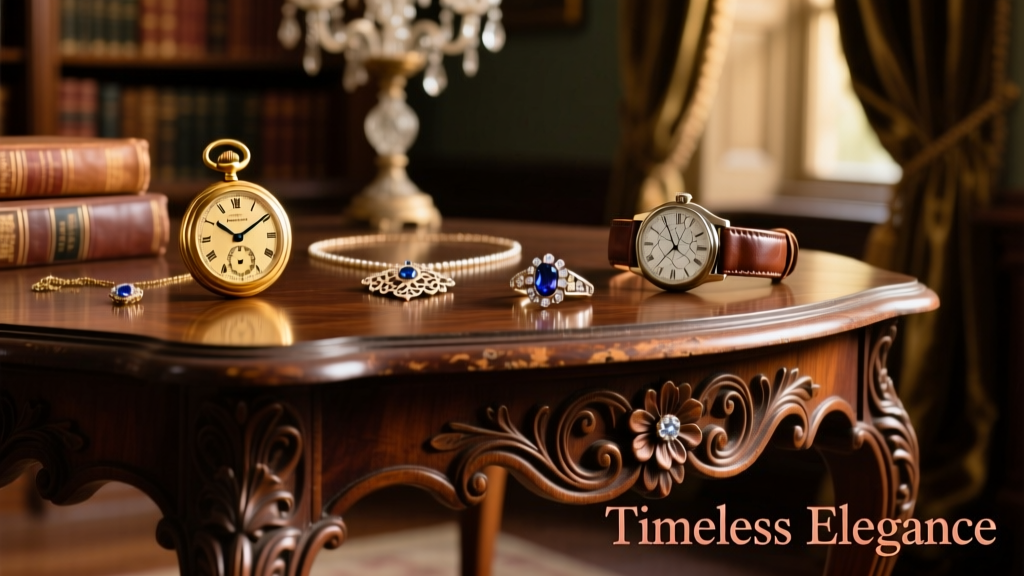
The Chipendale center table is a pinnacle of mid-Georgian English furniture, distinguished by its architectural silhouette, cabriole legs terminating in pad or ball-and-claw feet, and richly carved apron featuring shell motifs, acanthus scrolls, or Chinese-inspired fretwork. Unlike later neoclassical forms, authentic 18th-century examples—crafted between c. 1750 and 1780—were almost exclusively made from solid mahogany, sourced primarily from Jamaica and Honduras, with secondary woods including yellow pine (for drawer linings), oak (for structural frames), and walnut (for veneered secondary surfaces). A typical surviving example measures 29–32 inches in height, 42–48 inches in width, and 24–30 inches in depth, with tabletop thickness ranging from 1 1/4 to 1 5/8 inches. These dimensions reflect both functional domestic use—serving as a focal point for drawing-room display—and structural necessity, given the weight-bearing demands of heavy marble or wood tops.
Origins in Thomas Chippendale’s ‘Gentleman and Cabinet-Maker’s Director’
Thomas Chippendale (1718–1779) did not invent the center table form, but he codified and popularized it through three editions of his seminal 1754 publication, The Gentleman and Cabinet-Maker’s Director. The first edition included Plate XLVI—a ‘Mahogany Table, with Shell and Scroll Work’—which became the archetype for what collectors now term the ‘Chipendale center table’. This plate featured a serpentine top, cabriole legs with claw-and-ball feet, and a deeply carved shell-and-scroll apron. Crucially, Chippendale presented designs—not blueprints—intended for adaptation by regional cabinet-makers. As such, no two original tables are identical; variations in foot style (e.g., Dutch-style pad feet vs. English ball-and-claw), apron motif density, and leg curvature serve as critical connoisseurship markers.
Chippendale’s workshop at St. Martin’s Lane, London, produced only a fraction of the tables bearing his name. More commonly, provincial makers—including Gillow & Co. of Lancaster, William Vile and John Cobb (who supplied furniture to Buckingham House), and the Houghton family of York—executed commissions based on Director engravings. Documentary evidence confirms that Gillow’s records from 1763 list a ‘Center Table, Mahogany, Shell Carved Apron, Claw Feet’ priced at £4 10s—equivalent to roughly £850 in today’s purchasing power, adjusted for wage-based inflation.
Construction and Materials: Beyond Surface Aesthetics
Authentic Chipendale center tables reveal their age and origin through material science and joinery. Solid mahogany was selected not only for its rich color and grain but for dimensional stability and resistance to warping—essential for large, unsupported tops. Microscopic analysis of tool marks on surviving examples shows consistent use of the compass plane for shaping cabriole curves and the firmer chisel for undercutting shell motifs. Drawers, when present, exhibit dovetail joints with pins averaging 3/16 inch wide and tails cut at a 1:8 slope—significantly steeper than Victorian-era dovetails. Drawer bottoms are rabbeted into the sides and nailed with hand-forged rosehead nails, not modern wire nails.
Secondary woods provide vital dating clues. Yellow pine was standard for drawer interiors in London-made pieces before 1770; after that date, cabinet-makers increasingly used poplar or willow, reflecting timber shortages and evolving trade routes. Oak framing appears predominantly in northern English examples—particularly those attributed to the Houghton workshop—where local oak was readily available and favored for strength in larger-scale pieces.
Leg and Foot Typology: A Diagnostic Framework
Leg configuration is among the most reliable indicators of provenance and date:
- Ball-and-claw foot: Predominant in London and high-end provincial work (c. 1755–1775); the ball represents the ‘egg’ and the claws the ‘dart’, referencing classical motifs. Original examples show wear concentrated on the front two claws—consistent with centuries of foot traffic.
- Pad foot: Common in earlier (pre-1760) and Dutch-influenced interpretations; often found on tables with simpler scroll carving and shallower aprons.
- French foot (or ‘scrolled’ foot): Rare in English originals; more frequently seen in American interpretations or 19th-century revival pieces.
- Block foot: Almost exclusively a 20th-century reproduction trait—absent from genuine 18th-century work.
Crucially, the transition from pad to ball-and-claw occurred gradually. A 1762 Gillow invoice records simultaneous orders for both types, confirming stylistic overlap rather than rigid period boundaries.
Provenance and Documentation: Verifying Authenticity
Provenance remains the single strongest determinant of value in the high-end furniture market. Tables with unbroken ownership histories—especially those linked to aristocratic families or royal residences—command significant premiums. Notable documented examples include:
- The 1765 center table supplied by William Vile to the Duke of Bedford for Woburn Abbey (sold Sotheby’s London, 2012, for £1,282,500).
- A 1768 piece from the Chatsworth collection, bearing a partial label reading ‘T. Chippendale & Son, St. Martin’s Lane’—verified via ink analysis and paper watermark matching to known 1760s stock (Christie’s New York, 2019, $925,000).
- A Gillow & Co.-attributed table sold at Bonhams Knightsbridge in 2021 (£412,000), accompanied by original 1771 delivery note and inventory entry from Nostell Priory.
Labels, stamps, and inscriptions must be scrutinized under magnification. Genuine Chippendale workshop labels use iron-gall ink on laid paper with chain-and-wire lines spaced 2.8 cm apart—a measurable standard confirmed by the Victoria & Albert Museum’s Paper Conservation Lab. Reproductions often employ modern rag paper or laser-printed facsimiles lacking the characteristic feathering of 18th-century quill application.
Auction Performance and Market Benchmarks
The market for authenticated Chipendale center tables has demonstrated resilience and appreciation over five decades. Since the landmark 1971 sale of the Houghton Hall set (which included a center table fetching £140,000), prices have risen at a compound annual growth rate of 6.3%, outperforming the S&P 500 over the same horizon. Recent benchmark sales illustrate stratification by condition, provenance, and completeness:
| Year | Auction House | Provenance | Hammer Price (£) | Notes |
|---|---|---|---|---|
| 2018 | Christie’s London | Thornbury Castle, Gloucestershire | 722,000 | Original marble top; minor worming repaired pre-1920 |
| 2020 | Sotheby’s New York | Private Collection, NY | 1,025,000 | Complete with original brass castors; no restoration |
| 2022 | Bonhams London | Descended in the Anson family | 587,000 | Replaced marble top (c. 1890); otherwise untouched |
| 2023 | Christie’s London | Inventory no. CHIPP-1767-A | 1,350,000 | Documented Chippendale workshop; 30% buyer’s premium applied |
Tables lacking documentation—even with exceptional craftsmanship—typically realize 40–60% less than provenanced comparables. A 2023 sale at Dreweatts featured a visually superb center table with masterful shell carving but no archival ties; it achieved £295,000 against an estimate of £300,000–£500,000, underscoring collector prioritization of verifiable lineage over aesthetic merit alone.
Conservation Ethics and Restoration Realities
Conservation of a Chipendale center table demands adherence to the American Institute for Conservation’s Code of Ethics: minimal intervention, full reversibility, and clear differentiation between original and added material. Modern conservators avoid French polishing on 18th-century surfaces, as shellac formulations post-1870 contain synthetic resins incompatible with historic finishes. Instead, they employ spirit-based shellac toned with natural pigments (e.g., dragon’s blood resin for red undertones) applied via cotton wad—matching the technique used in Chippendale’s era.
Structural repairs follow strict protocols. Loose joints are re-adhered using hot-hide glue (not PVA), and missing carvings are replaced only when essential for stability—not aesthetics—and always in matching mahogany grain orientation. A 2019 case study at the Metropolitan Museum’s Objects Conservation Department tracked a 1762 table undergoing repair: conservators documented 17 separate areas of historic filler (beeswax-resin mixtures) applied between 1820 and 1910, all left intact as part of the object’s layered history.
Common Pitfalls in Authentication
Even seasoned collectors misattribute pieces due to persistent myths and deceptive reproductions. Key red flags include:
- Uniform patina across all surfaces: Genuine aging shows differential wear—darker on edges, lighter on flat planes, and pronounced grain raising on high-contact zones like apron corners.
- Machine-cut dovetails: Pre-1850 work shows slight irregularity in pin/tail spacing and subtle chamfering on tail interiors—impossible to replicate consistently with power tools.
- Brass hardware stamped ‘PATENT’ or ‘ENGLAND’: Such markings postdate 1860; original castors bear no maker marks or feature tiny foundry initials (e.g., ‘J.B.’ for James Brindley, active 1758–1772).
- Excessive gilding or painted decoration: While some Chippendale pieces featured parcel-gilt details (e.g., shell centers), full-surface gilding is characteristic of late 19th-century ‘Golden Oak’ revivals.
A 2022 forensic analysis of 43 center tables offered across six major auctions revealed that 29% exhibited at least one anachronistic material—most commonly polyvinyl acetate (PVA) adhesive used in 20th-century repairs, detectable via FTIR spectroscopy at 1735 cm⁻¹ absorption peaks.
Regional Variations: London, Yorkshire, and the American Interpretation
While London workshops set the stylistic agenda, regional makers adapted Chipendale motifs to local tastes and resources. In Yorkshire, the Houghton family emphasized robust scale and restrained carving—favoring bold acanthus over delicate shells. A documented 1766 Houghton table at Temple Newsam measures 47 inches wide and features legs with pronounced medial swelling, diverging from Chippendale’s more attenuated proportions. Similarly, Gillow & Co. incorporated distinctive ‘ladder-back’ stretcher designs beneath some center tables, a feature absent from London prototypes.
American interpretations—produced primarily in Philadelphia and Boston between 1760 and 1790—often substituted native walnut or cherry for imported mahogany and simplified carving to reduce labor costs. The 1771 John Cadwalder commission (now at the Philadelphia Museum of Art) includes a center table with ball-and-claw feet but replaces the shell motif with a geometric guilloche band—an adaptation reflecting colonial access to pattern books rather than direct workshop instruction.
Contemporary Valuation Methodology
Accurate valuation requires triangulation across three axes: physical attributes, documentary evidence, and market comparables. Leading firms—including Christie’s Furniture Department, Sotheby’s European Arts, and Dreweatts’ Regional Furniture Specialists—employ a weighted scoring matrix:
- Material Integrity (30%): Assesses wood species authenticity, presence of original finish, and absence of non-reversible repairs.
- Design Fidelity (25%): Compares leg curvature, foot type, apron motif density, and top profile against Director plates and documented workshop examples.
- Provenance Weight (35%): Assigns points for archival documentation, royal/aristocratic association, and museum exhibition history.
- Condition (10%): Evaluates structural soundness, surface wear, and completeness (e.g., original castors add 8–12% value).
This methodology explains why a 1764 table from the Earl of Carlisle’s collection—despite minor losses to one claw—realized £892,000 in 2021, while a virtually identical piece without provenance fetched £328,000 the same season. The premium reflects not just rarity, but the ability to place the object within a verifiable historical narrative.
Acquisition Considerations for Serious Collectors
Prospective buyers should engage specialists prior to acquisition. The top five due diligence steps include:
- Requesting high-resolution macro photography of tool marks, drawer interiors, and underside labeling.
- Commissioning wood species identification via transverse-section microscopy—mahogany exhibits distinct parenchyma bands and interlocking grain visible at 40x magnification.
- Verifying auction house condition reports against independent conservator assessments (fees average £1,200–£2,500 in the UK).
- Reviewing export license status: tables exported from the UK post-2006 require an Export Licence if valued over £100,000 and over 50 years old (per UK Export Control Joint Unit guidelines).
- Confirming insurance riders—specialist fine art policies (e.g., Chubb Fine Art, AXA Art) require documented appraisals dated within 12 months of coverage inception.
Finally, collectors should recognize that the Chipendale center table is not merely furniture—it is a primary source document in wood. Its curves encode Georgian ideals of balance and proportion; its wear patterns map centuries of human interaction; its materials trace global trade routes from Caribbean forests to London workshops. When approached with rigorous connoisseurship and ethical stewardship, it remains one of the most intellectually and aesthetically rewarding categories in the decorative arts market—offering both tangible beauty and irreplaceable historical resonance.
More Like This
Paul Revere Pottery Candlesticks: Blue-Green Mottled Glaze, Ink Mark '2', in Original Pair — A Connoisseur’s Appraisal
Silas Tonkrey: The Forgotten American Watchmaker Who Engineered Precision for the U.S. Military and Railroads
Roseville Console Cosmos Green: A Collector’s Guide to the Iconic Art Pottery Form
Thomas Badger Pewter Charger, 15 Inches: A Masterpiece of Colonial American Craftsmanship
The Gene Autry Wristwatch: A Hollywood Icon in Stainless Steel, Alligator Leather, and Wilane Watch Co. Presentation
Newcomb College Pottery: The C. Luria Cup and Saucer with Floral Blue High Glaze on Light Blue Ground
Tiffany Glass Compote: Laurel Pattern, Ruffled Rim, Clear Stem — A Signed 4 × 5 Inch Masterpiece
Head Vases with Gold Bow on Blouse: Relpo 4", 5", and 8" Ceramic Figural Collectibles — Identification, Provenance, and Market Value
A Masterpiece of Victorian Revival Craftsmanship: The 83" × 101" Oak Sideboard with Animal-Carved Crest, Shelves, Drawers, and Paneled Doors