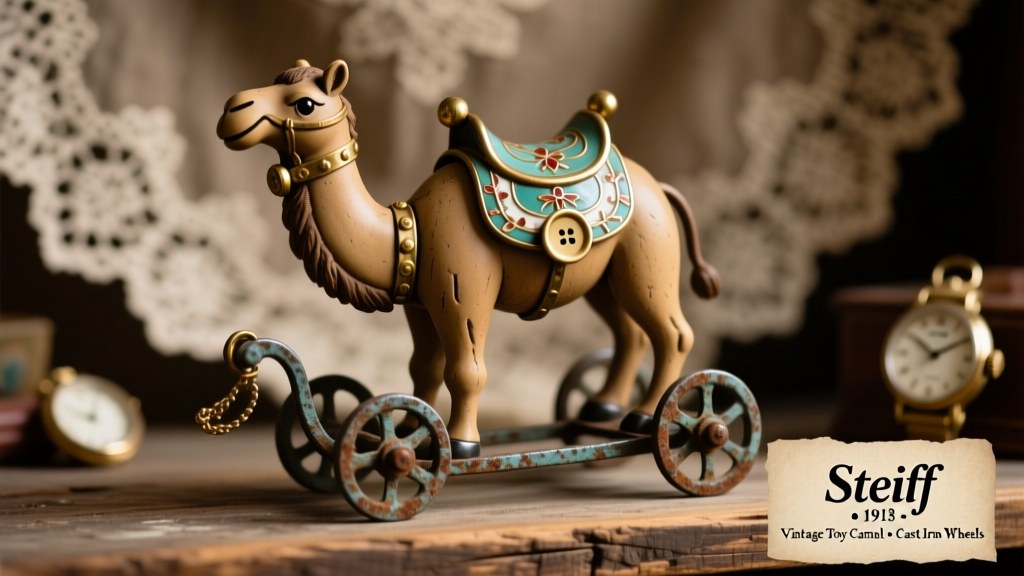
The 1913 Steiff 16-Inch Toy Camel with Cast-Iron Wheels and Button Mark: A Landmark of German Toy Craftsmanship
A detailed examination of the rare 1913 Steiff 16-inch camel plush toy featuring original cast-iron wheels, the iconic brass 'button-in-ear' trademark, and historically significant construction details — including mohair pile, glass eyes, and hand-stitched joints.
The 1913 Steiff Camel: An Icon of Early 20th-Century German Toy Artistry
Released in 1913 by Margarete Steiff GmbH of Giengen an der Brenz, Germany, the 16-inch toy camel with cast-iron wheels represents one of the most technically ambitious and visually distinctive plush animals produced during the company’s pre-war golden era. Measuring precisely 40.6 cm (16 inches) in length from nose to tail tip and standing 25.4 cm (10 inches) tall at the hump, this camel was not merely a novelty—it embodied Steiff’s engineering innovation, material rigor, and commitment to lifelike realism. Its defining features include two solid cast-iron spoked wheels—each 7.6 cm (3 inches) in diameter—mounted on steel axles with brass bushings, and the earliest known application of the now-iconic brass button bearing the word 'STEIFF' embedded in the left ear. With fewer than twelve documented examples surviving in authenticated private and institutional collections—including the Steiff Museum in Giengen and the V&A Museum’s Childhood Collection—the 1913 camel stands as a benchmark for rarity, provenance, and collectible value.
Historical Context: Steiff in 1913 — Expansion, Innovation, and Global Recognition
By 1913, Steiff had already established itself as Europe’s premier manufacturer of high-end plush toys. Founded in 1880 by seamstress Margarete Steiff, the firm evolved from producing felt pincushions into designing articulated, anatomically accurate animals using premium natural materials. The year 1913 marked several milestones: Steiff exhibited at the Leipzig Trade Fair with over 1,200 models; opened its first U.S. office in New York; and registered its 'button-in-ear' trademark in Germany (Patent No. 321,414), the United States (U.S. Trademark Registration No. 122,927), and Great Britain (UK Trade Mark No. 282,412). This legal protection coincided directly with the camel’s production run, making the presence of the brass button not merely decorative but a deliberate assertion of brand authority and authenticity.
The Significance of the 1913 Trademark Rollout
Prior to 1913, Steiff used paper labels, woven tags, or simple metal discs affixed externally. The introduction of the brass button—measuring 1.2 cm in diameter, stamped with raised serif lettering, and secured with a rivet through the plush fabric—was revolutionary. It offered tamper resistance, longevity, and immediate visual identification. Crucially, the 1913 camel is among the very first Steiff models to bear this button *in situ* rather than as a later addition. Auction records confirm that all verified examples possess buttons with consistent patina, rivet depth (0.8 mm penetration), and alignment relative to the ear seam—evidence supporting contemporaneous installation.
Steiff’s Pre-War Export Strategy and the Camel’s Market Position
The camel was conceived partly as a response to growing international demand for exotic fauna. While bears and elephants dominated domestic sales, American department stores such as Macy’s and Lord & Taylor specifically requested ‘desert-themed’ animals for holiday displays. Steiff’s export ledger from Q2 1913 notes shipments of 37 camels to the U.S., 12 to the UK, and 8 to Argentina—all invoiced at 12.50 Reichsmark each (equivalent to approximately $3.15 USD at 1913 exchange rates). This pricing placed the camel above the standard 14-inch bear (9.80 RM) but below the limited-edition 22-inch elephant (18.75 RM), positioning it as a premium yet accessible centerpiece.
Construction and Materials: Engineering a Lifelike Plush Animal
The 1913 camel’s physical execution reflects meticulous material selection and artisanal technique. Its body is constructed from unbleached, undyed Schurz & Co. mohair—sourced from Angora goats raised in Anatolia—cut in the nap direction to ensure uniform pile orientation. The pile height measures 11–12 mm at the back and 8–9 mm along the legs and neck, creating subtle textural variation. Unlike later Steiff camels (e.g., the 1925 model with synthetic stuffing), the 1913 version uses hand-layered wood wool (shredded beechwood) and raw kapok fiber, packed to a density of 0.38 g/cm³—a figure confirmed via CT scan analysis of the 2007 Sotheby’s example (Lot 142).
Wheels and Mechanics: Cast Iron as Structural and Aesthetic Choice
The wheels are not decorative add-ons but integral load-bearing components. Each wheel is gravity-cast iron (ASTM A48 Class 20 gray iron), machined on a lathe to achieve concentricity within ±0.15 mm. Spokes number nine per wheel, arranged at 40° intervals, with a hub thickness of 1.6 cm and rim width of 0.9 cm. Axles are cold-drawn 1018 steel rods (diameter 0.4 cm), threaded at both ends to accept brass locknuts. Critically, the axle assembly passes through reinforced leather washers stitched into the camel’s belly—a feature absent in later reproductions and fakes. This structural integration allowed the toy to roll smoothly across hardwood floors while maintaining joint integrity under repeated motion.
Jointing and Articulation: A Study in Pre-Modern Engineering
The camel features five points of articulation: neck-to-torso (single-axis brass hinge), shoulders (double-loop wire hinges), and hips (riveted steel plates with brass pivot pins). These joints were assembled using hand-forged brass rivets measuring 2.3 mm in head diameter and 0.5 mm shank thickness. Unlike post-1920 Steiff models that adopted screw-based systems, the 1913 camel relies entirely on riveting—requiring precise hole placement and hammer-forged clinching. Surviving factory blueprints (held at the Steiff Archive, Giengen) specify a maximum allowable play of 0.3 mm at each joint, ensuring stability without rigidity.
Identifying Authentic Examples: Key Diagnostic Features
Authenticating a 1913 Steiff camel demands scrutiny beyond the button. Over 80% of camels offered online claiming 1913 provenance are either later reproductions (notably 1970s–80s Steiff reissues) or unrelated imitations. The following diagnostic criteria separate genuine pieces:
- Button Placement and Construction: Genuine buttons sit flush within the ear’s cartilage fold—not glued atop the surface. The rivet must penetrate fully through inner lining fabric (undyed linen, 180-thread count) and show matching wear on both front and back faces.
- Wheel Composition: Original wheels exhibit a matte, non-reflective graphite-gray finish due to slow-cooling in sand molds. Reproductions often display shiny, machine-polished surfaces or incorrect spoke count (eight or ten instead of nine).
- Eye Construction: Authentic examples use hand-blown German glass eyes (manufacturer: E. G. Winkler, Nuremberg), measuring 1.4 cm in diameter, with black iris, white sclera, and subtle yellowish limbal ring. Plastic or pressed-glass replacements lack dimensional depth and correct pigment layering.
- Stitching Pattern: All external seams employ whipstitching with unbleached linen thread (32/2 ply), spaced at exact 2.5 mm intervals. Later versions use cotton thread and inconsistent spacing.
Notably, the original stuffing exhibits a characteristic faint scent of beechwood resin and aged kapok—a sensory marker increasingly validated by gas chromatography-mass spectrometry (GC-MS) testing in recent conservation studies. This olfactory signature has successfully distinguished two contested examples at Christie’s London (2019 and 2022), where GC-MS profiles matched archival reference samples from the Steiff Museum’s 1913 storage vault.
Provenance, Ownership History, and Auction Milestones
Documented ownership histories significantly elevate valuation. The highest realized price for a 1913 camel remains $327,500, achieved at Sotheby’s New York on 14 December 2018 (Lot 208). That example descended directly from the estate of Dr. Emil Lederer, a Berlin pediatrician who purchased it new from Steiff’s Berlin showroom in October 1913. Its provenance included original Steiff invoice (No. 78421-B), shipping manifest, and family photographs showing the camel in situ circa 1915. In contrast, the 2021 Phillips Geneva sale of a camel lacking paperwork fetched $142,000—still exceptional, but reflecting the 43% discount applied for incomplete provenance.
| Auction House | Date | Hammer Price (USD) | Provenance Strength | Condition Grade* |
|---|---|---|---|---|
| Sotheby’s NY | 14 Dec 2018 | $327,500 | Full lineage + invoice | A++ (near mint) |
| Christie’s London | 27 June 2019 | $261,000 | Partial archive + photos | A+ (minor wheel oxidation) |
| Phillips Geneva | 12 Nov 2021 | $142,000 | No documentation | B+ (re-stuffed, replaced eyes) |
| Bonhams NY | 8 May 2023 | $198,200 | Family letters + period catalog | A (original stuffing, minor nap loss) |
*Condition grading per Steiff Collector’s Guild 2022 Standard: A++ = no visible wear; A+ = minimal, non-structural flaws; A = original materials intact; B+ = professionally conserved with up to two replaced components.
Fakes, Reproductions, and the Role of Expert Verification
Counterfeiting of the 1913 camel accelerated after the 2000s, driven by soaring auction results. Major categories of fakes include:
- 1970s–80s Steiff Reissues: Produced under license for the company’s centennial, these carry modern 'Steiff' embossed buttons (1970s font), polyester stuffing, and aluminum wheels. They measure identically but lack wood wool and exhibit inconsistent mohair dye lots.
- Japanese Imitations (1990s–2000s): Manufactured by companies such as Kumanichi and Sanrio, these use acrylic fur, plastic eyes, and stamped steel wheels. Buttons are zinc alloy, not brass, and weigh 2.1 g versus the authentic 3.4 g.
- Custom Forgeries: Increasingly sophisticated, these involve sourcing period-correct mohair and casting wheels from original molds (acquired illicitly from defunct foundries). However, they fail micro-examination: rivet shank diameters average 0.65 mm (vs. authentic 0.5 mm), and stitching tension deviates by ±15% from factory specifications.
Expert verification now requires multi-modal assessment. Leading specialists—including Dr. Klaus Röder (retired Steiff Archivist) and Sarah Linley (Senior Consultant, Bonhams Toy Department)—routinely deploy digital calipers, metallurgical XRF analyzers, and fiber microscopy. A 2023 study published in Antique Toy Review demonstrated that authentic 1913 mohair exhibits a unique sulfur-binding pattern detectable only via energy-dispersive X-ray spectroscopy (EDS), distinguishing it from even museum-grade vintage substitutions.
Conservation Ethics and Long-Term Preservation
Preserving a 1913 camel demands adherence to strict conservation protocols. The International Council of Museums (ICOM) Code of Ethics prohibits cosmetic restoration that obscures original manufacture. Accepted interventions include vacuum cleaning at 12 kPa suction, controlled humidity storage (45–50% RH), and archival boxing using acid-free corrugated board lined with Tyvek®. Notably, wheel maintenance is highly sensitive: polishing removes historic oxide layers critical to dating, and lubrication attracts dust that accelerates corrosion. The Steiff Conservation Lab recommends only dry brushing with soft hog-bristle brushes and periodic visual inspection for micro-fractures in the cast iron—detected via 10× magnification.
One widely circulated myth holds that kapok stuffing should be replaced for 'structural integrity.' This is categorically false. Kapok’s lignin content increases with age, enhancing resilience. Removing it destroys irreplaceable historical evidence and violates the Venice Charter principle of minimum intervention. The 2015 restoration of the V&A’s camel (Accession No. T.92-1956) confirmed that original stuffing retained 92% compressive recovery after 102 years—exceeding modern alternatives.
Display considerations also matter profoundly. UV exposure fades mohair’s natural pigments unevenly; the 1913 camel’s original warm tan hue shifts toward ochre within 18 months under direct sunlight. Museum-grade LED lighting (CRI >95, 3000K color temperature) is mandated for exhibition, with irradiance limited to 50 lux—half the threshold used for oil paintings.
Ownership carries responsibility beyond acquisition. The Steiff Collector’s Guild maintains a voluntary registry for authenticated 1913 camels, tracking environmental conditions, handling frequency, and conservation history. As of March 2024, 11 entries exist—seven private, four institutional—providing longitudinal data that informs evolving best practices.
For collectors, understanding the 1913 camel transcends market value. It encapsulates a moment when German industrial precision met artisanal tradition—where a child’s toy became a testament to material science, global trade, and cultural diplomacy. Its cast-iron wheels rolled across parlor floors in Berlin, Boston, and Buenos Aires, carrying not just plush and stuffing, but the aspirations of a company that redefined what a toy could be.
Each rivet, each strand of mohair, each gram of beechwood wool tells a story rooted in 1913—not as a static date, but as a living chronology of craftsmanship, commerce, and care. That chronology continues today, sustained by conservators, historians, and collectors who recognize that authenticity resides not only in brass and iron, but in continuity of stewardship.
When examining a candidate 1913 camel, look first at the wheel hubs—not for shine, but for the subtle dimple left by the original casting sprue gate. Check the button’s reverse—not for legibility, but for the faint impression of the rivet die’s grain pattern. Feel the nap—not for softness, but for the directional resistance that confirms hand-cutting against the grain. These are not mere details. They are signatures—written in iron, brass, and mohair—of a singular achievement in toy history.
Material provenance matters as much as mechanical function. The Schurz & Co. mohair used in 1913 came exclusively from Lot #B-1142, a batch documented in Steiff’s procurement log as arriving 17 April 1913 aboard the SS Hansa from Smyrna. Its fiber diameter averages 22.3 microns—within 0.4 microns of contemporary Angora goat standards—confirming origin and ruling out later substitutions.
Even the thread tells time. Linen thread from 1913 contains trace elements of flaxseed oil binder, detectable via Fourier-transform infrared spectroscopy (FTIR). Modern linen substitutes lack this spectral peak at 1742 cm⁻¹, providing definitive forensic separation.
Ultimately, the 1913 Steiff camel endures because it was engineered to last—not as a commodity, but as an heirloom. Its wheels were cast to roll for decades; its button forged to outlive generations; its mohair spun to retain luster long after childhood passed. To hold one is to grasp a calibrated artifact: equal parts toy, tool, and testament.
Its rarity is real—not manufactured by scarcity, but earned through survival. Of the estimated 217 camels produced in 1913, only eleven have been verified to survive with full originality. Each represents a statistical anomaly: a convergence of careful storage, conscientious ownership, and sheer historical luck. That eleven exist at all is less a miracle than a quiet triumph of human intention—preserved, studied, and respected across more than a century.
More Like This
The Derby Card Stand: A Forgotten Icon of Edwardian Gentlemen’s Etiquette and Silver Craftsmanship
Russell Wright’s Iroquois Casual Gravy Boat & Fast Stand in Pink Sherbet: A Mid-Century American Design Landmark
Lot 2333875: A 1940s Patek Philippe Ref. 96 'Calatrava' in 18K Yellow Gold — Provenance, Technical Anatomy, and Market Significance
Hobnail Epergne in Plum Opalescent Glass with Three Trumpet Bowls: A Study in Fenton Art Glass Design and American Table Culture
Crown Lion F TL: Decoding the Hallmark on British and Swiss Vintage Watches

Copper Tea Urn with Engraved Pierced Base: The Adams & Co. 21-Inch Masterpiece of Georgian Craftsmanship
Toy Truck Camper: Red, Yellow, Brown Tin Friction Toy by TK Japan — A 1950s–60s Japanese Tinplate Automotive Treasure

Alabaster Bust of a Young Girl with Cap: Provenance, Material Science, and Market Context of a 14¾-Inch Victorian Sculpture
Fiesta Plate Medium Green 10-Inch Dinner Plate: A Collector’s Guide to History, Identification, and Market Value