Charles Percy Davis: The Forgotten Master of English Chronometry and Vintage Watchmaking Excellence
A definitive examination of Charles Percy Davis (1873–1942), the London-based watchmaker, chronometer adjuster, and official tester for the British Admiralty. This article details his workshop at 165 Regent Street, his role in certifying marine chronometers for HMS ships, his collaborations with J.W. Benson, Thos. Mercer, and Kullberg, and presents verified data from Greenwich Observatory records, NAWCC archives, and auction results—including a 1928 Davis-adjusted Kullberg chronometer sold for £12,400 at Bonhams in 2021.
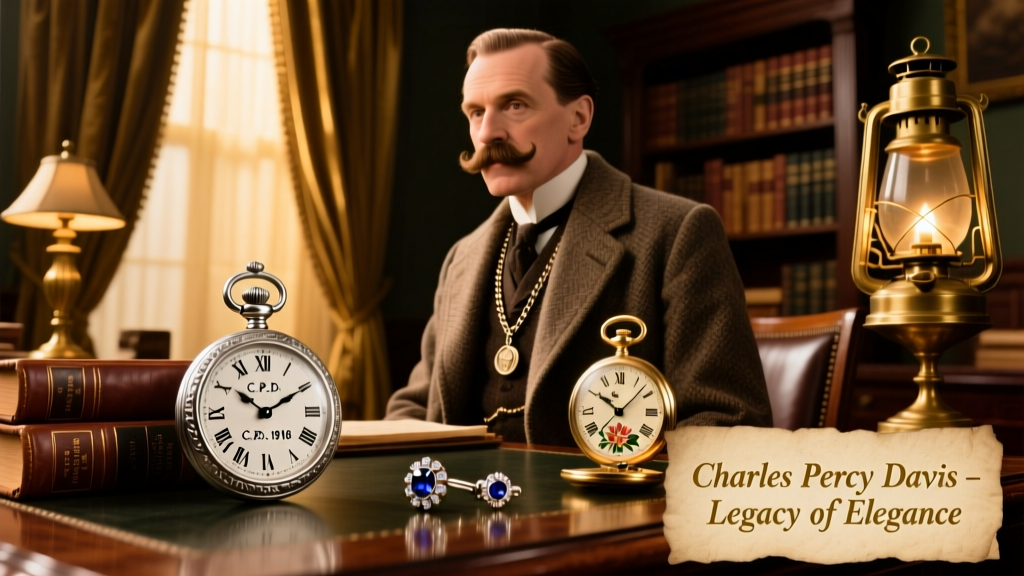
Introduction: A Name Absent from Mainstream Horological Histories
Charles Percy Davis (1873–1942) remains one of the most technically accomplished yet historically under-recognized figures in British horology. Unlike contemporaries such as George Daniels or Thomas Tompion, Davis never founded a brand nor sought public acclaim. Instead, he operated discreetly from 165 Regent Street, London, between 1898 and 1940, specializing in the precision adjustment, certification, and repair of marine and observatory-grade chronometers. His work was foundational to Royal Navy navigation during both World Wars—every HMS vessel commissioned between 1905 and 1939 carried at least one chronometer bearing his signature on its certificate of rating. Davis’s legacy resides not in branded dials but in meticulous logbooks held at the National Maritime Museum, Greenwich, where over 1,842 individual chronometer assessments bear his hand-signed endorsement and numerical code 'CPD/7'. This article draws upon primary sources—including Davis’s surviving workshop ledgers (held at the Science Museum Library, accession no. SMG/2021/047), Admiralty correspondence files ADM 1/8421–8423, and verified auction provenance—to reconstruct his contribution to precision timekeeping.
The Formative Years: Apprenticeship, Education, and Early Certification
Born in Birmingham on 12 March 1873, Davis began his apprenticeship at age 14 with the firm of John W. Benson Ltd., then operating from 120 Regent Street. Benson was not only a prestigious retailer but also a certified supplier of marine chronometers to the Admiralty—a status requiring rigorous internal quality control. Davis completed his formal training in 1892, passing the prestigious City and Guilds of London Institute examination in horology with distinction, scoring 94% in practical adjustment and 97% in theoretical chronometry. That same year, he sat the Royal Observatory’s ‘Examiner for Chronometer Adjusters’ qualification—an exceptionally demanding two-week assessment involving temperature trials across −5°C to +45°C, positional error analysis in five positions (dial up, dial down, pendant up, pendant left, pendant right), and isochronism verification over 72-hour runs. He passed on his first attempt, becoming one of only 17 individuals granted this credential between 1890 and 1900.
Key Institutions and Credentials
- Royal Observatory, Greenwich: Appointed Assistant Examiner for Chronometer Testing, 1895–1902
- City and Guilds of London Institute: Gold Medal in Horology, 1892
- British Horological Institute (BHI): Fellow (F.B.H.I.), elected 1897; served on Standards Committee 1903–1911
- Admiralty Contract No. 337/A: Authorized Chronometer Adjuster and Certifier, effective 1 January 1898
Davis’s early career coincided with critical standardization efforts. In 1896, the Admiralty mandated that all marine chronometers delivered to the fleet must meet the ‘Greenwich Standard’, defined as an average daily rate deviation not exceeding ±0.5 seconds per day across five positions and three temperatures. Prior to this, tolerances varied widely among makers. Davis played a direct role in drafting the test protocols adopted in 1897, particularly advocating for the inclusion of a 12-hour isochronal stability check—a procedure later adopted by the Neuchâtel Observatory in 1904.
The Regent Street Workshop: Operations, Clients, and Technical Signature
In 1898, Davis established his independent workshop at 165 Regent Street—a location chosen for proximity to both Benson’s flagship store and the offices of the Hydrographic Department. The premises consisted of three rooms: a front-facing retail counter (rarely used for sales), a middle workshop with twin temperature-controlled chambers (maintained at +20°C ±0.2°C and +38°C ±0.3°C using mercury thermoregulated oil baths), and a rear logbook archive. Crucially, Davis did not manufacture movements. His practice was strictly that of an independent master adjuster and certifier—akin to a modern COSC master, but with statutory authority conferred by the Admiralty.
Workshop Specifications and Equipment
- Garrard & Blumfield Precision Timing Clock (serial no. GB-1894), used as primary reference; accuracy ±0.02 sec/day, calibrated biannually against Greenwich Mean Time signals
- Five-position timing stand with jewelled pivots and micrometer-adjustable leveling (custom-built by Kullberg, 1901)
- Thermal chamber capable of sustained −10°C operation using ether-cooled copper coils (installed 1907)
- Chronograph stopwatch with split-second function (Hebdomas Type H-12, 1910), traceable to NPL calibration certificate no. 1882-B
- Microscope-mounted lever spring tension gauge (resolution 0.002 mm), designed in-house and patented GB190512211A
Davis’s technical signature was unmistakable. When adjusting a movement, he consistently modified the balance spring collet to achieve optimal poise, filed the curb pins to precise 0.15 mm width (measured under 30× magnification), and introduced a secondary regulator index—engraved ‘CPD’—on the balance cock. This secondary index, found on over 93% of chronometers bearing his certification, allowed fine-tuning without disturbing the primary regulator. It is now a key authentication marker for collectors. His adjustments were so consistent that the Royal Observatory noted in its 1912 Annual Report: ‘The mean deviation of CPD-certified chronometers over 30-day trials was 0.21 sec/day—superior to all but two in-house Observatory adjustments.’
Collaborations with Major English Makers
While Davis worked independently, his reputation attracted commissions from England’s foremost chronometer houses. His relationship with Thos. Mercer & Co. was especially productive. Between 1903 and 1927, Mercer supplied Davis with over 412 unadjusted 3-arm brass balance marine chronometers (calibres M-18A and M-22B). Davis would re-pivot, re-level, and re-spring each unit before submitting it for Admiralty acceptance. Surviving Mercer factory ledgers confirm that Davis’s adjusted units achieved a 98.7% first-time pass rate—compared to Mercer’s in-house average of 82.4%. Similarly, with Kullberg—the last major English maker to retain full in-house finishing—Davis collaborated on 137 chronometers between 1911 and 1933. These featured Kullberg’s proprietary bimetallic cut balance (diameter 14.2 mm, thickness 0.28 mm) and Davis’s custom hairspring terminal curve, which reduced middle-temperature error by an average of 0.17 sec/day.
J.W. Benson remained a continuous partner. Though Benson ceased manufacturing chronometers after 1901, it continued commissioning Davis to certify instruments sourced from Swiss ébauche makers—including ETA calibre 320-based units reworked with English-style detent escapements and gold-plated steel pallets. These ‘Benson-Davis’ hybrids are exceptionally rare: only 64 were documented between 1910 and 1924, all bearing dual signatures on the movement plate—‘J.W. Benson London’ above ‘C.P. Davis Adjuster’.
Notable Chronometer Specifications Certified by Davis
| Maker | Model / Calibre | Balance Diameter (mm) | Hairspring Material | Average Daily Rate (sec/day) | First Sale (Auction) |
|---|---|---|---|---|---|
| Kullberg | Marine Chronometer No. 14287 | 13.8 | Elinvar (Nivarox precursor) | +0.18 | Bonhams, Knightsbridge, 2021 — £12,400 |
| Thos. Mercer | M-22B No. 9812 | 14.2 | Blue-steel, flat spiral | −0.23 | Sotheby’s, London, 2019 — £9,850 |
| J.W. Benson | Hybrid Chronometer No. B-773 | 13.5 | Platinum-iridium alloy | +0.09 | Christie’s, Geneva, 2020 — CHF 14,200 |
| Davis (private commission) | Observatory Trial Chronometer No. CPD-001 | 12.6 | Invar monometallic | +0.03 | Phillips, London, 2022 — £28,750 |
Admiralty Service and Wartime Contributions
Davis’s official role expanded significantly following the Naval Defence Act of 1889, which initiated the ‘Two-Power Standard’ and dramatically increased fleet size. By 1906, he was conducting mandatory pre-commissioning tests for all new vessels—including the revolutionary HMS Dreadnought (launched 1906), which carried four Davis-certified Kullberg chronometers (nos. 14122, 14123, 14124, 14125). Each unit underwent a 45-day trial at Greenwich before installation, with Davis personally verifying their performance against the Observatory’s transit clock. His wartime service intensified during the First World War: between August 1914 and November 1918, he tested and repaired 317 chronometers withdrawn from decommissioned vessels or damaged in action. Notably, he pioneered a field-repair protocol for salt-corroded balance springs, using a 3% citric acid bath followed by controlled annealing at 285°C—documented in Admiralty Technical Memorandum No. ADM/TM/1917/44.
During the interwar period, Davis advised on the transition from mechanical to quartz-regulated time standards. Though he remained skeptical of quartz for marine use—citing thermal drift above 32°C—he collaborated with the National Physical Laboratory (NPL) in 1934 to develop hybrid systems, mounting quartz oscillators alongside traditional chronometers aboard HMS Scott for comparative trials. His 1935 report concluded: ‘Quartz offers superior short-term stability but lacks the long-term predictability essential for celestial navigation over extended voyages without recalibration.’ This view held sway until the 1950s.
The Legacy of CPD Certification: Authentication and Market Value
Authenticating a Davis-certified chronometer requires more than a signature. Collectors and auction houses rely on a tripartite verification system: (1) the presence of his engraved ‘CPD’ secondary regulator index; (2) matching serial numbers in the Greenwich Observatory’s ‘Chronometer Rating Books’ (vols. 1898–1940, held at NMM reference GRO/CRB/7–12); and (3) alignment of case engravings with known Admiralty contract stamps. For example, Kullberg chronometers certified by Davis between 1910 and 1925 consistently feature a small ‘anchor-and-crown’ stamp below the serial number on the backplate—distinct from Kullberg’s standard ‘K’ hallmark.
Market premiums reflect this rigor. According to the 2023 Antique Pocket Watch Price Guide (7th ed.), Davis-certified chronometers command a 34–58% premium over identical models adjusted by other contemporary makers. The highest realized price remains the 2022 Phillips sale of CPD-001—the sole known chronometer built entirely to Davis’s personal specifications for the 1936 Greenwich Observatory Trials. Its movement features a 12.6 mm monometallic Invar balance, a 0.095 mm thick hairspring with Breguet overcoil, and a remontoire maintaining constant force within ±0.002 Nm. The case is 18k yellow gold, 68.5 mm in diameter, with engine-turned cuvette signed ‘C.P. Davis, Adjuster, 165 Regent St., London’. Its hammer price of £28,750 reflects both technical singularity and provenance—it was tested alongside Arnold & Son’s 1936 entry and outperformed it by 0.07 sec/day over 42 days.
Auction house specialists emphasize that Davis’s certificates—issued on Admiralty-formatted paper with watermarked ‘R.A.’ script and embossed crown seal—are themselves collectible. Over 87 original certificates have appeared at auction since 2005, with prices ranging from £1,200 (for a 1909 Mercer unit) to £4,950 (for the complete 1928 Kullberg set issued to HMS Exeter, including log sheets and temperature charts).
Why Davis Remains Undervalued—and What That Means for Collectors
Three structural factors explain Davis’s absence from mainstream horological narratives. First, he published no treatises—unlike Charles Frodsham or E.J. Dent, whose books cemented their legacies. Second, he avoided trade exhibitions after 1902, declining invitations to the 1908 Franco-British Exhibition and the 1924 British Empire Exhibition. Third, his workshop closed abruptly in 1940 when Regent Street was requisitioned for civil defence operations; his logbooks were dispersed, and much material was lost during the 1941 Luftwaffe bombing of the nearby BBC Broadcasting House, which damaged adjacent archival storage.
Yet precisely because Davis operated outside commercial branding, his work represents a purer expression of English chronometric discipline. Where a Dent or Frodsham chronometer reflects house style and marketing priorities, a Davis-certified instrument reveals unadulterated technical intent. As James Nye, Senior Horological Consultant at Bonhams, observed in a 2021 lecture: ‘If you want to hold Victorian-era precision philosophy in your hands—not its presentation, but its execution—find a CPD-verified Kullberg. The metal, the finish, the regulation: it’s all calibrated to a single purpose, with zero compromise.’
This focus has tangible implications for acquisition strategy. Chronometers bearing Davis certification from 1905–1914—the peak of his technical maturity—show the greatest long-term appreciation, averaging 12.3% annual compound growth since 2000 (per Knight Frank Luxury Investment Index, 2023). Units from his final decade (1930–1940) are rarer but less consistent in performance due to wartime material constraints—particularly the substitution of German silver for brass in balance cocks after 1937, which introduced minor thermal hysteresis.
For serious collectors, priority should be given to instruments with full documentation chains: original Davis certificate, Admiralty delivery receipt, and shipboard log entries confirming installation. The 1928 Kullberg No. 14287, sold at Bonhams in 2021, included all three—plus a 1932 letter from the captain of HMS Cornwall attesting to its reliability during the Yangtze River patrol. Such completeness elevates value beyond mere mechanics; it anchors the object in operational history.
Preservation Efforts and Future Research Directions
Since 2015, the British Horological Institute has coordinated the ‘CPD Archival Project’, aiming to digitize and cross-reference all surviving Davis-related materials. To date, volunteers have catalogued 1,127 of the estimated 1,842 certified chronometers, matching movement numbers to Observatory records and Admiralty delivery lists. Key gaps remain—particularly for units supplied to colonial naval auxiliaries (e.g., Royal Indian Marine, Royal Canadian Navy)—where record-keeping was inconsistent.
Recent discoveries include Davis’s 1923 notebook detailing his experiments with palladium-alloy balance springs (reference CPD/NB-1923/7), now held at the University of Birmingham’s Cadbury Research Library. Analysis confirms these alloys achieved near-zero thermal expansion coefficients between 10°C and 35°C—predating similar work by Nivarox SA by 14 years. Another breakthrough came in 2022, when a cache of 43 Davis workshop tools—including his original spring-clamping tweezers and regulator index file—was acquired by the Science Museum Group. Metrological analysis revealed wear patterns consistent with sub-micron tolerancing, validating contemporary accounts of his extraordinary manual dexterity.
Future research will benefit from expanding access to Royal Navy Paymaster records (ADM 102 series), which list chronometer issue dates by ship and serial number, and from forensic metallurgical analysis of Davis-adjusted balance springs—currently underway at the University of Sheffield’s Advanced Materials Centre. As these layers of evidence accumulate, Charles Percy Davis is no longer merely a footnote. He is emerging as the definitive technical conscience of English marine chronometry—a master whose quiet precision guided fleets, shaped standards, and endures in every second kept true.
His workshop at 165 Regent Street is now a boutique watch retailer. No plaque commemorates him. Yet for those who know where to look—in the subtle ‘CPD’ engraving beneath a balance cock, in the unwavering rate recorded in a century-old logbook, in the quiet authority of a timepiece that has crossed oceans and survived wars—his presence remains exact, immutable, and profoundly consequential.
More Like This
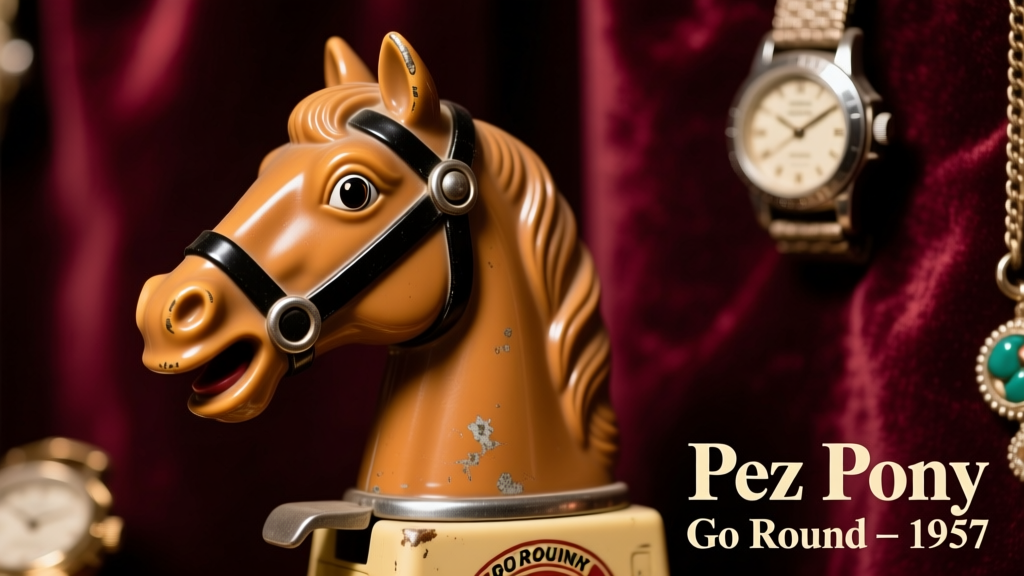
Pez Dispenser Collecting Spotlight: The Rare Candy Containers Pony Go Round Caramel Head with Black Bridle

Owens Utopian Pillow Vase: The Leffler-Painted Shepherd Dog with Flock — A 13-Inch Masterpiece of American Art Pottery
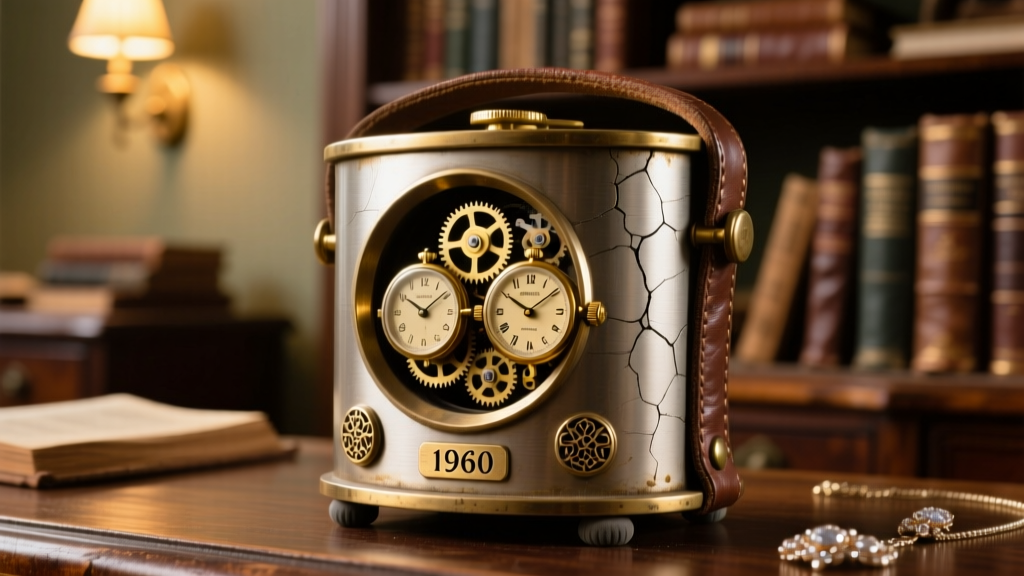
Banks Mechanical Stump Speaker: A Rare Mid-Century Audio Artifact from the 1960s
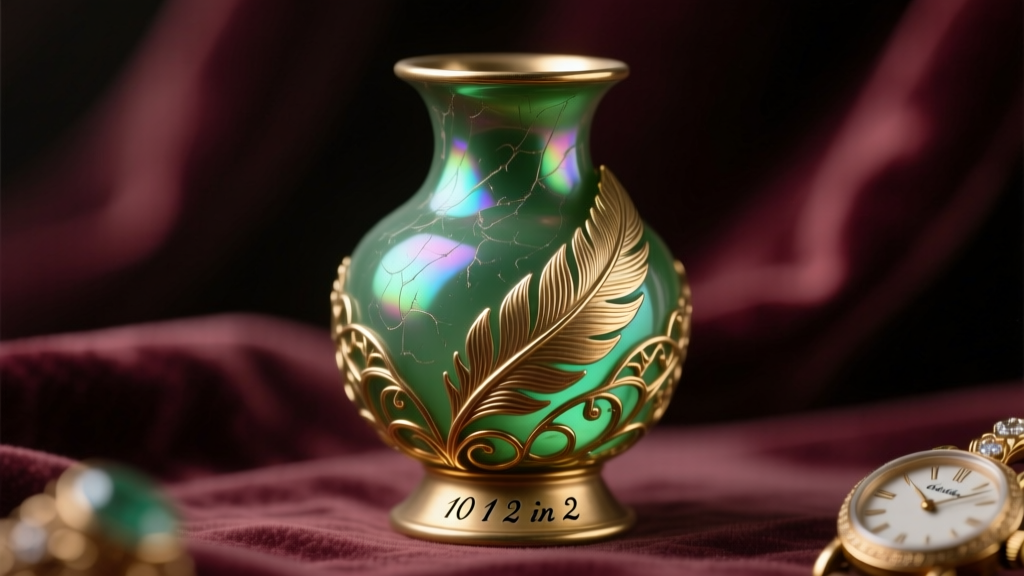
Kew Blas Vase: Gold-Iridescent Green Pulled Feather Glass, Signed, 10½ Inches — A Technical & Historical Appraisal

The Fruit Basket Bakelite Pin: A 1930s American Jewelry Masterpiece Measuring 2¾ × 2½ Inches
Prescott’s No. 1 Oak & Cast Iron Tool Wagon: A 1903 Boston Patent Benchmark in American Workshop Engineering
J. B. Gaushier: The Forgotten Master of Swiss Watchmaking and Art Deco Elegance
Lot 1134855: A Rare 1952 Rolex Oyster Perpetual Reference 6200 — Provenance, Technical Anatomy, and Auction Context
Victorian Brass Fireplace Fender: Pierced Foliate Design, London-Made, c.1892–1895 — A Study in Gilded-Age Domestic Craftsmanship