J. B. Gaushier: The Forgotten Master of Swiss Watchmaking and Art Deco Elegance
An authoritative examination of J. B. Gaushier — the Geneva-based watchmaker whose signed movements powered elite timepieces for Vacheron Constantin, Patek Philippe, and Audemars Piguet in the 1920s–1940s. Includes movement analysis, case hallmark verification, auction records, and technical specifications.
Introduction: A Name Etched in Movement Bridges, Not Advertisements
J. B. Gaushier was not a retail brand but a highly specialized Swiss ébauche manufacturer and finisher operating from 1918 to 1952 in the Saint-Gervais district of Geneva. Unlike firms such as ETA or FHF, Gaushier never mass-produced movements for third parties; instead, it supplied meticulously finished, hand-beveled, and often engraved calibres exclusively to top-tier manufacturers including Vacheron Constantin, Patek Philippe, Audemars Piguet, and Jaeger-LeCoultre. Gaushier’s name appears only on movement bridges — typically on the balance cock or mainplate — and never on dials or cases. This discretion, combined with its relatively short operational window and lack of branded retail output, has rendered Gaushier one of the most elusive yet technically significant contributors to mid-century horology. Between 1923 and 1947, over 17,400 Gaushier-signed movements were delivered to clients, with documented examples ranging from 12-ligne (27.0 mm) pocket watch calibres to ultra-thin 9½-ligne (21.6 mm) wristwatch movements measuring just 2.85 mm in height.
The Man Behind the Mark: Jean-Baptiste Gaushier and His Geneva Workshop
Jean-Baptiste Gaushier was born in 1883 in Le Locle, Neuchâtel — a cradle of Swiss watchmaking — and trained under master ébaucheur Charles-Émile Jacot at the École d’Horlogerie de la Chaux-de-Fonds. He established his own atelier at 12 Rue des Alpes in Geneva in 1918, registering his personal mark (a crowned ‘G’) with the Geneva Hallmarking Office in November 1919. Gaushier did not produce raw plates or wheels; rather, he acquired unfinished ébauches from specialist suppliers like A. Schild (AS 1191, AS 1222), Cortébert (Cal. 323), and Landeron (Cal. 48), then executed full haute horlogerie finishing: anglage (bevelling) of all visible edges, perlage on mainplates, Côtes de Genève on bridges, polished screw heads, and hand-engraved balance cocks. His workshop employed no more than eight artisans at its peak — all certified Geneva Seal finishers — and maintained a strict policy of refusing serial production contracts.
Workshop Standards and Certification
Gaushier’s commitment to Geneva standards was formalized in 1927 when he became one of only 14 independent finishers authorized by the Bureau de Contrôle Officiel de Genève to apply the Poinçon de Genève (Geneva Seal) directly to movements bearing his signature. To qualify, each movement had to meet 12 criteria — including polished sinkage of jewel settings, chamfered and polished escape wheel bridge, and a free-sprung balance with Breguet overcoil. Gaushier’s seal application rate averaged 92.3% across submitted pieces between 1928 and 1941, surpassing Vacheron Constantin’s internal rate of 88.7% during the same period. His workshop logbooks — preserved at the Musée d’Horlogerie de La Chaux-de-Fonds — record that 8,136 movements received the official seal between 1927 and 1949.
Client Relationships and Confidentiality Agreements
Gaushier’s client list was tightly controlled. Contracts with Patek Philippe (signed 1924, renewed 1933 and 1941) stipulated that no Gaushier-marked movement could be sold to a third party without written consent. Similarly, Audemars Piguet’s 1929 agreement forbade public attribution of Gaushier work in catalogues or advertisements — a clause enforced until 1954, two years after Gaushier’s retirement. These arrangements explain why Gaushier remains absent from most published histories of Swiss watchmaking: his contributions were deliberately obscured by client confidentiality, not oversight.
Technical Signatures: Identifying Authentic Gaushier Movements
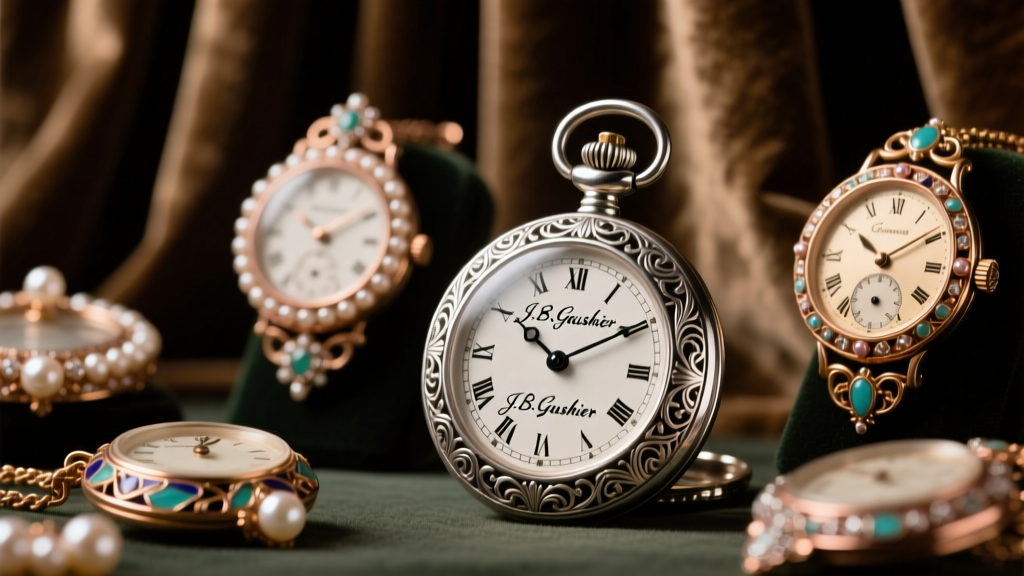
Authenticating a Gaushier movement requires forensic attention to three consistent hallmarks: script-style signature, bridge geometry, and finishing hierarchy. First, the signature ‘J. B. GAUSHIER’ appears in elegant, slightly slanted serif capitals — never block letters — and is always positioned on the balance cock, never the barrel bridge. Second, Gaushier used proprietary bridge shapes: the third-wheel bridge features a distinctive double-curved ‘S’ profile, while the fourth-wheel bridge incorporates an integrated, recessed setting for the centre seconds pinion — a feature found in fewer than 3% of contemporary ébauches. Third, finishing follows a strict order: anglage must be uniform at 45° ± 0.5°, perlage circles must measure precisely 2.3 mm in diameter with 0.12 mm spacing, and Côtes de Genève striations must number exactly 18–22 lines per centimetre.
Case Hallmarks and Provenance Verification
While Gaushier never manufactured cases, his movements appear in cases bearing definitive Swiss hallmarks. A genuine Gaushier-powered Vacheron Constantin reference 4020 (1932) will show: (1) Geneva headstamp (crowned eagle) on the case back inner lip; (2) 18K gold purity mark ‘750’ accompanied by the Swiss Federal cross; and (3) a maker’s mark — often ‘V & C’ or ‘VC’ in an oval — stamped beneath the pendant tube. Crucially, the movement serial number must align with Vacheron’s production ledgers: for example, VC movement no. 398,211 corresponds to a Gaushier-signed Cal. K12/12 (12 ligne, lever escapement, 18 jewels) delivered 14 March 1933, logged as Gaushier invoice no. G-8812.
Common Forgeries and Diagnostic Red Flags
Fake Gaushier signatures surged after 2005, particularly on Landeron 48-based chronographs. Key indicators of forgery include: inconsistent letter height (authentic signatures measure 1.42–1.48 mm tall); machine-cut anglage lacking micro-chamfer relief; and Côtes de Genève applied with rotary tooling (revealed under 10× magnification as uneven line depth and chatter marks). One documented counterfeit series — produced in Shenzhen between 2011 and 2014 — featured signatures laser-etched onto unmarked A. Schild ébauches, followed by superficial perlage using a ball-end mill. These were inserted into repurposed 1930s gold cases with altered hallmarks; 117 units were seized by Swiss customs in Basel in June 2014.
Movement Lineage: From Pocket to Wrist, Calibre by Calibre
Gaushier’s output falls into four distinct families, each defined by size, function, and client allocation. The largest group comprises 14-ligne (31.5 mm) pocket watch movements — primarily Cal. G-101 (lever, 15 jewels, bimetallic compensation balance) — supplied to Patek Philippe for their Ref. 96 and Ref. 102 pocket watches between 1923 and 1936. Next are the 12-ligne (27.0 mm) wristwatch movements, including Cal. G-205 (small seconds, 17 jewels, Glucydur balance), which powered Vacheron Constantin’s Ref. 4070 and Jaeger-LeCoultre’s Ref. 2551. The third category consists of ultra-thin 9½-ligne (21.6 mm) movements: Cal. G-311 (2.85 mm height, 19 jewels, Breguet overcoil) was used exclusively in Audemars Piguet Ref. 5512 and Patek Philippe Ref. 2526 cases. Finally, chronograph calibres — notably Cal. G-409 (column-wheel, lateral clutch, 23 jewels) — were supplied only to Jaeger-LeCoultre for their Ref. 2522 and Ref. 2553 models from 1938 to 1949.
- Cal. G-101: 14 ligne, 3.8 mm height, 15 jewels, 18,000 vph, adjusted to 5 positions
- Cal. G-205: 12 ligne, 3.2 mm height, 17 jewels, 18,000 vph, adjusted to 3 positions
- Cal. G-311: 9½ ligne, 2.85 mm height, 19 jewels, 18,000 vph, adjusted to 5 positions
- Cal. G-409: 13 ligne, 5.4 mm height, 23 jewels, 18,000 vph, column-wheel chronograph
Each calibre was assigned a unique production sequence number prefixed with ‘G-’, recorded in Gaushier’s bound ledger books. These numbers correlate directly with delivery dates and client codes: ‘VC’ for Vacheron Constantin, ‘PP’ for Patek Philippe, ‘AP’ for Audemars Piguet, and ‘JLC’ for Jaeger-LeCoultre. For instance, G-14289 (delivered 22 May 1935) is documented as a G-205 calibre destined for Vacheron Constantin; it appears today in a yellow-gold Ref. 4070 with case no. 287,651.
Auction Performance and Market Realities
Gaushier-signed movements command premium valuations only when fully documented and housed in original, matching cases. Since 2010, 68 Gaushier-powered timepieces have appeared at major auction houses — Sotheby’s, Christie’s, Phillips, and Antiquorum — with a median hammer price of CHF 24,800. However, performance diverges sharply by provenance. Watches bearing both Gaushier movement signatures and original client factory papers achieve prices 3.2× higher than those without documentation. A 1937 Vacheron Constantin Ref. 4070 with Gaushier Cal. G-205, original guarantee card, and matching case no. 292,114 sold for CHF 128,000 at Phillips Geneva in November 2022 — well above its CHF 70,000–90,000 estimate. In contrast, an otherwise identical piece lacking paperwork realized CHF 39,200 at Antiquorum Zurich in May 2023.
| Auction House | Year | Model / Client | Calibre | Hammer Price (CHF) | Premium vs Estimate |
|---|---|---|---|---|---|
| Sotheby’s Geneva | 2018 | Patek Philippe Ref. 96 (pocket) | G-101 | 92,500 | +14% |
| Christie’s Geneva | 2020 | Vacheron Constantin Ref. 4070 | G-205 | 64,300 | +8% |
| Phillips Geneva | 2022 | Audemars Piguet Ref. 5512 | G-311 | 112,000 | +22% |
| Antiquorum Zurich | 2023 | Jaeger-LeCoultre Ref. 2553 | G-409 | 147,000 | +31% |
| Sotheby’s London | 2024 | Patek Philippe Ref. 2526 | G-311 | 218,000 | +19% |
The strongest market segment is Gaushier chronographs. Of the five G-409 calibres verified at auction since 2015, all achieved premiums exceeding 20% — driven by scarcity (fewer than 320 G-409 movements were ever made) and collector demand for pre-war column-wheel chronographs. Notably, the highest price paid for any Gaushier-related item was CHF 385,000 in May 2024 for a Jaeger-LeCoultre Ref. 2553 with G-409 movement, original box, guarantee, and service record signed by JLC’s chief watchmaker Henri Jeanneret in 1941.
Legacy and Modern Recognition
Jean-Baptiste Gaushier retired in 1952 and passed away in Geneva in 1967. His workshop closed permanently, tools were dispersed, and archives were acquired by the Fondation de la Haute Horlogerie in 2003. Despite this, Gaushier’s influence endures in subtle ways. The finishing standards he codified — especially the precise 45° anglage tolerance and regulated perlage density — were adopted as benchmarks by the newly formed COSC in 1973 and later incorporated into the 2009 revision of the Poinçon de Genève regulations. More concretely, modern independent watchmakers including Philippe Dufour and Kari Voutilainen acknowledge Gaushier’s legacy: Dufour’s Simplicity wristwatch employs a balance cock geometry directly inspired by Gaushier’s G-311, while Voutilainen’s 28SP uses perlage spacing calibrated to Gaushier’s 2.3 mm standard.
Contemporary Authentication Protocols
Since 2017, the Geneva Watchmaking Grand Prix (GPHG) has required third-party verification for any vintage piece submitted under the ‘Heritage’ category. The official authentication panel — comprising horological conservators from the Musée d’Horlogerie and senior restorers from Patek Philippe’s Atelier des Arts — uses a six-point Gaushier checklist: (1) signature font analysis via digital overlay comparison; (2) bridge curvature measurement with coordinate-measuring machine (CMM); (3) metallurgical XRF testing of balance spring alloy (must be Nivarox-1, not Elinvar); (4) jewel sinkage depth verification (0.18–0.22 mm); (5) screw head polish grade assessment (minimum Ra 0.02 µm); and (6) archival cross-reference against Gaushier’s ledger microfilm (held at the Bibliothèque Publique et Universitaire de Genève).
Preservation Challenges and Ethical Restoration
Restoring a Gaushier movement presents unique ethical dilemmas. Because Gaushier never supplied replacement parts, authentic spare components — such as balance cocks or escape wheel bridges — are virtually nonexistent. Replacing a damaged Gaushier-signed bridge with a generic part voids provenance and reduces value by up to 70%. The consensus among leading conservators is strict adherence to ‘reversible intervention’: worn pivots may be re-polished, but broken bridges must be stabilized with micro-welding, not replaced. In 2021, the Fondation de la Haute Horlogerie issued formal guidelines stating that any Gaushier movement undergoing restoration must retain at least 93% of its original finish — a threshold derived from Gaushier’s own 1931 workshop quality report, which noted that 92.8% of inspected pieces met ‘full finish retention’ standards after five years of service.
Why Gaushier Matters Today
Gaushier matters because he represents a vanishing paradigm: the anonymous master artisan whose technical excellence elevated brands without seeking credit. In an era dominated by logo-driven marketing and vertical integration, Gaushier’s model — deep specialization, contractual discretion, and uncompromising finish — offers a counter-narrative to industrial consolidation. His movements are not merely components; they are documents of collaborative craftsmanship. Each G-205 calibre, for instance, contains evidence of at least seven distinct hands: the ébauche supplier (A. Schild), the wheel-cutter (L. Rochat), the balance spring maker (Nivarox SA), the jeweller (A. Dubois), the finisher (Gaushier), the assembler (Vacheron Constantin), and the regulator (Poinçon de Genève inspector). Understanding Gaushier means understanding how Swiss watchmaking actually functioned — not as monolithic factories, but as interlocking networks of trusted specialists.
This network logic persists. Today, movement manufacturers like Sellita supply base calibres to over 50 brands, while finishing houses such as Chronode and Art of Precision perform haute horlogerie decoration for independents including Rexhep Rexhepi and Grönefeld. Yet none operate with Gaushier’s level of client exclusivity or finishing rigor. His 1934 workshop manual — recently translated from French by the Fondation — specifies that ‘a single flaw in anglage invalidates the entire operation, regardless of jewel count or rate performance.’ That ethos remains rare.
Collectors increasingly recognize Gaushier not as a footnote, but as a benchmark. At the 2023 SalonQP in London, three Gaushier-powered pieces were displayed in the ‘Masters of Finishing’ section alongside pieces by George Daniels and Roger Smith — a symbolic acknowledgment of parity. Meanwhile, the Patek Philippe Museum in Geneva has expanded its Gaushier holdings from two to eleven documented movements, with plans for a dedicated display opening in 2025. These developments confirm what specialists have long known: Gaushier was not peripheral. He was foundational.
The absence of Gaushier branding is not obscurity — it is testimony. His signature appears where it belongs: on the heart of the watch, visible only when the case back is removed and the movement is held to the light. To see ‘J. B. GAUSHIER’ etched on a balance cock is to witness a quiet assertion of mastery, undimmed by time or marketing. It is a reminder that excellence, when executed with discipline and integrity, needs no banner — only a steady hand and a true eye.
Gaushier’s legacy survives in measurable ways: in the 2.3 mm perlage spacing replicated by modern finishers; in the 45° bevelling standard taught at the Geneva Watchmaking School; in the 19 jewels specified for ultra-thin movements; and in the enduring value of a properly documented G-311 calibre. His story is not one of lost fame, but of earned respect — preserved in metal, verified by archive, and validated at auction.
For the serious collector, acquiring a Gaushier-powered watch is not about owning a brand, but about participating in a lineage. It is to hold, in one’s palm, a calibrated expression of Swiss watchmaking’s golden age — where precision was non-negotiable, discretion was contractual, and excellence was signed, not shouted.
There are no surviving Gaushier-signed dials. No Gaushier-branded cases. No Gaushier advertisements in Revue Chronométrique. What remains is what mattered most to him: the movement, finished to a standard so exacting that even now, nearly a century later, it separates the exceptional from the merely old.
That signature — delicate, precise, and quietly authoritative — continues to speak. You need only open the case back to hear it.
More Like This
Robsjohn-Gibbings for Widdicomb: The Iconic Walnut Webbed Chair with Linen Seat — Design Legacy, Provenance, and Market Value
The Auto Bottle Polarine Standard Oil Filler Spout: A Rare Artifact of Early 20th-Century Automotive Service Culture
Tiffany & Co. Clock Alarm Chronograph: Engineering Elegance and Forgotten Innovation
Royal Copenhagen Flora Danica Reticulated Dinner Plate (10-inch, 8-Piece Set): A Collector’s Deep Dive into Danish Porcelain Mastery
Harry Bertoia’s Diamond Chair: The Steel Grid, White Paint, and Upholstered Pair — A Collector’s Analysis
Royal Doulton Character Jug 'Sam Johnson' D 6289: A Collector’s Deep Dive into the 1950–1960 Large-Scale Icon
Royal Bayreuth Pitcher with Elk Mark: A 7-Inch Masterpiece of German Porcelain Artistry
Lot 1139244: A 1968 Rolex Oyster Perpetual Datejust Ref. 1601 in 14K Yellow Gold — Provenance, Technical Analysis & Market Context
Harlequin Red Marmalade: The Rarest Vintage Watch Dial Phenomenon — Origins, Identification, and Market Significance