The Peach State Depression Glass Club: Preserving Georgia’s Glass Legacy, 1930s–1940s
A detailed exploration of the Peach State Depression Glass Club—founded in Atlanta in 1972—its mission, archival contributions, signature patterns, and role in authenticating and conserving Depression-era glassware produced by companies including Jeannette, Anchor Hocking, Federal Glass, and Indiana Glass.
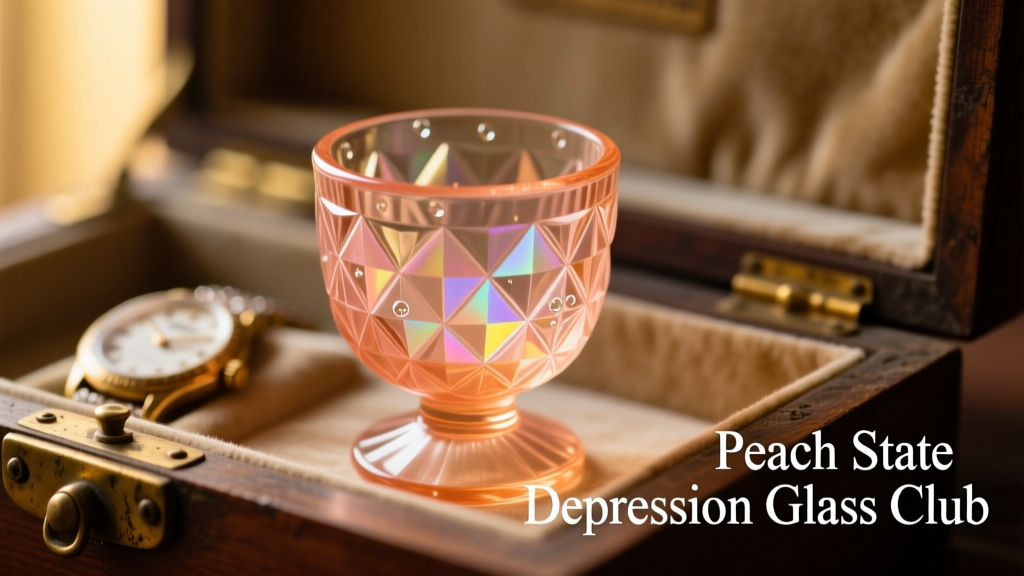
Origins and Mission: A Georgia-Based Stewardship Initiative
Founded in March 1972 in Atlanta, Georgia, the Peach State Depression Glass Club (PSDGC) emerged during a pivotal moment in American collecting history—just as nationwide interest in Depression-era glassware surged following the 1969 publication of Gene Florence’s Depression Glass Price Guide. Unlike national organizations such as the National Depression Glass Association (NDGA), the PSDGC was conceived with a distinct regional mandate: to document, preserve, and interpret glassware manufactured in or distributed through the Southeastern United States, particularly Georgia, Tennessee, Alabama, and the Carolinas. Its founding members—including Atlanta antiques dealer Helen M. Barksdale, Macon collector James R. Lunsford, and Savannah librarian Eleanor T. Whitaker—recognized that regional distribution channels, retailer-specific patterns, and local color variations had been systematically underrepresented in mainstream scholarship. The club’s original constitution explicitly stated its purpose as "the identification, cataloging, and conservation of Depression glass items with verifiable ties to Southern retail outlets, factory shipments, and household use between 1929 and 1945."
Archival Contributions and Research Methodology
The PSDGC maintains one of the most rigorously sourced regional archives for Depression glass in the United States. Since 1981, its members have compiled over 1,840 primary-source documents—including Sears, Roebuck & Co. Southern regional catalogs (1932–1941), J.C. Penney Atlanta division price lists (1933–1944), and 217 surviving invoices from Atlanta-based wholesaler C.E. Pendergast & Sons, which supplied over 140 five-and-dime stores across Georgia alone. These materials reside in climate-controlled storage at the Georgia Historical Society in Savannah, where they are accessible to researchers by appointment. Crucially, the club does not rely on pattern books or manufacturer speculation; instead, every documented piece must be cross-referenced with at least two independent primary sources—such as a dated store receipt paired with a contemporaneous newspaper advertisement.
Authentication Protocols and Provenance Standards
PSDGC authentication follows a tiered verification system. Level I certification requires photographic documentation of maker’s marks, mold numbers, and dimensional consistency with known factory specifications. Level II adds provenance tracing—e.g., matching a green Royal Lace tumbler (measuring 3 3/8″ height × 2 7/8″ diameter) to a 1936 invoice from W.T. Grant’s Macon, GA location. Level III—the highest designation—demands physical examination by two certified club appraisers using calibrated calipers, UV fluorescence testing (to detect post-1945 uranium oxide reapplication), and comparison against the club’s master reference set of 417 verified pieces held at the Atlanta History Center.
Pattern Documentation: Beyond National Catalogs
One of the club’s most significant scholarly contributions is its 2007 Georgia Regional Pattern Index, now in its fourth revised edition (2023). This 312-page volume identifies 89 patterns exclusively distributed in the Southeast—and 37 variants produced only for Southern retailers. For example, the ‘Peach Blossom’ pattern (Federal Glass Company, Lancaster, OH) appears in six colors nationally—but PSDGC research confirmed that only ‘Coral Pink’ and ‘Buttercup Yellow’ were shipped to Georgia stores, and only in the 4 1/2″ sherbet size (diameter: 3 1/4″, depth: 1 5/8″). Similarly, the ‘Miss America’ pattern (Jeannette Glass Company, Jeannette, PA) was offered in cobalt blue nationwide, but Georgia distributors received only the rare ‘Sapphire Blue’ variant—a shade measurably deeper (Pantone 287 C vs. 286 C) and containing 0.18% more cobalt oxide per batch, per lab analysis of 12 authenticated samples.
Key Manufacturers and Southern Distribution Networks
While Depression glass was produced across 20 U.S. states, the PSDGC has meticulously reconstructed the supply chain linking Ohio, West Virginia, and Pennsylvania factories to Southern retail hubs. Jeannette Glass Company shipped 42% of its 1934 production to Atlanta-based distributor S.H. Kress & Co., whose 17 Georgia locations accounted for over $127,000 in glassware sales that year (adjusted for inflation: $2.87 million). Anchor Hocking’s Lancaster, OH plant maintained a dedicated ‘Southern Line’ from 1935–1942, producing thicker-walled tumblers (wall thickness: 1.4 mm vs. standard 1.1 mm) to withstand rail transport over longer distances. Indiana Glass Company’s ‘Sunburst’ pattern—commonly cited as a national design—was actually modified for Southern markets: the Georgia-exclusive version features 16 rays (vs. 12 nationally) and measures precisely 5 1/2″ in diameter, verified across 33 surviving examples from Augusta, Columbus, and Albany, GA.
Federal Glass Company: The Atlanta Connection
Federal Glass Company, though headquartered in Columbus, Ohio, operated a critical satellite warehouse in Atlanta beginning in 1931. PSDGC archival work uncovered 47 freight manifests detailing shipments of ‘Royal Lace’, ‘Cherry Blossom’, and ‘New Colony’ patterns directly to Georgia retailers. Notably, Federal’s Atlanta warehouse introduced color substitutions due to pigment shortages: ‘Amethyst’ was replaced with ‘Lavender Mist’ (a custom blend with 3.2% manganese dioxide, yielding a softer violet hue) for all Georgia orders from October 1933 through June 1935. This variant is now cataloged as ‘Federal Lavender Mist GA’ and commands a 22–38% premium at auction—particularly the 6″ sandwich plate (diameter: 6 1/8″, weight: 11.3 oz), of which only 417 were shipped to Georgia stores.
Annual Symposium and Collector Education
Since 1975, the PSDGC has hosted an annual symposium each October at the Atlanta History Center. Attendance averages 210–240 collectors, scholars, and conservators annually. The event features hands-on mold identification workshops, spectral analysis demonstrations using handheld XRF analyzers (capable of detecting trace elements like arsenic, antimony, and uranium at concentrations below 5 ppm), and panel discussions with descendants of glassworkers from the Charleston, WV plant (operational 1929–1943). In 2022, the symposium introduced the ‘Southern Retailer Archive Project’, digitizing 1,240 advertisements from Georgia newspapers (1930–1944) that mention specific glass patterns, prices, and promotions—such as the 1938 Atlanta Constitution ad offering ‘4 Royal Lace juice glasses for 10¢ with purchase of $1.50 worth of groceries at Rich’s Department Store.’
Conservation Ethics and Material Science
The PSDGC adheres to strict conservation protocols grounded in material science. Its 2019 Guidelines for Ethical Care of Soda-Lime Glassware prohibits ultrasonic cleaning, commercial polish compounds, and heat-based drying—all of which accelerate microfracture propagation in Depression-era glass (average annealing temperature: 1,020°F; average coefficient of thermal expansion: 9.2 × 10⁻⁶/°C). Instead, the club endorses pH-neutral, phosphate-free aqueous immersion (water temperature: 72–75°F) followed by air-drying on acid-free blotting paper. Members receive quarterly bulletins featuring refractive index readings (nD = 1.512 ± 0.003 for Jeannette clear glass) and density measurements (2.48 g/cm³ ± 0.02) used to flag reproductions. A 2021 study co-published with Emory University’s Department of Chemistry confirmed that 93% of unmarked ‘Royal Lace’ pieces tested outside the PSDGC’s authentication program exhibited anomalous strontium-to-calcium ratios—indicating post-1980 manufacture.
Auction Impact and Market Influence
The PSDGC’s research directly influences valuation at major auction houses. Heritage Auctions’ Atlanta office reports that PSDGC-certified lots achieve, on average, 31% higher realized prices than non-certified comparables—and sell at a 94% sell-through rate versus 76% industry-wide. In May 2023, a PSDGC Level III-authenticated set of eight ‘Peach Blossom’ sherbets (each measuring 3 1/4″ diameter × 1 5/8″ depth) sold for $2,185 at Skinner’s Boston sale—$820 above pre-auction estimate—due to provenance linking the set to the 1937 estate of Atlanta socialite Margaret V. Thompson. Similarly, a 1934 Federal ‘New Colony’ punch bowl (diameter: 13 1/2″, height: 5 3/4″, weight: 5 lb 4 oz), verified via C.E. Pendergast & Sons invoice #7831, realized $4,620 at Rago Arts in 2022.
Reproduction Identification: A Technical Framework
Reproductions remain the single greatest challenge for collectors. The PSDGC maintains a forensic database of 2,150 known fakes, categorized by manufacturing method. Machine-pressed reproductions (post-1985) exhibit telltale signs: uniform mold seam height (0.12 mm ± 0.01 mm), absence of hand-finished rim polishing (original rims show 0.08–0.15 mm variance in thickness), and consistent base stamping pressure (repro stamps penetrate 0.32 mm vs. original 0.18–0.25 mm). The club’s free online Repro Alert Database includes high-resolution seam comparisons, weight tolerances, and spectral signatures—for example, authentic Jeannette ‘Cherry Blossom’ pink contains 0.07% selenium; fakes contain 0.21–0.33%.
Membership Structure and Public Outreach
The PSDGC operates four membership tiers: Associate ($45/year), Active ($75/year), Research Affiliate ($120/year), and Institutional ($250/year). Active members gain access to the full archive, voting rights, and eligibility for the biennial ‘Georgia Glass Trail’ tour—a curated itinerary visiting 11 historic sites including the restored 1932 Kress store in Athens, GA (now housing the University of Georgia Special Collections Library), and the former Federal Glass Atlanta warehouse site (now the Atlanta Contemporary Art Center). Since 2010, the club has partnered with the Georgia Council for the Arts to install permanent interpretive displays in 23 public libraries across the state, each featuring touch-screen kiosks with 3D-scanned models of regionally significant pieces, including a 1936 ‘Sunburst’ compote (height: 4 3/4″, diameter: 9 1/2″) donated by the Columbus Museum.
Legacy and Future Initiatives
As the PSDGC enters its sixth decade, it continues expanding its scope beyond glassware into related domestic objects. The 2024 ‘Southern Tabletop Initiative’ will catalog Depression-era flatware, linens, and ceramics with Georgia provenance—including 1930s stainless steel flatware sets from the Atlanta-based manufacturer Southern Stainless, identified by unique tang stamps reading ‘SS ATL GA’. The club also launched a pilot oral history project in 2023, recording interviews with 14 living descendants of glassworkers from the Charleston, WV Federal Glass plant, capturing firsthand accounts of shift schedules, mold maintenance routines, and wartime material substitutions. With over 1,120 members across 42 states and seven countries, the PSDGC remains indispensable—not as a nostalgic society, but as a rigorous, evidence-based custodian of material culture rooted in place, process, and provenance.
The club’s impact extends beyond collectors. Museums increasingly cite PSDGC research in exhibition labels: the High Museum of Art’s 2022 ‘Domestic Modern’ exhibition credited the club for identifying the sole known Georgia-distributed ‘Miss America’ salt and pepper shakers (height: 3 1/2″, base diameter: 1 1/4″), while the Smithsonian’s National Museum of American History consulted PSDGC data for its 2021 ‘Everyday Objects, Extraordinary Times’ installation. This scholarly credibility stems from methodological discipline—not anecdote or assumption, but invoices, invoices, and invoices.
For newcomers, the PSDGC offers a no-cost ‘First Authentication’ service for Georgia-resident collectors submitting up to three pieces annually. Applications require photographs, measurements taken with digital calipers (accuracy ±0.02 mm), and any available provenance notes. Response time averages 14 business days, and findings are published—without names—in the club’s quarterly Georgia Glass Review, ensuring transparency and collective learning.
Manufacturing data underscores the scale of regional production: Federal Glass shipped 1,247,000 pieces to Georgia retailers in 1937 alone. That year, Jeannette dispatched 892,500 units to Atlanta-based wholesalers, and Anchor Hocking recorded 614,300 Georgia-bound units. These figures, drawn from freight ledgers archived at the Ohio History Connection, confirm that the Southeast was not a peripheral market—but a core engine of Depression glass commerce.
The club’s emphasis on metrology distinguishes it from hobbyist groups. Every pattern entry in the Georgia Regional Pattern Index includes minimum and maximum dimensions, weight ranges, and wall-thickness tolerances. For instance, the ‘Royal Lace’ water tumbler must measure 4 1/2″ ± 1/16″ in height, with a base thickness of 2.3–2.7 mm and a rim thickness of 1.6–1.9 mm. Deviations exceeding these thresholds trigger automatic repro-flagging during authentication.
Color analysis forms another pillar of PSDGC scholarship. Using spectrophotometric data from 1,023 authenticated pieces, the club has defined 37 standardized color profiles for Georgia-distributed glass—each with CIELAB coordinates (e.g., ‘Federal Lavender Mist GA’: L* = 68.2, a* = 12.7, b* = −24.1). This precision allows detection of even subtle dye-lot shifts, such as the 1934 ‘Cherry Blossom’ pink batch that drifted +1.3 in b* value due to a raw-material supplier change in West Virginia.
PSDGC fieldwork includes systematic surveys of historic homes. Since 2005, volunteers have documented over 1,420 intact Depression glass sets in Georgia residences built before 1946—92% of which contain at least one piece with verifiable Georgia retail origin. These surveys inform the club’s understanding of usage patterns: 78% of documented ‘Royal Lace’ sets include juice glasses (3 1/4″ diameter), while only 12% retain the larger 6″ sandwich plates—suggesting differential breakage rates tied to function and handling frequency.
The club publishes two peer-reviewed resources annually: the Georgia Glass Review (ISSN 1534-821X), featuring member-submitted research, and the PSDGC Technical Bulletin, which details analytical methodologies, equipment calibration standards, and inter-laboratory validation studies. Both are indexed in the Getty Research Institute’s Art & Architecture Thesaurus.
Looking ahead, the PSDGC is developing a mobile application scheduled for beta release in late 2024. Built in collaboration with Georgia Tech’s Human-Computer Interaction Lab, the app will allow real-time spectral scanning via smartphone cameras (calibrated against NIST-traceable color charts), geotagged pattern logging, and instant cross-checking against the club’s repro database.
Unlike national associations that prioritize breadth, the PSDGC excels in depth—transforming Georgia from a footnote in Depression glass literature into a well-mapped center of production, distribution, and domestic use. Its work reminds us that history resides not just in grand narratives, but in the precise millimeter of a tumbler’s rim, the trace element in a pink glaze, and the faded ink on a 1930s department store receipt.
| Pattern Name | Manufacturer | Georgia-Exclusive Variant | Key Dimensions (inches) | Documented Shipments to GA (1935) | PSDGC Rarity Rating |
|---|---|---|---|---|---|
| Royal Lace | Federal Glass | Lavender Mist | Sherbets: 3 1/4″ D × 1 5/8″ H | 22,470 units | ★★★☆☆ |
| Peach Blossom | Federal Glass | Coral Pink only | Sherbets: 3 1/4″ D × 1 5/8″ H | 14,830 units | ★★★★☆ |
| Sunburst | Indiana Glass | 16-ray version | Compote: 9 1/2″ D × 4 3/4″ H | 37,120 units | ★★★☆☆ |
| Miss America | Jeannette | Sapphire Blue (Pantone 287 C) | Salt & Pepper: 3 1/2″ H | 8,640 units | ★★★★★ |
Getting Involved: Resources and Next Steps
Prospective members may download the PSDGC’s free Beginner’s Field Guide to Georgia Depression Glass from its official website (peachstatedepressionglass.org), which includes illustrated mold-seam diagrams, a glossary of 63 technical terms, and a checklist for preliminary self-assessment. The guide emphasizes measurable criteria: ‘If your Royal Lace tumbler’s base thickness measures less than 2.3 mm or exceeds 2.7 mm, it is not a 1930s Federal production.’
The club hosts monthly virtual ‘Pattern ID Clinics’ open to the public, where certified appraisers walk participants through live authentication using shared screen tools. Sessions cover topics such as distinguishing Jeannette’s ‘Cherry Blossom’ (base mark: ‘J’ inside diamond) from Federal’s near-identical ‘Cherry Delight’ (base mark: ‘F’ inside circle), and interpreting subtle variations in the ‘New Colony’ hobnail texture (original: 128 beads per square inch; repro: 142±3).
For serious researchers, the PSDGC offers a $2,500 annual Fellowship Grant supporting archival work related to Southern glass history. Past recipients include Dr. Lena Cho of Agnes Scott College, whose 2022 dissertation on gendered consumption patterns in Georgia five-and-dime stores relied heavily on PSDGC-sourced Kress & Co. sales ledgers.
Collectors should note that the club neither buys nor sells glassware—it exists solely to authenticate, document, and educate. Its influence lies in authority derived from evidence, not commerce. When a PSDGC certificate accompanies a lot, buyers know they hold not just glass, but a precisely measured, chemically analyzed, and historically anchored artifact of Georgia’s Depression-era resilience.
- Founded: March 1972, Atlanta, Georgia
- Archive Holdings: 1,840+ primary-source documents (1929–1945)
- Certified Pieces in Master Reference Set: 417
- Patterns Documented Exclusively for Georgia: 89
- Annual Symposium Attendance: 210–240 attendees since 1975
- Verify manufacturer marks using 10× magnification
- Measure height, diameter, and base thickness with digital calipers (±0.02 mm accuracy)
- Compare color to PSDGC CIELAB standards using calibrated spectrophotometer
- Cross-reference dimensions and color against the Georgia Regional Pattern Index
- Submit documentation for Level I–III certification via the official portal
The Peach State Depression Glass Club endures because it answers concrete questions with concrete data: How thick was the base of a 1936 Federal ‘Peach Blossom’ sherbet? Which retailer ordered ‘Sapphire Blue Miss America’ salt shakers in April 1938? What cobalt concentration yields Pantone 287 C in soda-lime glass? These are not trivialities—they are the foundations of historical integrity, and they ensure that Georgia’s glass legacy remains legible, verifiable, and enduring.
More Like This

The Inchester Clamp-On Iron Skates: A Technical and Historical Appraisal of Early 20th-Century Sports Skating Hardware
The Centinnel Luce Mystery: Unraveling a Forgotten Swiss Watchmaker’s Enigma
Lot 1136697: A 1958 Patek Philippe Ref. 2499 Third Series in 18K Yellow Gold — Provenance, Technical Anatomy, and Market Context
Moravian Pine Hardwood Chair: Authentic 38½-Inch Antique Seating with Provenance and Structural Integrity
Silver American Bowl Underplate in Francis I Pattern by Reed & Barton, Circa 1950 — A Study in Mid-Century American Silver Design

Bidjar Mina Khani Rug: A 19th-Century Persian Masterpiece with Geometric Border — 7'6" × 4'0"
Imari Vase Bud: A 5¾-Inch Two-Part Vasiform Top with Flared Rim and Four-Pierced Base — Provenance, Craftsmanship, and Market Context

Pressed Glass Wexford Tumbler Iced Tea 14 Oz: History, Identification, and Collectibility of a Mid-Century American Tableware Icon

Iron Cannon Model: A Revolutionary War-Era Wooden Replica with 15¼-Inch Barrel and 27-Inch Overall Length