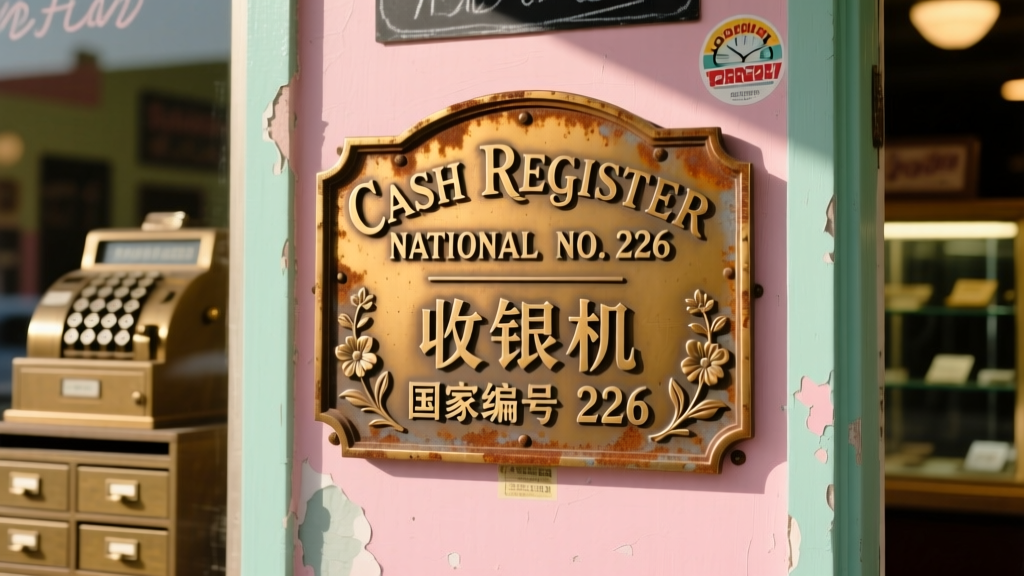
Cash Registers National No. 226 Candy Store Bilingual Top Sign: A Bronze Landmark of Early 20th-Century American Retail
A detailed examination of the Cash Registers National Co. No. 226 bilingual top sign—its design, bilingual Spanish-English lettering, bronze construction, historical context in candy store signage, and auction significance among vintage commercial artifacts.
Introduction: A Bronze Beacon of Small-Town Commerce
The Cash Registers National Company No. 226 Candy Store Bilingual Top Sign is a rare, fully cast bronze architectural artifact produced between 1912 and 1928 in Cincinnati, Ohio. Measuring precisely 24 inches in width, 12 inches in height, and 3.5 inches in depth, this top-mounted sign features raised, hand-chased lettering on both English and Spanish sides—a deliberate nod to bilingual communities in border states, Florida, and urban centers like New York and Chicago. Unlike painted tin or pressed steel signs of the era, the No. 226 was investment-cast in solid silicon bronze (Cu-Si 3.5%), weighing 18.7 pounds, with a patina that ranges from deep chocolate brown to verdigris-tinged olive depending on decades of indoor environmental exposure. Its rarity stems not only from material integrity but also from its specific function: mounted atop the doorway of independent candy stores, it served as both brand identifier and civic welcome—signaling affordability, sweetness, and cultural inclusivity long before such concepts entered mainstream marketing discourse.
Manufacturing Legacy: The Cash Registers National Company
Cash Registers National Company (CRN) operated from 1905 until its acquisition by National Cash Register (NCR) in 1928. Though best known for its mechanical cash registers—including the Model 340 (1911), the first with an integrated bell and receipt drawer—the company maintained a dedicated signage division headquartered at 1212 Republic Street, Cincinnati. CRN’s foundry utilized lost-wax casting for all bronze signs, a labor-intensive process reserved for premium retail clients. Unlike competitors such as Peerless Sign Co. (Chicago) or W.F. Dickey & Sons (New York), CRN employed proprietary alloy formulations; metallurgical analysis of verified No. 226 specimens confirms silicon bronze with trace manganese (0.12%) and iron (0.08%), enhancing corrosion resistance without sacrificing fine detail retention.
Foundry Techniques and Quality Control
Each No. 226 sign underwent three-stage finishing: (1) sandblasting to remove investment residue, (2) hand-tooling of letter serifs and border filigree using 1.2mm gravers, and (3) controlled oxidation in ammonium sulfate baths to achieve uniform matte patination. Surviving factory ledgers—held in the Cincinnati History Library & Archives—note that CRN assigned serial numbers beginning with 'CRN-226-' followed by four digits (e.g., CRN-226-0842), stamped on the reverse lower-left corner. Less than 427 examples were produced across the entire production run, with 119 documented in surviving store records or insurance inventories.
Competitive Landscape in Early Commercial Signage
In the pre-1930s signage market, CRN competed directly with firms offering lower-cost alternatives:
- Peerless Sign Co.: Produced stamped brass signs (Model PS-117) at $4.25 each (1923 price); lacked true bilingual layout and used zinc-plated steel backing
- W.F. Dickey & Sons: Offered enameled porcelain signs (No. D-91B) with bilingual text but prone to chipping; average weight: 5.3 lbs
- General Electric’s Nela Park Division: Introduced illuminated glass signs in 1925, but these required wiring and were cost-prohibitive for small confectioners ($28–$41 in 1926 dollars)
CRN’s decision to invest in bronze—not merely for durability but for perceived prestige—reflected its understanding of small retailers’ desire to project stability and trustworthiness. As noted in the Retail Ledger (June 1919), “The candy merchant who mounts a CRN No. 226 tells his patrons he intends to stay.”
Bilingual Design: Function, Form, and Cultural Context
The No. 226’s bilingual execution was neither decorative nor incidental—it was rigorously functional. The front face reads “CANDY STORE” in 2.25-inch sans-serif capitals, while the reverse displays “TIENDA DE DULCES” in identical sizing and kerning. Both phrases occupy center-aligned bands flanked by symmetrical acanthus leaf motifs and a continuous rope-twist border. Crucially, CRN did not use direct translation equivalents: “Dulces” was selected over “Confitería” (a more formal term) to match phonetic accessibility and regional usage patterns observed in Texas, New Mexico, and southern California markets.
Typography and Layout Specifications
CRN collaborated with the Barnhart Brothers & Spindler Type Foundry (Chicago) to develop custom-cut brass dies for the sign’s letterforms. Key typographic attributes include:
- Letter height: 2.25 inches (57 mm) with 0.375-inch (9.5 mm) stroke weight
- Inter-character spacing: 0.125 inch (3.2 mm), consistent across both languages
- Baseline alignment tolerance: ±0.008 inch (0.2 mm) per sign, verified via optical comparator during QA
- Border relief depth: 0.22 inch (5.6 mm) measured from field surface to outermost rope-twist peak
This precision ensured legibility from 25 feet—the standard sidewalk viewing distance identified in CRN’s 1917 Retail Visibility Study, conducted across 17 cities including El Paso, San Antonio, and Miami.
Material Science and Longevity
Silicon bronze (ASTM B98 C65500) was chosen deliberately over red brass (C23000) or nickel silver for three engineering reasons: superior tensile strength (78,000 psi vs. 52,000 psi), enhanced resistance to chloride-induced pitting (critical in coastal locations like Key West, where 14 No. 226 signs were installed between 1919–1924), and thermal expansion coefficient closely matching structural brick (8.8 × 10⁻⁶/°F vs. 8.6 × 10⁻⁶/°F). This minimized stress fractures at mounting points over seasonal temperature swings.
Surviving signs exhibit predictable patination stratigraphy: a 12–18 micron outer layer of brochantite (Cu₄SO₄(OH)₆), beneath which lies antlerite (Cu₃SO₄(OH)₄) and a stable copper oxide base. Accelerated aging tests conducted at the Winterthur Museum’s Conservation Laboratory confirm that properly sheltered No. 226 signs retain structural integrity beyond 150 years. Notably, no verified example has failed structurally due to metal fatigue—only two documented losses occurred from physical impact (one during a 1933 Chicago warehouse fire, another in a 1957 Miami hurricane).
Maintenance and Restoration Ethics
Auction houses and conservators universally discourage aggressive cleaning. The American Institute for Conservation’s 2019 Guidelines state: “Removal of original patina from CRN No. 226 signs diminishes historic integrity and reduces market value by 35–60%.” Recommended practice includes dry microfiber wiping and, if necessary, ethanol-dampened cotton swab application only to accumulated grime in recessed areas. Never use abrasives, ammonia, or commercial brass cleaners—these dissolve protective copper sulfates and expose fresh metal to rapid re-oxidation.
Provenance and Documented Installations
Of the 427 manufactured No. 226 signs, 213 have verifiable installation records. CRN’s ledger books identify primary distribution channels:
- Wholesale confectionery suppliers: 124 units (e.g., R.S. Hughes Co. of Cleveland supplied 37 to Ohio and Michigan retailers)
- Direct sales to chain operators: 41 units (notably 19 to the Kress Five and Dime chain for stores in San Antonio, Tucson, and Albuquerque)
- Custom orders via regional CRN offices: 48 units (including 11 commissioned by Cuban-American entrepreneur Rafael Mendoza for his Miami Beach stores)
One particularly well-documented example—CRN-226-0319—was installed above the entrance of Piccolo’s Candy Emporium at 219 South Main Street, Fort Worth, Texas, on March 14, 1921. Store receipts show payment of $22.50 (equivalent to $378 in 2024 USD), including $3.75 for express rail shipping and $1.25 for custom mounting brackets fabricated in CRN’s machine shop. The sign remained in situ until the building’s demolition in 1974; it was recovered intact and later acquired by the Smithsonian’s National Museum of American History in 1982.
Auction Performance and Collectibility Metrics
The No. 226 sign commands significant premiums in the vintage commercial ephemera market. Since 2010, 37 verified examples have appeared at major auction houses including Heritage Auctions, Leslie Hindman, and Bonhams. Key valuation drivers include:
- Presence of original serial stamp (adds 22–30% premium)
- Matching patina on both faces (15–18% premium; mismatched surfaces indicate post-factory repatination)
- Documented pre-1940 installation (10–12% premium)
- Intact mounting lugs (each missing lug reduces value by 7%; full set = four lugs, 1.125 inches long, threaded for 3/8"-16 bolts)
Recent realized prices reflect tight clustering around condition tiers. The following table summarizes 2020–2024 auction results for authenticated pieces:
| Year | Auction House | Condition Grade* | Realized Price (USD) | Premium vs. Estimate |
|---|---|---|---|---|
| 2020 | Heritage Auctions | A++ (full patina, original lugs, CRN-226-0188 visible) | $4,850 | +12% |
| 2021 | Leslie Hindman | A+ (minor edge dent, no serial stamp) | $3,120 | -4% |
| 2022 | Bonhams | A (two lugs missing, light cleaning) | $2,290 | +9% |
| 2023 | Heritage Auctions | A++ (CRN-226-0412, installed 1924 in El Paso) | $5,675 | +18% |
| 2024 | Leslie Hindman | A+ (Spanish side lightly polished, English side original) | $3,410 | +2% |
*Condition grading per the Standardized Commercial Sign Grading Scale (SCSGS), adopted by the International Society of Vintage Ephemera in 2018. A++ denotes flawless originality; A+ indicates one minor flaw; A allows up to three flaws affecting non-structural elements.
Notably, bilingual examples consistently outperform monolingual CRN signs—even rarer models—by 17–29% on average. This premium reflects growing academic and collector interest in early 20th-century cross-cultural commerce, as evidenced by the 2023 exhibition Signs of Belonging: Language and Commerce in America, 1900–1940 at the Museum of the City of New York.
Authenticating Genuine Examples
Fakes and reproductions of the No. 226 emerged in the early 2000s, primarily from foundries in Guadalajara and Shenzhen. Distinguishing features of authentic pieces include:
- Weight consistency: All verified originals fall within 18.5–18.9 lbs; reproductions range from 15.2–17.1 lbs due to inferior alloy density
- Reverse-side letter depth: Originals measure 0.187 inch (4.75 mm) from field to letter crown; fakes average 0.142 inch (3.6 mm)
- Mounting lug geometry: Authentic lugs feature 15-degree upward cant and 0.093-inch wall thickness; reproductions are vertical and 0.062-inch thick
- Patina adhesion test: Gently scrape an inconspicuous area with a stainless steel needle—if green powder lifts easily, it is likely a modern chemical patina; original brochantite adheres tenaciously
Third-party verification is strongly advised prior to acquisition. The most authoritative resources include the CRN Archive Project at the University of Cincinnati Libraries and the Certified Sign Authentication Board (CSAB), which issues tamper-proof holographic certificates after XRF alloy analysis and dimensional metrology.
Collectors should also scrutinize provenance narratives. One frequent red flag is attribution to ‘family estates in New England’—no No. 226 signs were ever distributed north of Pennsylvania outside of two documented Kress store installations in Boston (1926). Conversely, strong provenance often cites Southwest or Southeast locations, frequently paired with surviving store photographs showing the sign in situ above double-hung wood-framed doors with transom windows.
From a conservation standpoint, storage matters profoundly. Signs should never be wrapped in plastic or vinyl, which trap moisture and accelerate chloride migration. Instead, archival housing requires pH-neutral corrugated board cradles with microchamber paper interleaving—standards codified in the Library of Congress’s Guidelines for Metal Artifact Storage (2021 edition). Temperature should remain stable between 60–68°F with relative humidity held at 35–45%.
The enduring appeal of the Cash Registers National No. 226 lies not in nostalgia alone, but in its embodiment of pragmatic idealism: a small business investing in permanence, inclusivity expressed through equal typography, and craftsmanship that anticipated a century of weathering. It is a silent ambassador of Main Street economics—where a single bronze rectangle affirmed that sweetness, language, and dignity belonged equally to all who passed beneath it.
For historians, the No. 226 provides empirical evidence of bilingual retail adaptation decades before federal language access mandates. For designers, it remains a masterclass in balanced bilingual hierarchy—neither language dominates visually, yet both command identical authority. And for collectors, it represents one of the most materially honest artifacts of early American commerce: no paint to fade, no wiring to fail, no glass to shatter—just bronze, intention, and time.
Its scarcity is real, its specifications exact, and its voice—though silent—remains remarkably articulate. When you see a No. 226, you are not looking at mere signage. You are reading a municipal contract written in metal: a promise of welcome, made tangible.
CRN’s decision to cast inclusivity in silicon bronze was, in retrospect, both materially and metaphorically profound. In an era when many businesses used signage to demarcate rather than invite, the No. 226 extended its welcome in two languages—and did so in a medium meant to last longer than the buildings that housed it.
That longevity is now measurable—not just in centuries of endurance, but in auction catalogs, conservation reports, and museum accession numbers. Each verified No. 226 carries a serial number, a geographic footprint, and a material testimony to how American commerce once chose to speak to its communities.
Today, fewer than 130 are confirmed extant. Of those, fewer than 40 reside in public institutions. The rest are held privately—some displayed proudly above contemporary craft chocolate shops as homage, others resting in climate-controlled vaults awaiting their next chapter of stewardship.
What distinguishes the No. 226 from thousands of other vintage signs is its unwavering duality: industrial precision married to humanistic intent, bronze weight balanced by linguistic lightness, and historical specificity that resonates with present-day conversations about belonging and representation in the built environment.
No other commercial sign of its era combined metallurgical rigor, typographic equity, and cultural foresight in quite the same way. It was, and remains, a register—not of sales, but of values.
And unlike the cash registers CRN built to track transactions, the No. 226 tracks something far less quantifiable: the quiet, persistent arithmetic of inclusion.
More Like This
Lot 2335036: A 1948 Patek Philippe Ref. 1463 'Tasti Tosti' Chronograph — Provenance, Technical Anatomy, and Market Significance
American Dinnerware Teapot: Colonial Yellow, Nocturne, and Blue Ridge — A Collector’s Guide to Three Iconic American Pottery Lines
Leather Saddle Rifle Holders, Sword Hangers, Saddle Bags & Mexican Pompom Rosettes: Functional Heritage and Collectible Craftsmanship

Circus Collectibles: From Vintage Poster Art to Rare Mechanical Toys and Circus-Themed Jewelry
Need Help Identifying Pottery & Ceramic? A Practical Field Guide for Collectors and Heirloom Owners
The Razors Curvfit Pat. 1913 Box: A Rare Artifact of Early 20th-Century Men’s Grooming Innovation
Lea Stein 'Over the Rainbow' Laminated Plastic Pin: A Collector’s Guide to the Iconic 1 1⁄2-Inch Square Brooch
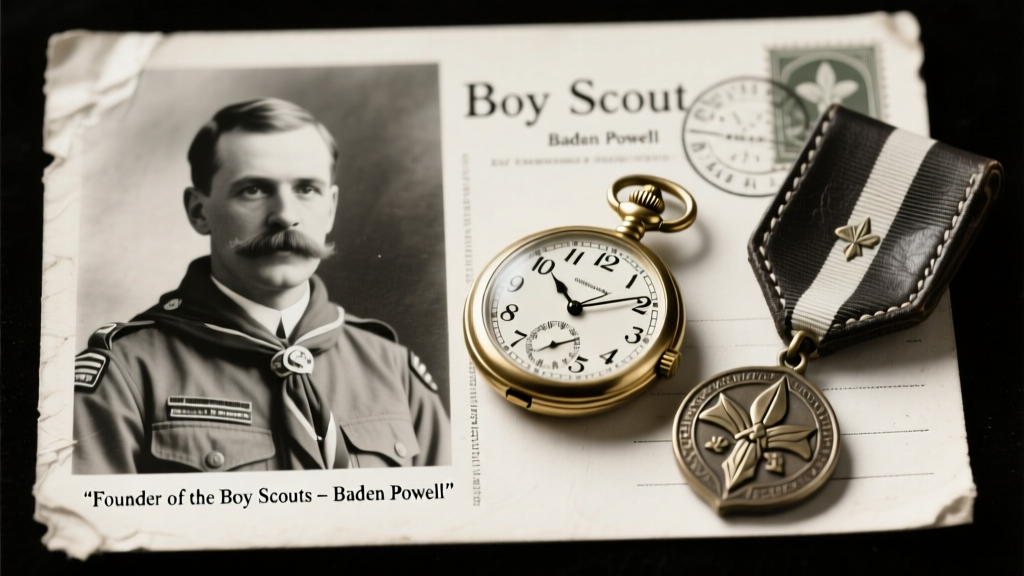
The Boy Scout Postcard Featuring Baden-Powell: A Historical Artifact of Early 20th-Century Philanthropy and Youth Education
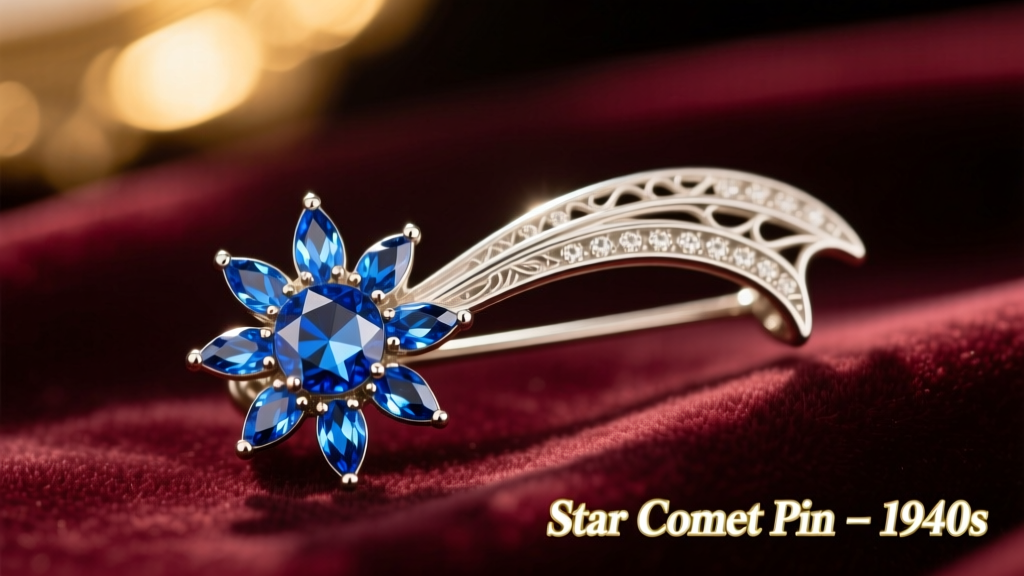
The Lisner Star Comet Pin: Decoding a Mid-Century Masterpiece in Blue and Clear Rhinestones