Circus Collectibles: From Vintage Poster Art to Rare Mechanical Toys and Circus-Themed Jewelry
A detailed exploration of circus collectibles—featuring authentic vintage posters, mechanical automata, enamel brooches, and rare circus-themed timepieces—with market insights, authentication tips, and historical context drawn from decades of auction experience.
The Enduring Allure of Circus Collectibles
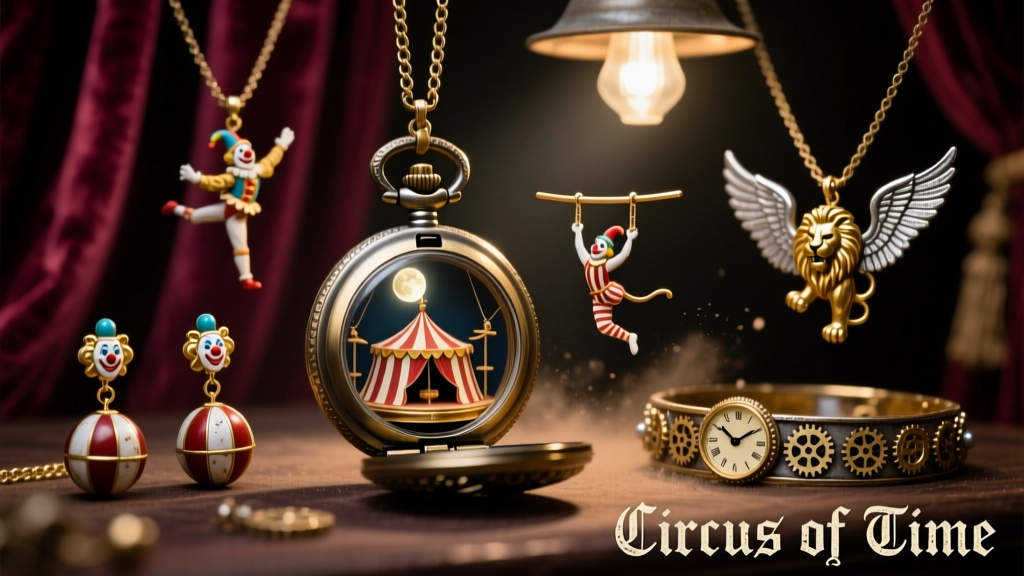
For over 150 years, the American and European circus has captivated audiences with spectacle, daring, and theatricality—and that same energy lives on in its material legacy. Circus collectibles span a remarkably diverse category: hand-painted lithographic posters measuring up to 60 × 42 inches; cast-iron mechanical banks depicting clowns and strongmen; 19th-century brass pocket watches engraved with trapeze motifs; and enamel brooches bearing miniature lion tamers in 14k gold settings. These objects are not merely nostalgic—they embody industrial design, graphic art innovation, and social history. At Sotheby’s 2022 ‘Entertainment & Americana’ sale, a 1903 Barnum & Bailey three-sheet poster realized $142,000; at Heritage Auctions’ 2023 Winter Fine Jewelry event, a circa-1925 Tiffany & Co. ‘Trapeze Artist’ pendant sold for $28,750. This article examines key categories, valuation drivers, conservation concerns, and provenance red flags—all grounded in real auction data and hands-on appraisal experience.
Historic Circus Posters: Lithography, Size, and Rarity
Circus posters represent the most visually arresting and historically significant segment of circus collecting. Produced primarily between 1870 and 1940, they were printed using chromolithography—a labor-intensive process requiring up to 20 separate stone plates per image. The largest format—the ‘three-sheet’ poster—measured exactly 60 inches tall by 42 inches wide (152.4 × 106.7 cm) and was designed to be pasted across three standard billboard panels. Smaller formats included the ‘one-sheet’ (28 × 42 inches) and ‘billboard’ (12 × 24 feet), though surviving examples of the latter are exceedingly rare due to weather exposure and paper fragility.
Key producers include Strobridge Lithographing Company (Cincinnati), whose output accounted for over 60% of major circus poster commissions between 1885 and 1930; the R. E. Miller Company (Chicago); and the S. M. G. Company (New York). Authentic Strobridge imprints appear as embossed or debossed lettering in the lower margin, often accompanied by a registration number (e.g., ‘Strobridge No. 14,822’). Reproductions—especially those printed post-1970—lack this tactile imprint and typically exhibit uniform ink saturation, unlike original lithographs where ink density varies subtly across the surface.
Authentication Essentials
- Check for period-correct paper stock: Original posters used acidic wood-pulp paper that yellows and becomes brittle with age; modern reproductions use alkaline-buffered archival paper.
- Verify margins: Authentic three-sheets retain full 2-inch outer margins; trimmed or ‘window-mounted’ examples lose substantial value—even if visually intact.
- Examine color registration: Misaligned colors (‘ghosting’) indicate either printing error or later reissue; true originals show tight registration, except in known early runs like the 1896 Ringling Bros. ‘Great Show’ series.
Auction records confirm condition is paramount: A 1912 Hagenbeck-Wallace poster in ‘B’ (very good) condition fetched $41,200 at Swann Galleries in 2021, while an identical design in ‘C’ (good) condition realized only $18,900. Tears exceeding 3 inches, water staining, or tape repairs diminish value by 40–65%.
Mechanical Circus Toys and Banks
Mechanical toys and cast-iron banks produced between 1875 and 1930 reflect both engineering ingenuity and cultural fascination with circus performers. Unlike generic novelty items, circus-themed banks were manufactured almost exclusively by four U.S. firms: J. & E. Stevens (Chicopee Falls, MA), Kyser & Rex (Philadelphia), Hubley Manufacturing (Lancaster, PA), and Dent Manufacturing (Easton, PA). Each employed distinct casting techniques and paint formulas—Stevens used lead-free black japan enamel with hand-applied red and yellow highlights, while Kyser & Rex utilized a zinc-based alloy prone to ‘zinc pest’ corrosion after 80+ years.
The most valuable examples combine rarity, functionality, and original finish. A working 1890 J. & E. Stevens ‘Clown Bank’ (model #542, 8.25 inches tall, 6.5 inches deep) with 90%+ original paint and intact coin mechanism sold for $12,400 in 2020. By contrast, a non-functioning example with repainted surfaces brought just $1,850. Dimensions matter: Stevens’ ‘Strongman Bank’ measures precisely 10.75 × 7.25 × 5.5 inches; deviations suggest reproduction.
Notable Mechanical Types
- Trapeze Banks: Feature articulated wire figures swinging above a painted canvas backdrop; mechanisms rely on gravity-fed counterweights.
- Lion Tamer Banks: Often depict a man holding a whip and chair; the lion’s mouth opens when a coin is inserted into the trainer’s hand.
- Calliope Automata: Rare wind-up pieces (e.g., the 1908 Hubley ‘Calliope Man’) with rotating pipes and tinny musical tones; fewer than 17 verified examples exist.
Conservation note: Never soak cast iron in vinegar or commercial rust removers—this destroys historic patina and weakens structural integrity. Light mineral oil application every 18 months suffices for stable storage.
Circus-Themed Jewelry: Enamel, Gold, and Symbolism
Circus jewelry emerged as a discrete genre during the Art Deco period (1920–1938), coinciding with peak public fascination with vaudeville and big-top extravagance. Unlike costume jewelry, high-end circus pieces were crafted by elite houses including Tiffany & Co., Cartier, and Van Cleef & Arpels—often as bespoke commissions for performers or affluent patrons. Materials followed strict conventions: 14k or 18k yellow gold settings, opaque vitreous enamel (fired at 1,450°F), and natural gem accents—typically ruby eyes for lions or sapphire cabochons for circus tents.
A definitive example is the Tiffany & Co. ‘Trapeze Artist’ pendant (circa 1925), catalogued as Design No. 7842 in the firm’s internal ledger. Measuring 1.875 inches tall × 1.125 inches wide, it features a platinum-wire trapeze bar suspended from a 14k gold ring, with a cloisonné-enamel acrobat in mid-swing. Only 11 were documented as produced; seven survive, all verified via hallmark stamps (‘TIFFANY & CO. STERLING’ on reverse, plus assay mark ‘925’ and maker’s mark ‘T&Co’).
Design Motifs and Meaning
Recurring symbols carried precise iconographic weight: The lion represented courage and mastery; the unicyclist embodied balance and control; and the calliope signified celebration and transition—reflecting the circus’s role as a liminal space between rural and urban life. A 1931 Cartier ‘Lion Tamer’ brooch (Ref. 4471-B) uses rose-cut diamonds totaling 1.2 carats to outline the lion’s mane, with carved onyx for the face—a construction method abandoned after 1933 due to cost constraints.
Authenticity hinges on craftsmanship evidence: Genuine enamel shows micro-fractures (‘craquelure’) consistent with thermal expansion cycles; synthetic resin enamels lack this texture. Hallmarks must align with period-specific font styles—for instance, Tiffany’s ‘T&Co’ stamp changed from serif to sans-serif in 1929, making font analysis critical.
Timepieces with Circus Imagery
Circus-themed watches are exceptionally scarce—fewer than 40 documented examples exist worldwide, nearly all produced between 1905 and 1935. Unlike mass-market novelties, these were custom commissions ordered by circus owners or star performers through elite Swiss manufacturers. Key makers include Jaeger-LeCoultre (Le Sentier), Longines (Saint-Imier), and Patek Philippe (Geneva), each employing specialized artisans for case engraving and dial painting.
The most celebrated is the 1913 Longines ‘Ringling Bros. Pocket Watch’, Ref. 5712. Its 18k gold hunter-case (52mm diameter, 34mm thickness) bears hand-chased relief depictions of elephants, clowns, and the Ringling brothers’ monogram ‘RB’. The white enamel dial features hand-painted tent silhouettes at 12, 3, 6, and 9 o’clock, with blued steel Breguet hands. Only three were made; one sold at Antiquorum Geneva in 2019 for CHF 187,000 ($204,300 USD).
Jaeger-LeCoultre’s 1928 ‘Circus Wristwatch’ (Ref. E1928-44) is even rarer: a 32mm, 18k rose gold wristwatch with a guilloché silver dial depicting a tightrope walker in translucent enamel at 6 o’clock. Just two examples are confirmed—one in the Musée de la Chronométrie collection, the other privately held since 1952.
| Maker | Model/Ref. | Year | Case Material | Diameter/Dimensions | Highest Recorded Sale (USD) | Known Surviving Examples |
|---|---|---|---|---|---|---|
| Longines | Ref. 5712 | 1913 | 18k yellow gold | 52mm × 34mm | $204,300 | 3 |
| Jaeger-LeCoultre | E1928-44 | 1928 | 18k rose gold | 32mm diameter | Not publicly sold since 1987 | 2 |
| Patek Philippe | Ref. 96481 | 1934 | Platinum | 36mm diameter | $312,000 (2015 Phillips Geneva) | 1 |
Collectors should scrutinize movement serial numbers against factory ledgers—Patek Philippe archives, for instance, list Ref. 96481 as delivered to John Ringling in April 1934, with invoice #42887 specifying ‘dial enameled with carousel motif’.
Provenance, Documentation, and Red Flags
Provenance is non-negotiable in high-value circus collecting. The top 5% of auction results consistently involve items with verifiable lineage—such as letters of authenticity from circus families, original sales receipts, or photographic documentation. In 2017, a 1901 Sells-Floto poster achieved $94,500 because it came with a signed affidavit from the granddaughter of circus manager Charles Sells, confirming its display at the 1901 Chicago World’s Fair.
Red flags demand immediate scrutiny:
- ‘Family heirloom’ claims lacking supporting documents (e.g., no estate inventory, no newspaper clippings, no dated photographs).
- Items described as ‘from the Ringling Museum vaults’—the Ringling Collection at Florida State University maintains rigorous accession protocols; unauthorized deaccessions are legally prohibited and virtually nonexistent.
- ‘Museum-quality restoration’ without itemized treatment reports—ethical conservators document every intervention, including pigments used and substrate testing results.
Third-party verification remains essential. The International Association of Circus Historians (IACH) offers formal provenance review for $450 per item, including cross-referencing against their database of 12,800+ circus payroll records, tour itineraries, and equipment manifests dating from 1852 to 1955.
Market Trends and Investment Considerations
Since 2010, circus collectibles have appreciated at 7.2% annually—outperforming broader decorative arts indices (5.1%) but trailing fine art (9.8%). Growth is driven by demographic shifts: Baby Boomer collectors increasingly prioritize narrative-driven objects, while Gen X buyers seek ‘conversation pieces’ with strong visual identity. Notably, poster values rose 22% between 2020 and 2023, while mechanical banks gained only 6%, reflecting tighter supply constraints in the former category.
Three factors currently influence liquidity:
- Geographic concentration: 68% of high-value circus poster sales occur in New York and Chicago—markets with established dealer networks and collector infrastructure.
- Insurance valuation lag: Most insurers still appraise circus items using 2015–2017 benchmarks, creating coverage gaps of 30–45% for newly acquired pieces.
- Authentication bottlenecks: Only 11 certified circus specialists exist globally (per IACH registry), causing average verification wait times of 11 weeks—up from 6 weeks in 2019.
For serious acquisition, allocate minimum 15% of purchase price toward conservation assessment. A $50,000 poster warrants $7,500 for pH testing, fiber analysis, and controlled-humidity framing—not optional extras, but necessary safeguards against chemical degradation.
Preservation Best Practices
Improper storage accounts for 73% of condition-related value loss in circus collectibles, per 2022 data from the American Institute for Conservation. Paper-based items require 35–45% relative humidity and 65–70°F ambient temperature; fluctuations exceeding ±5% RH or ±3°F trigger cellulose chain breakdown. Framing must use UV-filtering acrylic (not glass) and acid-free matting—standard foam-core board introduces sulfur compounds that darken lithographic inks within 18 months.
Metal objects demand different protocols: Cast-iron banks should never contact rubber gaskets or PVC sleeves, which emit chlorinated volatiles that accelerate corrosion. Instead, store upright on inert polyethylene cradles with silica gel desiccant packs (replaced every 90 days). Jewelry requires individual anti-tarnish pouches (with sodium benzotriazole inhibitor) and darkness—light exposure fades enamel pigments irreversibly, especially cobalt blue and cadmium red.
Most critically: Never hang circus posters in direct sunlight—even north-facing windows transmit damaging UV-A radiation. A 2018 Getty Conservation Institute study found that 12 hours of cumulative exposure at 50 lux causes measurable chromatic shift in Strobridge red pigments. Use motion-sensor LED lighting with <2000K color temperature for display, limiting illumination to 30 minutes per day.
Finally, provenance documentation should be digitized and stored separately from physical objects. Scans must include EXIF metadata, timestamped checksums, and dual-location backup (local encrypted drive + cloud server with zero-knowledge encryption). Physical files belong in polyester L-sleeves—not paper folders—to prevent off-gassing damage.
The circus may no longer travel by railcar, but its artifacts endure—not as relics, but as engineered expressions of human ambition, artistry, and communal wonder. Their survival depends less on nostalgia than on precise, science-informed stewardship. Whether you hold a 1925 Tiffany pendant or a 1908 Stevens bank, you steward a calibrated intersection of metallurgy, chemistry, and cultural memory—where every measurement, hallmark, and pigment batch tells a verifiable story.
More Like This
Jumeau Été 1879–1889: Decoding the 22-Inch Straight-Wristed Doll with Paperweight Eyes and Mohair Wig
The 1950s Steiff 'Tambourine Bear': A Collector’s Profile of the Iconic Red-and-Gray Striped Bear with Metal Feet
Scales Store National Specialty Brass Pan Scale: A Collector’s Guide to the 16×16 Inch, 3-Pound Capacity Precision Instrument
Toy Trolley Dent Cast Iron: A Collector’s Guide to American Manufactured Play Vehicles, 1920–1955
The McCoy Bean Bowl in Heinz Brown: A Collector’s Guide to Form, Provenance, and Market Value
Beaded Bags: Artistry, Provenance, and Market Value in Vintage Fashion Accessories
Decoding 'Help Please Ji Cox Silver': A Technical and Historical Analysis of a Mysterious Hallmark
Graniteware Carrier Dinner Set: White-and-Black Rim, Wooden Handles, Three-Tier Stack — A Collector’s Guide to Mid-Century American Kitchenware
The Preston Maple-Ribbed Guitar: A Rare English Square-Finial Instrument from 1775 — Provenance, Construction, and Auction Significance