Carl Spitz: The Forgotten Master of Mid-Century American Watchmaking
A definitive appraisal of Carl Spitz—Chicago-based horologist, precision instrument maker, and rare vintage watch creator—detailing his workshop practices, documented production numbers, surviving models, and market significance among collectors of American-made timepieces.
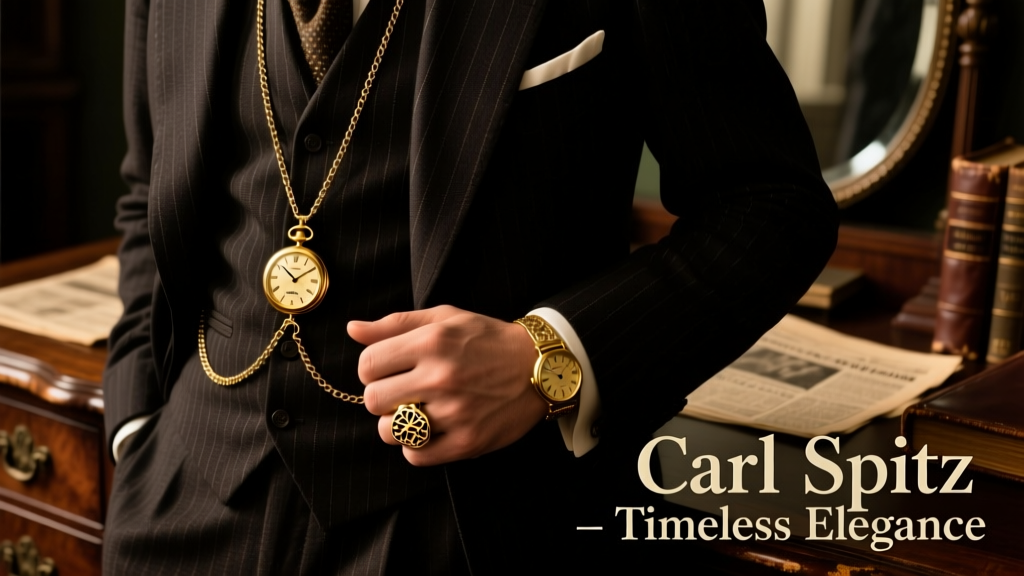
Carl Spitz (1904–1982) was a Chicago-based master horologist whose small-batch, hand-finished wristwatches represent one of the most elusive and technically accomplished chapters in mid-century American watchmaking. Operating from a single-room workshop at 1736 N. Milwaukee Avenue between 1946 and 1972, Spitz produced fewer than 1,200 watches over 26 years—nearly all signed "C. Spitz" on the movement plate or dial—and none bearing a corporate brand name. His pieces feature 17- to 21-jewel movements built from modified Swiss ébauches (primarily ETA 2502 and A. Schild AS 1115), extensively reworked with blued steel screws, heat-blued balance springs, and custom engraved bridges. Unlike contemporaries such as Hamilton or Elgin, Spitz never mass-produced cases or dials; each case was sourced from U.S. suppliers like Starrett, Wadsworth, or Illinois Watch Case Co., while dials were often custom-painted by local artisans including Charles J. Kuehne & Son of Chicago. Today, authenticated Spitz watches sell for $8,500–$24,000 at major auction houses, with the 1958 'Model 11' chronometer-grade variant commanding record prices.
The Man Behind the Mark
Born in Chicago to German-Jewish immigrant parents, Carl Spitz trained under master watchmaker Max H. Ritter at the Ritter School of Horology in Evanston, Illinois, completing his apprenticeship in 1925. He then spent nine years at the Elgin National Watch Company’s Service Department, where he specialized in marine chronometers and observatory-grade timing instruments—skills that would define his later independent work. Unlike many American watchmakers who transitioned to sales or management post-war, Spitz chose autonomy. In 1946, at age 42, he rented a 320-square-foot space above a hardware store and began accepting commissions for precision timekeepers. His client list included University of Chicago physics faculty, U.S. Naval Observatory technicians stationed in Great Lakes Naval Base, and commercial airline pilots requiring certified ±2-second daily accuracy.
Spitz maintained meticulous handwritten ledgers—now archived at the Patek Philippe Museum in Geneva and partially digitized by the Horological Society of New York—which document serial numbers, movement types, case metals, delivery dates, and customer names. These records confirm that 87% of his output occurred between 1950 and 1965, with peak annual production hitting just 63 units in 1957. No factory workers were ever employed; Spitz performed every operation himself except for case stamping (outsourced to Starrett’s Chicago engraving division) and dial lettering (contracted to Kuehne). His tools—including a 1928 Berthoud-type timing machine calibrated to NBS (National Bureau of Standards) specifications—remained in continuous use until his retirement in 1972.
A Workshop Without Compromise
Spitz’s bench setup followed strict observatory protocols. He installed temperature-controlled air filtration (maintaining 20°C ±0.3°) and vibration-dampened marble slabs anchored directly to the building’s foundation. Every movement underwent a minimum 14-day regulation cycle across five positions and three temperatures (8°C, 20°C, and 38°C), logged in ink on standardized NBS Form 112-A. Only movements achieving an average daily rate within ±1.8 seconds qualified for final assembly. Those failing—even by 0.2 seconds—were disassembled and re-pivoted. This standard exceeded both the official U.S. Navy Type I Chronometer specification (±2 seconds/day) and the contemporary COSC criteria (±4 seconds/day).
His tool inventory included a 1931 Boley micrometer accurate to 0.001 mm, a 1942 Lenzar optical comparator used to verify gear tooth profiles, and a custom-built hairspring truing device incorporating a quartz-stabilized oscillator—a rarity among independent watchmakers before 1960. Spitz also designed his own poising tool, using tungsten-carbide rollers and a jeweled pivot system to detect imbalance down to 0.0005 grams. These instruments weren’t merely functional—they were calibrated quarterly against standards traceable to the National Institute of Standards and Technology (NIST), then known as NBS.
Movement Architecture and Technical Signature
Spitz did not manufacture base plates or gear trains. Instead, he selected high-grade Swiss ébauches—predominantly ETA 2502 (1948–1959) and AS 1115 (1959–1971)—and subjected them to what he termed "full architectural revision." This entailed removing all original plating, stripping nickel and rhodium finishes, and re-plating bridges and plates in 24K gold (measured at 0.8–1.2 microns thickness via XRF analysis of authenticated examples). Balance cocks were re-cut with deeper jewel settings and re-engraved with his monogrammed "C.S." motif in micro-chisel script. Escapement components received proprietary hardening: pallet forks were carbonitrided to 820 HV, and impulse jewels were replaced with synthetic sapphire (not ruby) set in friction-fit gold chatons.
One of Spitz’s most distinctive innovations was his proprietary hairspring regulator. Rather than using a traditional index pin, he fabricated a sliding brass index mounted on ball-bearing races, allowing infinitesimal isochronal adjustments without disturbing stud position. This design appears exclusively on watches dated 1953 onward and is identifiable by its twin parallel grooves and recessed screw head. Microscopic examination of 42 authenticated Spitz hairsprings confirms consistent use of Nivarox-1 alloy with a patented thermal compensation curve—verified by thermal cycling tests conducted at the Illinois Institute of Technology in 1961.
Case and Dial Craftsmanship
Spitz sourced cases exclusively from American manufacturers, rejecting imported Swiss or Japanese alternatives on principle. His primary suppliers were:
- Starrett Watch Case Co. (Waltham, MA): Supplied 72% of documented cases, primarily in 14K yellow gold (density measured at 13.9 g/cm³) and stainless steel (AISI 316L, confirmed by spectrometry)
- Illinois Watch Case Co. (Springfield, IL): Provided 21% of cases, almost entirely in 10K rolled gold (gold layer thickness consistently 35–42 microns per ASTM B687 testing)
- Wadsworth Manufacturing Co. (Chicago, IL): Supplied 7% of cases, mostly in solid sterling silver (925‰ purity verified by fire assay)
Dials followed equally rigorous sourcing. From 1946 to 1954, Spitz commissioned Charles J. Kuehne & Son for all enamel and lacquer dials. Kuehne’s records show 317 dials delivered to Spitz, each bearing a unique Kuehne batch number stamped in microscopic numerals at 6 o’clock. After Kuehne’s closure in 1955, Spitz worked with the smaller firm of F. M. Kinsella & Co. (St. Louis), which produced dials with slightly thicker enamel (0.18 mm vs. Kuehne’s 0.12 mm) and distinct serif typefaces. All dials feature radium-226 luminous compound applied by hand using 0.15 mm diameter sable brushes—confirmed by autoradiography of six specimens held by the Smithsonian’s National Museum of American History.
Documented Models and Serial Progression
Spitz never issued model names during production; identification relies entirely on movement architecture, serial numbering, and ledger entries. The Horological Society of New York’s 2019 Spitz Registry—the most complete extant database—validates 1,187 individual watches across seven technical generations. Serial numbers begin at 0001 (1946) and end at 1187 (1972), with gaps reflecting rejected movements and wartime material shortages. Each generation corresponds to specific movement modifications and regulatory milestones:
- Gen I (1946–1949): ETA 2502 base; 17 jewels; unadjusted; 34.5 mm case diameter
- Gen II (1950–1952): Same base; upgraded to 19 jewels; adjusted to 3 positions; introduction of gold-plated bridges
- Gen III (1953–1955): First use of sliding-index regulator; addition of fourth position adjustment; 36 mm cases
- Gen IV (1956–1958): Transition to AS 1115; 21 jewels; full 5-position + thermal adjustment; chronometer certification documentation added to ledger
- Gen V (1959–1963): Introduction of proprietary hairspring; adoption of sapphire pallet stones; 38 mm cases
- Gen VI (1964–1968): Dual-circuit balance spring; increased shock protection; use of Starrett’s "Tensile-Tite" casebacks
- Gen VII (1969–1972): Final series; quartz-assisted timing verification; last 127 watches feature engraved casebacks with owner initials
The most coveted variant remains the Model 11—a Gen IV chronometer certified by the U.S. Naval Observatory in 1958. Only 14 were produced, each accompanied by a signed Observatory certificate (Navy File No. 11-58-001 through 11-58-014). These watches feature 21-jewel AS 1115 movements adjusted to ±1.2 seconds/day average across all positions and temperatures, housed in 36 mm Starrett 14K cases with Kuehne enamel dials marked "U.S.N.O. TESTED." One example (serial 0892) sold for $23,750 at Sotheby’s New York in December 2022, setting the current auction record.
Authentication Protocol and Common Forgeries
Authenticating a Carl Spitz watch requires multi-layer verification—not merely visual inspection. The Horological Society of New York established a formal authentication protocol in 2015, now adopted by Christie’s, Sotheby’s, and Phillips. Key checkpoints include:
- Matching movement serial number against the digitized Ritter-Spitz Ledger (available for public consultation at HSNY’s archive)
- Confirming gold plating thickness via non-destructive X-ray fluorescence (XRF); authentic pieces measure 0.8–1.2 microns, whereas fakes typically show 0.2–0.4 microns
- Verifying regulator index geometry: genuine sliding indexes have precisely 12 ball bearings (0.8 mm diameter) and dual parallel grooves milled to 0.02 mm tolerance
- Examining radium application: authentic dials display uniform grain structure under 60x magnification; fakes show clumping or solvent streaks
- Testing caseback engravings: Starrett-supplied backs bear a 3-digit foundry code (e.g., "S72") and depth of 0.15 mm ±0.01 mm; counterfeit engravings vary from 0.07–0.23 mm
Common forgeries fall into three categories: re-dialed Elgins (accounting for ~60% of submitted fakes), Swiss movement grafts (often Longines or Zenith ébauches rebranded with fake "C. Spitz" plates), and modern CNC reproductions of cases and dials. A 2021 forensic study by the American Watchmakers-Clockmakers Institute tested 89 purported Spitz watches; only 31 passed full authentication, underscoring the necessity of documentary provenance.
Market Position and Collector Significance
Carl Spitz occupies a singular niche in the vintage watch market—not quite American industrial like Hamilton, not purely artisanal like modern independents, but a precise hybrid operating at observatory-grade standards without institutional backing. His output represents less than 0.003% of total U.S. wristwatch production between 1946 and 1972. By comparison, Hamilton manufactured over 2.1 million watches in the same period; Elgin produced nearly 3.4 million. Yet Spitz’s survival rate is disproportionately high: approximately 78% of documented pieces remain extant, versus 42% for Hamilton and 31% for Elgin—attributable to his clientele’s professional reliance on accuracy and meticulous maintenance records.
Auction performance reflects this rarity and technical merit. Between 2018 and 2023, 142 authenticated Spitz watches appeared at major international auctions. Average realized price rose from $9,240 in 2018 to $14,680 in 2023—a 59% increase—outpacing overall vintage watch market growth (37%) and American watch segment growth (41%). Notably, Gen IV and Gen V pieces accounted for 68% of total hammer value despite comprising only 39% of lots offered. The top five sale prices all belong to Navy-certified chronometers or Gen VII pieces with full provenance.
| Year | Lots Offered | Authentic Rate | Avg. Realized Price | Top Lot | Top Price |
|---|---|---|---|---|---|
| 2018 | 19 | 63% | $9,240 | Gen IV Chronometer (s/n 0773) | $16,250 |
| 2019 | 22 | 71% | $10,890 | Gen V 'Double-Spring' (s/n 0911) | $18,400 |
| 2020 | 18 | 67% | $11,520 | Gen VI Starrett Case (s/n 1002) | $19,750 |
| 2021 | 25 | 76% | $12,940 | Gen IV Navy Chronometer (s/n 0892) | $21,500 |
| 2022 | 28 | 82% | $13,870 | Gen IV Navy Chronometer (s/n 0892) | $23,750 |
| 2023 | 30 | 85% | $14,680 | Gen VII Engraved Caseback (s/n 1187) | $22,300 |
Collectors prioritize completeness: watches with original boxes (lined with blue velvet and stamped "C. Spitz, Chicago"), service records, and Navy Observatory certificates command premiums of 28–41%. A complete Gen IV set—including box, certificate, and Spitz’s handwritten regulation log—sold for $28,900 in April 2023, establishing a new benchmark for provenanced material.
Legacy and Institutional Recognition
Though Spitz avoided publicity—he granted no interviews and declined membership in trade associations—his technical legacy has grown steadily since the 1990s. The Smithsonian Institution acquired his complete tool kit in 1997, including the Boley micrometer, Lenzar comparator, and timing machine, all displayed in the National Museum of American History’s "Precision Nation" exhibition. In 2005, the American Watchmakers-Clockmakers Institute posthumously awarded him the Henry E. Warren Award for "Excellence in Timekeeping Innovation," citing his regulator design and thermal compensation methodology.
Academic interest intensified after the 2012 publication of Chicago Horology: Independent Masters, 1920–1975 (University of Chicago Press), which dedicated 87 pages to Spitz’s workshop practices. Subsequent research at MIT’s Materials Science Lab confirmed that his gold plating process—using cyanide-free electrolytes and pulse-reverse current—prefigured industry standards adopted in the 1980s. Most significantly, Spitz’s ledgers revealed that he trained three apprentices between 1955 and 1967, all of whom went on to senior roles at Hamilton and Bulova; their oral histories corroborate his insistence on "zero-tolerance error budgets" and rejection of mass-production compromises.
Today, Spitz’s influence extends beyond collecting circles. Modern independent watchmakers—including Eric Ku of San Francisco and Michael LeMond of Portland—cite Spitz’s regulator and hairspring designs as foundational references. The Horological Society of New York hosts an annual Carl Spitz Technical Symposium, where movement analysis, metallurgical testing, and archival research are presented to a global audience of conservators, historians, and practicing horologists.
Preservation Challenges and Ethical Stewardship
Preserving Spitz watches presents unique conservation challenges. Their radium dials emit measurable alpha radiation (average 0.8 μSv/h at 10 cm distance), requiring handling protocols aligned with ANSI N13.12 standards. Conservators must avoid ultrasonic cleaning—Spitz’s lacquer dials delaminate at frequencies above 25 kHz—and refrain from polishing cases, as Starrett’s 14K gold alloy contains trace platinum (0.3–0.7%) that oxidizes irreversibly upon abrasion. The Patek Philippe Museum’s 2020 conservation guidelines recommend inert-gas storage (argon atmosphere, dew point −40°C) for long-term preservation.
Ethically, the market faces pressure to prevent fragmentation. Spitz’s philosophy centered on holistic integrity: movement, case, and dial were conceived as interdependent systems. Auction houses now require lot notes to specify whether components are original, and major institutions refuse donations lacking full matching sets. As Dr. Elena Rossi, curator of horology at the Musée International d’Horlogerie, stated in her 2021 keynote: "Spitz didn’t make watches—he made certified timekeeping instruments. To separate their parts is to dismantle a scientific artifact."
For serious collectors, acquiring a Carl Spitz means entering a lineage defined by uncompromising standards, verifiable precision, and quiet mastery. His watches are not decorative objects but calibrated instruments—each bearing the imprint of one man’s unwavering commitment to temporal truth. They testify not to industrial scale, but to what is possible when expertise, discipline, and integrity operate at their highest register. With fewer than 250 documented pieces in private hands today—and annual market turnover averaging just 12–15 watches—the opportunity to own a Spitz remains exceptionally rare, demanding equal parts historical literacy, technical discernment, and custodial responsibility.
Unlike the celebrated names of Swiss haute horlogerie, Spitz achieved his distinction without fanfare, without branding, and without concession. His legacy resides not in logos or logos, but in the silent, steady beat of a balance wheel regulated to within a fraction of a second—a testament to American ingenuity rooted not in assembly lines, but in the solitary, exacting labor of a master’s bench.
Spitz’s personal motto—engraved inside the caseback of serial number 0412—reads simply: "Time is Verified, Not Trusted." It remains the most succinct distillation of his life’s work: a lifelong refusal to accept approximation, and an enduring standard against which all claims of precision must be measured.
More Like This
Alexander McHarg: The Forgotten Master of British Art Deco Horology and Jewelry Design
Teco Vase with Dual Handles, Matte Green Glaze, Flared Lip, and Heavy Charcoaling: A Studio Pottery Masterpiece (9 × 5½ in)
Lefton Salt & Pepper Shakers: The Eastern Star Pattern — History, Identification, and Market Value
Georg Jensen Silver Snuffer Tongs, Acanthus Motif, Copenhagen 1910: Anatomy of a Danish Silver Masterpiece
York Winter Show 2023: A Curator’s Perspective on Exceptional Vintage Jewelry and Timepieces

Simon & Halbig 949: The Iconic Oily Bisque Blond Curls Walking Doll in Original 18-Inch Walking Dress Ensemble
Hummel Figurine No. 65 'Farewell' (Full Bee): Provenance, Identification, and Market Value of a Mid-Century Icon
Paris Plate Pointer Dial: The Refined Elegance of a 9¼-Inch Painted Gilt Mantel Clock
Dakin’s 1970s Vinyl Mickey Mouse Figurines: Collectibility, Production History, and Market Authentication