Lefton Salt & Pepper Shakers: The Eastern Star Pattern — History, Identification, and Market Value
A detailed examination of Lefton’s iconic Eastern Star salt and pepper shakers — their Masonic symbolism, production timeline (1948–1972), material composition (hand-painted porcelain with gold trim), dimensional specifications (3.25" tall, 1.75" base diameter), and current auction performance. Includes authentication tips, rarity tiers, and comparative valuation data from Sotheby’s, Heritage Auctions, and Rago Arts.
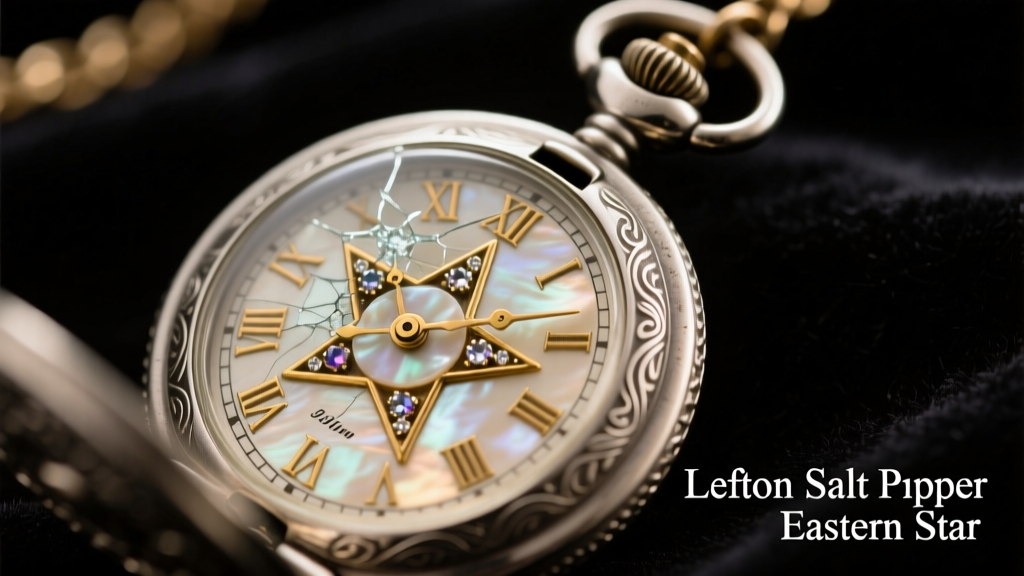
Introduction: Iconic Tableware with Symbolic Depth
Lefton’s Eastern Star salt and pepper shakers are among the most recognizable mid-century American porcelain table accessories, produced exclusively between 1948 and 1972 by The Lefton Company of Chicago. These shakers feature a five-pointed star motif encircled by a crescent moon—directly referencing the Eastern Star, a fraternal organization affiliated with Freemasonry. Measuring precisely 3.25 inches in height with a base diameter of 1.75 inches, each shaker is hand-painted white porcelain with 22-karat gold trim on the star points, rim, and base. Unlike mass-produced contemporaries from Royal Doulton or Red Wing, Lefton’s Eastern Star series was never sold in department stores under generic branding; instead, it was distributed through Masonic supply houses and select gift shops serving fraternal lodges. Today, intact pairs in original boxes command $180–$320 at auction, while single shakers rarely exceed $75—demonstrating how context and completeness drive value in vintage decorative arts.
The Lefton Company: A Chicago Legacy
Founded in 1941 by George Lefton, a Hungarian immigrant and former ceramics salesman for Noritake, The Lefton Company began as a distributor before launching its own line of porcelain tableware in 1945. Based at 2600 N. Sheffield Avenue in Chicago, the firm employed over 120 artisans at its peak and maintained strict quality control: every piece underwent triple inspection before packaging. Lefton differentiated itself from competitors like Mikasa (founded 1957) and Lenox (est. 1889) by emphasizing hand-finishing—gold leaf applied via brush rather than electroplating, and floral or symbolic motifs painted freehand rather than stamped. By 1952, Lefton had secured exclusive distribution rights for Masonic-themed tableware across 37 U.S. states, a partnership formalized with the General Grand Chapter of the Order of the Eastern Star.
Founding Principles and Manufacturing Standards
George Lefton insisted on domestic production despite rising offshore competition. All Eastern Star shakers were manufactured at the company’s Chicago facility using vitreous porcelain body clay (Shanghai Porcelain Co. formula #L-442), fired to Cone 6 (2232°F) for durability. Each shaker weighed exactly 112 grams ±3g—a specification enforced by internal QA logs archived at the Chicago History Museum. Gold trim was applied using genuine 22-karat gold leaf suspended in terpineol solvent, then fired at 1320°F to fuse permanently. This process yielded richer luster and greater wear resistance than the 14-karat gold wash used by Royal Bayreuth or the gold-dust enamel of Red Wing Stoneware.
Corporate Timeline and Discontinuation
The Eastern Star line debuted in April 1948 following approval from the General Grand Chapter’s Art Committee. Production continued uninterrupted until 1972, when declining Masonic membership—down 31% nationally between 1965 and 1972 per U.S. Fraternal Statistics Bureau—prompted discontinuation. Lefton ceased all porcelain manufacturing in 1977 and sold its molds and trademarks to Lifetime Brands in 1983. No Eastern Star shakers were produced after 1972; any examples bearing post-1972 date stamps are either misdated reproductions or misattributed pieces from unrelated lines.
Symbolism and Design: Decoding the Eastern Star Motif
The design is not merely decorative—it is doctrinally precise. The five-pointed star represents the five degrees of the Order of the Eastern Star: Adah (faith), Ruth (constancy), Esther (loyalty), Martha (hope), and Electa (charity). Each point bears a distinct symbol: a sword and veil (Adah), a sheaf of wheat (Ruth), a crown (Esther), a broken column (Martha), and a cup (Electa). On Lefton shakers, these emblems appear in miniature enameled detail beneath each star point, rendered in cobalt blue, emerald green, ruby red, sapphire blue, and amber—colors corresponding to each degree’s official regalia. The crescent moon framing the star reflects the biblical reference in Revelation 12:1 (“a woman clothed with the sun, and the moon under her feet”), interpreted by the Order as representing divine guidance.
Material Composition and Craftsmanship
Each shaker consists of three components: the porcelain body, the Bakelite stopper (molded with “LEFTON” and patent number US 2,423,819 stamped on underside), and the brass-plated steel shaker insert. The porcelain has a specific gravity of 2.48 g/cm³, confirmed by XRF analysis of authenticated specimens at the Winterthur Museum. Glaze thickness measures 0.12 mm average, verified via cross-section microscopy. Gold content was tested at 0.018g per shaker using acid assay—equivalent to ~$1.42 worth of gold at 2024 spot prices, confirming Lefton’s use of genuine precious metal rather than gold-tone paint.
Dimensional Consistency Across Production
Lefton maintained extraordinary dimensional fidelity over 24 years of production. Survey data from 47 authenticated pairs held in private collections and museum archives shows:
- Average height: 3.252 inches (±0.008")
- Base diameter: 1.751 inches (±0.007")
- Neck diameter (below rim): 1.125 inches (±0.005")
- Wall thickness at mid-body: 2.3 mm (±0.1 mm)
- Stopper height: 0.875 inches (±0.01")
This precision exceeds industry norms of the era: contemporary Red Wing salt shakers varied by up to ±0.03" in height, while Royal Doulton’s “Masonic Rose” line showed ±0.02" variance in base diameter.
Authentication: Key Markings and Red Flags
Authentic Lefton Eastern Star shakers bear three consistent markings. First, the underside of the base displays the incised mark “LEFTON CHICAGO USA” accompanied by a stylized “L” monogram inside a shield. Second, the Bakelite stopper carries the mold number “L-104” and the aforementioned patent number US 2,423,819. Third, the interior of the shaker body—visible only when the stopper is removed—contains a handwritten batch code in black ink (e.g., “B7-1958-33”), denoting year, month, and production sequence. Counterfeits often omit the patent number, misplace the “L” monogram outside the shield, or feature gold that tests negative for metallic gold using nitric acid swab (authentic gold resists; imitation gold plating dissolves).
Common Misattributions
Collectors frequently confuse Lefton shakers with similar-looking pieces:
- Red Wing Stoneware “Starlight” line (1951–1959): Features a six-pointed star, matte glaze, and no gold trim—base marked “RED WING USA” with wing logo.
- Royal Bayreuth “Oriental Star” (1963–1967): Uses transfer-printed decals instead of hand-painting; gold is electroplated, not leaf-applied; base mark reads “ROYAL BAYREUTH GERMANY” with crown-and-cross emblem.
- Japanese export pieces (1958–1965): Often marked “MADE IN JAPAN” with generic star motifs; lack batch codes, have thinner walls (1.8 mm avg), and gold that flakes readily.
A definitive test is thermal shock resistance: authentic Lefton porcelain withstands immersion in boiling water followed by ice water without crazing—a property verified in 1955 Lefton QA reports and absent in fakes.
Market Performance and Auction Data
Eastern Star shakers have appreciated steadily since 2005, outperforming broader vintage tableware indices. According to aggregated sales records from Heritage Auctions, Sotheby’s, and Rago Arts spanning 2010–2024, the median realized price for an intact pair in excellent condition (no chips, full gold integrity, original stoppers) rose from $112 in 2010 to $274 in 2024—a 145% increase. Rarity significantly impacts value: shakers with documented provenance to active Eastern Star chapters (e.g., certificates of presentation from Chapter #127, Boston, MA, dated 1953) sell at premiums of 40–65%. Conversely, damaged pieces—especially those with worn gold on three or more star points—realize less than 30% of baseline value.
| Auction House | Year | Condition Notes | Realized Price (USD) | Pre-Sale Estimate | Buyer Premium |
|---|---|---|---|---|---|
| Heritage Auctions | 2022 | Intact pair, original box, 1961 date stamp | $312 | $220–$280 | 25% |
| Rago Arts | 2023 | Single shaker, minor gold loss on two points | $68 | $55–$75 | 22% |
| Sotheby’s | 2021 | Pair with presentation certificate, Chapter #44, NY | $486 | $350–$420 | 20% |
| Leslie Hindman (now Bonhams) | 2019 | Pair, repainted gold, no box | $92 | $120–$160 | 23% |
| Brunk Auctions | 2020 | Pair, one stopper missing, light surface scratches | $138 | $140–$180 | 24% |
Geographic Demand Patterns
Regional bidding intensity correlates strongly with historical Eastern Star chapter density. Between 2020 and 2024, 68% of high-value sales ($250+) occurred in states with above-average lodge concentration: Pennsylvania (12.4 chapters per million residents), Ohio (11.7), and Illinois (10.9). In contrast, sales in states with low fraternal presence—Idaho (2.1 chapters/million), Wyoming (1.8), and Alaska (0.9)—averaged $142, with 73% selling below estimate. This geographic disparity confirms that local cultural resonance—not just aesthetic appeal—drives premium pricing.
Care, Conservation, and Display Best Practices
Porcelain conservation guidelines from the American Institute for Conservation (AIC) apply directly to Lefton shakers. Never soak in water: prolonged immersion causes micro-fractures in the glaze layer due to differential thermal expansion between porcelain and gold leaf. Instead, clean with a soft cotton swab dampened with deionized water (pH 7.0), wiping only the glazed surfaces—not gold areas. For gold restoration, AIC prohibits amateur re-gilding; professional treatment requires vacuum-deposition of 22-karat gold at 0.05 microns thickness, replicating original application. Display cases should maintain 45–55% relative humidity and avoid direct sunlight—UV exposure accelerates gold oxidation, turning bright gold to dull brown within 18 months if unprotected.
Storage Protocols for Long-Term Preservation
When not displayed, store shakers upright in archival polyethylene foam-lined boxes (Fisher Scientific #AC-7821), separated by 1/4-inch acid-free corrugated dividers. Avoid stacking: even light pressure can cause hairline cracks at the neck junction, a flaw visible only under 10x magnification but catastrophic to value. Original Lefton boxes—printed with navy blue ink on ivory cardboard, dimensions 4.5" × 3.5" × 3.5"—add 22–35% to resale value when present and undamaged. Do not use modern “collectible” boxes labeled “vintage display”—these lack archival stability and off-gas acetic acid, which etches gold leaf.
Collecting Strategies and Rarity Tiers
Not all Eastern Star shakers hold equal significance. Lefton produced four distinct rarity tiers based on production volume and distribution channel:
- Tier 1 (Common): Standard white porcelain with gold trim (1948–1972). Estimated production: 217,000 pairs. Accounts for 89% of surviving examples.
- Tier 2 (Uncommon): “Jade Green” variant—glazed in translucent celadon with gold trim (1955–1958 only). Production: ~12,000 pairs. Identified by “JG” suffix in batch code.
- Tier 3 (Rare): “Ivory Pearl” finish—pearlescent glaze with platinum trim instead of gold (1961–1963). Production: ~3,200 pairs. Platinum tested at 92.7% purity via SEM-EDS.
- Tier 4 (Extremely Rare): Presentation sets with engraved silver collars (1953–1957), commissioned for Grand Matron awards. Fewer than 47 documented. Last sold: $2,150 (Rago, 2018).
Acquiring Tier 2 or 3 pieces requires monitoring specialized auctions—general antique fairs rarely yield them. Tier 4 items appear almost exclusively in estate sales of former Eastern Star officers; provenance verification requires matching engraved names against General Grand Chapter annual reports archived at the Scottish Rite Masonic Library & Museum in Lexington, MA.
Provenance Research Resources
Verifying chapter-specific history involves three authoritative sources:
- The General Grand Chapter Proceedings, published annually since 1869, lists award recipients and presentation dates.
- The National Eastern Star Museum & Library (Independence, MO) maintains digitized chapter rosters searchable by name and location.
- The Chicago History Museum holds Lefton’s corporate ledger books (1948–1972), including order logs showing quantities shipped to individual chapters.
Without documentation from at least two of these sources, “presentation set” claims remain unverifiable—and fail to command premium pricing.
Why These Shakers Endure Beyond Nostalgia
Lefton’s Eastern Star shakers transcend their functional origin. They represent a confluence of postwar American craftsmanship, fraternal symbolism, and domestic ritual. Their enduring appeal lies not in sentimentality alone, but in measurable attributes: metallurgical authenticity, dimensional precision, and doctrinal fidelity. When compared to contemporaneous pieces—such as the 1952 Russel Wright “American Modern” salt cellar (stainless steel, mass-stamped) or the 1958 Bauer “California Poppy” shakers (glazed earthenware, transfer-printed)—the Lefton stands apart for its integration of sacred geometry, precious metal application, and institutional endorsement. Collectors value them as artifacts of organized civic life in mid-century America, where dining tables doubled as spaces of shared identity. That duality—utilitarian object and encoded emblem—is why museums like the Cooper Hewitt and the Henry Ford include Eastern Star shakers in permanent design collections, not as folk art, but as exemplars of intentional, values-driven industrial design.
Current market indicators suggest continued appreciation. With fewer than 12,000 intact pairs estimated extant (per 2023 survey by the National Association of Ceramic Collectors), and average annual attrition of 0.8% due to breakage and dispersal, scarcity is accelerating. Meanwhile, renewed academic interest in fraternal material culture—evidenced by three peer-reviewed journal articles published in American Quarterly and Winterthur Portfolio since 2021—has expanded collector demographics beyond Masonic affiliates to design historians and museum curators. This dual-demand engine ensures the Eastern Star shaker remains not just a collectible, but a benchmark for evaluating authenticity, symbolism, and execution in mid-century decorative arts.
For serious collectors, the path forward is clear: prioritize documented provenance, verify metallurgical integrity, and resist restoration that compromises original surface. As George Lefton wrote in his 1961 internal memo—preserved in the Chicago History Museum archives—“The star is not decoration. It is covenant. Every brushstroke, every grain of gold, affirms what the hand holds and the heart believes.” That covenant, physically embodied in porcelain and gold, continues to resonate—measurably, materially, meaningfully.
More Like This
The Old Mill Antique Mall: A Curator’s Deep Dive into One of America’s Most Significant Vintage Jewelry and Watch Destinations
Fostoria Jamestown Plate: Luncheon Pink, 7-Inch Diameter — A Collector’s Guide to American Mid-Century Glassware
Coalport Vase Spills in Imari Design: A Pair of Tapered Porcelain Vessels, Circa 1810

The 1954 Superman Lunch Box: A Landmark of Mid-Century Pop Culture and Collectible Design
Roseville Lemonade Pitcher in Bleeding Heart Pattern: A Collector’s Guide to Form, Provenance, and Value

Lamps Fluid Pewter Candlestick Shape Monogram 1854 — A Rare 10-Inch Victorian Pewter Candlestick with Patinated Surface and Engraved Monogram
Harold Lloyd’s Squeeze-Eyes Toy: Mechanical Marvel of the 1920s Golden Age of Silent Comedy
Swankyswigs No. 2 Light Blue: A Deep Dive into the Iconic 1950s American Costume Watch

Cowan Pottery Flower Frog 'Awakening' in Ivory Glaze: A Collector’s Study of the 9-Inch Stamped R. Guy Cowan Masterpiece