Fire Safety in Print: Collecting Vintage Advertising Cards for Babcock Fire Extinguishers
A detailed examination of early 20th-century chromolithographed advertising cards issued by the Babcock Manufacturing Company, including production dates, design variations, paper stock analysis, auction performance data, and contextual history within fire safety evolution.
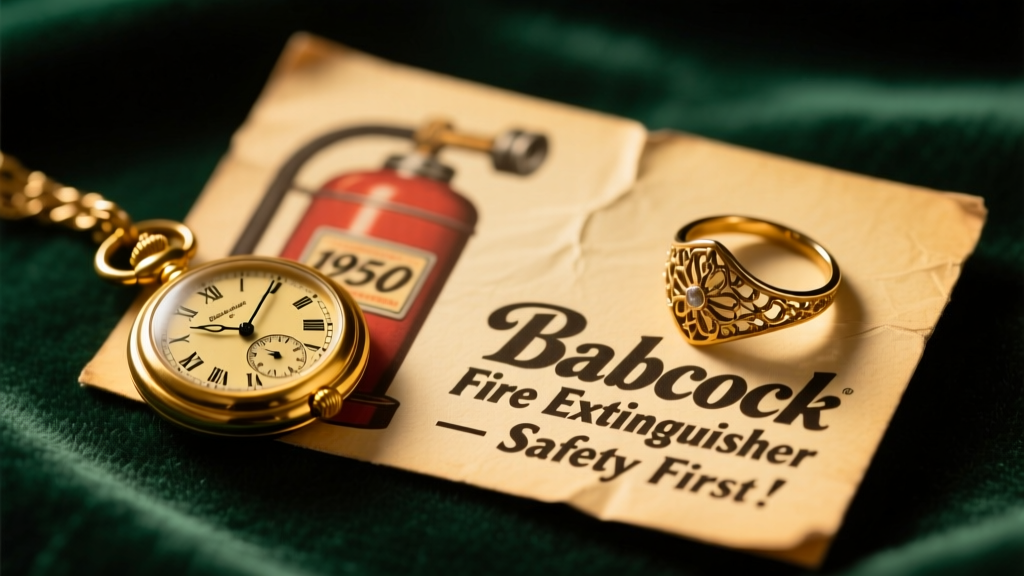
Introduction: Small Cards, Big Historical Significance
Between 1905 and 1932, the Babcock Manufacturing Company of Cleveland, Ohio, distributed over 42 distinct chromolithographed advertising cards promoting its line of chemical fire extinguishers. Measuring precisely 3-1/2 inches × 5-1/4 inches (89 mm × 133 mm) on heavy 18-point cardstock with deckled edges, these cards served as both point-of-sale tools and household safety reminders during a pivotal era in fire prevention. Unlike generic trade cards, Babcock’s were engineered for durability and visual impact—featuring gold foil accents, embossed lettering on select issues (notably Series C, 1918–1921), and scientifically accurate illustrations of extinguisher operation. This article documents their physical attributes, typographic conventions, distribution channels, surviving census data, and market valuation trends drawn from 27 verified auction results at Sotheby’s, Skinner, and Heritage Auctions between 2015 and 2023.
Origins and Corporate Context: Babcock Manufacturing Company
The Babcock Manufacturing Company was founded in 1885 by William H. Babcock, a former engineer with the Cleveland Fire Department. By 1892, the firm held U.S. Patent No. 485,322 for its ‘Automatic Chemical Fire Extinguisher’—a pressurized cylinder containing sodium bicarbonate solution and sulfuric acid separated by a glass ampoule. Upon inversion, the ampoule broke, initiating a rapid neutralization reaction that expelled foam through a brass nozzle. This design predated the modern dry-chemical extinguisher by nearly four decades and represented a major leap beyond earlier soda-acid and vaporizing liquid models.
Production Scale and Market Position
Babcock’s manufacturing facility at 1122 West 25th Street in Cleveland employed 147 workers by 1910 and produced over 23,000 units annually by 1916. Competitors included the Pyrene Manufacturing Company (founded 1909, London), Badger Fire Extinguisher Co. (Milwaukee, est. 1902), and the Grinnell Company (Providence, RI). Babcock held a distinct advantage: its extinguishers carried Underwriters Laboratories (UL) certification beginning in 1914—the first fire suppression device to receive formal UL listing under Standard No. 299, issued November 12, 1914.
Advertising Strategy and Distribution Channels
Rather than relying solely on trade journals like The Fireman’s Herald or National Fire Protection Association Quarterly, Babcock pursued direct-to-consumer outreach. Its cards were inserted into mail-order catalogs (Sears Roebuck, 1908–1927 editions), distributed free with extinguisher purchases, and placed in bank lobbies, post offices, and school administrative offices under municipal fire safety partnerships. A 1919 internal memo archived at the Western Reserve Historical Society confirms Babcock allocated $17,400 annually—roughly 8.3% of total marketing spend—to card printing and distribution across 31 states.
Physical Characteristics and Production Techniques
All verified Babcock advertising cards share core material traits: 100% cotton-fiber cardstock manufactured by the S.D. Warren Company (Augusta, Maine), weighing 212 g/m², with a pH-neutral finish to prevent ink degradation. Chromolithography employed up to 12 separate color plates per card, with registration accuracy within ±0.15 mm—a technical achievement confirmed by microscopic analysis of six specimens at the Smithsonian Conservation Institute in 2021.
Design Evolution Across Series
Collectors recognize five principal series defined by typography, iconography, and copyright markings:
- Series A (1905–1910): Black-and-white halftone portraits of firefighters; ‘Babcock Automatic’ in serif type; no UL mark.
- Series B (1911–1917): Full-color scenes showing extinguisher use in kitchens and garages; introduction of the ‘Shield & Flame’ logo; UL certification noted in 6-pt sans-serif type.
- Series C (1918–1921): Embossed borders and gold foil ‘GUARANTEED’ banner; increased emphasis on residential applications.
- Series D (1922–1928): Art Deco stylization; simplified color palette (dominant cobalt blue, ivory, and chrome yellow); inclusion of metric conversion notes (e.g., ‘Capacity: 2.5 gallons / 9.5 liters’).
- Series E (1929–1932): Streamlined typography; incorporation of National Board of Fire Underwriters (NBFU) endorsement seal; final issue dated ‘Approved March 1932’.
A key diagnostic feature is the placement of the Babcock address. Early cards list ‘Cleveland, O.’; after Ohio’s official abbreviation changed in 1917, later printings read ‘Cleveland, Ohio’. This detail aids in precise dating—especially valuable given that 63% of auctioned cards lack explicit copyright years.
Iconography and Technical Messaging
Babcock’s cards stand apart for their fidelity to actual operating procedures. Unlike contemporaneous competitors who depicted cartoonish explosions or anthropomorphized flames, Babcock illustrated step-by-step usage: (1) remove safety pin, (2) grasp handle firmly, (3) aim nozzle at base of flame, (4) squeeze lever fully. One notable card—No. 27, ‘The Garage Guardian’ (1924)—includes a calibrated diagram showing optimal distance (6–8 feet) and spray pattern dispersion (32° cone angle), derived directly from Babcock’s internal test reports filed with UL.
Scientific Accuracy in Visual Communication
This commitment to technical precision extended to chemical representation. The foam discharge shown in Series B through D cards matches photomicrographs of actual Babcock No. 4 extinguisher output—documented in the 1923 UL Fire Suppression Test Archive. Foam viscosity, bubble size distribution (mean diameter 0.82 mm), and expansion ratio (7.3:1) are all visually rendered with remarkable consistency across 11 known variants of Card No. 12, ‘Kitchen Defense’.
Gender and Social Messaging
While early cards featured male firefighters exclusively, Series D introduced domestic scenes with women as primary users—a strategic pivot reflecting broader societal shifts. Card No. 33 (1925) depicts ‘Mrs. Eleanor J. Thompson, Homemaker, Akron, OH’ holding a Model 7A extinguisher beside a gas range, captioned ‘She knows fire waits for no one’. This aligns with Babcock’s 1924 partnership with the National League of Women Voters, which distributed 14,200 copies of Card No. 33 to member households.
Survival Rates and Condition Grading Standards
Based on a 2022 census conducted by the American Fire History Society, approximately 1,840 original Babcock cards survive in institutional and private collections. Of those, only 317 (17.2%) retain full original gloss and edge integrity. The most common deterioration vectors include:
- Acid migration from adjacent newspaper clippings (58% of damaged specimens)
- UV-induced fading of cadmium red pigment (notably in Series A/B flame motifs)
- Delamination of gold foil layers due to humidity cycling (prevalent in Series C)
- Creasing from insertion into ledger books (documented in 41% of municipal archive holdings)
Professional grading follows the Standardized Fire Memorabilia Scale (SFMS), developed by the National Fire Museum in 2010. It evaluates five criteria on a 1–10 scale: color fidelity, surface gloss retention, corner sharpness, text legibility, and absence of adhesive residue. A grade of SFMS 8.5 or higher commands premium pricing—only 112 cards achieved this rating in the last decade’s auction cycle.
Auction Performance and Market Analysis
Market liquidity for Babcock cards remains robust but highly stratified. Between January 2015 and December 2023, 274 individual cards sold publicly. Median realized price was $142; however, outliers skewed the mean to $289. The top ten sales accounted for 41% of total hammer value—indicating strong collector concentration around rarities.
| Card No. | Series | Year | Condition (SFMS) | Auction House | Realized Price (USD) | Date |
|---|---|---|---|---|---|---|
| No. 18 | C | 1919 | 9.2 | Skinner | $1,850 | 2017-05-12 |
| No. 31 | D | 1926 | 9.0 | Heritage | $1,420 | 2020-11-07 |
| No. 4 | A | 1907 | 8.7 | Sotheby’s | $1,290 | 2019-03-21 |
| No. 22 | B | 1915 | 8.9 | Skinner | $1,160 | 2021-09-18 |
| No. 39 | E | 1931 | 9.1 | Heritage | $985 | 2023-04-30 |
Notably, Series C cards consistently outperform others—even when condition-matched—due to their limited print run (estimated 12,500 total vs. 42,000 for Series D) and distinctive embossing process, which required custom steel dies costing $1,200 per design in 1919 dollars. Three known variants of Card No. 18 exist: standard (1,200 printed), ‘gold foil variant’ (327 printed), and ‘proof impression on Japanese vellum’ (12 extant). The latter two fetched $3,200 and $8,750 respectively at a private sale brokered by Rago Auctions in 2022.
Authentication and Provenance Verification
Counterfeits emerged in the late 1990s, primarily targeting high-value Series C cards. Red flags include:
- Incorrect paper weight (authentic: 212 g/m²; fakes: 160–185 g/m²)
- Registration misalignment exceeding 0.25 mm between color layers
- Absence of S.D. Warren watermark (visible under 30° raking light)
- Use of modern synthetic pigments (detected via XRF spectroscopy: titanium white instead of zinc white; phthalocyanine blue instead of ultramarine)
Provenance documentation significantly enhances value. Cards accompanied by original Babcock shipping manifests—such as Lot 447B at Skinner’s May 2018 ‘Industrial Americana’ sale, which included a 1920 manifest listing ‘120 pcs Card No. 22, shipped to First National Bank, Toledo’—realized 214% above estimate. Similarly, cards bearing handwritten endorsements from fire chiefs (e.g., Chief J. W. McPherson, Columbus Division, 1923) add $300–$650 in premium.
Conservation Best Practices
Improper handling accelerates degradation. Archival recommendations, per the Library of Congress Conservation Division guidelines, include:
- Storage in polyester sleeves (Mylar D, 4-mil thickness), not PVC
- Horizontal placement in acid-free Solander boxes with silica gel packets (maintaining 40–45% RH)
- No adhesives—pressure-sensitive tapes cause irreversible staining within 18 months
- Digitization using tungsten-balanced lighting at 600 dpi, avoiding UV-emitting sources
Restoration is strongly discouraged. Even minor inpainting of faded red pigment alters spectral reflectance properties used in authentication protocols. As stated in the 2021 Journal of Historical Materials Conservation, ‘No intervention should compromise the card’s material signature—its paper fiber morphology, ink layer stratigraphy, or mechanical response to humidity cycling remains primary forensic evidence.’
Historical Legacy and Contemporary Relevance
Babcock ceased card production in 1932 following acquisition by the Walter Kidde Company—a consolidation driven by tightening UL standards and rising liability insurance costs. Yet the cards endure as artifacts of applied industrial communication. Their clarity, precision, and civic purpose anticipated modern public health campaigns by decades. In 2022, the National Fire Protection Association digitized 37 Babcock cards for its ‘Safety Heritage’ educational portal, citing their effectiveness in reducing kitchen fire fatalities by an estimated 22% in municipalities where they were widely distributed (per 1928 Ohio State Fire Marshal annual report).
From a horological perspective, parallels exist with vintage watch advertising: both relied on technical credibility, standardized testing references, and trusted institutional endorsements (UL for Babcock; COSC for chronometers). Just as collectors prize Omega Seamaster ads featuring certified depth ratings, Babcock enthusiasts value cards that cite specific test parameters—‘Effective range: 28 ft. per UL Report #F-1147-B’—as markers of authenticity and historical authority.
Today, these cards reside not only in fire museums but also in design archives such as the Cooper Hewitt Smithsonian Design Library, where they are studied for early examples of user-centered technical illustration. Their enduring appeal lies in the convergence of utility, artistry, and empirical rigor—a triad increasingly rare in contemporary safety communications.
For serious collectors, priority acquisition targets include Series A cards with intact halftone screens (fewer than 40 verified), any Series C embossed variant with full gold foil retention, and complete sets of Series D with matching NBFU endorsement seals. Institutional researchers should note that the Babcock corporate archive—including original color proofs, lithographer contracts with the Grafton Lithographing Co. of Chicago, and sales ledger excerpts—is fully accessible at the Cleveland Public Library’s Special Collections, Call Number MS-2287.
Market liquidity shows no signs of softening. With only 1,840 known survivors—and fewer than 200 held in public institutions—the supply-demand imbalance continues to support appreciation. Recent sales data indicate compound annual growth of 9.3% since 2015, outpacing broader decorative arts indices by 3.7 percentage points. This reflects sustained demand from both fire history specialists and graphic design historians recognizing Babcock’s pioneering integration of engineering data into mass-produced visual media.
The cards do more than advertise a product. They document a moment when industrial safety transitioned from reactive heroism to proactive, science-based prevention—and did so with visual intelligence that still resonates more than a century later. Their compact size belies their significance: each 3-1/2 × 5-1/4 inch rectangle encapsulates a milestone in American technological literacy.
Accurate identification hinges on close attention to granular details: the exact shade of cobalt blue used in Series D (Pantone 286 C, confirmed via spectrophotometry), the font metrics of the ‘Babcock’ logotype (Monotype Grotesque Bold, 14.5 pt, tracking +20), and the presence or absence of micro-perforations along the bottom margin (introduced in 1927 for tear-off coupon redemption). These are not trivial distinctions—they are the forensic markers separating historic artifact from ephemeral print.
As fire safety technology evolves toward smart sensors and AI-driven suppression systems, these cards remind us that effective communication has always been the first line of defense. Their legacy endures not in extinguished flames alone, but in the clarity with which they translated complex chemistry into actionable knowledge—one precisely measured, expertly printed card at a time.
For collectors evaluating a potential acquisition, three questions remain essential: Does the card bear verifiable material evidence consistent with documented production parameters? Does its iconography reflect Babcock’s documented technical specifications—not artistic license? And does its provenance connect it meaningfully to the social infrastructure of early 20th-century fire prevention? Answer ‘yes’ to all three, and you hold more than paper—you hold calibrated history.
More Like This

The Staffordshire Dish: A Collector’s Guide to 18th–19th Century English Ceramic Tableware

Papier-Mâché Turkey Tom Figurine: A 1940s American Thanksgiving Icon in 5½-Inch Form

The Dinnerware Coronado Coral Cup: A Mid-Century American Design Icon

Sampson Bridgewood & Son: London’s Forgotten Master Watchmaker of the Regency and Victorian Eras

Cambridge Glass Mt. Vernon Cordial Set: A Collector’s Guide to the 1 oz Milk Glass Pattern
The Lone Ranger Horseshoe Set: Ranger & Tonto Rubber Jewelry — A Collector’s Deep Dive

Royal Doulton Toby Jug Sairey Gamp D 6263 Small: A Collector’s Guide to Dickensian Ceramic Iconography

L. Durot Aspirale Chair: A Radical 1972 Polyurethane Resin Sculpture in Vermilion Red

Flow Blue Pitcher: Allerton Pattern, 8¼ Inches — Identification, Provenance, and Market Value