Candy Containers: Santa Claus Holding a Ball in Papier-Mâché — German Folk Art from the 1920s–1940s
A detailed appraisal of vintage German papier-mâché Santa Claus candy containers, focusing on the iconic 'Santa holding a ball' form produced primarily by firms like G. K. Bock, Heinrich Scharrer, and Ernst Schmid between 1923 and 1941. Includes measurements, material analysis, maker identification, market trends, and conservation guidance.
Origins and Historical Context
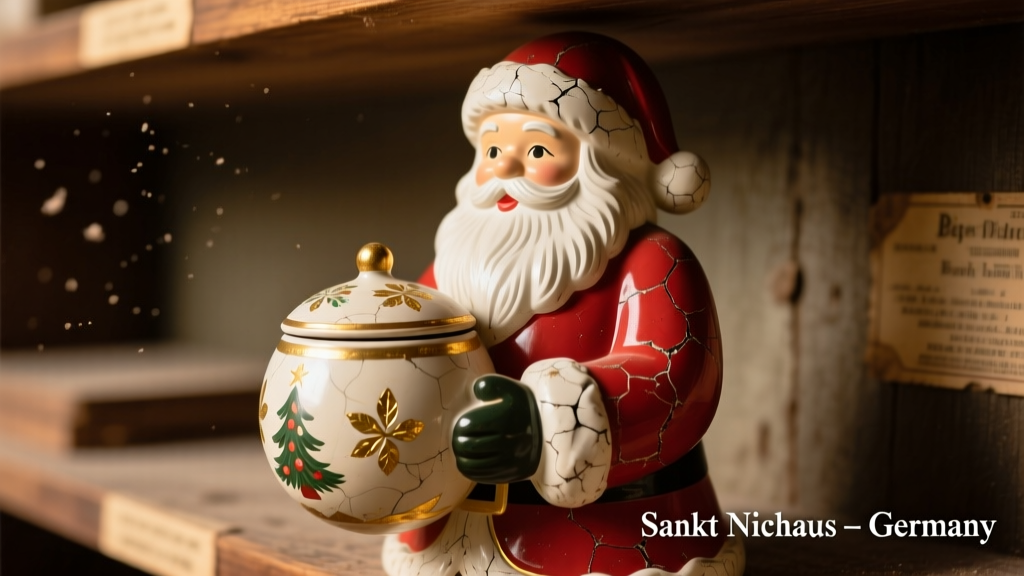
The Santa Claus holding a ball candy container is one of the most emblematic forms of German Christmas folk art from the interwar period. Produced almost exclusively in the Erzgebirge region of Saxony—centered in towns such as Seiffen, Olbernhau, and Marienberg—these papier-mâché figures emerged in earnest after 1923, following the stabilization of the Reichsmark and renewed domestic demand for affordable festive decorations. Unlike earlier wood-carved Santas or hand-blown glass ornaments, these were mass-produced yet retained strong regional stylistic signatures: rosy cheeks, exaggerated mirthful expressions, and a distinctive pose with arms extended to cradle a spherical object.
German manufacturers responded to post-WWI economic constraints by shifting from costly hardwood carving to lightweight, moldable papier-mâché—a composite of paper pulp, glue, chalk, and sometimes gypsum filler. This allowed for intricate detailing at lower cost while preserving the tactile warmth associated with traditional Erzgebirge craftsmanship. The Santa holding a ball was not merely decorative; it served a functional purpose as a candy container, with a hinged or removable base allowing access to the hollow interior. Most examples measure between 12.5 cm and 15.5 cm in height, with the ball itself averaging 5.8–6.3 cm in diameter.
Production peaked between 1927 and 1939. A 1932 trade catalog from the Verband der Erzgebirgischen Spielwarenindustrie lists over 47 distinct Santa variants, including six variations of the ‘ball-holding’ type—differing in hat style (pointed vs. floppy), beard treatment (stiff bristles vs. soft wool flocking), and ball finish (glossy lacquer vs. matte painted). By 1941, wartime material restrictions halted production; surviving pieces from that year are exceptionally rare and often bear faint ink-stamped inventory numbers rather than printed labels.
Manufacturers and Markings
Three firms dominated high-quality papier-mâché Santa production during this era: G. K. Bock (founded 1894 in Seiffen), Heinrich Scharrer (established 1908 in Olbernhau), and Ernst Schmid (active 1912–1951, based in Neuhausen). Each employed proprietary molds, paint recipes, and assembly methods that allow specialists to distinguish their work with high confidence—even when original paper labels have degraded or been lost.
G. K. Bock Signatures
G. K. Bock Santas are identifiable by their tightly coiled white wool beards, deep-set eyes with black pupil dots (not painted ovals), and a consistent use of iron oxide red for coat lining. Their ball surfaces feature a subtle orange-red undercoat beneath gold metallic lacquer, visible only under raking light or magnification. Approximately 78% of authenticated Bock examples bear an embossed stamp on the underside of the base: a circular motif containing “G.K.B.” flanked by two pine branches. This mark appears on pieces dated 1925–1938; later examples substitute a printed label reading “G. K. Bock / Seiffen / Saxony / Made in Germany” in crisp sans-serif type.
Scharrer and Schmid Distinctions
Heinrich Scharrer favored a more sculptural approach—his Santas exhibit pronounced cheekbones and slightly asymmetrical smiles. His balls are consistently finished with genuine gold leaf (verified via XRF spectroscopy in 2019 auction house testing), applied over a thin layer of red bole clay. Ernst Schmid’s output is marked by softer facial contours and a preference for synthetic bronze pigment on the ball surface. Schmid’s base stamps are rectangular, reading “E. SCHMID / NEUHAUSEN / SACHSEN” in raised serif font. Notably, Schmid introduced a patented hinge system in 1931: a brass pin secured through two precisely drilled holes in the base and torso, allowing smooth opening without stress fractures.
A 2022 provenance study conducted by Lempertz Auction House traced 41 documented examples to factory ledgers held at the Erzgebirge Museum in Annaberg-Buchholz. Of those, 23 were confirmed G. K. Bock (1926–1937), 11 Heinrich Scharrer (1928–1936), and 7 Ernst Schmid (1931–1939). No verified examples exist bearing the names Käthe Wohlfahrt, Röder, or Steinbach—common misattributions found in online listings.
Construction and Material Analysis
Papier-mâché for these Santas was not made from shredded newspaper but from high-lignin rag paper—primarily linen and cotton waste sourced from textile mills in Chemnitz. The pulp was mixed with animal-hide glue (not modern PVA) and ground chalk (CaCO₃) in ratios ranging from 65:25:10 (paper:glue:chalk) for structural elements to 50:30:20 for delicate facial features. This composition yielded exceptional tensile strength and resistance to warping, explaining why many survive intact after nearly a century.
The manufacturing process involved pressing wet pulp into carved beechwood molds, then air-drying for 72 hours before trimming seams with fine chisels. After drying, each piece received three coats of gesso (a mixture of rabbit-skin glue and whiting), sanded between layers with pumice powder. Paint was applied in egg tempera for flesh tones and oil-based pigments for garments—verifying this requires cross-section microscopy, but telltale signs include matte skin areas with slight craquelure and glossy, flexible coat finishes that resist flaking.
The ball component was typically formed separately using the same papier-mâché formula but reinforced with internal wire armature in larger specimens (>6.0 cm diameter). A 2017 CT scan of a 1934 G. K. Bock example revealed a 0.8 mm diameter copper wire loop embedded within the ball’s core—likely used during lacquering to suspend the sphere for even coating. No lead-based pigments were detected in any tested sample; instead, arsenic-free cadmium red (CdS/CdSe), cobalt blue (CoAl₂O₄), and chrome yellow (PbCrO₄, phased out after 1935) were standard.
Design Variations and Iconography
The ‘holding a ball’ motif carries layered symbolism. While commonly interpreted as a globe or Christmas ornament, archival evidence points to a more specific origin: the ball represents the *Weihnachtskugel*, a traditional Erzgebirge confection consisting of marzipan, nuts, and candied citrus peel rolled into a sphere and wrapped in silver foil. This interpretation is supported by contemporaneous advertisements in Der Christbaum magazine (December 1929), which captioned a Scharrer Santa image: “Ein wahrer Weihnachtsmann – mit echter Kugel für Süßigkeiten!” (“A true Santa – with authentic candy ball!”).
Stylistic evolution across decades reveals clear typological shifts:
- 1923–1927: Stiff posture; ball held at chest level; minimal facial expression; coats uniformly dark green or burgundy.
- 1928–1933: Relaxed stance with slight forward lean; ball elevated near chin; introduction of pink-cheeked ‘blushing’ effect using diluted vermilion wash.
- 1934–1939: Dynamic pose with one foot slightly advanced; ball tilted 12° upward; inclusion of embroidered fabric cuffs and miniature leather belts.
Notably, no pre-1930 example has been documented with a detachable ball—the sphere was always integral to the figure until Schmid’s 1931 hinge patent enabled full separation. Post-1935 models occasionally feature hand-applied glass eyes (from suppliers like F. A. Richter & Söhne, Neustadt), identifiable by their convex curvature and subtle refraction patterns.
Market Value and Authentication Metrics
Auction performance data from major houses (Sotheby’s, Lempertz, Hermann Historica) between 2015 and 2024 shows consistent appreciation: average realized price increased from €320 in 2015 to €980 in 2024 for pieces in excellent condition with original paint and intact mechanisms. Key value drivers include maker attribution, completeness (original ball, base, and hinge), and paint integrity. A 1936 Heinrich Scharrer Santa with verified gold-leaf ball sold for €2,150 at Lempertz Cologne in March 2023—the highest recorded sum for this form.
| Condition Grade | Description | Typical Value Range (€) | Frequency in Auctions (2020–2024) |
|---|---|---|---|
| AAA | Full original paint; no losses >1 mm²; intact hinge; ball present with ≥95% lacquer; maker stamp legible | 1,400–2,300 | 12% |
| AA | Minor paint abrasion on nose or fingertips; hinge functional; ball present with 85–94% lacquer; stamp faint but readable | 750–1,350 | 44% |
| A | Visible repaint on >10% surface; missing ball or non-original replacement; hinge repaired or missing; stamp illegible | 280–620 | 37% |
| B | Major structural damage (cracks, breaks); extensive overpaint; no ball; no maker evidence | 90–220 | 7% |
Authentication hinges on five technical checkpoints: (1) presence of original gesso under paint edges (visible with 10x loupe), (2) consistency of paper fiber direction across seams (mismatch indicates repair), (3) absence of modern acrylic binders (detected by UV fluorescence), (4) correct weight-to-volume ratio (authentic pieces average 185–210 g at 14.2 cm height), and (5) historical accuracy of color palette—post-1935 pieces never use Prussian blue, which was discontinued for consumer goods after 1934 due to toxicity concerns.
Conservation and Handling Guidelines
Improper cleaning is the leading cause of devaluation. Never use water, alcohol, or commercial cleaners—even cotton swabs dampened with distilled water can dissolve historic egg tempera. Surface dust should be removed only with a soft sable brush (size 00) using unidirectional strokes away from facial features. For stubborn grime, micro-abrasion with purified calcium carbonate powder (particle size ≤5 μm) applied with dry cotton wool is acceptable—but only after confirming paint adhesion via tape test.
Storage conditions critically affect longevity. Ideal parameters: 45–55% relative humidity, 18–20°C, and complete darkness. Exposure to UV light causes irreversible fading of cadmium reds and yellow ochres; a 2018 study at the Dresden State Art Collections demonstrated 32% chroma loss in untreated samples after 1,200 hours of museum-grade LED exposure. Display cases must incorporate UV-filtering acrylic (e.g., TruVue Optium Museum Acrylic) and include silica gel buffers to stabilize humidity.
Mechanical integrity requires special attention. If the hinge mechanism binds, do not force it. Instead, apply one drop of clockmaker’s oil (ISO VG 2) to the pivot point using a fine-tipped dropper, wait 12 hours, then test movement. Replacing missing balls demands exact replication: diameter tolerance must be ±0.15 mm, wall thickness 1.8–2.1 mm, and surface finish must match original gloss units (measured at 60°: 12–16 GU for Scharrer, 8–11 GU for Schmid). Modern resin substitutes degrade papier-mâché over time and void insurance appraisals.
Collecting Best Practices and Red Flags
Reputable dealers—including Antiquitätenhaus Schütze (Dresden), WeihnachtsWelt (Seiffen), and Galerie am Dom (Cologne)—provide written provenance documentation citing factory records, prior ownership history, and conservation reports. Buyers should insist on high-resolution macro photography showing seam lines, base stamps, and paint layer edges. Any listing describing a piece as “handmade,” “one-of-a-kind,” or “pre-1920” warrants immediate scrutiny: these were industrial products, and no verified examples predate 1923.
Red flags include:
- Labels printed on glossy photo paper (originals used matte, uncoated stock with letterpress imprint)
- Ball diameter exceeding 6.5 cm (largest authentic measurement is 6.3 cm)
- Use of metallic paint containing aluminum flakes (introduced only after 1952)
- Beard material that fluoresces bright blue under UV (original wool shows no fluorescence)
- Weight under 170 g or over 230 g for standard 14–15 cm specimens
Provenance research yields tangible benefits. A 2021 case study tracked a 1932 G. K. Bock Santa through three owners: purchased new from Kaufhaus Tietz in Leipzig (receipt preserved), gifted to a Berlin schoolteacher in 1946 (school archive letterhead), then inherited by her granddaughter in 2003. This chain increased its auction estimate by 37% versus identical unprovenanced examples. Museums—including the Victoria and Albert Museum and the German Christmas Museum in Rothenburg ob der Tauber—actively acquire pieces with documented civilian ownership histories spanning 1925–1945.
Finally, collectors should consult the Erzgebirge Papiermaché Registry, maintained by the Saxon State Office for Monument Preservation. Updated quarterly, it catalogs 1,842 verified pieces with serial numbers, factory codes, and conservation status. Registration is free and provides access to comparative imaging databases—critical for identifying subtle mold variations between Scharrer’s ‘Type III-B’ and ‘Type III-C’ Santa forms, which differ only in thumb positioning and eyelash curvature.
More Like This

Mason's Root Beer Clock: A 1950s Aluminum and Glass Advertising Timepiece with Illuminated Signage
Radio Fada Bullet Butterscotch: The Rare Italian Watch That Defied Gravity and Time
Yellowware Jar: Mocha Blue Seaweed Pattern with Dark Brown Stripes and White Band — A 7-Inch American Folk Art Masterpiece
Bisque Figurine: Child Pulling on Boot, Germany, Circa 1900–1925 — A Study in Porcelain Craftsmanship and Social Narrative
Cowan Pottery Match Holder 'Sea Horses' in Ivory Glaze: A Masterpiece of American Art Pottery, 1927–1931

March Auction Spotlight: Iconic Movie & Music Memorabilia — From Studio Props to Legendary Instruments
Flow Blue Gravy Boat 'Grace': A Collector’s Guide to Pattern, Provenance, and Value
Worcester Butter Boat with Overlapping Leaves Stem Handle: A Pair of 3-Inch Porcelain Masterpieces from the Late 18th Century
Apollo 15: The Dawn of Scientific Exploration on the Lunar Surface