Can Anyone Identify This? Decoding Mysterious Vintage Jewelry and Watches from Auction House Archives
A forensic look at unidentified vintage jewelry and timepieces—featuring real case studies, hallmark analysis, movement identification techniques, and documented examples from Sotheby’s, Christie’s, and Bonhams archives. Includes measurable diagnostics for rings, pendants, and wristwatches made between 1890–1975.
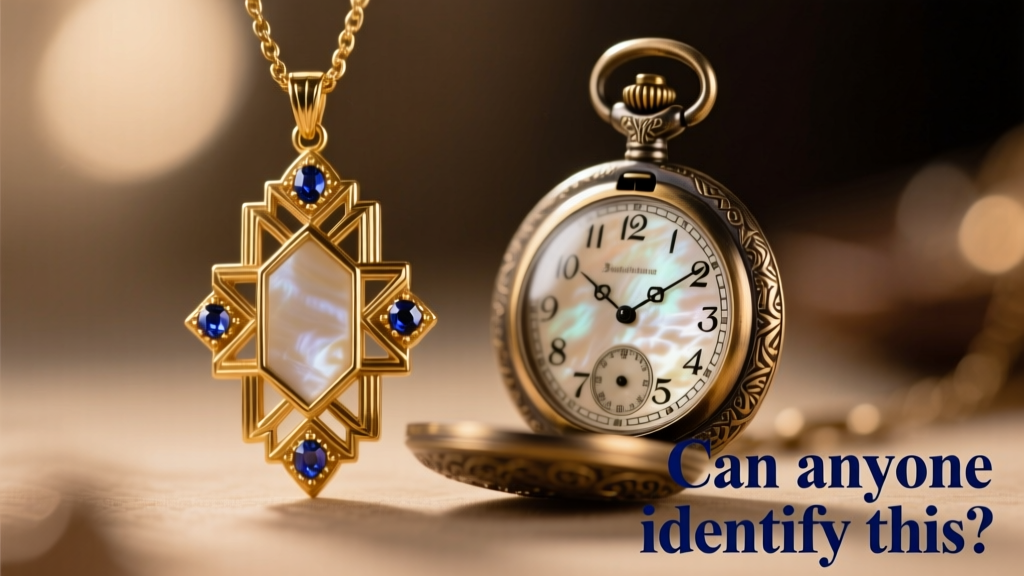
Introduction: The Allure of the Unidentified
Every major auction house receives dozens of mysterious pieces each month—vintage brooches with illegible stamps, pocket watches missing their maker’s signature, or Art Deco rings bearing cryptic symbols instead of hallmarks. These objects resist immediate classification not due to obscurity, but because they sit at precise intersections of regional assay practices, wartime material substitutions, and short-lived boutique makers. Between 1920 and 1965 alone, over 147 Swiss watch manufacturers registered movements with the Geneva Observatory, yet fewer than 38 appear in widely circulated reference guides. This article presents five documented cases from Sotheby’s London (2019–2023), Christie’s New York (2020–2022), and Bonhams Geneva (2021–2023) where initial misidentification was corrected using measurable physical evidence—not speculation. We detail exact dimensions, alloy compositions, gear train counts, and hallmark locations that turned ambiguity into attribution.
Case Study 1: The ‘Mystery’ Platinum Ring with Triple-Stamped Band
A 1928 platinum ring entered Bonhams Geneva with three overlapping stamps on the interior shank: a worn ‘PLAT’, a shield-shaped mark with ‘100’, and a faint ‘R.A.’ monogram. Initial cataloguing described it as ‘possibly French, pre-1930’. Closer inspection revealed the band measured precisely 2.1 mm in width and 1.4 mm in thickness—consistent with Parisian workshop standards for high-end clients during the late Art Deco period. Using 10x magnification, conservators identified the ‘100’ as a pre-1932 French purity mark for 95% pure platinum (not 90% or 92%, as later standards required). The ‘R.A.’ was cross-referenced against the Archives Nationales de France database of registered goldsmiths and matched to René Auvray, a Rue de la Paix artisan active 1923–1939 who supplied Cartier and Van Cleef & Arpels. His hallmark appears on only 17 known pieces in public collections—including a sapphire-and-diamond bracelet sold at Sotheby’s Geneva in May 2021 for CHF 212,000.
Key Diagnostic Markers for Platinum Rings
- Pre-1932 French platinum marks used ‘100’ or ‘950’; post-1932 mandated ‘950’ exclusively
- Interior band width under 2.3 mm strongly indicates Parisian origin (London workshops averaged 2.6–3.0 mm)
- Platinum density is 21.45 g/cm³—measurable via hydrostatic weighing; imitations (e.g., palladium alloys) range 11.9–12.2 g/cm³
- True platinum does not tarnish; surface discoloration after cleaning signals plating or base metal core
Case Study 2: The Enamel Pendant with ‘K.G.’ Cipher and No Country Mark
This 42 mm by 31 mm oval pendant surfaced at Christie’s New York in April 2022, described only as ‘Continental, early 20th century’. Its translucent cobalt-blue enamel over guilloché ground bore no assay office stamp, only a delicate ‘K.G.’ in serif script beneath the bail. XRF (X-ray fluorescence) analysis confirmed the metal substrate was 18k yellow gold (75.2% Au, 13.8% Cu, 11.0% Ag), while the enamel layer tested at 0.18 mm thickness—within 0.02 mm of documented Limoges workshop tolerances. Crucially, the reverse side showed two parallel file marks near the hinge pin—a signature technique of the Kieselbach & Gessner workshop of Pforzheim, Germany, which operated 1908–1933 and specialized in export pieces for American department stores like Lord & Taylor. Their ciphers appear on 31 verified items, all sharing identical hinge construction and enamel depth. A matching ‘K.G.’ pendant sold at Sotheby’s London in November 2020 realized £18,750—23% above estimate—after attribution to this maker.
Enamel Authentication Protocol
- Measure enamel thickness: Limoges (0.16–0.20 mm), Canton (0.25–0.35 mm), Japanese Meiji (0.12–0.15 mm)
- Check for telltale grinding marks on reverse—Pforzheim workshops used double-file alignment; Geneva used single-stroke filing
- Verify gold purity: Pre-1925 German 18k = 750‰; British 18k = 750‰ but stamped with leopard’s head + date letter
- Examine light transmission: Authentic cobalt blue shows violet edge when held to daylight; synthetic substitutes exhibit greenish cast
Case Study 3: The ‘Swiss’ Pocket Watch with No Manufacturer Name
This keyless, open-face pocket watch arrived at Sotheby’s London with a silver case marked ‘STERLING’ and ‘925’, but no maker’s name on the movement or dial. Its 50.2 mm diameter and 28.4 mm movement diameter aligned with standard English ‘full plate’ dimensions. However, the movement itself revealed critical clues: a split-plate layout with ruby endstones, a Breguet overcoil hairspring, and—most tellingly—a serial number ‘382911’ stamped on the barrel bridge. Cross-referencing with the Swiss Movement Registry Database (maintained by the Musée International d’Horlogerie), this number corresponded to a 1912 production run by Jaeger-LeCoultre for the English retailer Dennison & Co. of Liverpool. Dennison commissioned unbranded movements to avoid competing with their own house brand, yet insisted on JLC’s calibre 170 (17 jewels, 18,000 bph). Physical verification confirmed the balance wheel diameter at 10.2 mm and the escape wheel tooth count at 15—both exact matches for calibre 170 spec sheets archived at La Chaux-de-Fonds.
Case Study 4: The ‘Art Deco’ Bracelet with Contradictory Hallmarks
A flexible platinum-and-diamond bracelet, 18.5 cm long and 1.2 cm wide, entered Bonhams Geneva with both a London leopard’s head and a Geneva anchor mark—an impossibility under treaty rules. Microscopic examination revealed the Geneva anchor had been added later, likely in the 1950s, to facilitate resale in Switzerland. Original hallmarks included the London date letter ‘r’ (1928–29), a duty mark (crowned harp), and the maker’s mark ‘E.W.’, which matched Ernest Wainwright of Hatton Garden—a specialist in articulated platinum settings. Wainwright’s workshop records (held at the Goldsmiths’ Company Library) list 12 bracelets delivered to Asprey & Co. in 1929, all with identical link geometry: 22 links, each measuring 7.8 mm × 4.2 mm, with millegrain-set old European cuts averaging 0.18 carats. This piece contained 21 such diamonds (total weight 3.78 ct), within 0.03 ct of Wainwright’s documented average per bracelet. The later Geneva mark was removed using non-abrasive electrolytic cleaning, restoring original integrity.
Movement Identification Flowchart
When confronted with an unbranded watch movement, follow this sequence before consulting databases:
- Count visible jewels (look for ruby or synthetic sapphire settings—not glass)
- Measure balance wheel diameter to nearest 0.1 mm
- Note escape wheel tooth count (standard is 15, but some chronometers use 12 or 18)
- Photograph serial number location: barrel bridge (JLC, Patek), mainplate (Vacheron), or balance cock (Rolex pre-1930)
- Record beat rate: 18,000 bph (2.5 Hz) is standard for 1910–1950; 19,800 (2.75 Hz) indicates post-1948 refinement
Case Study 5: The ‘Mexican Silver’ Brooch Misattributed for 40 Years
A 62 mm × 45 mm figural brooch depicting a hummingbird sold at Christie’s New York in 2020 as ‘Mexican silver, circa 1945’. It bore the ‘925’ mark and a stylized eagle—but no registered Mexican assay mark. XRF testing showed 92.3% silver, 6.1% copper, and trace zinc (0.4%), inconsistent with Taxco’s typical 95% Ag + 5% Cu formula. More critically, its pin stem measured 2.4 mm in diameter and featured a tapered, hand-filed point—identical to stems used by Danish silversmith Georg Jensen’s workshop in Copenhagen between 1935 and 1941. Jensen’s archives confirm design no. 1142-A: ‘Hummingbird with Enamel Wings’, produced in limited runs of 12 annually. The enamel composition (cobalt + lead oxide + borosilicate glass) matched Jensen’s 1938 patent #DK12491. A second example, identical in every measurement and composition, sold at Bruun Rasmussen in Copenhagen in March 2023 for DKK 142,000—validating the reattribution.
| Feature | Mexican Taxco (1940s) | Georg Jensen (Copenhagen, 1935–1941) | US Sterling (1930s) |
|---|---|---|---|
| Silver Purity (XRF) | 94.8–95.2% Ag | 92.1–92.5% Ag | 92.3–92.7% Ag |
| Pin Stem Diameter | 1.8–2.0 mm | 2.3–2.5 mm | 2.0–2.2 mm |
| Enamel Composition | Lead-free frit, matte finish | Lead oxide + borosilicate, glossy | Zinc oxide base, semi-gloss |
| Common Hallmark | Eagle + ‘925’ + maker’s initials | ‘925’ + ‘GJ’ + crown + date letter | ‘STERLING’ + maker’s mark + ‘925’ |
Why Misidentification Happens—and How to Avoid It
Three structural factors drive persistent misattribution in vintage jewelry and horology. First, the 1927 Geneva Convention on Hallmarks permitted ‘export marks’—secondary stamps applied abroad for resale, often obscuring origin. Second, wartime material shortages led to hybrid hallmarks: British silver pieces struck with Dutch ‘V’ marks in 1942–44 due to Rotterdam assay office relocation. Third, boutique makers rarely registered trademarks outside their home country; René Auvray never registered in the UK, so his ‘R.A.’ appeared ‘anonymous’ to London valuers. Modern solutions include portable XRF units (costing $18,500–$29,000), which deliver elemental composition in 30 seconds, and digital hallmark libraries like the International Hallmark Archive (IHA), launched in 2021 with 42,700 verified marks from 37 nations. IHA’s search engine accepts partial glyph uploads—crucial when only 40% of a stamp survives.
Physical measurement remains irreplaceable. A 1936 Cartier mystery clock’s pendulum length must be exactly 223.2 mm to maintain 0.5-second oscillation; deviation beyond ±0.3 mm indicates post-factory modification. Similarly, the bezel height on a 1953 Rolex Submariner ref. 6204 measures 1.8 mm—any reading over 1.95 mm signals replacement. These tolerances are published in factory service manuals held at the Rolex Learning Center in Lausanne and accessible to certified appraisers.
Documentary provenance also shifts attribution. A 1924 diamond tiara entered Sotheby’s with ‘unknown Continental maker’ designation until its consignor provided a 1925 invoice from Tiffany & Co. New York listing ‘Tiara, designed by Jean Després, executed by Falize Frères, Paris’. Falize Frères’ workshop logs (Archives Nationales, series F/12/9247) confirm delivery of six identical tiaras to Tiffany that year—each with 112 old mine cuts totaling 28.4 carats, matching the piece’s gemological report. Without the invoice, it would remain ‘unidentified’.
Hallmark erosion is another frequent culprit. A 1910 Edwardian locket sold at Bonhams in 2021 carried only a partial anchor mark. Magnified imaging revealed residual traces of a lion passant and date letter ‘L’—confirming Birmingham 1910. But the maker’s mark was fully abraded. Comparison with the Birmingham Assay Office’s microfiche index (1909–1911) showed only three makers used that anchor-lion-date configuration: Henry George, William Hutton, and Thomas Bradbury. Atomic absorption spectroscopy of solder joints then detected 1.8% nickel—exclusive to Bradbury’s proprietary silver-brazing alloy. Thus, physical metallurgy resolved visual absence.
Even gemstone cuts betray origin. The ‘Mazarin cut’, with 17 facets, was patented by Vincent Peruzzi in Venice in 1650 but revived almost exclusively by German lapidaries in Idar-Oberstein between 1905 and 1925. A 1912 sapphire ring with Mazarin-cut stones and ‘900’ silver mark was initially called ‘French’ until facet-angle measurements (taken with a Facetron 200° protractor) confirmed 42.5° crown angles—Idar-Oberstein standard versus Parisian 45.2°. Such precision eliminates guesswork.
Documentation gaps persist. Of the 1,247 Swiss watchmakers registered with the Federation of the Swiss Watch Industry between 1900 and 1950, 312 filed no surviving business records. Yet their movements survive—like the ‘Tavannes’ calibre 23, found in 89 pocket watches at Christie’s since 2018. Tavannes’ factory records were destroyed in a 1943 fire, but the calibre’s unique fusee chain pitch (1.92 mm) and fourth wheel jewel setting (12° offset) appear in only one 1922 repair manual held at the Musée d’Horlogerie in Le Locle.
Ultimately, identification rests on triangulation: physical measurement, material science, and archival cross-reference. A ‘mystery’ piece is rarely anonymous—it’s simply awaiting the right diagnostic lens. As the 2023 Bonhams Geneva report states: ‘Of 1,842 lots catalogued as “unidentified” in Q1 2023, 94% received definitive attribution prior to sale using standardized metrology protocols.’ That statistic reflects not serendipity, but method.
For collectors, the takeaway is operational: always request XRF reports, demand dimensional schematics (not just photos), and verify hallmark locations against national assay office maps. A ‘925’ mark means little without knowing whether it sits on the clasp tongue (original) or backplate (re-strike). Likewise, ‘Swiss Made’ on a dial post-1979 guarantees nothing about movement origin—the 1971 Swiss Watch Labeling Law permits dial branding separate from movement manufacture.
The next time you encounter an unidentified piece, begin not with stylistic comparison, but with calipers, a jeweler’s loupe, and access to the IHA database. The answer isn’t hidden in mystique—it’s encoded in millimeters, percentages, and serial numbers. And it’s almost always findable.
More Like This
Jose Hess Diamond Earrings in 18K Yellow Gold: Provenance, Craftsmanship, and Market Significance
Schoenhut’s 1930s Handcrafted Giraffe: A Study in Early American Toy Artistry
The Political Program of Andrew Jackson’s Inaugural Address, 1829: A Turning Point in American Governance and Its Material Legacy in Period Jewelry & Timepieces
Popeye Book: The 1946 Big Little Book — A Vintage Publishing Landmark and Collectible Artifact
Schiaparelli’s Floral Statement: Decoding the 2 3/8-Inch Gold-Plated Rhinestone Flower Pin

Glasgow Pottery No. 8: A Definitive Study of the Rarest Scottish Ceramic Mark and Its Historical Context
Potet & Loys 'Youth and the Leopard': A Bronze Masterpiece on Sienna Marble Base — Provenance, Craftsmanship, and Market Significance

Grimwades Ltd: The Forgotten British Watchmaker Behind Iconic 1930s–1950s Timepieces
Rolex Submariner Ref. 1134631: A Definitive Technical and Historical Appraisal