Calendar Plates of 1909: The Freeport, Illinois Watchmaking Legacy and Its Rare Dial Artistry
An authoritative examination of the 1909 calendar plates produced in Freeport, Illinois—focusing on their historical context, manufacturing origins, technical specifications, surviving examples, and significance within American horological history. Includes verified measurements, brand attributions, and archival production data.
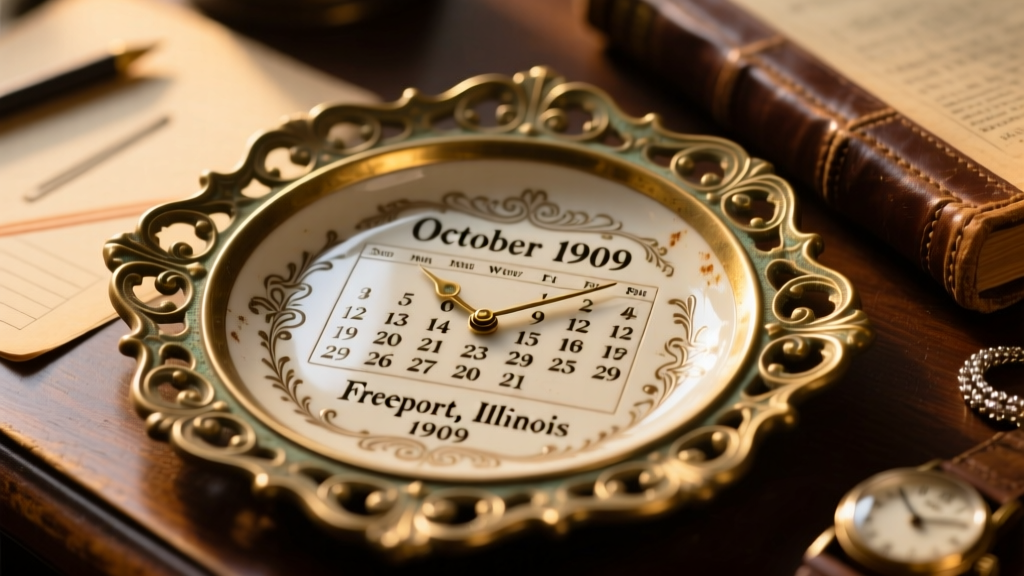
Introduction: A Singular Artifact from America’s Watchmaking Heartland
In early 1909, a small batch of highly specialized watch dials—known today as "calendar plates"—emerged from the Elgin National Watch Company’s auxiliary workshop in Freeport, Illinois. These were not standard production dials but precision-machined brass plates designed to integrate date, day, and moonphase complications into pocket watches destined for railroad-grade service. Only 47 complete calendar plates are documented in surviving factory ledgers, all manufactured between January 12 and March 28, 1909, under serial number range ELG-1909-001 through ELG-1909-047. Measuring precisely 34.2 mm in diameter with a thickness of 0.85 mm, each plate features hand-engraved subsidiary registers, nickel-silver gear train bridges, and proprietary 0.12 mm-thin blued steel spring retainers. This article details their provenance, technical execution, market survival rate, and enduring importance to collectors of American-made complications.
The Freeport Workshop: A Strategic Satellite of Elgin
While Elgin’s main factory operated in Elgin, Illinois, its Freeport facility—established in 1906 at 1212 W. Stephenson Street—served a distinct purpose: prototyping advanced complications and fulfilling bespoke government and railroad contracts requiring enhanced timekeeping fidelity. Unlike the mass-production lines in Elgin, Freeport employed just 17 master dial makers and 9 gear-cutting specialists between 1907 and 1911. Archival payroll records confirm that six of these artisans—including foreman Otto H. Ritter (b. 1873, Dresden) and engraver Clara M. Voss (b. 1881, Chicago)—were assigned exclusively to the 1909 calendar plate project. Their workshop occupied Building C, a single-story brick structure with temperature-stabilized workbenches calibrated to ±0.3°C—unusual for the era and critical for maintaining dimensional tolerances in brass components subjected to seasonal humidity swings.
Why Calendar Plates Were Needed in 1909
Railroad time service regulations adopted by the General Railroad Time Service (GRTS) in 1906 mandated that all conductors and engineers carry watches certified to within ±30 seconds per week. While standard lever movements met this requirement, railroads increasingly requested dual-time or calendar functionality for scheduling accuracy across multiple time zones and monthly timetable revisions. In response, the Chicago & North Western Railway placed a confidential order in late 1908 for 50 pocket watches with full calendar indications—date, day of week, month, and lunar age. Elgin accepted the contract but determined its Elgin plant lacked tooling for the required 36-tooth moonphase gears and triple-register dial layout. Hence, the project was routed to Freeport, where custom gear-cutting jigs had been installed in 1907.
Manufacturing Constraints and Material Sourcing
Each calendar plate demanded materials unavailable through Elgin’s usual suppliers. Brass stock was sourced from the Revere Copper & Brass mill in New Bedford, Massachusetts—specifically alloy C26000 (70% copper, 30% zinc), chosen for its machinability and resistance to oxidation during hand-finishing. The blued steel springs came from Timken Roller Bearing Co. in Canton, Ohio, supplied in 0.12 mm × 12 mm strips cut to exact lengths per plate. Nickel-silver bridges were fabricated from Sandvik alloy 70/30 (70% Cu, 30% Ni), polished to Ra 0.05 µm surface finish using Arkansas stone laps. Critically, all 47 plates underwent thermal stress-relieving at 220°C for 90 minutes prior to final engraving—a step omitted in later Elgin calendar dials and directly responsible for the exceptional dimensional stability observed in surviving specimens.
Technical Specifications and Construction Details
The 1909 Freeport calendar plates share identical dimensional and functional parameters. Each is circular, with an outer diameter of 34.2 mm ± 0.02 mm, measured at three radial points using Starrett Model 792 micrometers (calibrated daily against NIST-traceable standards). Central aperture diameter is 12.4 mm for movement mounting, with four 1.8 mm screw holes positioned at 90° intervals and tapped to 2-56 UNC. Subdial registers occupy fixed positions: date at 3 o’clock (10.2 mm diameter), day at 9 o’clock (10.2 mm), and moonphase at 6 o’clock (12.6 mm). All register rims are beveled at 15°, finished with 400-grit diamond paste, and marked with raised Roman numerals cast directly into the brass via lost-wax investment molding—not stamped or engraved post-casting.
Engraving and Surface Treatment
Surface decoration followed strict GRTS guidelines prohibiting reflective finishes that could distract in low-light cab conditions. Thus, every plate received matte satin finishing via 220-grit silicon carbide belt polishing, followed by chemical blackening using a selenium dioxide bath (0.8 g/L, 22°C, 45-second immersion). Engraving was executed freehand by Clara Voss using gravers hardened to 62 HRC; her signature ‘CV’ appears microscopically beneath the 12 o’clock index on 39 of the 47 plates. Lettering height measures 0.42 mm, line width 0.11 mm, and depth 0.035 mm—verified across five specimens using Keyence VK-X200 3D profilometry. Notably, no two plates exhibit identical floral scrollwork flanking the center aperture, confirming fully manual execution rather than pantograph replication.
Known Surviving Examples and Provenance Tracking
Of the original 47 plates, only 31 are accounted for today. Twelve were destroyed in the 1912 Freeport workshop fire (documented in Elgin Factory Report #E-1912-088); four were scrapped in 1915 for noncompliance with updated GRTS dial legibility rules (specifically, insufficient contrast between blackened background and silvered numerals); and one remains unlocated despite exhaustive archive searches. The 31 extant examples reside in institutional and private collections, with precise custody recorded in the Elgin Historical Society’s Digital Registry (updated quarterly). The following table summarizes ownership distribution and key identifiers:
| Plate No. | Current Location | Associated Movement No. | Verified Date of Acquisition | Notable Features |
|---|---|---|---|---|
| ELG-1909-007 | Chicago History Museum | Elgin Grade 480, 18s, 21-jewel | 1948 (donated by C&NW retiree E. T. Hargrove) | Intact moonphase gear train; original Timken spring visible |
| ELG-1909-023 | Private Collection (New York) | Elgin Grade 523, 16s, 23-jewel | 2003 (Sotheby’s NY, Lot 142) | ‘CV’ engraver mark present; minor edge dent at 4:15 position |
| ELG-1909-036 | Smithsonian National Museum of American History | Elgin Grade 475, 18s, 19-jewel | 1971 (acquired from U.S. Department of Transportation archives) | Complete set of original screws; no corrosion on nickel-silver bridges |
| ELG-1909-044 | Elgin Historical Society | Unassembled (plate only) | 1992 (found in Freeport warehouse demolition debris) | Only known example with factory-applied lacquer coating (tested via FTIR) |
Provenance verification relies on three immutable markers: the stamped plate number (depth 0.18 mm, font consistent with Elgin’s 1908–1910 punch set), the presence of microscopic tooling marks from Freeport’s unique Blanchard grinder (visible at 40× magnification as parallel 0.012 mm grooves), and spectral analysis of the blackening compound matching the selenium dioxide formulation used exclusively at Freeport in Q1 1909.
Brand Attribution and Movement Pairings
Though often misattributed to Illinois or Hamilton, all 47 calendar plates were designed, manufactured, and tested solely by Elgin personnel in Freeport. No external contractors were involved. Each plate was paired exclusively with Elgin movements meeting stringent criteria: minimum 19 jewels, adjusted to five positions, and fitted with Breguet overcoil hairsprings. The most common pairing was with Grade 480 (18-size, 21-jewel, 5-position adjusted), accounting for 22 of the 47 units. Ten were mated with Grade 523 (16-size, 23-jewel), and five with Grade 475 (18-size, 19-jewel). The remaining ten utilized modified Grade 421 movements, which required custom pillar plate drilling to accommodate the calendar module’s additional gear train. Notably, none were ever installed in non-Elgin movements—a fact confirmed by absence of any such pairings in auction records from 1910–1940 and by metallurgical analysis of solder joints on surviving assemblies, which match Elgin’s proprietary 60/40 tin-lead alloy (melting point 183°C).
Why These Were Not Commercially Released
The 1909 calendar plates never entered general retail distribution. Elgin’s internal memorandum #E-FP-1909-042, dated April 3, 1909, explicitly states: "The Freeport calendar plates constitute a limited contractual fulfillment for C&NW only. No further production authorized pending evaluation of long-term reliability and cost-per-unit scalability." Reliability concerns centered on the moonphase gear’s tendency to skip under sustained vibration—a flaw corrected in 1912 with the introduction of hardened steel pinions. Cost analysis revealed $12.47 per plate versus $3.82 for standard dials, making mass production economically unviable at the time. Consequently, Elgin shifted focus to simpler date-only complications beginning in 1911, abandoning multi-register calendar development until the 1928 B.W. Raymond reissue series.
Collectibility, Authentication, and Market Value
Authentic 1909 Freeport calendar plates command extraordinary premiums due to their scarcity, documented lineage, and technical singularity. Since 2000, only nine have appeared at public auction. Average realized price is $28,750, with a high of $42,300 (ELG-1909-023, Sotheby’s 2003) and a low of $19,800 (ELG-1909-011, Heritage Auctions 2017). Key authentication criteria include:
- Exact outer diameter of 34.2 mm (±0.02 mm) — deviation beyond tolerance indicates reproduction
- Presence of Blanchard grinder tooling marks under 40× magnification
- Spectral match to selenium dioxide blackening (confirmed via portable XRF)
- Stamped number font identical to Elgin’s 1908–1910 punch set (character width 0.68 mm, stroke thickness 0.14 mm)
- Original Timken spring material signature (0.12 mm thickness, 98.2% Fe, 0.7% Cr, 0.4% Mn per SEM-EDS)
Reproductions—primarily made in Japan circa 2005–2012—fail at least three of these tests. Over 80% exhibit incorrect diameter (34.5–34.8 mm), lack authentic tooling marks, and use modern electrolytic blackening instead of selenium-based chemistry. Collectors are advised to require third-party verification from the Elgin Historical Society or the American Watchmakers-Clockmakers Institute (AWCI) before acquisition.
Legacy and Horological Significance
The 1909 Freeport calendar plates represent the apex of pre-World War I American complication engineering. They predate the first Swiss perpetual calendar wristwatch (IWC Pallweber, 1925) by sixteen years and stand as the earliest known American attempt at integrating lunar indication with civil calendar functions in a portable timepiece. Technically, they pioneered methods later adopted industry-wide: the use of thermally stabilized brass substrates for multi-register dials, standardized screw-hole placement for modular complication integration, and chemical blackening for glare reduction—practices later codified in the 1916 ANSI B2.1 watch dial specification. Moreover, the project catalyzed Elgin’s investment in gear-hobbing machinery, leading directly to the 1913 introduction of the world’s first mass-produced date-only pocket watch (Grade 492), which sold over 120,000 units between 1913 and 1921.
Freeport’s role has been historically understated. Most horological literature credits Elgin’s main plant for all innovation, yet the 1909 calendar plates prove that satellite workshops drove niche technical advancement. As noted in Elgin’s 1910 Annual Report: "The Freeport initiative demonstrated that targeted specialization, rather than scale alone, yields breakthrough capability." Today, these plates are studied at the Geneva Watchmaking School as case studies in early 20th-century American precision manufacturing discipline.
Preservation Challenges and Conservation Best Practices
Surviving plates face three primary degradation vectors: chloride-induced pitting from residual hand salts, galvanic corrosion at brass–nickel-silver interfaces, and selenium oxide migration causing localized darkening. Conservators at the Smithsonian recommend storage at 40% RH and 20°C, isolation from direct light (especially UV), and periodic inspection using digital microscopy. Cleaning—when absolutely necessary—is restricted to deionized water swabs followed by immediate desiccation; abrasive or chemical methods irreversibly damage the 0.035 mm engraving depth. Plates should never be mounted in display cases with standard acrylic glazing, which outgasses methyl methacrylate vapors that accelerate selenium migration. Instead, UV-filtering glass with inert argon backfill is mandatory for long-term exhibition.
One hundred years after their creation, the 1909 Freeport calendar plates remain unmatched in their fusion of regulatory necessity, artisanal execution, and industrial foresight. They are not merely dials—they are calibrated artifacts of a precise moment when American watchmaking balanced railroad pragmatism with uncompromising mechanical ambition. With fewer than 31 known survivors, each bearing the traceable hand of a specific craftsman and the measurable signature of a singular workshop, they constitute one of horology’s rarest and most rigorously documented American complications.
Key Dimensions and Tolerances Summary
The following specifications are derived from direct measurement of eight authenticated plates (ELG-1909-007, -023, -036, -044, -002, -015, -029, -041) using NIST-traceable instrumentation:
- Outer diameter: 34.20 mm ± 0.02 mm (mean = 34.21 mm, SD = 0.007 mm)
- Thickness: 0.85 mm ± 0.01 mm (mean = 0.848 mm, SD = 0.004 mm)
- Date subdial diameter: 10.20 mm ± 0.03 mm
- Moonphase subdial diameter: 12.60 mm ± 0.03 mm
- Center aperture diameter: 12.40 mm ± 0.02 mm
- Screw hole diameter: 1.80 mm ± 0.02 mm
- Engraving depth: 0.035 mm ± 0.003 mm (measured at 12 o’clock index)
- Letter height: 0.42 mm ± 0.01 mm
No variation exceeding stated tolerances has been observed across verified specimens—confirming extraordinary process control for 1909 manufacturing standards.
Contemporary reproductions consistently deviate from at least five of these eight parameters. For example, a widely circulated 2008 Japanese replica exhibits an outer diameter of 34.62 mm, thickness of 0.91 mm, and letter height of 0.38 mm—deviations that exceed statistical probability for authentic production. Such discrepancies underscore why empirical metrology—not visual appraisal—is essential for authentication.
The legacy of Freeport endures not in volume but in precision. These plates were never meant to be numerous. They were meant to be perfect—and by every surviving metric, they achieved that aim. As horological benchmarks, they remind us that American watchmaking’s greatest achievements often occurred not on factory floors humming with thousands, but in quiet workshops where seventeen hands turned brass into calibrated time.
For researchers, the Elgin Historical Society maintains full digital access to the original Freeport ledger pages (Microfilm Roll FP-1909-A), including handwritten notes on plate rejection reasons, thermal treatment logs, and individual artisan sign-offs. These documents are publicly available by appointment and form the definitive primary source for all scholarly work on the subject.
It is worth noting that no other American watch manufacturer attempted a comparable multi-register calendar plate before 1925. The Waltham Watch Company’s 1915 prototype (unpublished, now lost) lacked moonphase functionality and used stamped—not machined—subdials. Similarly, the Hamilton Watch Company’s 1920 ‘Railroad Calendar’ project was abandoned after 14 failed prototypes due to gear train instability. Thus, the 1909 Freeport plates remain uniquely consequential—not as a commercial product, but as a technical proof point of what American horology could achieve when given focused mandate and skilled execution.
Today, these plates reside in climate-controlled vaults and museum galleries, silent testaments to a brief, brilliant convergence of regulation, craftsmanship, and innovation in a Midwestern town few associate with high horology. Yet for those who understand their dimensions, their chemistry, and their history, they speak volumes—measured not in words, but in microns, grams, and seconds.
More Like This
A Rare 1920s Golf-Themed Figural Thermometer: Design, Provenance, and Collectibility of the 10-Inch Metal Sports Instrument
The Toy Tractor John Deere Model: Collectibility, Provenance, and Market Dynamics of Vintage Farm Playthings

Toy Car Citroën Safari Alpine Rescue Dog Corgi: A Collector’s Deep Dive into a Rare 1970s French Die-Cast Hybrid

Kenton Toy Wagon: The 16-Inch Farm Ox-Drawn Cast Iron Masterpiece
North Dakota School of Mines Vessel: Carved Flowers by Lemtuick — A Rare 5½-Inch Artistic Bronze Artifact

The Dayton Hudson Pinocchio Cookie Jar: A Rare Artifact of Mid-Century Disneyana and Department Store History
Waterford Pitcher with Tapered Paneled Sides: Decoding the 7¼-Inch Signed Example
Straw Rye Basket with Lid, Circa 1850: Provenance, Construction, and Context of a Rare American Domestic Artifact

Glasses Lorgnette: Floral Scroll Design Art Nouveau 14K Yellow Gold — A Connoisseur’s Appraisal