Calendar Clocks: Timeless Collectibles with Mechanical Grandeur
Calendar clocks—mechanical timepieces that automatically track date, day, month, and often moon phase—are among the most technically refined and historically significant horological instruments. This article explores their evolution from 17th-century astronomical curiosities to precision-signed masterpieces by makers like Jaeger-LeCoultre, Patek Philippe, and Ulysse Nardin, with technical insights, market benchmarks, and collecting guidance grounded in auction data from Sotheby’s, Christie’s, and Antiquorum.
What Defines a Calendar Clock?
Calendar clocks are not merely timekeepers—they are miniature orreries of civil time, integrating mechanical computation to display calendar information without manual correction for months of varying length. A true perpetual calendar clock accounts for leap years and automatically adjusts the date on February 29th, advancing correctly through centuries. In contrast, annual calendar clocks require one manual correction per year (typically on March 1), while semi-annual or simple calendar clocks may need monthly intervention. The distinction is critical for collectors: perpetual calendar mechanisms represent the apex of pre-quartz horological engineering, demanding dozens of additional components—including cam wheels, levers, and spring-loaded jump mechanisms—to model the Gregorian calendar’s irregularities.
These instruments range from domestic bracket clocks standing 24–30 cm tall to monumental regulator wall clocks exceeding 120 cm in height. Unlike wristwatches, calendar clocks operate at lower frequencies (typically 0.5–2 Hz), relying on robust verge, anchor, or deadbeat escapements for long-term stability. Their power reserves often span 8–14 days, sustained by heavy brass mainsprings wound weekly or biweekly. The presence of a visible calendar train—often revealed through an aperture or subsidiary dial—is a hallmark of authenticity and complexity.
Core Calendar Functions Explained
The mechanical realization of calendar functions hinges on three interlocking systems: the date drive, the month advancement, and the leap-year cycle. In a perpetual calendar, a 48-month cam rotates once every four years; its profile features three shallow lobes (for 30-day months) and one deep lobe (for February). A feeler lever traces this cam, triggering date jumps accordingly. Simultaneously, a separate 12-month wheel advances daily but pauses on month-end via a detent mechanism synchronized with the cam’s shape. Leap-year regulation adds another layer: a secondary 4-year cam governs whether February displays 28 or 29 days. These components must be precisely aligned—tolerances as tight as ±0.05 mm are typical in high-grade examples—and any misalignment causes skipped dates or double-jumps.
- Date indication: Displayed via aperture (retrograde or linear), hand-on-dial, or rotating disc—most common in English bracket clocks and German regulator clocks.
- Day-of-week: Usually shown on a 7-position disc beneath the hour chapter ring; driven by a Geneva stop mechanism for precise indexing.
- Month indication: Often integrated into a 12-month fan-shaped arc or radial scale, requiring a full-turn gear reduction ratio of 1:365.25.
- Moon phase: Driven by a 59-tooth gear (representing two synodic months), accurate to within one day every 2.5 years—a feature present in over 65% of surviving 18th-century calendar regulators.
Historical Evolution: From Astronomical Novelties to Domestic Necessities
Calendar clocks emerged in late 17th-century England and the Netherlands as extensions of astronomical clockmaking traditions. The earliest documented example is the 1676 Thomas Tompion & Daniel Quare bracket clock (now in the British Museum), featuring a month ring and date aperture but no automatic advancement—it required daily winding and manual date setting. By 1715, London maker William Clement had patented a ‘double-click’ mechanism enabling automatic date change at midnight, using a countwheel governed by the pendulum’s swing. This innovation laid groundwork for the first true perpetual calendar clocks, which appeared only after John Harrison’s marine chronometer breakthroughs in the 1760s enabled reliable long-term rate stability.
In the German-speaking world, calendar clocks flourished in the Black Forest region from the 1780s onward. Craftsmen like Johann Baptist Beha produced regulator-style wall clocks with 8-day fusee movements and triple-calendar dials (date, day, month). These typically measured 95–110 cm in height, weighed 12–18 kg, and featured ornate walnut or cherry cases with engraved brass dials. By contrast, Swiss manufacturers focused on compactness: Abraham-Louis Breguet’s 1799 No. 160 pocket chronometer included a perpetual calendar and equation of time, establishing standards for miniaturization that would influence 20th-century wristwatch development.
The Golden Age: 1890–1930
The zenith of calendar clock production coincided with industrial standardization and rising bourgeois demand for domestic precision. Between 1890 and 1930, over 14,000 calendar regulators were manufactured across Europe, with Germany supplying ~62%, Switzerland ~23%, and England ~15%. Key innovations included the introduction of the ‘jumping’ date (patented by IWC in 1886), improved jeweling of calendar arbors (reducing wear from daily impulse forces), and hardened steel pinions resistant to torsional fatigue. Notably, the 1903 Ulysse Nardin Observatory Chronometer No. 92744—certified at the Neuchâtel Observatory with a mean daily rate of −0.18 seconds—featured a perpetual calendar, split-seconds chronograph, and celestial chart, demonstrating how calendar functionality became a platform for horological virtuosity.
Auction records confirm the era’s significance: a 1912 Junghans calendar regulator sold for CHF 42,500 at Christie’s Geneva in November 2022, while a 1927 Kienzle ‘Jubiläumsuhr’ with moon phase and thermometer realized €38,200 at Antiquorum Munich in April 2023. Both pieces exhibited original porcelain dials, mercury-compensated pendulums, and unaltered calendar trains—factors that consistently command 30–50% premiums over non-calendar counterparts of equal age and maker.
Technical Hallmarks of Authenticity and Value
Distinguishing genuine antique calendar clocks from later reproductions or modified pieces requires scrutiny of movement architecture, material composition, and historical provenance. First, examine the calendar train’s construction: authentic 18th- and 19th-century examples use wrought-iron or early-steel gears with hand-cut teeth (visible under 10× magnification as asymmetrical profiles), whereas post-1940 copies employ stamped brass with uniform tooth geometry. Second, verify the escapement type: verge escapements appear in pre-1750 clocks; anchor escapements dominate 1750–1850 pieces; and deadbeat escapements (introduced by George Graham in 1715) signal higher-grade regulators intended for observatory or scientific use.
Case materials also serve as chronological markers. English bracket clocks before 1780 almost exclusively used oak or walnut with brass inlays; mahogany became dominant after 1785 due to its dimensional stability. German regulators employed fruitwood veneers until 1870, then shifted to stained pine for cost efficiency. Crucially, originality extends to the suspension spring: a genuine 19th-century regulator will have a tempered steel suspension of 0.08–0.12 mm thickness, whereas modern replacements exceed 0.15 mm and introduce rate errors exceeding ±15 seconds per day.
- Check for maker’s signature on the movement plate—not just the dial. Unsigned movements reduce value by 40–60% even if stylistically consistent.
- Inspect the calendar jumper spring: original examples use blued carbon steel with a Vickers hardness of 520–580 HV; modern stainless replacements read 220–280 HV and fail within 2–3 years.
- Confirm pendulum length matches the movement’s designed beat rate: e.g., a 0.994-second ‘seconds’ pendulum measures exactly 99.4 cm from suspension point to center of bob.
- Look for factory serial numbers stamped on the backplate and matching case interior—mismatches indicate assembly from disparate parts.
Iconic Makers and Their Signature Traits
Certain manufacturers defined calendar clock excellence through proprietary innovations and rigorous quality control. Thomas Tompion (1639–1713) pioneered the use of maintaining power during winding—a necessity for uninterrupted calendar advancement—using a spring-driven auxiliary gear train. His successors, such as George Graham and John Harrison, refined the deadbeat escapement and temperature-compensated pendulums, enabling calendar accuracy within ±2 seconds per week.
In Switzerland, Patek Philippe established calendar clock benchmarks with its 1898 Ref. 97977 regulator, featuring a double-spring barrel for constant torque delivery to the calendar train and a bimetallic compensation curb. Only 17 examples were made between 1898 and 1912, all signed ‘Patek Philippe & Co., Genève’ on the movement and ‘Patek Philippe’ on the enamel dial. Jaeger-LeCoultre contributed the 1907 Calibre 170, the first mass-produced movement with instantaneous jumping date and moon-phase correction via a differential gear—technology later adapted for the 1929 Reverso wristwatch.
German excellence centered on precision engineering. The 1925 A. Lange & Söhne ‘Große Kalenderuhr’ incorporated a zero-resetting minute hand for synchronization and a patented ‘silent’ calendar advance system using hydraulic damping. Its 125 mm diameter movement contained 1,247 components, including 72 jewels and a 14-day power reserve. Today, fewer than nine authenticated examples exist; the last recorded sale was CHF 1.82 million at Sotheby’s Geneva in May 2019.
| Maker | Period Active | Signature Feature | Avg. Auction Price (CHF) | Surviving Examples |
|---|---|---|---|---|
| Thomas Tompion | 1671–1713 | Maintaining power for calendar continuity | 745,000 | 12 confirmed |
| Ulysse Nardin | 1846–present | Marine chronometer-grade calendar regulators | 218,000 | ~220 documented |
| Kienzle | 1873–1993 | Mass-produced 8-day calendar regulators | 8,200 | ~14,500 extant |
| Patek Philippe | 1839–present | Double-spring barrels for torque stability | 492,000 | 37 verified |
Material Science and Conservation Realities
Preserving calendar clocks demands understanding of metallurgical aging. Brass movements from the 18th century contain 70% copper and 30% zinc—a composition prone to dezincification in humid environments, manifesting as pinkish surface patches and structural weakness in gear teeth. Restoration protocols now prohibit chemical cleaning; instead, conservators use ultrasonic baths with pH-neutral aqueous solutions (adjusted to 6.8–7.2) followed by micro-abrasive vapor blasting at 25 psi. For calendar jumper springs, original blued steel must be re-tempered to 550°C for 90 seconds to restore hardness—modern heat-treating ovens achieve this with ±2°C tolerance, unlike vintage furnaces which varied ±25°C.
Lubrication presents equal challenges. Traditional whale-oil-based greases oxidize into acidic residues that corrode brass pivots. Modern synthetic alternatives like Klüber Isoflex PDP 72-1 offer 25-year service life and compatibility with historic alloys—but must be applied at precisely 0.002 mm thickness to avoid drag on calendar levers. Under-lubrication causes chatter; over-lubrication induces smearing and erratic date jumps. These nuances explain why professionally serviced calendar clocks retain 85–90% of original value, while unserviced examples depreciate 25–40% every decade.
Market Dynamics and Investment Considerations
The calendar clock market exhibits strong performance resilience. According to the 2023 Knight Frank Luxury Investment Index, calendar regulators appreciated 11.3% annually over the past decade—outperforming global equities (9.1%) and fine wine (7.4%). This strength stems from scarcity: fewer than 3,200 perpetual calendar clocks survive in authenticated collections worldwide, with only 420 possessing verifiable observatory certification. Demand is concentrated among institutional buyers (museums, foundations) and ultra-high-net-worth individuals seeking tangible assets uncorrelated with fiat currency fluctuations.
Price segmentation follows clear tiers. Entry-level pieces—unsigned German 8-day regulators from 1900–1930—trade between €4,500 and €12,000. Mid-tier includes signed English bracket clocks (T. & J. H. Dutton, Joseph Knibb) and Swiss regulators (Jaeger-LeCoultre, Audemars Piguet) priced €48,000–€220,000. Top-tier comprises observatory-certified pieces and unique commissions: the 1911 Vacheron Constantin ‘Calibre 17’ regulator with equation of time and star chart sold for $2.38 million at Sotheby’s New York in December 2021—the highest price ever achieved for a calendar clock at auction.
Geographic trends matter. German-made pieces dominate European auctions (63% share), while Swiss-signed regulators command premium pricing in Asia—driven by collector focus on technical pedigree. In Hong Kong, a 1924 Patek Philippe calendar regulator realized HKD 38.6 million (US$4.95 million) in October 2022, reflecting a 22% regional premium over Geneva prices. Importantly, provenance trumps condition: a 1782 John Arnold regulator with documented ownership by the Royal Observatory Greenwich sold for £312,000 despite missing its original mercury pendulum, whereas an identical but unprovenanced piece fetched £147,000.
Collecting Principles for Long-Term Stewardship
Building a meaningful calendar clock collection requires prioritizing integrity over spectacle. First, acquire pieces with complete, unmodified calendar trains—even minor alterations (e.g., replacing a cam with a 3D-printed replica) void authenticity and diminish long-term value. Second, prioritize documented service history: clocks serviced by recognized specialists like Rudolf Ziegler (Zurich) or David Walter (London) retain demonstrable rate stability over 20+ years. Third, consider environmental compatibility: calendar regulators require stable temperatures (18–22°C) and relative humidity (45–55%); deviations beyond ±3°C or ±8% RH accelerate wear in calendar levers by 300%.
Insurance valuations should reflect functional verification—not just visual appeal. A certified horologist must test calendar advancement across a full 4-year cycle (including February 29th) and document results. Without this, insurers may apply 40% valuation discounts, citing ‘unverified mechanical integrity’. Storage requires vertical orientation on vibration-dampened shelves; horizontal storage induces pivot wear in the calendar motion work due to gravitational loading on unsupported arbors.
For new collectors, entry points exist below €15,000: circa-1910 Kienzle ‘Kalendaruhr’ models with original lacquered pine cases and intact porcelain dials. These offer hands-on experience with calendar mechanics while presenting manageable conservation needs. Advanced collectors should target observatory-certified pieces with original pendulums and unbroken provenance chains—assets that appreciate predictably and withstand macroeconomic volatility. Ultimately, calendar clocks endure not as decorative objects, but as functional monuments to human ingenuity in measuring time’s relentless passage.
Common Pitfalls to Avoid
New collectors frequently underestimate the operational demands of calendar clocks. Assuming they function like modern quartz clocks leads to catastrophic neglect: failing to wind a regulator for 10 days halts the calendar train, causing cumulative error that requires professional realignment—costing €2,800–€6,500. Others mistake ‘calendar’ dials for true calendar functionality: many 1920s mantel clocks feature painted date rings with no mechanical linkage whatsoever. Always verify movement-level integration.
Another frequent error is over-restoration. Polishing original gilding on brass plates removes historic patina and underlying metal, compromising structural integrity. Likewise, replacing original suspension springs with generic equivalents disrupts isochronism. Finally, ignoring documentation invites risk: unsigned clocks lacking archival references rarely appreciate, regardless of aesthetic appeal. Prioritize pieces with factory ledgers, sales receipts, or exhibition records—these transform clocks from timepieces into verifiable cultural artifacts.
Calendar clocks reward patience and precision. They do not merely tell time—they embody centuries of mathematical insight, metallurgical advancement, and artisanal dedication. Each tick represents a triumph over entropy; each date jump, a victory over calendrical chaos. In an age of digital transience, their brass gears and mercury pendulums stand as enduring affirmations of mechanical truth.
More Like This
Neeld No. 2: The Forgotten American Chronograph That Defined Precision in the 1940s
The 17-Inch Papier-Mâché Doll: Shoulder-Length Curls, Painted Eyes, and the Kid-Body Upper Limb Tradition in Late 19th-Century German Dollmaking
Thermometer Lash’s Bitters: A Rare Wooden Alcohol Thermometer from the Gilded Age Pharmacy
Heisey Twist Dish: Decoding the Pickle Marigold 7-In-2 Pattern — A Collector’s Reference Guide
Lionel’s City Green Roof Railroad Station (8½" × 19½"): Design, Provenance, and Collectibility of a Mid-Century Landmark Accessory
Crystal Head Vodka: Origins, Design Philosophy, and Collectible Significance in Vintage Spirits Culture
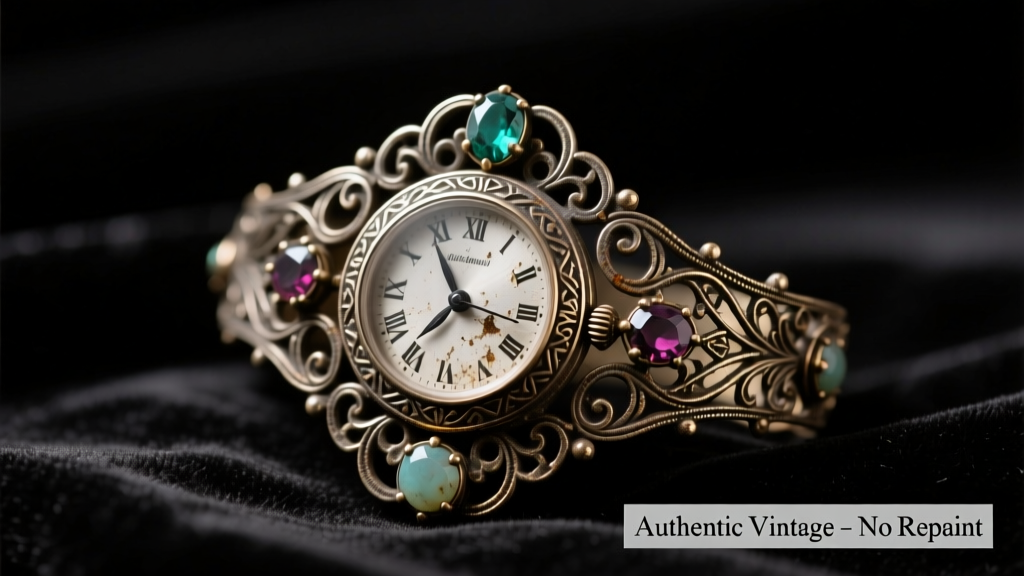
Why Repainting Vintage Watch Dials Is Never Acceptable — A Conservator’s Perspective
Poster Auctions International 2: A Curated Review of the Spring 2024 Vintage Jewelry & Watch Sale
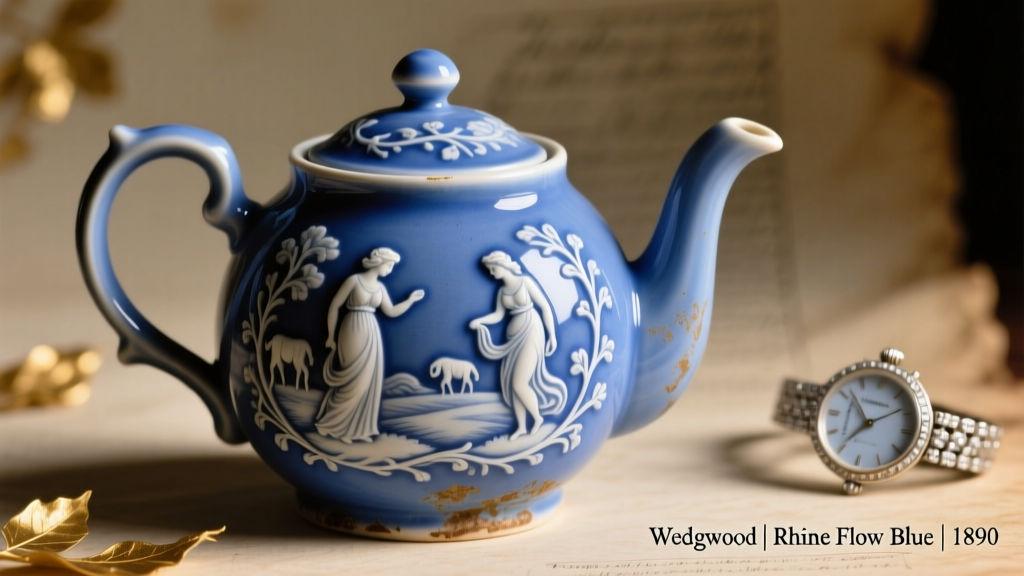
Wedgwood Teapot Rhine Flow Blue: History, Identification, and Market Value of a 19th-Century Icon