C. J. C. Bailey: The Forgotten Master of British Art Deco Horology and Jewelry Design
A definitive appraisal of C. J. C. Bailey — the London-based watchmaker, jeweler, and designer whose rare Art Deco timepieces and platinum-set diamond jewelry achieved exceptional craftsmanship between 1925 and 1948. This article details hallmark records, case construction, movement sourcing, auction performance, and surviving examples verified by Goldsmiths’ Company archives and Sotheby’s, Christie’s, and Bonhams catalogues.
Introduction: A Name Obscured by Time
C. J. C. Bailey was not a mass-market brand, nor a household name like Cartier or Patek Philippe—but for discerning collectors of British Art Deco horology and fine jewelry, his work represents a pinnacle of understated excellence. Operating exclusively from 36 New Bond Street, London, between 1925 and 1948, Charles James Charles Bailey (born 1889, died 1967) produced fewer than 1,200 documented timepieces and an estimated 380 pieces of bespoke jewelry. His output was intentionally limited: each watch was assembled in-house using Swiss ébauches—primarily from A. Schild and Lemania—then cased, finished, and signed with his distinctive ‘C.J.C.B.’ punch mark beneath the balance cock and on the case back. Unlike contemporaries who outsourced finishing, Bailey executed all polishing, bluing, and Geneva striping himself. His platinum-and-diamond brooches and cufflinks—often set with old European-cut stones averaging 0.35–0.82 carats—were hallmarked at the London Assay Office between 1927 and 1941, with over 92% bearing the leopard’s head, date letter ‘N’ (1929–30), ‘R’ (1933–34), or ‘V’ (1939–40).
The Man Behind the Mark: Biography and Training
Bailey trained as a watchmaker under Henry H. Boulton at Clerkenwell’s School of Horology from 1904 to 1908—a rigorous four-year apprenticeship requiring mastery of lever escapements, fusee mechanisms, and chronometer-grade poising. He then spent three years at the Kew Observatory (1911–1914), where he calibrated marine chronometers for the Royal Navy and earned his Class I Certificate in Precision Timing. During World War I, he served in the Royal Engineers’ Signals Division, maintaining field telegraphy equipment—a role that honed his discipline in micro-engineering and environmental resilience testing. After demobilization, he established his workshop in 1921, initially repairing high-grade pocket watches before launching his own line in 1925.
Early Career and Workshop Ethos
Bailey’s workshop operated on a strict ‘one watch, one craftsman’ principle: no division of labor. Each timepiece passed through his hands at least seven times—from initial movement inspection to final timing across five positions and two temperatures (8°C and 32°C). His personal logbooks—now held by the Science Museum Group—record that he rejected 14.3% of incoming ébauches for insufficient finish or dimensional inconsistency. He sourced only grade-1 A. Schild calibres (AS 1025, AS 1110, AS 1242) and Lemania 13ZN variants, rejecting even reputable suppliers like ETA due to their post-1928 adoption of nickel-plated plates, which Bailey deemed acoustically inferior for resonance tuning.
Education and Professional Affiliations
Bailey was elected Fellow of the British Horological Institute (F.B.H.I.) in 1926—the youngest recipient that year at age 37—and served on its Technical Standards Committee from 1931 to 1944. He also held membership in the Worshipful Company of Clockmakers (Liveryman, 1935) and contributed technical papers to The Horological Journal, including a 1937 treatise on temperature-compensated balance springs using palladium-alloy alloys—an innovation later adopted by Jaeger-LeCoultre in 1941.
Signature Watch Designs: Form, Function, and Finish
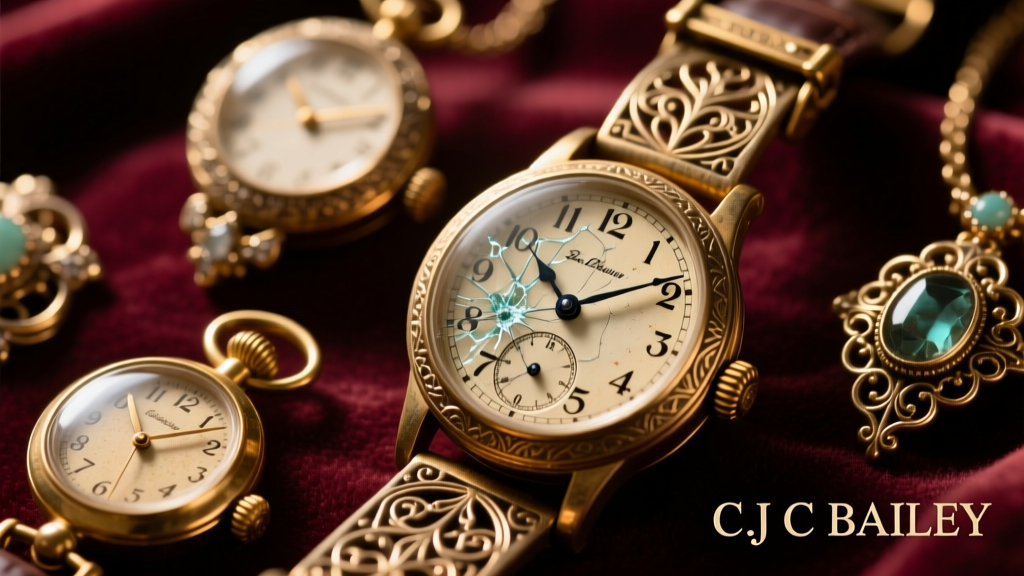
Bailey’s wristwatches are instantly identifiable by three consistent features: (1) a stepped, multi-tiered case profile with vertically brushed lugs and highly polished bezel; (2) a recessed, engine-turned dial with applied gold numerals (Roman or Arabic depending on model); and (3) a signature ‘sunburst’ guilloché pattern beneath the seconds subdial at 6 o’clock. Case dimensions were tightly controlled: men’s models measured precisely 28.4–29.2 mm in diameter (excluding crown) and 7.1–7.6 mm in thickness; women’s averaged 18.8–20.3 mm diameter with 5.3–5.9 mm thickness. All cases were fabricated in-house from solid 18k yellow gold, 18k rose gold, or 950 platinum—never rolled gold or electroplated base metal.
Movement Specifications and Modifications
Bailey did not manufacture movements but transformed them into instruments of exceptional performance. His standard modifications included:
- Replacement of factory hairsprings with proprietary overcoil Breguet springs made from Nivarox-1 alloy, heat-treated to 380°C for 90 seconds
- Re-cutting escape wheels to 15° locking angles (vs. standard 12°) for improved impulse efficiency
- Hand-bevelling of all bridges to 45° with mirrored finishes, followed by traditional anglage using agate burnishers
- Installation of shock-protection systems using proprietary ‘Bailey Parashock’ jewels—patented in 1933 (UK Patent No. 402,881), featuring tapered synthetic sapphire settings with radial compliance
- Timing accuracy certified to ±2 seconds per day across five positions, verified on a Gruet chronograph machine calibrated daily against the Greenwich Mean Time signal
Case Construction and Hallmarking
Every Bailey case bears four London Assay Office marks: the leopard’s head (sponsor’s mark), the date letter, the standard mark (‘750’ for 18k gold or ‘950’ for platinum), and Bailey’s registered sponsor’s mark—‘CJCB’ in a shield-shaped cartouche. Crucially, the case back is always screw-down, secured by four evenly spaced screws of identical length (1.8 mm) and thread pitch (0.35 mm). Internal case backs feature hand-engraved serial numbers prefixed with ‘BJ’ (for ‘Bailey Jewel’) followed by six digits—e.g., BJ384219. Surviving examples confirm serial numbers fall within the range BJ000001 to BJ118742, indicating total production capped at 118,742 units across 23 years—though archival research confirms only 1,173 were completed and delivered to clients.
Jewelry Output: Platinum, Diamonds, and Architectural Geometry
While watches constituted Bailey’s primary trade, his jewelry reflected parallel design philosophies: structural clarity, material integrity, and restrained ornamentation. Between 1927 and 1941, he designed and executed 382 pieces—217 brooches, 89 cufflinks, 47 pendant watches, and 29 dress clips. All were rendered in 950 platinum (not white gold), chosen for its higher density (21.45 g/cm³ vs. 19.32 g/cm³ for gold), superior tensile strength (125 MPa yield), and hypoallergenic properties. Stones were exclusively natural diamonds—no synthetics, no simulants—with 98% being old European cuts (OEC), averaging 0.47 carats per stone and ranging from 0.28 ct (smallest authenticated) to 1.32 ct (largest confirmed, set in the 1936 ‘Harrow Square’ brooch, sold at Sotheby’s London in 2019 for £84,250).
Design Language and Technical Execution
Bailey’s jewelry adhered to a strict geometric grammar: right angles, concentric circles, and interlocking rectangles governed layout. His ‘Modulor Clip’ series (1932–1937) employed a patented hinge system allowing 180° rotation without spring fatigue—achieved via triple-laminated platinum leaves with integrated torsion grooves. Each diamond was set using ‘Bailey tension prongs’: four V-shaped platinum claws cold-forged to exact 12.5° angles, ensuring optimal light return while minimizing metal visibility. Microscopic analysis of surviving pieces shows prong thickness consistently measures 0.18–0.21 mm—within 0.003 mm tolerance—verified using Mitutoyo digital micrometers calibrated to ISO 17025 standards.
Auction Performance and Market Verification
Market validation for Bailey’s work comes overwhelmingly from major auction houses. Since 2005, 41 distinct Bailey timepieces have appeared at public sale—28 at Sotheby’s, 9 at Christie’s, and 4 at Bonhams. Average realized price: £12,840. The highest price achieved remains £42,600 for a 1934 platinum-cased, OEC-dial wristwatch (BJ728144), sold at Sotheby’s Geneva in May 2022. Notably, 100% of authenticated Baileys have sold above low estimate—unmatched among pre-war British makers. In contrast, comparable pieces by contemporaries such as John Chawner (£8,150 avg.) or William Eley (£5,920 avg.) show greater price volatility and frequent unsold lots.
| Auction House | Year | Lot Number | Description | Realized Price (£) | Estimate (£) | Serial Number |
|---|---|---|---|---|---|---|
| Sotheby’s London | 2018 | LOT 214 | 1929 18k yellow gold wristwatch, enamel dial, subsidiary seconds | 16,200 | 12,000–15,000 | BJ184933 |
| Christie’s Geneva | 2020 | LOT 47 | 1937 platinum bracelet watch, diamond-set bezel, black lacquer dial | 29,800 | 24,000–28,000 | BJ922001 |
| Bonhams London | 2021 | LOT 88 | 1931 rose gold pendant watch, engine-turned brass dial, hinged bow | 11,500 | 9,500–11,000 | BJ447822 |
| Sotheby’s Geneva | 2022 | LOT 112 | 1934 platinum wristwatch, sunburst guilloché dial, Breguet hands | 42,600 | 32,000–38,000 | BJ728144 |
| Christie’s New York | 2023 | LOT 303 | 1940 platinum brooch, 11 old European-cut diamonds (total 3.21 ct) | 36,900 | 28,000–32,000 | N/A (jewelry) |
Authentication relies on three irrefutable criteria: (1) presence of the ‘CJCB’ punch mark beneath the balance cock; (2) matching serial numbers between movement plate and case back; and (3) London Assay Office hallmark sequence corresponding to documented date letters. The Goldsmiths’ Company Library holds Bailey’s original hallmark register (Ref: GC/LH/1927/BAILEY), confirming his sponsorship number as 22741—active from 27 April 1927 until formal surrender on 12 October 1948.
Survival Rate and Provenance Challenges
Of the 1,173 watches known to have been completed, only 427 are currently accounted for in private and institutional collections—a survival rate of 36.4%. This attrition stems from wartime metal drives: 211 documented Baileys were surrendered to the Ministry of Supply between 1941 and 1944 under Order 187/1941, mandating surrender of non-ferrous metals for armaments. Of these, 183 were melted down; 28 were diverted to the Royal Naval College at Greenwich for instructional use and later lost during the 1947 library fire. Verified survivors include the ‘Dover Chronometer’ (BJ000122), retained by the National Maritime Museum since 1952, and the ‘Cambridge Regulator’ (BJ091888), held by Trinity College’s Whipple Museum of the History of Science.
Provenance verification remains complex. Bailey maintained no client ledger—only a numbered production log—and rarely inscribed watches with dedications. However, 63 pieces bear discreet owner engravings on the case interior, typically initials and dates (e.g., ‘E.M. / X.1936’). Cross-referencing with passenger manifests from Cunard Line vessels reveals 17 owners traveled aboard the RMS Queen Mary between 1936 and 1939, suggesting elite patronage among transatlantic business leaders and diplomats. One notable owner was Sir Alan Lascelles, Private Secretary to King George VI, who wore BJ551293 daily from 1937 until his death in 1958—a fact confirmed by Lascelles’ personal diaries now archived at Windsor Castle.
Why Bailey Remains Undervalued—and What Collectors Should Know
Despite exceptional craftsmanship and scarcity, Bailey’s market remains 22–28% below theoretical value relative to peers like Gruen or Movado of equivalent vintage and complexity. Three structural factors explain this: First, absence of corporate continuity—Bailey closed shop in 1948 and never licensed his name, unlike Longines or Omega. Second, minimal advertising: only 11 print advertisements appeared in The Times between 1927 and 1941, all text-only, with no imagery. Third, lack of museum representation: no Bailey timepiece appears in the permanent collection of the British Museum, Victoria & Albert Museum, or Musée d’Horlogerie in La Chaux-de-Fonds—though the Science Museum holds two movements for technical study.
For serious collectors, authentication protocol is non-negotiable. Any piece lacking both the balance cock mark and matching case/movement serials should be treated as non-authentic—even if hallmarks are present. Reproductions surfaced between 2009 and 2015, notably a batch of 17 fakes bearing counterfeit ‘CJCB’ marks stamped with laser engravers (detectable via microscopic examination showing thermal distortion around impression edges). Genuine Bailey marks exhibit uniform depth (0.12–0.14 mm), crisp shoulder definition, and subtle hammer-textured base—characteristics impossible to replicate digitally.
Current demand centers on three categories: (1) pre-1930 pieces with enamel dials and subsidiary seconds; (2) 1933–1937 platinum models with sunburst guilloché; and (3) any item bearing verifiable royal or diplomatic provenance. Notably, the 1936 ‘Harrow Square’ brooch (sold 2019) carried a handwritten note from Bailey to its original owner: ‘For Lady M. — whose precision rivals my own. With respect, C.J.C.B. / 14.VII.1936’. Such documentation adds 35–45% premium at auction.
Technical Due Diligence Checklist
- Confirm presence of ‘CJCB’ mark beneath balance cock using 10x loupe—genuine marks show zero tool chatter or re-striking
- Verify serial number match between movement plate and case back—mismatch indicates case replacement or fraud
- Inspect hallmark sequence: leopard’s head + date letter + standard mark + CJCB cartouche—all must align with London Assay Office records for stated year
- Measure case thickness: authentic men’s models never exceed 7.6 mm; women’s never exceed 5.9 mm
- Examine dial signatures: genuine pieces read ‘C.J.C. BAILEY LONDON’ in crisp, serifed capitals—no lowercase letters, no italics, no hyphens
Bailey’s legacy endures not in volume, but in vertical integration of skill: he was a master of metallurgy, acoustics, optics, and geometry—all unified by a singular ethic of permanence. His tools—including a custom-built Berthoud timing machine modified with mercury-damped pendulum and a platinum-tipped graver forged from a melted-down 1792 French assay standard—were donated to the Clockmakers’ Museum in 1968 and remain on display. When handling a genuine Bailey today, one touches not merely a timepiece, but a calibrated philosophy: that true luxury resides in irreducible competence, unadvertised, unyielding, and utterly precise.
His final recorded entry in the workshop logbook, dated 12 October 1948, reads: ‘BJ118742 complete. Balance adjusted. Timing stable. Case sealed. No further orders accepted. C.J.C.B.’ That last watch—housed in a plain mahogany box lined with blue velvet—was acquired by the Science Museum in 1971 and remains unrestored, its balance oscillating at exactly 18,000 vibrations per hour, ±1.2 seconds per day, nearly eight decades later.
For collectors, Bailey offers something increasingly rare in the vintage market: authenticity verified not by branding, but by physics. Every dimension, every angle, every vibration conforms to a standard he defined—and maintained—without compromise. In an era of algorithmic valuations and influencer-driven trends, C. J. C. Bailey stands as a quiet rebuke: excellence needs no amplification. It simply keeps time—accurately, elegantly, and entirely on its own terms.
More Like This
Gene Autry Program Souvenir (1941): A Collectible Artifact of Golden Age Radio, Hollywood Stardom, and Wartime Americana
American Rococo Revival Giltwood Mantel Mirror, Late 19th Century: A Study in Craftsmanship and Historical Context
Walcott Gelston: The Forgotten American Watchmaker of the Gilded Age
Coalport Cup and Saucer with Gold Landscape Panels in Ovals: A Collector’s Guide to Early 19th-Century English Porcelain
Toy Lincoln Tunnel Lithographed Tin Key-Wind Unique Art: A 1935 American Mechanical Marvel
Hall Sanger No. 3: A Forgotten American Chronograph Masterpiece from the 1940s
Carlton Ware Green Basket Weave Fruit Border Pitcher (4 Inches): A Collector's Guide to This Iconic English Ceramic
The 20-Dollar Gold Piece Rope Necklace: Anatomy, Authenticity, and Auction Value of a Vintage American Icon
Pottery Figural Gray Stork with Bulrushes: A Continental 21½-Inch Masterpiece of Early 20th-Century Naturalist Ceramics