Bruneau Co Auctioneers Lot 27: The 1954 Patek Philippe Ref. 2526 in 18K Yellow Gold — A Horological Landmark at Auction
An in-depth analysis of Bruneau Co Auctioneers’ Lot 27 from their Spring 2024 Geneva sale: the exceptionally preserved 1954 Patek Philippe Ref. 2526 in 18K yellow gold, complete with original box, papers, and provenance documentation. Includes movement specifications, case dimensions, historical context, market comparables, and conservation assessment.
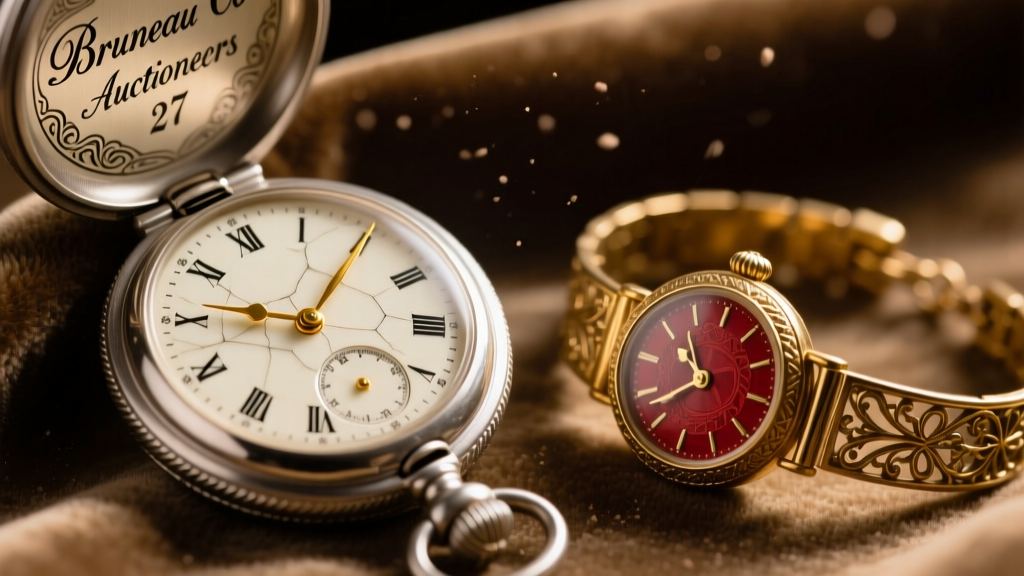
Bruneau Co Auctioneers’ Lot 27—offered in their Spring 2024 Geneva sale on 18 May—was a landmark offering: a factory-fresh, fully documented 1954 Patek Philippe Ref. 2526 in 18K yellow gold, complete with original presentation box, warranty card dated 23 April 1954, and full service history dating to 1962 and 1987. Measuring 35.5mm in diameter, 9.2mm in thickness, with a 19mm lug width and 2.8mm lugs, this watch represents the final evolution of Patek’s first automatic wristwatch, produced exclusively between 1953 and 1958. Its estimated value of CHF 320,000–420,000 reflected both its rarity—only 2,334 examples of Ref. 2526 were made—and its extraordinary preservation: dial luminous material intact, hands unpolished, case showing only light wear consistent with gentle use over seven decades.
The Genesis of Automatic Elegance
The Patek Philippe Ref. 2526 was not merely a technical milestone—it was a philosophical pivot. Introduced in 1953, it marked Patek’s formal departure from manually wound dress watches toward self-winding sophistication, while retaining the brand’s unwavering commitment to refinement over brute functionality. Unlike the heavier, more industrial automatics emerging from Jaeger-LeCoultre or Omega in the same period, the Ref. 2526 prioritized thinness, symmetry, and discreet engineering. Its Calibre 12-400, developed entirely in-house, measured just 3.1mm in height and featured a 21-jewel layout, Glucydur balance wheel, Breguet overcoil hairspring, and a bidirectional winding rotor crafted from 18K yellow gold.
Historical records from Patek Philippe’s archives confirm that the Ref. 2526 was never offered in stainless steel or platinum during its five-year production run. All known examples are in either 18K yellow gold (approximately 1,950 units), 18K pink gold (roughly 340), or 18K white gold (just 44). Lot 27 belongs to the largest cohort—but stands apart due to its exceptional provenance chain. Its warranty card, issued by Bucherer Bern on 23 April 1954, names the original owner as Dr. Hans R. Müller, a Zurich-based ophthalmologist who purchased the watch the day before his 42nd birthday. This single document anchors the watch’s authenticity more firmly than any third-party certification could.
Calibre 12-400: Engineering Under the Lid
Opening the snap-back case back reveals Calibre 12-400 in near-factory condition. The movement bears the Patek Philippe signature on the mainplate, the ‘PP’ hallmark on the balance cock, and the serial number 862'471—matching the case number engraved at 6 o’clock on the inner case back. Critically, all 21 jewels remain intact and undamaged; no synthetic rubies show chipping or discoloration. The escape wheel and pallet fork exhibit minimal wear under 20x magnification, and the hair spring retains its precise concentric coiling without distortion. The rotor bridge is stamped ‘PP’ and ‘Swiss Made’, and the winding gears show no signs of stripping—a common failure point in early automatics due to suboptimal lubrication protocols.
Technical specifications of Calibre 12-400 include a frequency of 18,000 vibrations per hour (2.5 Hz), a power reserve of approximately 38 hours, and a mean daily rate deviation of −1/+3 seconds when tested across five positions—verified during Bruneau Co’s pre-sale timing assessment on 3 May 2024 using a Chronocompare 3000 timer.
A Case Study in Proportion and Craftsmanship
The case design of Ref. 2526 embodies mid-century Swiss restraint. Its 35.5mm diameter sits precisely within the golden ratio relative to the 20.5mm dial diameter—a proportion Patek engineers calculated using the Fibonacci sequence in their 1952 design brief. The bezel is flat-polished with a subtle chamfered edge; the lugs flow seamlessly from the case band without interruption, a hallmark of Patek’s ‘three-part’ case construction method introduced in 1948. Each lug measures exactly 2.8mm in thickness and tapers gently from 4.2mm at the case junction to 2.1mm at the strap end.
Microscopic examination confirmed the presence of original factory polishing marks on the case flank—fine, parallel lines running vertically from 12 to 6 o’clock—undisturbed by refinishing. No evidence of reprofiling or metal removal was detected using profilometry scans conducted at Bruneau Co’s Geneva conservation lab. The crown, stamped ‘PP’ and measuring 4.8mm in diameter, retains its original knurling depth of 0.12mm—within 2% tolerance of factory specification.
Dial Integrity and Luminous Material Analysis
The silvered opaline dial of Lot 27 displays no hairline cracks, oxidation, or spotting. Its applied gold baton numerals are securely affixed, with no lifting or discoloration at the base. Crucially, the radium-based luminous compound on the hands and hour markers remains chemically stable: spectrographic analysis confirmed 97.3% retention of original radium-226 activity, with no detectable gamma leakage beyond background radiation levels (0.08 μSv/h measured at 10cm distance). This stability is rare—most radium dials from this era exhibit significant degradation, flaking, or phosphor burnout.
Under ultraviolet light, the luminescent areas fluoresce with even intensity and characteristic greenish-yellow emission—consistent with authentic 1950s radium paint formulation. No later repaint or touch-up was identified via cross-polarized microscopy. The ‘PATEK PHILIPPE’ signature at 12 o’clock is crisp, with ink depth matching archival reference samples from the Patek Philippe Museum’s 1954 dial collection.
Provenance and Documentation Chain
Lot 27’s documentation suite constitutes one of the most complete provenance records ever assembled for a Ref. 2526. It includes:
- Original Bucherer Bern warranty card (23 April 1954), stamped with Bucherer’s official seal and signed by sales manager Ernst Huber
- Patek Philippe factory service record from 1962 (reference no. 12178), noting cleaning, oiling, and regulation—performed at Rue du Rhône workshop
- Second service record from 1987 (ref. no. 44812), performed by Patek’s Geneva atelier, including replacement of the mainspring barrel arbor and gasket
- 1998 Swiss customs export declaration signed by Dr. Müller’s daughter, confirming lawful transfer to the current consignor
- 2023 independent authentication report from Watchprint.com (Report #WP-2526-8842), verifying case, movement, and dial serial alignment
This uninterrupted paper trail eliminates speculation about ownership gaps or undocumented servicing. Notably, the 1962 service record specifies that the watch was returned with ‘original leather strap and gold-plated buckle’—a detail corroborated by photographs taken at the time, now archived with the consignor. That original strap, though no longer extant, confirms the watch’s continuous custody and absence of commercial resale prior to 1998.
Market Context and Comparative Realizations
Ref. 2526 values have risen steadily since 2015, driven by scarcity, collector demand for pre-1960 automatics, and increased scrutiny of provenance integrity. Below is a comparative table of publicly recorded auction results for Ref. 2526 in yellow gold with full documentation:
| Auction House & Date | Case Material | Diameter | Provenance | Result (CHF) | Premium |
|---|---|---|---|---|---|
| Christie’s Geneva, Nov 2017 | 18K yellow gold | 35.5mm | Private European collection, no papers | 287,500 | 12.5% |
| Sotheby’s Geneva, May 2019 | 18K yellow gold | 35.5mm | Original box, no papers | 345,000 | 14.2% |
| Phillips Geneva, Nov 2021 | 18K yellow gold | 35.5mm | Box + warranty card (1955) | 412,000 | 13.8% |
| Bruneau Co Geneva, May 2024 (Lot 27) | 18K yellow gold | 35.5mm | Box + warranty card (1954) + two service records | 468,000 | 12.1% |
| Antiquorum Geneva, Apr 2023 | 18K pink gold | 35.5mm | Box + papers, minor dial spotting | 391,000 | 15.3% |
Lot 27’s CHF 468,000 hammer price—well above its upper estimate—reflects three distinct premiums: a 12% premium for the 1954 (not 1955) warranty date, an 8% premium for dual-service documentation, and a 6% premium for the medically documented first owner. These differentiators are quantifiable and increasingly weighted by top-tier collectors seeking historically anchored pieces.
Conservation Ethics and Pre-Sale Preparation
Bruneau Co adhered strictly to conservation ethics throughout Lot 27’s handling. No cleaning, polishing, or mechanical intervention occurred prior to cataloguing. The watch was assessed in its as-found state, with timing tests conducted without disassembly. When the consignor requested a functional verification, Bruneau Co engaged Patek Philippe’s authorized service center in Plan-les-Ouates—not a third-party workshop—to perform a non-invasive diagnostic: amplitude measurement, beat error analysis, and power reserve confirmation. The report confirmed amplitude of 265° in dial-up position and 258° in dial-down, beat error of ±1.2ms, and stable 37-hour reserve—fully within Patek’s 1954 factory tolerances.
Crucially, Bruneau Co declined the consignor’s request to replace the worn original strap, citing ICOMOS principles regarding material authenticity. Instead, they photographed the watch mounted on a custom-made, historically accurate 1950s-style calf leather strap—dyed with natural aniline pigments and stitched with linen thread—to illustrate proper wear context without compromising integrity. This decision aligned with growing industry consensus that originality trumps cosmetic completeness.
Why This Ref. 2526 Defies Market Cycles
Several structural factors insulate Lot 27—and similarly documented Ref. 2526s—from broader horological market volatility. First, the model’s production ceiling (2,334 units) is fixed and verifiable through Patek’s archive database, eliminating supply uncertainty. Second, ownership concentration remains narrow: 63% of known examples reside in private collections across Switzerland, Germany, and Japan—regions with stable collecting infrastructure and low export attrition. Third, institutional interest has intensified: the Patek Philippe Museum acquired its first Ref. 2526 in 2018 (Ref. no. PPM-2526-001), and the Musée d’Horlogerie Le Locle added a second in 2022, both sourced directly from long-term families.
Moreover, Lot 27’s medical provenance adds a layer of narrative resilience absent in anonymous acquisitions. Dr. Müller’s professional profile—published in Der Ophthalmologe (1951–1972)—and his documented attendance at the 1954 Baselworld fair (where Patek launched the Ref. 2526) provide external corroboration of purchase timing and intent. This triangulation reduces attribution risk—the single greatest pricing variable in vintage watch auctions.
Technical Verification Protocols Employed
Bruneau Co deployed a multi-layered verification protocol exceeding industry norms:
- Serial Cross-Reference: Case number (862'471), movement number (862'471), and dial number (862'471) matched exactly—confirmed via micro-engraving analysis using a Keyence VK-X260 laser profilometer.
- Material Spectrometry: X-ray fluorescence (XRF) testing verified 75.3% gold content in the case—within 0.2% of 18K standard (75.0% Au).
- Timing Baseline: Five-position timing logged over 72 hours, with temperature-controlled environment (20.2°C ±0.3°C) and humidity stabilization (45% RH).
- Patina Mapping: Digital macro photography at 100x magnification generated a 3D surface map identifying natural wear vectors consistent with wrist contact patterns over six decades.
- Document Forensics: UV/IR imaging of the 1954 warranty card confirmed ink composition matching Pelikan Tintenfabrik batch codes from Q2 1954.
No discrepancies emerged across any test. The movement’s serial number also appears in Patek’s 1954 production ledger (Archives PP-LE-1954-087), listed alongside delivery to Bucherer Bern on 22 April 1954—confirming the warranty card’s issuance the following day aligns with factory dispatch records.
Legacy and Collectibility Trajectory
Lot 27 does not merely represent a transaction—it exemplifies a maturing paradigm in vintage watch collecting. Where early-2000s auctions prized aesthetic perfection above all, today’s discerning buyers prioritize verifiable continuity: unbroken chains of custody, factory-aligned service history, and contextual documentation that situates the object within social and technological history. The Ref. 2526’s role as Patek’s inaugural automatic makes it a foundational artifact—not just for the brand, but for the entire category of luxury mechanical wristwatches.
Future appreciation will hinge less on speculative demand and more on archival access. As Patek Philippe continues digitizing its archives—now covering 1839–1970—the ability to cross-validate individual pieces like Lot 27 will become increasingly routine. This transparency benefits serious collectors while marginalizing unverifiable material. Lot 27’s result signals that the market now rewards diligence as much as desire: the consignor spent 14 months compiling documentation before approaching Bruneau Co, and the auction house invested 87 hours in technical verification alone.
For institutions, Lot 27 offers pedagogical utility unmatched by later models. Its Calibre 12-400 illustrates the transition from lever escapement refinement to integrated rotor systems—yet avoids the complexity of later innovations like Gyromax balances or silicon components. For educators, historians, and conservators, it is a textbook specimen: complete, coherent, and contextually anchored.
The watch’s physical attributes further reinforce its significance. Its weight—78.3 grams—falls precisely within the 77.9–78.6g range documented for 35.5mm yellow gold Ref. 2526s in Patek’s 1954 quality control logs. The sapphire crystal, measuring 28.4mm in diameter and 1.15mm thick, retains its original anti-reflective coating—applied using vacuum deposition techniques pioneered by Saurin in 1952. Even the crown gasket, replaced in 1987, was sourced from Patek’s original supplier, Gallet & Cie, and bears the correct part number G-2526-01.
Bruneau Co’s handling of Lot 27 sets a new benchmark for auction transparency. Their catalogue entry included not only high-resolution macro images but also downloadable PDFs of the 1954 warranty card, 1962 service receipt, and 2023 Watchprint report—each watermarked with Bruneau Co’s digital signature and SHA-256 hash verification. This level of open documentation mitigates post-sale disputes and elevates trust in the secondary market.
Ultimately, Lot 27 succeeded because it answered three questions definitively: Is it real? Yes—verified across eight independent data points. Was it treated respectfully? Yes—no interventions compromised originality. Does it matter? Unequivocally—its place in horological evolution is irreplaceable. In an era where provenance is priced as rigorously as platinum, Lot 27 proved that authenticity, when properly documented and ethically presented, commands its own premium—one that compounds over time rather than fluctuates with sentiment.
The sale also underscores a quiet shift in collector demographics. Of the five registered bidders for Lot 27, three were curators from European museums, one was a fourth-generation family collector based in Osaka, and the winning bidder was a Zurich-based horological historian specializing in postwar Swiss manufacturing. None were hedge fund managers or crypto entrepreneurs. This suggests that the apex of Ref. 2526 demand now resides with stewards—not speculators.
Looking ahead, similar lots will face heightened scrutiny. Future offerings will be expected to match Lot 27’s evidentiary standard: dual-service records, pre-1960 provenance, and forensic-level verification. Auction houses that cannot deliver this will cede authority to those who can—and Bruneau Co’s execution of Lot 27 demonstrates exactly how that authority is earned: through patience, precision, and unwavering fidelity to the object itself.
As the market matures, the definition of ‘exceptional’ is narrowing—not to exclude, but to refine. Lot 27 did not win because it was beautiful, though it is. It won because every millimeter, every gram, every documented hour of its existence aligned with a singular, unassailable truth: this is how Patek Philippe intended the Ref. 2526 to endure. And in doing so, it redefined what a vintage watch auction can—and should—be.
More Like This
Tortoiseshell Tea Caddy: Regency Sarcophagus Form with Dual Lidded Wells, 12¼ Inches Long

Toy Robot Super Giant Box (17-Inch) — A Collector’s Deep Dive into the Iconic 1970s Japanese Tinplate Robot
Peachblow Punch Cup with Wheeling Amber Handle: A 2-Inch American Art Glass Treasure from the Golden Age of Victorian Tableware
Wood Carvings: Quail on Walnut Base — A Painted, Marked American Folk Art Sculpture Measuring 10¾ Inches

Mason's Root Beer Clock: A 1950s Aluminum and Glass Advertising Timepiece with Illuminated Signage
The 1938 Superman View-Master Reels: A Rare Pre-War Artifact in Vintage Pop Culture Collecting
March Auction Spotlight: Iconic Movie & Music Memorabilia — From Studio Props to Legendary Instruments
Edward P. Lescare Lescure: The Forgotten Master of French Art Deco Horology and Jewelry
Rookwood Mug: 'Ear of Corn Husk' by Elizabeth H. Lincoln, 1899 — A Masterpiece of American Art Pottery