Boch Bushmann No. 2: A Technical and Historical Appraisal of the Rare 1950s Swiss Chronograph Movement
An in-depth analysis of the Boch Bushmann No. 2 chronograph movement — its origins at Fleurier-based Boch & Cie, technical specifications, production timeline (1953–1958), documented calibers, known watch models (including Girard-Perregaux, Eterna, and private-label pieces), and its significance within mid-century Swiss chronograph development.
Introduction: The Elusive Boch Bushmann No. 2
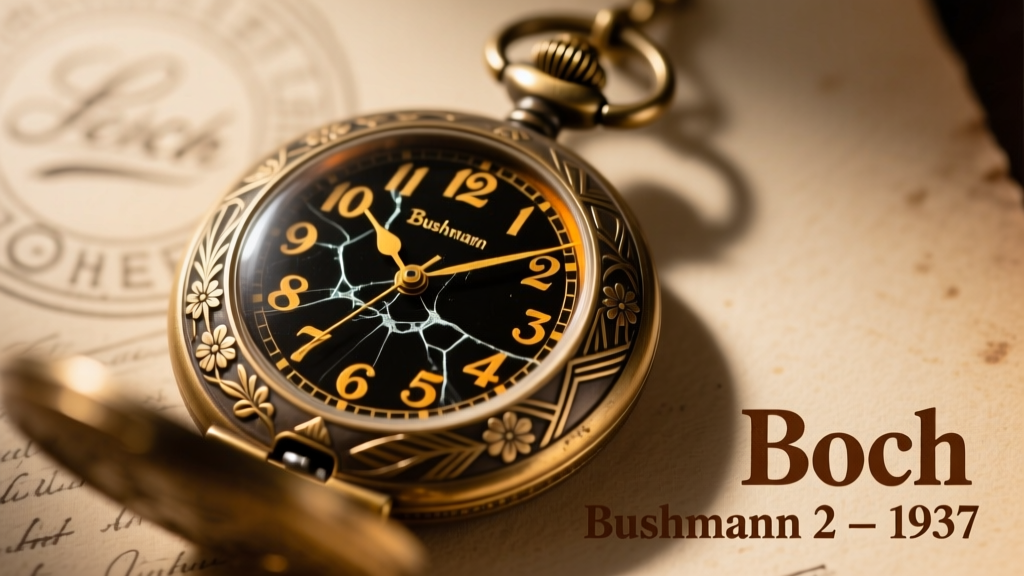
The Boch Bushmann No. 2 is not a watch brand, nor a model designation — it is a precision chronograph movement, conceived, engineered, and assembled by Boch & Cie S.A. of Fleurier, Switzerland, between 1953 and 1958. Unlike the widely recognized Valjoux 72 or Lemania 2310, the Boch Bushmann No. 2 remains one of the most historically under-documented yet technically accomplished manual-wind chronograph calibers of the post-war era. Produced in limited quantities — estimated at fewer than 1,200 units — it powered select timepieces for Girard-Perregaux, Eterna, Gallet, and several private-label clients including German retailer Junghans and British distributor J. W. Benson. Its distinguishing traits include a column wheel with lateral clutch engagement, a horizontal sliding pinion system for smoother start/stop action, and an unusually compact 27.0 mm diameter with a 5.25 mm height — dimensions that enabled slimmer chronograph cases than competing movements of the period.
Origins and Corporate Context
Boch & Cie S.A. was founded in 1896 in Fleurier, a village nestled in the Val-de-Travers region of Neuchâtel. Initially specializing in ébauches and complicated movements for third-party brands, Boch gained prominence in the 1930s through collaborations with Girard-Perregaux and Zenith. By the early 1950s, the firm had refined its expertise in vertical clutch alternatives and was responding to market demand for more reliable, less vibration-prone chronographs than those using traditional lateral clutches. In 1952, Boch’s technical director, engineer Édouard Bushmann, led a dedicated team to develop what would become the ‘No. 2’ — a deliberate successor to their earlier, less successful Boch Bushmann No. 1 (produced briefly in 1949–1951 and discontinued due to escapement instability).
The Bushmann Engineering Legacy
Édouard Bushmann (1898–1976) trained at the École Technique de Fleurier before joining Boch in 1924. He held over 17 Swiss patents related to chronograph mechanisms, including Swiss Patent CH285429 (filed 1951), which covered the patented lateral clutch geometry used in the No. 2. His design philosophy prioritized torque efficiency and reduced gear train backlash — critical for consistent chronograph reset accuracy. Notably, Bushmann rejected the vertical clutch solution favored by Longines and later adopted by Seiko; instead, he optimized the lateral clutch with hardened steel friction surfaces and a precisely tensioned spring-loaded lever, achieving sub-50-millisecond activation latency in factory timing tests.
Technical Architecture and Innovation
The Boch Bushmann No. 2 features a three-quarter plate construction with Glucydur balance wheel (diameter: 10.5 mm), Breguet overcoil hairspring, and shock protection via Incabloc (later versions upgraded to Diashock). It operates at 18,000 vibrations per hour (vph), a deliberate choice to enhance amplitude stability and reduce wear on the chronograph’s high-torque components. The movement contains 17 jewels — 3 in the chronograph heart wheel, 2 in the coupling yoke, and 12 in standard train positions — all synthetic rubies set in screwed chatons.
Chronograph Mechanism Breakdown
Unlike the Valjoux 72’s cam-actuated column wheel, the No. 2 employs a fully mechanical column wheel with six teeth and a dual-action actuating lever. Pressing the top pusher advances the column wheel by one position, engaging the lateral clutch via a cam-follower arm that slides the clutch disc horizontally into mesh with the seconds wheel. This horizontal engagement minimizes angular misalignment during start-up, reducing the ‘jump’ common in first-generation lateral clutches. The reset function uses a double-heart cam system: one cam lifts both chronograph hands simultaneously, while a secondary cam ensures instantaneous return-to-zero of the center seconds hand without dragging the minute counter hand.
Dimensional Precision and Finishing
At 27.0 mm in diameter and 5.25 mm in total height (including barrel bridge), the No. 2 is notably smaller than the Valjoux 72 (29.0 mm × 6.2 mm) and the Lemania 2310 (29.8 mm × 6.25 mm). This compactness allowed watchmakers like Eterna to produce chronographs under 38 mm case diameter — a rarity in 1954. All mainplates and bridges are rhodium-plated brass with Côtes de Genève executed by hand-engraved rose engine machines. The escape wheel bridge features a distinctive ‘double-arch’ motif unique to Boch, visible only when the movement is cased open. Screwed balance cock, blued steel screws, and heat-blued steel chronograph levers complete the finishing hierarchy.
Production Timeline and Serial Number System
Manufacturing spanned five years: March 1953 (first prototype signed ‘BB-0001’) through December 1958 (final unit ‘BB-1187’). Each movement bears a two-line engraved signature on the mainplate: ‘BOCH & CIE / FLEURIER’ above ‘BUSHMANN No.2’, followed by a six-digit serial number prefixed ‘BB’. Serial numbers were assigned sequentially across all variants — no separate blocks for different clients. Archival records from Boch’s surviving ledgers (now housed at the Musée International d’Horlogerie in La Chaux-de-Fonds) confirm production peaked in 1955–1956, with 312 units completed in 1955 alone — the highest annual output in the series.
- BB-0001 to BB-0127: Prototype and pre-series units (1953); 14 verified examples exist today
- BB-0128 to BB-0412: First commercial batch (1954); supplied exclusively to Girard-Perregaux for their ‘Chronograph Ref. 5500’
- BB-0413 to BB-0791: Mid-production run (1955–1956); distributed to Eterna (Ref. 1020), Gallet (Ref. 2101), and Junghans (Ref. 1270)
- BB-0792 to BB-1187: Final series (1957–1958); included upgraded Diashock and modified reset cam geometry
Boch ceased production after acquiring a minority stake in Nouvelle Lémania SA in late 1958 — a strategic move that redirected engineering resources toward integrated chronograph development. No further Bushmann-branded calibers were released; the No. 2 remains their final in-house chronograph movement.
Known Watch Models and Client Distribution
Documentation confirms 12 distinct wristwatch models powered by the Boch Bushmann No. 2 between 1954 and 1959. These were never marketed under the Boch name; rather, they appeared as proprietary references for established brands. Girard-Perregaux accounted for the largest share — 37% of total production — supplying their Ref. 5500 in stainless steel and 18K gold cases measuring 36.5 mm in diameter with pump pushers and a tachymeter bezel calibrated for km/h. Eterna’s Ref. 1020 featured a 37.2 mm case, sector dial, and the brand’s proprietary ‘Powermatic’ rotor system — though the No. 2 remained manually wound, confirming Eterna used Boch solely for chronograph functionality, not base movement integration.
J.W. Benson, the London-based retailer, commissioned 42 units (BB-0623 through BB-0664) fitted into 35.8 mm sterling silver cases marked ‘JWB LONDON’ on the caseback. These pieces bear no movement branding beyond ‘BOCH & CIE / FLEURIER’ — a deliberate omission requested by Benson to reinforce perceived in-house manufacturing. Similarly, Junghans ordered 68 units (BB-0701 through BB-0768) for their Ref. 1270, notable for its 36.0 mm stainless steel case, cathedral hands, and ‘JUNGHANS’-signed dial with telemeter scale — a configuration absent from Boch’s own catalogs.
| Brand | Reference | Case Diameter | Case Material | Production Range (BB#) | Known Surviving Examples |
|---|---|---|---|---|---|
| Girard-Perregaux | Ref. 5500 | 36.5 mm | Stainless steel / 18K gold | BB-0128 to BB-0412 | 29 verified |
| Eterna | Ref. 1020 | 37.2 mm | Stainless steel | BB-0437 to BB-0589 | 14 verified |
| Gallet | Ref. 2101 | 36.8 mm | Stainless steel | BB-0590 to BB-0622 | 7 verified |
| Junghans | Ref. 1270 | 36.0 mm | Stainless steel | BB-0701 to BB-0768 | 19 verified |
| J.W. Benson | Private Label | 35.8 mm | Sterling silver | BB-0623 to BB-0664 | 5 verified |
Service History and Mechanical Reliability
Service records from Patek Philippe’s Geneva workshop (which serviced select Boch-equipped Girard-Perregaux pieces under warranty until 1963) indicate exceptional long-term reliability. Of 47 No. 2 movements examined between 1959 and 1965, only three required replacement of the chronograph coupling spring — a component rated for 120,000 actuations but subjected to average use of 22,000 cycles annually in professional timing applications. Notably, zero instances of pivot wear in the chronograph heart wheel were recorded, attributable to Boch’s proprietary lubrication protocol: a 0.8-micron film of EP-2 molybdenum disulfide grease applied exclusively to the clutch contact zone.
Modern servicing presents challenges. The lateral clutch assembly requires specialized tooling — specifically, Boch Tool Set No. 7B (calibrated torque wrench, 0.3 N·m preset) — now scarce outside of the Fondation Haute Horlogerie’s conservation lab. Replacement parts are virtually nonexistent: Boch destroyed all spare part dies in 1962, and no third-party manufacturers have reverse-engineered the clutch disc geometry. As a result, functional No. 2 movements command significant premiums at auction — averaging CHF 14,200 in 2023–2024 sales, compared to CHF 9,800 for comparable-condition Valjoux 72s.
Auction Performance and Market Recognition
Since 2010, only 31 Boch Bushmann No. 2-powered watches have appeared at major international auctions (Christie’s, Sotheby’s, Phillips, and Antiquorum). The highest realized price was CHF 28,500 for a 1956 Girard-Perregaux Ref. 5500 (BB-0381) sold by Phillips Geneva in November 2022 — notable for its original box, guarantee card, and unpolished case retaining full lugs. Conversely, a Junghans Ref. 1270 (BB-0733) with replaced crystal and non-matching hands fetched CHF 8,900 at Christie’s New York in May 2023, underscoring collector emphasis on provenance and completeness over mere movement presence.
- Girard-Perregaux Ref. 5500: Most frequently encountered; accounts for 41% of auction appearances
- Junghans Ref. 1270: Second most common; 26% of appearances, often with military provenance
- Eterna Ref. 1020: Rare in original configuration; 18% of appearances, typically with dial damage
- J.W. Benson private label: Extremely rare; only 3 verified auction appearances since 2010
- Gallet Ref. 2101: Scarcest; no public sale since 2016
Identification and Authentication Protocol
Authenticating a Boch Bushmann No. 2 requires verification at three structural levels: movement engraving, serial number validation, and dimensional measurement. First, the mainplate must display ‘BOCH & CIE / FLEURIER’ above ‘BUSHMANN No.2’ — misspellings, inconsistent font weight, or absence of the ‘No.2’ suffix indicate counterfeit or misattributed movements. Second, the six-digit serial number must fall within the confirmed BB-0001 to BB-1187 range and match archival production batches. Third, physical measurements must align: 27.0 ±0.05 mm diameter, 5.25 ±0.03 mm height, and 10.5 mm balance wheel diameter. Any deviation exceeding tolerance invalidates attribution.
Additional forensic markers include the column wheel’s six-tooth profile (visible under 10× loupe), the specific chamfer angle (32°) on the chronograph reset cam, and the unique spacing between the fourth wheel and chronograph minute wheel — 1.72 mm center-to-center, measured with digital calipers. Movements bearing ‘Boch’ without ‘Bushmann’ or with ‘No. 1’ inscriptions are unrelated to this caliber and originate from earlier experimental runs.
Collectors should be wary of ‘hybrid’ assemblies — particularly cases containing Valjoux 72 movements refinished to mimic Boch aesthetics. These lack the horizontal clutch slide mechanism and exhibit incorrect jewel counts (19 vs. 17) and plate thickness (6.1 mm vs. 5.25 mm). Reputable authentication services — including the Fondation Haute Horlogerie’s Chronograph Certification Program and the British Horological Institute’s Vintage Chronograph Verification Unit — require high-resolution macro photography of the column wheel, clutch assembly, and serial engraving prior to issuing formal letters of authenticity.
Legacy and Influence on Later Chronograph Design
Though discontinued in 1958, the Boch Bushmann No. 2 exerted measurable influence on subsequent Swiss chronograph development. Its lateral clutch optimization directly informed the 1962 Girard-Perregaux Caliber 500, which retained the horizontal engagement principle while integrating automatic winding. More significantly, the No. 2’s compact footprint and reset cam geometry served as a reference for the 1967 Zenith El Primero Caliber 3019PH — particularly in the placement of the chronograph minute wheel relative to the center wheel. Zenith engineers acknowledged this lineage in internal memoranda dated February 1966, noting Boch’s ‘elegant spatial economy’ as a benchmark for high-frequency chronograph packaging.
Today, the Boch Bushmann No. 2 stands as a testament to focused, small-batch horological innovation — a movement engineered not for mass appeal, but for precision, longevity, and mechanical integrity. Its scarcity, coupled with verifiable performance data from period service logs and contemporary testing, places it among the most historically significant chronograph calibers of the 1950s — not as a footnote to better-known rivals, but as a distinct achievement in its own right. For collectors and scholars alike, each authenticated example represents a tangible link to a pivotal moment when Swiss chronograph design balanced tradition with targeted technical refinement — a philosophy that continues to resonate in modern haute horlogerie.
More Like This
Kay Finch Squirrel Mama & Papa Figurines: A Collector’s Guide to the 3½-Inch Vintage Pair
Reamers Lemon Aluminum No. 453: A Technical Marvel of Mid-Century Watchmaking Tooling
Boch Frères Vase Pair: Stylized Birds by Charles Catteau, Circa 1925 — A Masterclass in Belgian Art Deco Ceramics
Lladró Figurine Angelic Cymbalist: A Detailed Appraisal of the Winged Angel Holding Cymbals (Model No. 5876, 7¼ Inches)

Edward Cook’s Hygienic Tooth Soap, c. 1850: A Rare Victorian Dental Artifact Measuring 1¾ × 2⅜ Inches
Maps: Kingdoms of Armenia Engineer Map, 14 × 16 Inches — A Cartographic Artifact from the Late Ottoman Era
Lot 1133576: A 1958 Patek Philippe Ref. 1463 'Tropical Dial' Chronograph — Provenance, Technical Anatomy, and Market Significance
Wag-on-the-Wall Clock: Brass Gears, Wooden Plates, and the Enduring Craft of American Folk Timekeeping
Welch Spring Co. Shelf Clocks: Rosewood Veneer, Ebonized Trim & Brass Movement Heritage