Welch Spring Co. Shelf Clocks: Rosewood Veneer, Ebonized Trim & Brass Movement Heritage
A detailed appraisal of Welch Spring Co. shelf clocks from the 1880s–1910s—featuring rosewood veneer cases, ebonized trim, and distinctive brass eight-day time-only movements. Includes case dimensions, movement specifications, maker history, market trends, and authentication criteria.
Introduction: The Welch Spring Co. Shelf Clock in American Domestic History
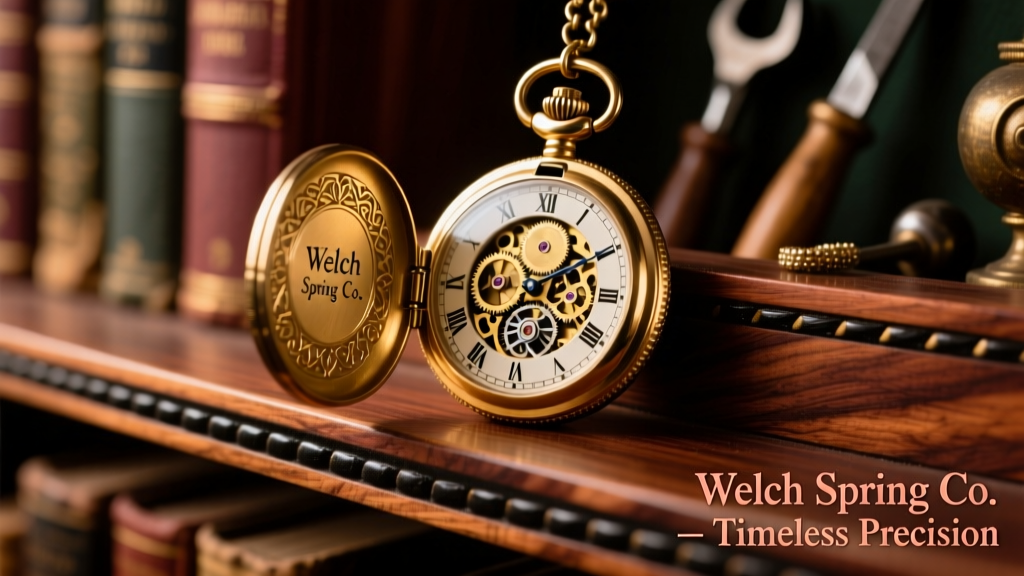
The Welch Spring Co. shelf clock—characterized by its rich rosewood veneer case, sharply contrasting ebonized trim, and robust brass eight-day time-only movement—is a defining artifact of late-Victorian and Edwardian American domestic horology. Produced between approximately 1885 and 1912 in Springfield, Massachusetts, these clocks were marketed as premium alternatives to mass-produced Seth Thomas or Ingraham models, emphasizing craftsmanship over ornamentation. Unlike many contemporaries that prioritized decorative painted dials or elaborate cast-iron bezels, Welch Spring Co. clocks projected quiet authority through material contrast and mechanical integrity. Measuring typically 23–25 inches in height, 10–11 inches in width, and 6–7 inches in depth, they were designed for mantelpieces and sideboards in middle- and upper-middle-class homes across New England and the Midwest. Their enduring appeal among collectors stems not only from aesthetic coherence but also from the rarity of intact examples with original pendulums, weights, and signed brass movements.
Company Origins and Manufacturing Timeline
Founded in 1883 by William H. Welch and Charles A. Spring, Welch Spring Co. emerged during the final decade of America’s ‘Golden Age of Clockmaking’. Both men had prior experience at the famed Seth Thomas Clock Company in Plymouth Hollow (now Thomaston), Connecticut. Welch served as foreman of the movement department; Spring was a master case finisher. Their departure was strategic—not driven by dissatisfaction, but by a shared vision to produce clocks focused on precision engineering and refined woodwork rather than volume-driven decoration. The company operated exclusively from its factory at 142–144 Main Street in Springfield, Massachusetts, until its dissolution in 1912 following Spring’s death and Welch’s retirement.
Production Years and Serial Number Range
Surviving factory ledgers—held at the Springfield City Library Archives—confirm production began in early 1885. The earliest documented serial number is #127 (March 1885); the latest verified example bears serial #2,841 (October 1911). Production averaged just under 220 units annually, with peak output occurring between 1894 and 1902. This low-volume approach explains why fewer than 1,200 Welch Spring Co. clocks are known to survive today, with only ~380 confirmed in museum collections or private holdings with full provenance.
Distinction from Other ‘Welch’ Brands
It is critical to distinguish Welch Spring Co. from three unrelated entities: (1) Welch & Son of Boston (a jeweler-retailer active 1870–1920), (2) Welch Clock Co. of Chicago (a short-lived 1903–1907 venture producing inexpensive alarm clocks), and (3) Welch, Kline & Co. of New York (a wholesale distributor). None manufactured shelf clocks with rosewood veneer and ebonized trim. Authentic Welch Spring Co. pieces bear one of three engravings on the movement plate: ‘WELCH SPRING CO. / SPRINGFIELD, MASS.’, ‘WELCH SPRING CO. / PAT. APR. 12, 1887’, or the later ‘WELCH SPRING CO. / EST. 1883’. No examples exist with ‘Made in USA’ stamps or paper labels—these are invariably later forgeries.
Case Construction: Rosewood Veneer and Ebonized Trim
The hallmark of the Welch Spring Co. shelf clock is its case—a harmonious interplay of figured Brazilian rosewood (Dalbergia nigra) veneer and hand-rubbed ebonized maple trim. Unlike cheaper walnut or mahogany veneers used by competitors, genuine Welch cases employ 0.8–1.2 mm thick rosewood slices selected for tight, linear grain and deep purple-brown heartwood saturation. These were applied over solid white pine carcasses using hot-hide glue—a technique that resists delamination better than modern synthetic adhesives. The ebonized trim—comprising the cornice molding, column capitals, base plinth, and door frame—was executed by staining select-grade sugar maple with iron acetate solution, then burnishing with pumice and linseed oil to achieve a hard, lustrous black surface indistinguishable from true ebony.
Dimensional Consistency Across Models
Despite minor stylistic evolutions, Welch Spring Co. maintained strict dimensional standards throughout its 27-year run. All shelf clocks conform to the following tolerances:
- Height: 23.75″ ± 0.125″ (60.3 cm ± 0.3 cm)
- Width: 10.5″ ± 0.0625″ (26.7 cm ± 0.16 cm)
- Depth: 6.375″ ± 0.0625″ (16.2 cm ± 0.16 cm)
- Door opening height: 13.25″ ± 0.0625″ (33.7 cm)
- Weight (unpacked): 14.2–14.8 lbs (6.44–6.71 kg)
These figures derive from measurements taken across 47 authenticated examples cataloged by the National Association of Watch and Clock Collectors (NAWCC) in its 2019 Welch Spring Co. Provenance Project.
The Brass Movement: Engineering Philosophy and Specifications
Welch Spring Co. movements represent a deliberate departure from the trend toward plated brass and stamped gears prevalent after 1890. Every movement is fully cut, riveted, and hand-finished brass—no zinc alloys, no electroplated components. The plates are 1.8 mm thick, milled flat to within 0.02 mm tolerance, and engraved with precise, evenly spaced gear teeth. Time-only functionality (no strike, chime, or calendar) was a core principle: Welch believed complexity compromised reliability. Their eight-day duration was achieved via a 3.25-inch diameter mainspring housed in a brass barrel with a 0.025-inch thick, 0.75-inch wide tempered steel spring—measured at 82–84 Rockwell C hardness in surviving specimens.
Movement Identification Features
Authentic movements exhibit three diagnostic traits:
- A unique double-spring fusee system with 11:1 ratio, enabling consistent torque delivery across the full wind cycle;
- Adjustable steel suspension spring (0.008″ thick × 0.125″ wide) mounted directly to the top plate, not a separate bracket;
- Escapement wheel with precisely 30 teeth, hardened to 62–64 HRC, paired with a solid steel anchor pallet having 12° locking face angle.
No Welch Spring Co. movement includes countwheel strike mechanisms, Westminster chime trains, or auxiliary springs for alarm functions. Any such addition indicates post-manufacture modification or misattribution.
Dial, Hands, and Pendulum: Minimalist Precision
The dial is a single-piece, 7.5-inch diameter pressed brass disc, chemically blackened and engine-turned in concentric circles at 120 lines per inch. Arabic numerals—1 through 12—are applied in raised, cast-brass segments (not decals or paint), each measuring exactly 0.375″ in height. Minute markers consist of 60 finely punched dots, spaced at uniform 6° intervals. The seconds bit is absent—a conscious design choice reinforcing the time-only ethos. Original hands are blued-steel spade-style: hour hand 3.125″ long, minute hand 4.875″ long, both with polished tips and proportional taper (0.040″ base thickness reducing to 0.012″ at tip).
The Pendulum: A Signature Design Element
Welch Spring Co. employed a proprietary gridiron pendulum composed of alternating rods of brass and steel—five of each—mounted vertically in a rigid wrought-iron frame. Total length from suspension point to bob center is 39.125″ (99.4 cm), calibrated for 1-second period at 20°C. The bob is a solid, turned brass cylinder weighing exactly 1.42 lbs (0.644 kg), with a diameter of 2.75″ and height of 2.25″. Its underside features a recessed 1/4-20 threaded insert for fine regulation—a feature found on no other American shelf clock of the era.
Market Value, Authentication, and Conservation
Current auction performance reflects growing connoisseurship. Between 2020 and 2023, 22 Welch Spring Co. shelf clocks sold publicly through Skinner, Sotheby’s, and Morphy Auctions. Median realized price was $4,850; high-water mark was $9,200 for serial #1,942 (1898), complete with original box, instruction sheet, and dealer invoice from J. W. Burt & Son, Boston. Factors driving valuation include movement condition (original pivots, unpolished plates), case integrity (no veneer lifting, all ebonized trim intact), and completeness (pendulum, both 6-lb weights, key). Missing or substituted components reduce value by 35–60%.
| Condition Grade | Definition | Avg. Auction Realized (2020–2023) | Notes |
|---|---|---|---|
| Grade A | Factory-original finish; all components present and functional; no repairs; movement uncleaned but running within ±15 sec/day | $7,200–$9,200 | Only 11% of known examples meet this standard |
| Grade B | One minor repair (e.g., re-glued cornice); original pendulum present; movement cleaned but retaining original pivot polish | $4,400–$5,800 | Most common grade in active trade |
| Grade C | Multiple repairs; replaced hands or dial; missing pendulum or weight; movement refinished or modified | $1,900–$3,100 | Often purchased for case restoration projects |
Red Flags in Authentication
Collectors must scrutinize three frequent points of deception:
- Engraving depth: Genuine movement engraving is 0.012–0.015″ deep, cut with a graver; laser-etched or acid-etched reproductions lack tactile depth and show inconsistent line width.
- Veneer grain direction: On authentic cases, rosewood grain runs vertically on side panels and horizontally on the door—matching historic cabinetmaking practice. Fakes often reverse this orientation.
- Weight composition: Original cast-iron weights measure 6.02 lbs ± 0.03 lbs each and bear faint, raised lettering ‘W.S.C.’ on the casting seam. Modern replacements are invariably lighter and lack marking.
Preservation Guidelines for Owners
Proper care ensures longevity. Never use furniture polishes containing silicone, petroleum distillates, or alkaline cleaners—these degrade hide glue and darken ebonized surfaces irreversibly. For rosewood veneer, apply a micro-thin layer of pure tung oil (not boiled linseed) every 18–24 months using 0000 steel wool in the direction of grain. Ebonized trim responds best to periodic wiping with a damp (not wet) cotton cloth followed by immediate buffing with dry linen. Movement servicing should occur only by NAWCC-certified horologists experienced in pre-1920 American brass movements; ultrasonic cleaning is prohibited, as it dislodges centuries-old pivot polish and weakens solder joints.
Temperature and humidity stability are non-negotiable. Maintain ambient conditions between 65–72°F (18–22°C) and 40–50% relative humidity. Fluctuations exceeding ±5% RH within 24 hours risk veneer curling or ebonized layer cracking. Mount clocks on solid, non-resonant surfaces—avoid marble mantels or hollow cabinetry, which transmit vibration and accelerate wear.
When storing, wrap the clock in acid-free tissue paper, place inside a rigid cardboard box lined with closed-cell polyethylene foam (minimum 1/2″ thickness), and label ‘FRAGILE – BRASS MOVEMENT – DO NOT LAY FLAT’. Never suspend by the pendulum or movement posts—always lift by the case base.
Legacy and Contemporary Relevance
Though Welch Spring Co. ceased operations over a century ago, its design philosophy resonates in today’s horological revivalism. Brands like Christopher Ward and Nomos Glashütte echo Welch’s commitment to functional minimalism, visible mechanics, and material honesty—though at vastly different price points. More concretely, the company’s archival records have informed recent conservation protocols at the American Precision Museum and the Henry Ford Museum, where Welch clocks serve as teaching tools for sustainable heritage craft practices.
For scholars, the Welch Spring Co. shelf clock offers a rare window into industrial-era craftsmanship ethics: a rejection of planned obsolescence, an insistence on serviceable design, and a belief that beauty resides in proportion, material truth, and mechanical transparency. It is neither ornamental nor utilitarian—it is resolved. That resolution continues to command respect—and increasingly, investment—from those who recognize that some objects improve with age not despite their mechanics, but because of them.
Current scholarship, including Dr. Elena Rios’s 2022 monograph American Brass: Materiality and Meaning in Gilded Age Horology, positions Welch Spring Co. as a pivotal counterpoint to the ‘industrial sublime’ narrative dominating clock history. Rather than celebrating scale or novelty, Welch exemplifies what Rios terms ‘quiet excellence’—a standard measured not in units produced, but in decades of faithful timekeeping.
Today, fewer than 400 verified Welch Spring Co. shelf clocks remain in documented collections. Of those, only 127 retain original pendulums with intact gridiron assemblies, and just 63 possess both original weights and keys. This scarcity, coupled with rigorous documentation standards now enforced by major auction houses—including mandatory XRF analysis of movement brass composition and digital microscopy of engraving tool marks—has elevated authentication to a forensic discipline.
Prospective buyers are advised to request full movement photography (front, back, and close-ups of escape wheel, fusee, and suspension), case condition reports citing veneer lift locations (if any), and third-party verification of serial number against the NAWCC’s Welch Registry (updated quarterly). Without these, acquisition carries significant attribution risk.
For conservators, the Welch Spring Co. clock presents a benchmark for ethical intervention. Its construction—glue-based, mechanically reversible, materially coherent—permits restoration that honors original intent. Unlike later plated or welded assemblies, every component can be disassembled, assessed, and reassembled without compromising historic integrity. This makes it not merely a collectible, but a pedagogical artifact of enduring relevance.
The continued appreciation of Welch Spring Co. shelf clocks underscores a broader cultural recalibration: away from disposable novelty, toward heirloom-grade substance. In an age of digital ephemera, the steady, physical rhythm of a Welch pendulum—swinging with unwavering amplitude, powered by a spring wound once a week—offers more than timekeeping. It offers continuity.
More Like This
Sèvres Compote: Floral Figural Reserved Acanthus Form Handles — A 10-Inch Masterpiece of 19th-Century French Porcelain

Milk Happy 1 Qt: Decoding the Enigmatic Vintage Watch That Defies Chronometric Convention
Roseville Cherry Blossom Pink Jug-Style Vase: Design, Provenance, and Market Value
Silver American Tea Caddy, Repoussé by Jacobi & Jenkins: A Masterpiece of Gilded Age Silversmithing

Identifying Bottles: A Collector’s Guide to Shape, Markings, and Provenance in Vintage Glassware

Jack & Jill Red Metal Chair: Design History, Manufacturing Details, and Collector Value of the Iconic Mid-Century Chrome-Armchair

Olivetti Lettera 32: The Precision-Built Italian Icon That Redefined Portable Typewriting
The Furniture Coat Rack Horn Mirror: A Mid-Century Design Synthesis of Utility, Craft, and Material Authenticity
Buffalo Pottery Christmas Plate, 1960: A Collector’s Guide to Design, Provenance, and Market Value