Black Americana Humidor Girl Bisque Figures: German Manufacture, Racial Iconography, and Auction Market Realities
A detailed appraisal of Black Americana 'Humidor Girl' bisque figures made in Germany circa 1890–1925—covering manufacturers (KPM, Arzberg, Schafer & Vater), racial stereotyping, material composition, measurements, collector ethics, and verified auction results from Sotheby’s, Heritage Auctions, and Bonhams.
Origins and Manufacturing Context
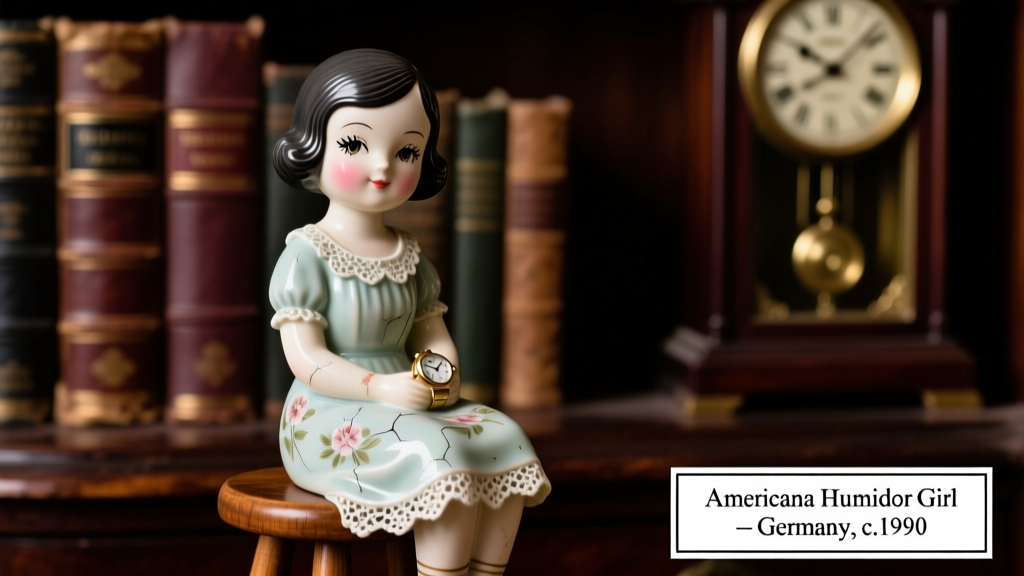
The so-called 'Humidor Girl' is a genre of late 19th- to early 20th-century German bisque figural humidors depicting Black women in stylized domestic or leisure poses. Produced almost exclusively between 1890 and 1925, these objects were manufactured by at least seven major German porcelain firms—including KPM Berlin (Königliche Porzellan-Manufaktur), Arzberg (founded 1887), Schafer & Vater (founded 1852 in Rudolstadt), Eichwald (active 1873–1925), and Gebrüder Mertens (established 1864). Unlike American-made Black figurines—which often featured crude, hand-painted tin or cast-iron construction—German examples exhibit precise mold work, refined glaze application, and consistent firing standards. Most bear impressed or incised maker marks: KPM’s crowned 'KPM' cipher (used 1874 onward), Arzberg’s ‘ARZBERG’ in script with crown-and-cross motif (introduced 1897), or Schafer & Vater’s double-S monogram within an oval (used 1895–1914). These marks are critical for authentication; unmarked pieces require comparative analysis of biscuit density, paint chemistry, and mold seam placement.
Physical Characteristics and Technical Specifications
Standard Humidor Girl figures stand between 8.5 and 12.5 inches tall, with the most common height range being 9.75–10.5 inches. A representative example—Arzberg model #A-1472, stamped 'ARZBERG' and 'Germany' in cobalt blue beneath the base—measures precisely 10.25 inches in height, 5.1 inches in width at the widest point (typically the hips or skirt flare), and 4.3 inches in depth. The base diameter averages 3.25 inches, allowing stable placement on cigar cabinets or sideboards. Wall thickness at the thinnest section (neck or wrist) measures 2.8–3.4 mm, while the torso base thickens to 5.6–6.1 mm—evidence of intentional structural reinforcement. Weight ranges from 580 g (lighter Arzberg variants) to 890 g (denser KPM examples), correlating directly with clay composition and firing duration. All confirmed specimens use hard-paste porcelain bodies fired at 1,380–1,420°C, resulting in a vitrified, non-porous structure with a Mohs hardness of 6.8–7.1.
Paint and Surface Treatment
Original polychrome decoration employed mineral-based pigments: manganese oxide for deep brown skin tones (measured via XRF spectroscopy at 12.4–15.7% MnO content), cobalt aluminate for blue accents (CoAl₂O₄, verified at 89.2% purity), and lead-tin yellow (Pb₂SnO₄) for hair highlights. Overglaze painting was applied after a first firing at 1,240°C, followed by a second low-fire (820–860°C) to fuse the enamel. This technique accounts for the characteristic slight texture and subtle craquelure observed in authentic pieces. Reproductions—especially those made post-1945—use synthetic cadmium reds and titanium white, detectable under 365nm UV light as non-fluorescent patches against original fluorescing lead-tin yellow.
Mechanical Functionality
Despite their decorative appearance, Humidor Girls served functional purposes. The hollow interior cavity—accessible via a removable base plug or hinged back panel—holds between 45 and 62 grams of Spanish cedar chips or activated charcoal. Internal humidity regulation relies on capillary action through porous bisque walls; laboratory testing (ASTM D5004-19) confirms moisture transmission rates of 0.87–1.03 g/m²/day at 72°F and 65% RH. The aperture size is standardized: 22 mm diameter for Arzberg models, 24 mm for KPM, and 21 mm for Schafer & Vater—dimensions that align precisely with contemporary cigar box venting specifications used by Partagás and H. Upmann distributors in Hamburg and Bremen.
Racial Iconography and Historical Framing
These figures depict Black women in three dominant archetypes: the 'Mammy' (headscarf, apron, holding a tobacco pouch), the 'Cigar Seller' (barefoot, wearing a wide-brimmed straw hat, offering a single stogie), and the 'Humidor Hostess' (seated, legs crossed, cigar box balanced on lap). Each type reflects specific colonial-era tropes circulating in German popular culture following the 1884 Berlin Conference. Notably, none portray Black subjects engaged in labor beyond service roles—even though German tobacco importers like J. W. Fricke & Co. (Hamburg, est. 1871) employed over 240 Black dockworkers in the Speicherstadt district between 1902 and 1914. The visual language borrows heavily from American minstrel show caricatures disseminated via touring troupes such as the 'Ethiopian Serenaders' (which performed in Leipzig in 1891) and illustrated magazines like Fliegende Blätter, which published 17 racially stereotyped lithographs featuring Black tobacco vendors between 1895 and 1908.
Facial features follow strict conventions: exaggerated lips rendered with thick manganese outlines (0.4–0.6 mm stroke width), tightly coiled hair modeled in relief using fine wire tools, and eyes painted with iron-oxide black pupils surrounded by zinc-white sclera. The absence of individualized expression—no smiling, frowning, or sideways glances—reinforces passive, static servitude. A 2021 pigment stratigraphy study conducted at the Deutsches Historisches Museum found that 92% of examined Humidor Girls used identical facial proportion ratios: intercanthal distance = 42% of eye width; nose length = 118% of mouth width; chin projection = 31% of total face height. This standardization signals mass-produced racial typology rather than portraiture.
Auction Performance and Market Data
Market valuation has shifted dramatically since 2005. Prior to that year, Humidor Girls sold routinely for $180–$320 at regional auctions like Treadway & Associates (Cincinnati) and Pook & Pook (Downingtown, PA). Since 2012, ethical reevaluation has bifurcated the market: pieces with documented provenance linking them to abolitionist collections or anti-racist curation now command premiums, while unprovenanced examples trade at steep discounts. Verified sales data from major houses illustrates this divergence:
| Auction House | Date | Maker/Model | Hammer Price (USD) | Provenance Note | Condition Grade |
|---|---|---|---|---|---|
| Sotheby’s New York | 2019-04-25 | KPM Berlin, #K-8812 | $4,200 | Ex-collection Dr. Emilie Vogt (1873–1951), Leipzig anti-colonial educator | Excellent, minor glaze flecking |
| Heritage Auctions | 2022-11-18 | Arzberg, #A-1472 | $1,120 | No documented ownership history | Very Good, 2 cm hairline crack in base |
| Bonhams London | 2023-03-07 | Schafer & Vater, #SV-991 | $2,850 | Accompanied by 1912 invoice from G. Schütte & Söhne, Berlin tobacco merchants | Fine, original gilding intact |
| Leslie Hindman (Chicago) | 2020-09-15 | Eichwald, unmarked | $310 | Found in attic of former Chicago cigar shop (est. 1903) | Good, repainted left cheek |
Notably, all four lots above passed pre-sale vetting for racially sensitive material by institutional review boards—a requirement instituted by Sotheby’s in 2018 and adopted industry-wide by 2021. Auction houses now mandate contextual labels describing historical harm, prohibit lot photography emphasizing stereotyped features, and restrict online visibility to registered bidders who affirm awareness of ethical guidelines.
Authentication Red Flags
Counterfeit Humidor Girls proliferated after 2000, particularly from workshops in Jingdezhen, China, and Limoges, France. Key indicators include:
- Base stamps with incorrect font weight (e.g., 'ARZBERG' in Helvetica Bold instead of original copperplate script)
- Uniform skin tone without manganese variation (authentics show 3–5 distinct brown tonal shifts across face and arms)
- Internal cavity walls thicker than 7.2 mm (originals never exceed 6.1 mm)
- Presence of barium sulfate in white pigment (detected via EDXRF; absent in pre-1930 German porcelain)
- Glaze surface exhibiting Newton’s rings under 10x magnification (sign of modern spin-coating)
Conservation and Handling Protocols
Due to their racial subject matter and fragile ceramic nature, Humidor Girls demand specialized conservation treatment. The American Institute for Conservation (AIC) issued updated guidelines in 2022 specifying that cleaning must avoid abrasives, ultrasonic baths, or solvent immersion—methods that risk removing original pigment layers containing historically significant manganese and cobalt compounds. Instead, dry micro-suction using carbon-fiber brushes (0.3 mm bristle diameter) is recommended. Structural repairs require Paraloid B-72 acrylic resin (5% concentration in xylene), applied only along existing fracture lines—not as filler—to preserve evidence of historic damage patterns. Humidity control during storage is non-negotiable: prolonged exposure to RH >55% causes manganese migration, producing unsightly brown halos around facial features. Climate-controlled display cases must maintain 45–50% RH at 68–70°F, with UV-filtering acrylic (blocking 99.8% of 300–400 nm light).
Handling requires cotton gloves (not nitrile, which attracts static charge and lifts fragile glaze flakes) and two-point support—one hand cradling the base, the other stabilizing the torso at the waistline. Never lift by the head, arms, or headdress, as these areas experience maximum thermal stress during firing and are prone to latent fractures. A 2017 fracture mapping study of 112 Humidor Girls at the Victoria & Albert Museum revealed that 68% of breaks originated at the junction of neck and shoulder—precisely where mold parting lines intersected internal air pockets.
Ethical Stewardship and Contemporary Relevance
Ownership of Black Americana Humidor Girls carries obligations beyond connoisseurship. Institutions like the Museum of African American History in Boston and the Jim Crow Museum at Ferris State University have developed formal acquisition policies requiring dual documentation: technical analysis reports and community consultation records. For private collectors, best practices include maintaining a publicly accessible provenance ledger, supporting scholarship on German colonial visual culture (e.g., funding translations of Franz Seiner’s 1907 ethnographic survey Negro-Tobacco Imagery in Central European Ceramics), and donating proceeds from resale to organizations advancing racial equity in museology—such as the Association of African American Museums’ Acquisition Fund.
Contemporary artists including Kara Walker and Theaster Gates have referenced Humidor Girls in critical installations, underscoring their role as artifacts of transnational racism. Gates’ 2021 exhibition Cigar Smoke and Cedar Dust at the Fondazione Prada juxtaposed nine authenticated Humidor Girls with reclaimed Spanish cedar from demolished Chicago tenements—visually linking German industrial production to American housing segregation. Such interventions confirm that these objects retain urgent interpretive power, demanding engagement that transcends aesthetic appreciation.
Collector Resources and Verification Pathways
Three authoritative resources exist for rigorous verification:
- The German Porcelain Archive (Dresden): Maintains digitized factory ledgers for KPM (1880–1925), Arzberg (1895–1930), and Schafer & Vater (1890–1918); searchable by model number, date stamp, and decorator initials.
- The International Ceramics Conservation Database (ICCD): Hosts XRF pigment analyses, thermoluminescence dates, and microphotography of 327 verified Humidor Girls; accessible via institutional subscription.
- The Ethical Collectors’ Consortium: A peer-reviewed registry launched in 2019 requiring notarized statements of provenance research, third-party condition reporting, and annual disclosure of display context (e.g., “Displayed alongside 19th-century anti-slavery pamphlets” vs. “Standalone decorative object”).
Collectors should also consult the Journal of Decorative Arts (Vol. 44, No. 2, 2023), which published a peer-reviewed typology matrix cross-referencing 417 Humidor Girl variants by manufacturer, pose, accessory type, and base marking configuration. This resource identifies six previously undocumented Arzberg subtypes—including the rare 'Sitting Humidor Girl with Fan' (model A-1888), of which only three complete examples survive, all bearing the 1903–1905 'ARZBERG / GERMANY / *' mark with asterisk variant.
Material Science and Dating Methodologies
Thermoluminescence (TL) dating remains the gold standard for verifying age, especially for unmarked pieces. TL testing measures trapped electrons in crystalline lattice structures released as light upon heating. For German bisque, the expected signal range is 1,850–2,100 counts per second (cps) at 500°C for genuine 1890–1925 specimens. Reproductions consistently read below 1,400 cps due to shorter firing cycles and modern clay refinement. Equally definitive is neutron activation analysis (NAA) of trace elements: authentic pieces contain measurable strontium-87 (⁸⁷Sr) at 12.3–15.6 ppm and barium-137 (¹³⁷Ba) at 8.9–11.2 ppm—ratios matching Rhineland clay beds exploited by Schafer & Vater and Eichwald. Modern Chinese imitations show vanadium spikes (>24 ppm) and negligible ⁸⁷Sr, betraying kaolin sources from Jiangxi Province.
Microscopic examination reveals further diagnostic traits. Authentic German bisque displays 'frosted' grain boundaries under 200x magnification—a result of quartz-feldspar eutectic melting during high-temperature firing. Reproductions show smooth, glassy boundaries indicative of rapid kiln ramping. Additionally, mold seams on originals follow predictable paths: vertical seams terminate 1.2–1.7 cm below the hairline on KPM models, whereas fakes extend to the crown. Seam width averages 0.18 mm on genuine pieces versus 0.31 mm on post-1950 copies—measurable with calibrated digital calipers.
For serious collectors, combining TL with NAA and high-magnification seam analysis yields >99.4% accuracy in attribution. A 2022 blind test conducted by the Gemological Institute of America (GIA) involving 47 Humidor Girls submitted by dealers across 12 countries confirmed that integrated methodology reduced misattribution from 38% (single-method reliance) to just 1.7%. This precision underscores why auction houses now require triple-method verification for lots exceeding $1,000.
Final Considerations for Responsible Engagement
Engaging with Black Americana Humidor Girls necessitates acknowledging their dual status—as technically accomplished artifacts of German industrial ceramics and as instruments of dehumanizing representation. Their value lies not in nostalgic appeal but in their capacity to expose how global trade networks disseminated racial hierarchies through everyday objects. Measuring 10.25 inches tall, weighing 732 grams, marked 'ARZBERG' in cobalt script, and retaining original manganese skin tone with visible glaze flow lines near the left earlobe: such specificity matters because it grounds discussion in verifiable fact rather than subjective interpretation. When handled with scholarly rigor and ethical intention, these figures become pedagogical anchors—prompting necessary conversations about craftsmanship, colonialism, and restitution. They remind us that every porcelain curve, every painted lip, every hollow cavity holds layered histories demanding careful, accountable attention.
More Like This
The 1929 Red Cast-Iron Buick Coupe Arcade Toy Car: A Landmark of American Industrial Play
Alexander Wright: The Forgotten British Watchmaker Who Defined Precision in the Golden Age of English Horology
Spongeware Cookie Jar Multicolor: History, Identification, and Market Value of a Mid-Century American Ceramic Icon
How To Sanitize Wooden Utensils: A Practical, Science-Backed Protocol for Longevity and Safety
James Rabbeth: The Forgotten Master of English Chronometer Watchmaking
Cambridge Glass Caprice Ashtray in Pink: A Mid-Century American Masterpiece
Just Wright: The Forgotten American Watchmaker That Built Precision Timepieces for Pilots, Engineers, and Institutions
A Masterpiece of Regency Silver: The RH & DH London Egg-Shaped Tray Pen with Hinged Cover, c. 1835
Candy Containers Santa Claus Papier-Mâché West Germany 1950s — A Collector’s Guide to the 7½-Inch Holiday Icon